
Time to First Token · GPT-5.6 Terra (xhigh)
8782ms
Time to First Token · GPT-5 mini (high)
0ms
Deep dive into reasoning, benchmarks, and latency insights.
The current catalog does not contain complete performance evidence for both models, so this page does not declare an overall winner. Use the available fields as comparison signals and validate the models on your own workload.
Key decision metrics at a glance.
| Model | Metric | Value | Unit | Source / snapshot |
|---|---|---|---|---|
| GPT-5.6 Terra (xhigh) | Reasoning | 6.0 | benchmark or capability score | Artificial Analysis · current catalog |
| GPT-5 mini (high) | Reasoning | 9.0 | benchmark or capability score | Artificial Analysis · current catalog |
| GPT-5.6 Terra (xhigh) | Coding | 7.0 | benchmark or capability score | Artificial Analysis · current catalog |
| GPT-5 mini (high) | Coding | 2.0 | benchmark or capability score | Artificial Analysis · current catalog |
| GPT-5.6 Terra (xhigh) | Multimodal | 4.0 | benchmark or capability score | Artificial Analysis · current catalog |
| GPT-5 mini (high) | Multimodal | 2.0 | benchmark or capability score | Artificial Analysis · current catalog |
| GPT-5.6 Terra (xhigh) | Long Context | 7.0 | benchmark or capability score | Artificial Analysis · current catalog |
| GPT-5 mini (high) | Long Context | 3.0 | benchmark or capability score | Artificial Analysis · current catalog |
| GPT-5.6 Terra (xhigh) | Blended Price / 1M tokens | $4.5 | USD per 1M tokens | Artificial Analysis · current catalog |
| GPT-5 mini (high) | Blended Price / 1M tokens | $0.688 | USD per 1M tokens | Artificial Analysis · current catalog |
| GPT-5.6 Terra (xhigh) | P95 Latency | — | milliseconds | Artificial Analysis · current catalog |
| GPT-5 mini (high) | P95 Latency | — | milliseconds | Artificial Analysis · current catalog |
| GPT-5.6 Terra (xhigh) | Tokens per second | 115.448 | tokens per second | Artificial Analysis · current catalog |
| GPT-5 mini (high) | Tokens per second | 0 | tokens per second | Artificial Analysis · current catalog |
Data provided by Artificial Analysis; live values use the current catalog.
This radar chart visually maps the core capabilities (reasoning, coding, math proxy, multimodal, long context) of `GPT-5.6 Terra (xhigh)` vs `GPT-5 mini (high)`.
This grouped bar chart provides a side-by-side comparison for each benchmark metric.
Lower time to first token is better; higher tokens per second is better.
Compare input and output pricing in USD per 1M tokens.
GPT-5.6 Terra (xhigh)$5
GPT-5 mini (high)$0.75
GPT-5 mini (high) costs $4.25 less per run
This article is a dated snapshot published on 2026-08-07. Live cards above use the current catalog; missing live fields are not inferred.
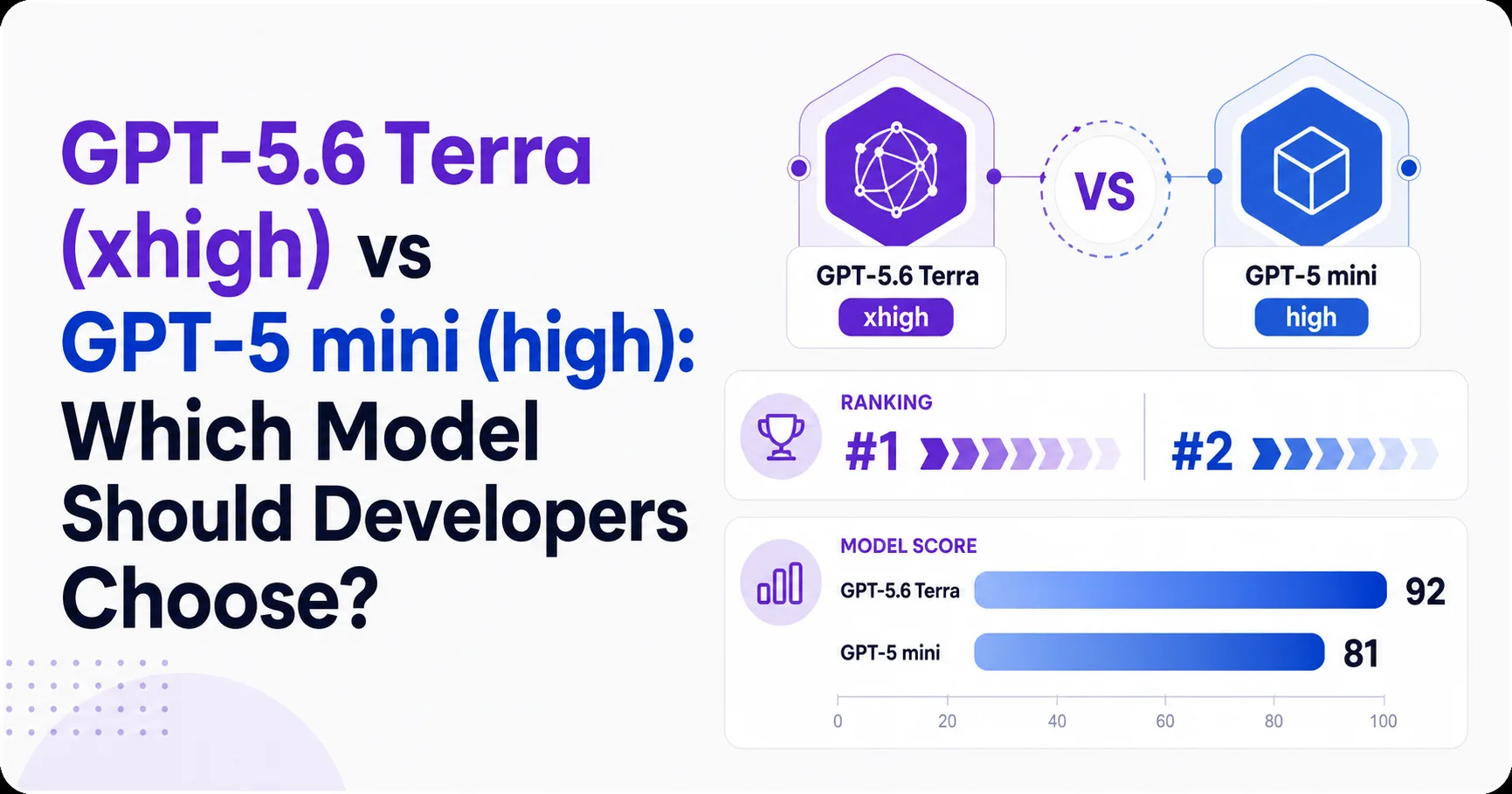
GPT-5.6 Terra (xhigh) is the stronger engineering choice, while GPT-5 mini (high) is the lower-cost experiment. The data brief gives Terra a 70.6 coding index and a 51.6 intelligence index, compared with 15.6 and 25.3 for GPT-5 mini (high). GPT-5 mini (high) does have one reported advantage: its blended price is $0.6875 per 1M tokens, compared with $4.500000000000001 for Terra.\n\nThat result does not make the decision simple. Developers are choosing between a model with substantially stronger measured coding performance and a model whose current official documentation is difficult to verify. The official OpenAI model directory does not list a dedicated GPT-5 mini entry in the supplied research. It also does not confirm whether the “high” label is an API reasoning setting or a separate model variant.\n\nThe practical question is therefore not which model wins every category. Terra is the safer default for code generation, debugging, and complex technical work. GPT-5 mini (high) is attractive for high-volume, cost-sensitive workloads, but its deployment and capability assumptions require direct validation.
GPT-5.6 Terra (xhigh) offers the clearer production case, while GPT-5 mini (high) offers the clearer cost case. Terra leads the supplied coding evaluation at 70.6 versus 15.6, a difference of 54.99999999999999 points. It also leads the intelligence evaluation at 51.6 versus 25.3.\n\n| Decision factor | GPT-5.6 Terra (xhigh) | GPT-5 mini (high) | What it means for developers | |---|---:|---:|---| | Coding index | 70.6 | 15.6 | Terra has the stronger measured fit for software tasks | | Intelligence index | 51.6 | 25.3 | Terra has the stronger general evaluation result | | Math index | Not reported | 90.7 | The comparison is incomplete, not a mini-model win | | Blended price per 1M tokens | $4.500000000000001 | $0.6875 | Mini is cheaper for repeated, predictable traffic | | Input price per 1M tokens | $2 | $0.25 | Mini reduces prompt-heavy operating cost | | Output price per 1M tokens | $12 | $2 | Mini reduces verbose-response cost | | Latency | 0.3 seconds | 0.3 seconds | The supplied latency data is tied | | Median output speed | 121.137 tokens per second | Not reported | Terra has measurable throughput evidence | \nThe missing math score for Terra prevents a complete math comparison. The missing output-speed value for GPT-5 mini (high) prevents a complete throughput comparison. These gaps matter because the data supports a quality and cost conclusion, but not a complete ranking across every developer workload.\n\nThe official GPT-5.6 Terra model page identifies Terra as an available reasoning model. The supplied research found no equivalent current model page for GPT-5 mini (high), so model identity and operational continuity deserve extra testing before adoption.
GPT-5.6 Terra (xhigh) is the better fit for tasks where incorrect code creates review, debugging, or operational cost. The coding index gap is large enough to change the expected role of the model. Terra can reasonably be evaluated as a primary coding assistant. GPT-5 mini (high) should first be evaluated as a constrained helper, draft generator, classifier, or fallback path. The data does not prove that every Terra response is correct, and it does not prove that every mini response fails. It does show a materially stronger aggregate coding result for Terra.\n\nThe difference also affects workflow design. A weaker coding model may require more human review, more retries, stronger test scaffolding, or narrower prompts. Those controls can erase part of the apparent token savings. If a cheap response produces an incorrect migration, a flawed patch, or an incomplete diagnosis, the application pays through review time and follow-up calls. The supplied research contains no reproducible community evidence that would quantify those failure patterns for GPT-5 mini (high), so developers should measure them directly.\n\nSpeed evidence favors Terra only in one dimension. Terra has a reported median output speed of 121.137 tokens per second. GPT-5 mini (high) has no reported value in the data brief. Both models have a reported latency of 0.3 seconds, but equal latency does not establish equal streaming behavior, time to first token, or completion time.\n\nThe official OpenAI model parameter migration guide says higher reasoning effort should be used when it creates a measurable quality benefit. That guidance supports testing Terra’s xhigh configuration against the actual task, rather than assuming the highest setting is always necessary. The same source does not validate “high” as a separate GPT-5 mini model identity.
GPT-5 mini (high) is the obvious token-cost winner, but GPT-5.6 Terra (xhigh) can be cheaper at the application level when it avoids retries and manual correction. The supplied blended prices are $0.6875 for mini and $4.500000000000001 for Terra per 1M tokens. Mini also costs $0.25 per 1M input tokens and $2 per 1M output tokens, compared with $2 and $12 for Terra.\n\nThose prices favor mini for traffic with three properties: prompts are stable, outputs are short, and errors are inexpensive. Examples include lightweight transformations, routing, extraction, simple summaries, and other tasks where a response can be checked mechanically. The data brief does not establish that GPT-5 mini (high) performs reliably on any specific one of these tasks, so each use case still needs an acceptance test.\n\nTerra becomes easier to justify when the response is part of a longer engineering loop. Code review, test repair, repository navigation, architecture analysis, and multi-step debugging can create hidden costs when the first answer is incomplete. A model that needs fewer retries can consume more tokens while still reducing total work. The supplied materials do not contain retry rates, correction time, success rates, or cost-per-success measurements. Therefore, no precise break-even point can be claimed.\n\nThe official OpenAI pricing page lists current pricing information for the models documented there, but the supplied research could not verify a dedicated GPT-5 mini price entry on that page. That conflict is important. The data brief provides comparison prices, while the official current pricing evidence does not confirm the mini model’s present availability or price. Treat $0.6875 and $4.500000000000001 as evaluation inputs, then verify live billing before committing budget.
GPT-5 mini (high) leads on 3 of 3 metrics
GPT-5.6 Terra (xhigh) should be the default choice for production coding workflows, while GPT-5 mini (high) should be the default candidate for cost-sensitive trials. Terra’s measured coding index of 70.6 gives it the stronger starting position for code generation, debugging, and technical reasoning. Its reported output speed of 121.137 tokens per second also gives developers a concrete throughput signal.\n\nChoose GPT-5.6 Terra (xhigh) when the model’s output can modify code, explain complex failures, generate tests, or support decisions that are expensive to review. Keep the reasoning setting under test. The official GPT-5.6 Terra model page documents Terra as a current model, while the migration guide distinguishes reasoning effort from the model ID. That means “GPT-5.6 Terra (xhigh)” should be implemented as the Terra model with the relevant reasoning parameter, not assumed to be a separate API model slug.\n\nChoose GPT-5 mini (high) when token volume dominates the budget and the task has cheap, automated validation. Its blended price of $0.6875 is the strongest reason to test it. Do not treat the name “high” as verified API behavior. The supplied research could not confirm a current model entry, stable identifier, official context limit, official tool set, or current official price for GPT-5 mini (high).\n\nA sensible rollout is a split evaluation. Use the same prompts, acceptance tests, and production-like traffic for both models. Track successful task completion, retries, human correction, output length, and total cost. The supplied materials do not provide those measurements, so direct application testing is required before a final procurement decision.
GPT-5.6 Terra (xhigh) is the safer first test for developers who need documented model identity and stronger coding evidence. The OpenAI model directory does not currently provide the same level of dedicated documentation for GPT-5 mini (high).\n\nGPT-5 mini (high) is the better first cost experiment when responses are easy to validate and a failed answer does not create substantial downstream work. Its evaluation price is much lower, but the research does not prove its present API availability or behavior.\n\nThe comparison remains incomplete for math and throughput. GPT-5 mini (high) has a math index of 90.7, while Terra has no supplied math value. Terra has a speed value of 121.137 median output tokens per second, while mini has no supplied speed value. Neither missing value should be interpreted as a win.
Yes, GPT-5.6 Terra (xhigh) is the stronger coding candidate in the supplied evidence, with a 70.6 coding index compared with 15.6 for GPT-5 mini (high).
Yes, GPT-5 mini (high) is cheaper in the supplied pricing snapshot, at $0.6875 per 1M blended tokens compared with $4.500000000000001 for GPT-5.6 Terra (xhigh).
The available evidence does not support a complete speed ranking, because GPT-5.6 Terra (xhigh) reports 121.137 median output tokens per second while GPT-5 mini (high) has no reported output-speed value.
Developers should make GPT-5.6 Terra (xhigh) the first production candidate for coding workflows, then confirm task success, retries, review effort, and billing behavior with their own workload.
The supplied research does not confirm “GPT-5 mini (high)” as a current official API model name, because the current OpenAI model directory does not list a dedicated GPT-5 mini entry.