
Time to First Token · GPT-5.6 Terra (xhigh)
8782ms
Time to First Token · o3
7185ms
Deep dive into reasoning, benchmarks, and latency insights.
The current catalog does not contain complete performance evidence for both models, so this page does not declare an overall winner. Use the available fields as comparison signals and validate the models on your own workload.
Key decision metrics at a glance.
| Model | Metric | Value | Unit | Source / snapshot |
|---|---|---|---|---|
| GPT-5.6 Terra (xhigh) | Reasoning | 6.0 | benchmark or capability score | Artificial Analysis · current catalog |
| o3 | Reasoning | 9.0 | benchmark or capability score | Artificial Analysis · current catalog |
| GPT-5.6 Terra (xhigh) | Coding | 7.0 | benchmark or capability score | Artificial Analysis · current catalog |
| o3 | Coding | 6.0 | benchmark or capability score | Artificial Analysis · current catalog |
| GPT-5.6 Terra (xhigh) | Multimodal | 4.0 | benchmark or capability score | Artificial Analysis · current catalog |
| o3 | Multimodal | 3.0 | benchmark or capability score | Artificial Analysis · current catalog |
| GPT-5.6 Terra (xhigh) | Long Context | 7.0 | benchmark or capability score | Artificial Analysis · current catalog |
| o3 | Long Context | 4.0 | benchmark or capability score | Artificial Analysis · current catalog |
| GPT-5.6 Terra (xhigh) | Blended Price / 1M tokens | $4.5 | USD per 1M tokens | Artificial Analysis · current catalog |
| o3 | Blended Price / 1M tokens | $3.5 | USD per 1M tokens | Artificial Analysis · current catalog |
| GPT-5.6 Terra (xhigh) | P95 Latency | — | milliseconds | Artificial Analysis · current catalog |
| o3 | P95 Latency | — | milliseconds | Artificial Analysis · current catalog |
| GPT-5.6 Terra (xhigh) | Tokens per second | 115.448 | tokens per second | Artificial Analysis · current catalog |
| o3 | Tokens per second | 119.185 | tokens per second | Artificial Analysis · current catalog |
Data provided by Artificial Analysis; live values use the current catalog.
This radar chart visually maps the core capabilities (reasoning, coding, math proxy, multimodal, long context) of `GPT-5.6 Terra (xhigh)` vs `o3`.
This grouped bar chart provides a side-by-side comparison for each benchmark metric.
Lower time to first token is better; higher tokens per second is better.
Compare input and output pricing in USD per 1M tokens.
GPT-5.6 Terra (xhigh)$5
o3$4
o3 costs $1 less per run
This article is a dated snapshot published on 2026-08-07. Live cards above use the current catalog; missing live fields are not inferred.
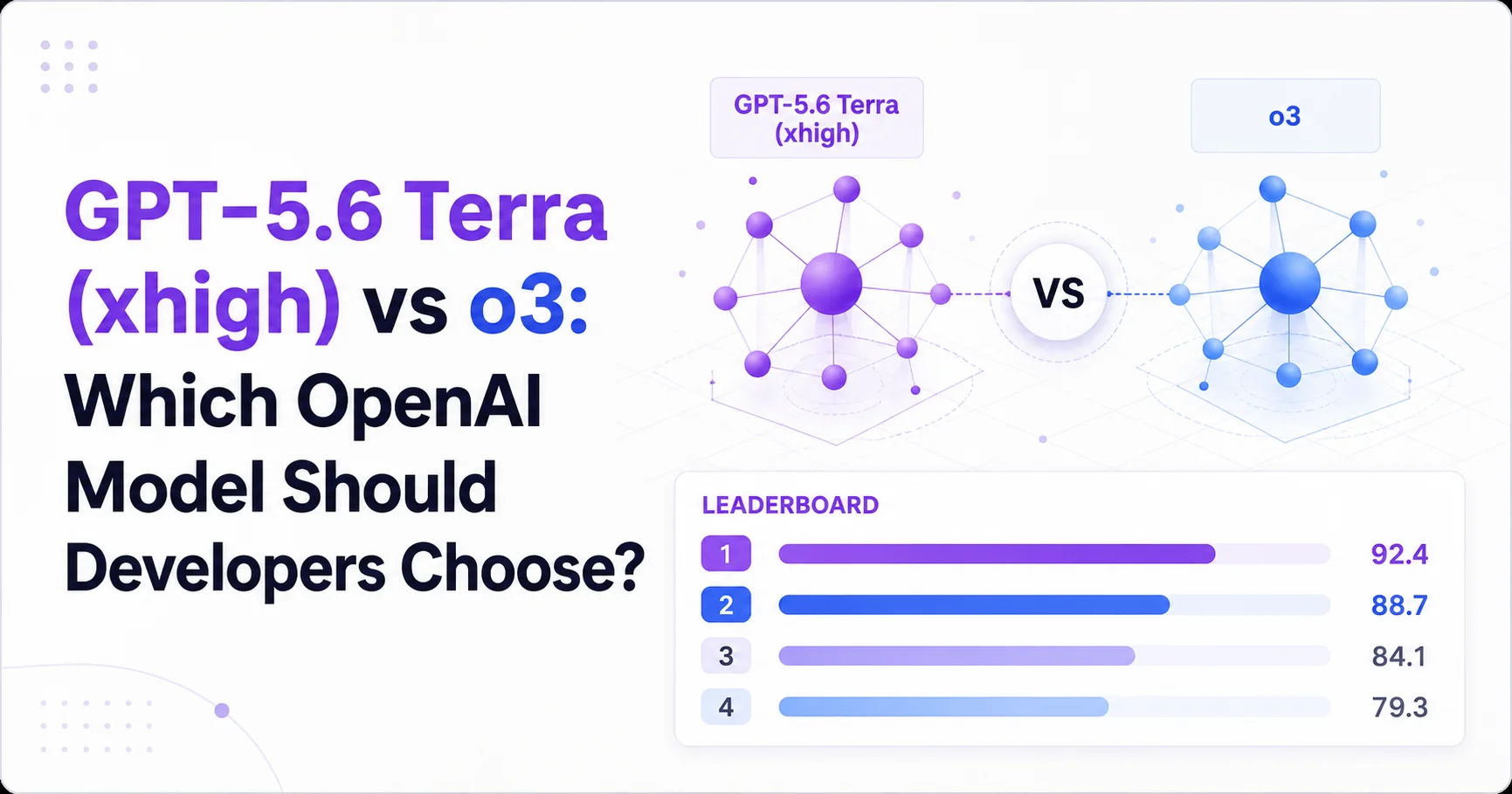
GPT-5.6 Terra (xhigh) is the safer default for developers who need broad capability and a currently documented API path. The data brief reports an Artificial Analysis Intelligence Index of 51.6 for GPT-5.6 Terra (xhigh), compared with 30.4 for o3, while o3 remains cheaper and slightly faster. Artificial Analysis provides the comparison data used in this article.
The comparison is not a complete capability shootout. GPT-5.6 Terra (xhigh) has a reported coding index of 70.6, but the data brief has no corresponding o3 coding score. o3 has a mathematics index of 88.3, but the brief has no corresponding Terra mathematics score. Those missing counterparts prevent a definitive winner for coding or mathematics.
For production selection, the central question is therefore not simply which model scores higher. It is whether your application values documented availability, broad measured intelligence, lower output cost, or a specialized mathematics signal.
GPT-5.6 Terra (xhigh) offers the stronger general-purpose case, while o3 offers the lower-cost and faster-response case. The measured intelligence gap favors Terra at 51.6 versus 30.4, but the available benchmark coverage is asymmetric. Terra's reported coding index is 70.6, and o3's reported mathematics index is 88.3. Neither figure establishes a direct head-to-head winner because the other model lacks the matching score.
OpenAI describes GPT-5.6 Terra as a reasoning model positioned between intelligence and cost in its model documentation. The OpenAI model catalog places Terra among current frontier models. By contrast, the supplied current catalog material does not list o3 or document its current context window, output limit, API endpoints, or multimodal support.
That documentation difference matters. A model with incomplete current documentation creates more uncertainty around implementation, migration, and operational support. It does not prove that o3 is unusable, retired, or technically weaker in every task. The supplied sources simply do not establish those conclusions.
Both models show 0.3 seconds of reported latency in the data brief. o3 produces 128.056 median output tokens per second, compared with 121.137 for Terra. The speed difference is likely less important than task length, reasoning configuration, tool calls, and the amount of output your product actually displays.
GPT-5.6 Terra (xhigh) is the better-supported broad-reasoning choice, but the benchmark evidence does not justify calling it the universal winner. Its Artificial Analysis Intelligence Index is 51.6, while o3 records 30.4. The data brief reports the difference as 21.200000000000003. For mixed developer workloads, that gap is the clearest available signal favoring Terra.
The practical implication is that Terra is the more defensible starting point for agents, code assistance, technical analysis, and workflows that combine several reasoning modes. That interpretation should remain conditional because the brief does not disclose enough methodology here to explain how the index maps to your exact task mix. The coding result strengthens Terra's case for software work, but the missing o3 coding score leaves the comparison incomplete.
o3's mathematics index of 88.3 is a meaningful counter-signal for math-heavy workloads. It may justify a targeted evaluation for symbolic reasoning, quantitative verification, or contest-style tasks. It cannot establish that o3 is better for every mathematical production workflow because the brief provides no matching Terra mathematics score and no reproducible community tests.
The output-speed result points slightly toward o3 at 128.056 versus 121.137 median output tokens per second. Both models report 0.3 seconds of latency. Developers should treat this as a throughput clue, not a complete user-experience prediction. Streaming behavior, tool execution, prompt size, reasoning effort, retries, and output length can dominate perceived response time.
OpenAI advises using higher reasoning effort only when it produces measurable quality gains, according to the latest-model parameter guide. That guidance is especially relevant to the xhigh label, which is a reasoning parameter value rather than a separate Terra model ID.
GPT-5.6 Terra (xhigh) is more expensive in the blended comparison because its reported price is $4.500000000000001 per 1M blended tokens, versus $3.5 for o3. The input price is $2 for both models, so the difference comes from output economics: Terra is listed at $12 per 1M output tokens, while o3 is listed at $8. The OpenAI API pricing page should be checked before deployment because the supplied material does not provide a current o3 price there.
The headline blended price can reverse in practice when a cheaper model needs more retries, longer explanations, external verification, or additional orchestration to reach an acceptable result. A more capable model can also become the expensive option if it generates unnecessarily long answers or uses high reasoning effort for routine requests. The data brief does not measure retry rates, task success, or tokens per successful workflow, so it cannot answer which model has the lower total cost of ownership.
Terra's documented pricing has additional conditions for long-context requests. The Terra model page states that requests above 272K tokens receive higher input and output charges. That threshold makes prompt design, retrieval, summarization, and cache strategy important for large repositories or long-running agents.
Terra also lists Standard, Batch, Flex, and Fast mode pricing in the supplied research. Those options may matter more than the blended number for asynchronous evaluation, bulk processing, or latency-sensitive applications. No equivalent current o3 pricing matrix is present in the supplied sources, so a fair production budget needs a live o3 quote and a workload-specific pilot.
o3 leads on 2 of 3 metrics
GPT-5.6 Terra (xhigh) is the recommended first choice for new production systems that need documented capability, broad reasoning, and an identified API model ID. OpenAI documents the stable model ID as gpt-5.6-terra and describes xhigh as the reasoning.effort value used with that model, rather than a separate gpt-5-6-terra-xhigh API model. The parameter migration guide also states that the generic gpt-5.6 alias routes to gpt-5.6-sol, so developers should not use that alias as Terra's stable identifier.
Choose Terra when your application combines coding, analysis, structured outputs, function calls, retrieval, or web-connected tools. Its model page documents support for Responses API, Chat Completions API, and Batch API, alongside streaming, Structured Outputs, function calling, File Search, Web Search, Prompt Caching, and additional tools. The data residency and model support guide is relevant when regional handling or endpoint support affects architecture.
Choose o3 for a controlled pilot when lower blended cost, lower output pricing, or the mathematics signal is the priority. The choice should remain provisional because the supplied official materials do not document o3's current API availability, stable alias, context window, output limit, or deployment status. Community evidence is also insufficient to fill those gaps.
Avoid treating Terra's xhigh setting as an automatic quality upgrade. OpenAI recommends validating whether higher reasoning effort produces measurable gains. Also validate deployment-specific tool behavior: the Amazon Bedrock guidance documents restrictions for some Terra tools on that path. The deprecations page is the supplied source for checking replacement or retirement status, but the research brief found no o3 status conclusion there.
GPT-5.6 Terra (xhigh) is the safer default when documentation certainty matters more than the lowest headline price. The supplied sources identify its model ID, endpoints, tools, and reasoning parameter, while the provided o3 material leaves those implementation details unresolved.
The most important unresolved issue is not a missing benchmark decimal. It is the absence of matched evidence for the workloads developers care about most. The comparison has Terra coding data without o3 coding data, and o3 mathematics data without Terra mathematics data. That makes a small private evaluation essential before committing either model to a narrow specialty.
Choose GPT-5.6 Terra (xhigh) for a general developer assistant because it has the stronger reported intelligence score, a coding index of 70.6, and substantially more complete current API documentation. The evidence does not include a matched o3 coding result.
Choose o3 for the lower headline blended price, listed as $3.5 per 1M blended tokens versus $4.500000000000001 for GPT-5.6 Terra (xhigh). Total workflow cost remains uncertain because the brief does not report retries, success rates, or tokens per completed task.
o3 is slightly faster on median output throughput at 128.056 tokens per second versus 121.137 for GPT-5.6 Terra (xhigh), while both models report 0.3 seconds of latency. Tool calls and output length can change the observed experience.
o3 has the stronger available mathematics signal because its Artificial Analysis mathematics index is 88.3. GPT-5.6 Terra (xhigh) has no matching mathematics score in the supplied data, so the evidence cannot establish a direct head-to-head winner.
No, developers should use gpt-5.6-terra as the documented model ID and set reasoning.effort to xhigh. OpenAI's migration guidance describes xhigh as a parameter value, not a separate Terra model identifier.