
Time to First Token · GPT-5 (medium)
0ms
Time to First Token · o3
7185ms
Deep dive into reasoning, benchmarks, and latency insights.
The current catalog does not contain complete performance evidence for both models, so this page does not declare an overall winner. Use the available fields as comparison signals and validate the models on your own workload.
Key decision metrics at a glance.
| Model | Metric | Value | Unit | Source / snapshot |
|---|---|---|---|---|
| GPT-5 (medium) | Reasoning | 9.0 | benchmark or capability score | Artificial Analysis · current catalog |
| o3 | Reasoning | 9.0 | benchmark or capability score | Artificial Analysis · current catalog |
| GPT-5 (medium) | Coding | 6.0 | benchmark or capability score | Artificial Analysis · current catalog |
| o3 | Coding | 6.0 | benchmark or capability score | Artificial Analysis · current catalog |
| GPT-5 (medium) | Multimodal | 3.0 | benchmark or capability score | Artificial Analysis · current catalog |
| o3 | Multimodal | 3.0 | benchmark or capability score | Artificial Analysis · current catalog |
| GPT-5 (medium) | Long Context | 4.0 | benchmark or capability score | Artificial Analysis · current catalog |
| o3 | Long Context | 4.0 | benchmark or capability score | Artificial Analysis · current catalog |
| GPT-5 (medium) | Blended Price / 1M tokens | $3.438 | USD per 1M tokens | Artificial Analysis · current catalog |
| o3 | Blended Price / 1M tokens | $3.5 | USD per 1M tokens | Artificial Analysis · current catalog |
| GPT-5 (medium) | P95 Latency | — | milliseconds | Artificial Analysis · current catalog |
| o3 | P95 Latency | — | milliseconds | Artificial Analysis · current catalog |
| GPT-5 (medium) | Tokens per second | 0 | tokens per second | Artificial Analysis · current catalog |
| o3 | Tokens per second | 119.185 | tokens per second | Artificial Analysis · current catalog |
Data provided by Artificial Analysis; live values use the current catalog.
This radar chart visually maps the core capabilities (reasoning, coding, math proxy, multimodal, long context) of `GPT-5 (medium)` vs `o3`.
This grouped bar chart provides a side-by-side comparison for each benchmark metric.
Lower time to first token is better; higher tokens per second is better.
Compare input and output pricing in USD per 1M tokens.
GPT-5 (medium)$3.75
o3$4
GPT-5 (medium) costs $0.25 less per run
This article is a dated snapshot published on 2026-08-07. Live cards above use the current catalog; missing live fields are not inferred.
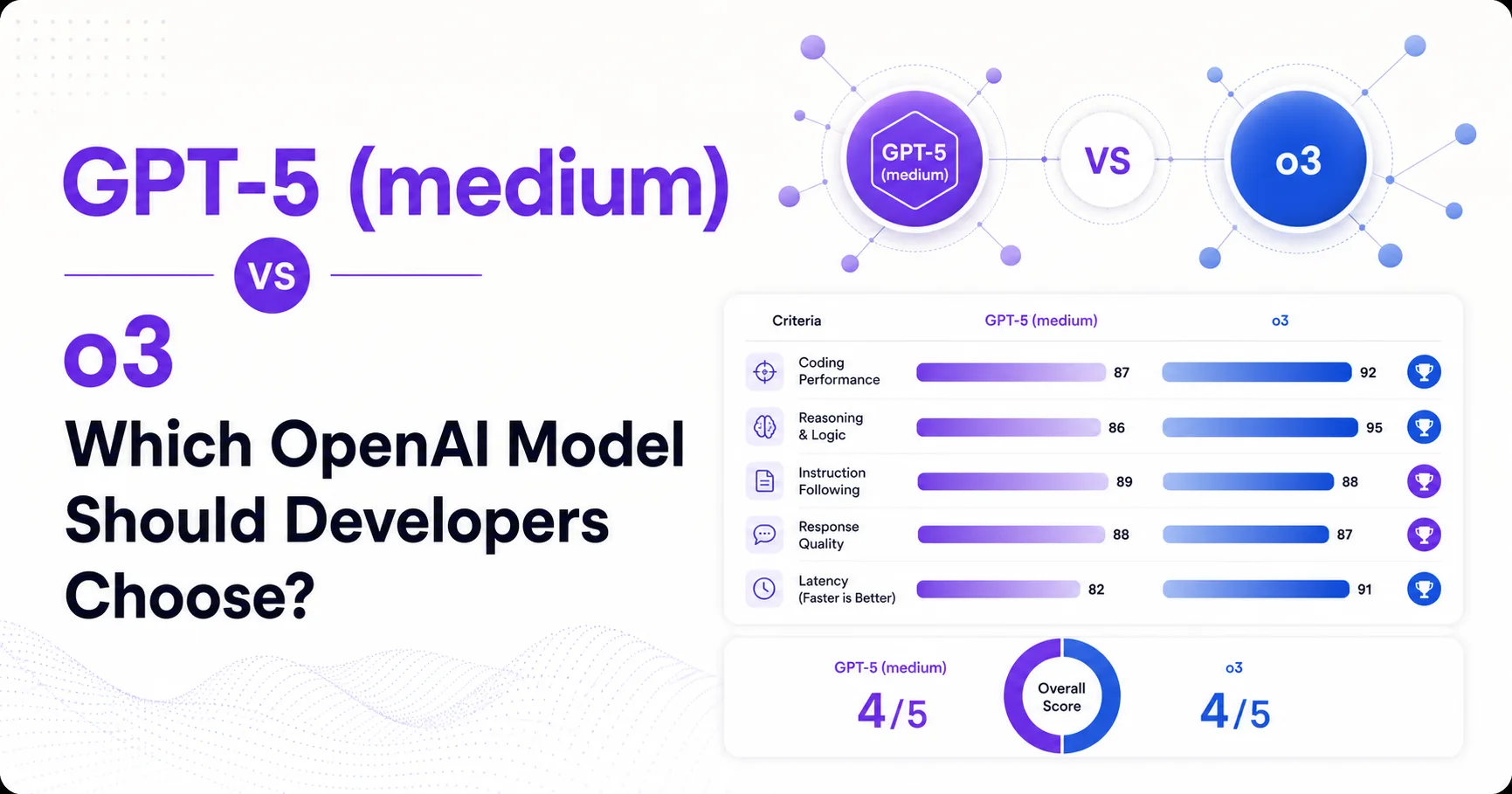
GPT-5 (medium) is the stronger measured choice, but o3 is the safer performance choice when streaming speed matters. The data snapshot gives GPT-5 (medium) an Artificial Analysis Intelligence Index of 33.7 and a Math Index of 91.7, compared with 30.4 and 88.3 for o3. The same snapshot reports 0.3 seconds of latency for each model. It reports o3 at 128.056 median output tokens per second, while GPT-5 (medium) has no reported output-speed value.
That result needs a qualification. The current OpenAI Models documentation does not list GPT-5 (medium) or o3, and it does not provide model-specific context limits, output limits, API parameters, or benchmark results for either one. The current OpenAI API Pricing documentation also does not list either model. The data therefore supports a practical snapshot comparison, but it does not establish current production availability.
For a new application, GPT-5 (medium) fits quality-sensitive workloads if the model is actually callable in your account. For latency-sensitive interfaces, o3 deserves testing because its measured output rate is explicit. For a long-lived production dependency, neither model should be selected without verifying endpoint access, aliases, quotas, and retirement risk.
GPT-5 (medium) leads the available quality and blended-cost evidence, while o3 leads the available streaming-speed evidence. GPT-5 (medium) scores 3.3 points higher on the Artificial Analysis Intelligence Index and 3.4 points higher on the Artificial Analysis Math Index. Those margins are meaningful for tasks where answer quality, planning, and mathematical reliability drive review effort.
The pricing picture is more nuanced. GPT-5 (medium) costs $1.25 per 1M input tokens and $10 per 1M output tokens in the data snapshot. o3 costs $2 per 1M input tokens and $8 per 1M output tokens. The reported 3-to-1 blended price is $3.4375 for GPT-5 (medium) and $3.5 for o3. A workload dominated by large prompts favors GPT-5 (medium). A workload dominated by generated text favors o3.
Neither model has a reported context-window value in the data snapshot. Neither model has a documented dedicated profile in the supplied official pages. The models page describes capabilities for current models in general, including text and image inputs, text output, multilingual use, and vision, but it does not confirm that those statements apply to either comparison target.
The central selection issue is therefore not simply quality versus cost. It is measured quality versus operational certainty, with the evidence incomplete on both sides.
GPT-5 (medium) has the stronger measured evaluation profile, while o3 has the only explicit median output-speed result. GPT-5 (medium) reaches 33.7 on the Artificial Analysis Intelligence Index versus 30.4 for o3. It also reaches 91.7 on the Artificial Analysis Math Index versus 88.3 for o3. The data snapshot reports 0.3 seconds of latency for both models.
For developers, the quality gap matters most when model output requires human correction or downstream validation. A higher intelligence score can support broader reasoning workloads, while the higher math score is especially relevant to symbolic work, quantitative explanations, and code that depends on numerical logic. The scores do not prove that GPT-5 (medium) wins every task. They indicate that the supplied evaluation evidence favors it across both listed indices.
The streaming result changes the operational story. o3 is reported at 128.056 median output tokens per second. GPT-5 (medium) has no reported value, so the comparison cannot establish that o3 is faster overall. It can establish that o3 has documented output-speed evidence in this snapshot and GPT-5 (medium) does not.
A chat product that reveals tokens progressively may benefit from o3 even if its final answers need more checking. A batch workflow may care less about visible streaming and more about answer quality. Because the official OpenAI Models page does not provide dedicated profiles for either model, developers should validate first-token latency, sustained generation, tool-call behavior, and failure recovery in their own workload. The supplied materials do not answer those questions.
GPT-5 (medium) leads on 2 of 2 metrics
GPT-5 (medium) has the lower blended price, but o3 can be cheaper for output-heavy workloads. The data snapshot lists GPT-5 (medium) at $3.4375 per 1M blended tokens and o3 at $3.5. That makes GPT-5 (medium) the nominal blended-price winner under the stated 3-to-1 mix.
The input and output rates point in opposite directions. GPT-5 (medium) charges $1.25 per 1M input tokens, compared with $2 for o3. This favors applications that repeatedly send large instructions, documents, conversation history, or retrieved context. o3 charges $8 per 1M output tokens, compared with $10 for GPT-5 (medium). This favors applications that generate long reports, verbose code, or multi-step responses.
The blended figure should not be treated as a universal bill estimate. It describes one token mix, while real applications vary by prompt size, response length, retries, tool traces, and caching behavior. A short-answer assistant may be input-heavy. A report generator may be output-heavy. A coding agent can be expensive in both directions because it repeatedly resends context and produces intermediate actions.
The OpenAI API Pricing page does not list either model, so the data snapshot prices cannot be independently confirmed as current public prices from the supplied official source. Before committing, developers should verify the actual account price, billing mode, availability, and any rate limits. The materials do not provide enough evidence to predict total application cost from the blended figure alone.
GPT-5 (medium) leads on 2 of 3 metrics
GPT-5 (medium) is the best first candidate for quality-sensitive development workflows, while o3 is the better test candidate for output-heavy or streaming-sensitive products. GPT-5 (medium) leads both supplied evaluation scores, with 33.7 on the Artificial Analysis Intelligence Index and 91.7 on the Artificial Analysis Math Index. It also has the lower reported blended price of $3.4375 per 1M tokens.
Choose GPT-5 (medium) for code review, technical analysis, mathematical reasoning, and applications where reducing correction work matters more than maximizing output throughput. Its lower input price also suits retrieval-heavy systems that send substantial context. That recommendation remains conditional because the current official OpenAI Models documentation does not list the model or confirm a stable API identity.
Choose o3 for interfaces where visible generation speed is central, especially if long responses are common. The snapshot reports 128.056 median output tokens per second for o3, while no corresponding GPT-5 (medium) value is available. Choose o3 for output-heavy workloads only after confirming that its lower output rate, $8 per 1M tokens, offsets its higher input rate of $2 per 1M tokens.
Do not make either model a default production dependency based on this comparison alone. The supplied official OpenAI API Pricing documentation lists neither model, and the research found no reliable community tests, failure reports, or model-specific limitations. The evidence is sufficient to prioritize experiments, not sufficient to certify availability or long-term support.
A sensible evaluation sequence is straightforward: first verify that each model can be called, then replay representative prompts, then measure quality, first-token latency, sustained output speed, retries, and token mix. If GPT-5 (medium) is unavailable or unstable, o3 becomes the practical choice regardless of the score gap. If both are available, GPT-5 (medium) is the default quality choice and o3 is the speed and output-cost challenger.
The evidence supports a cautious integration decision. The questions below address the gaps that the supplied benchmark and research materials do not resolve directly.
GPT-5 (medium) is the better measured choice in the supplied data because it scores 33.7 versus 30.4 on the Artificial Analysis Intelligence Index and 91.7 versus 88.3 on the Math Index. That evidence does not prove universal superiority across every developer task.
GPT-5 (medium) has the lower reported blended price at $3.4375 per 1M tokens versus $3.5 for o3, and its input price is lower at $1.25 versus $2. o3 has the lower output price at $8 versus $10, so the cheaper model depends on token mix.
o3 is the only model with a reported median output speed, at 128.056 output tokens per second. Both models have a reported latency of 0.3 seconds, but the materials do not provide GPT-5 (medium) output speed or enough measurements to establish overall streaming superiority.
The supplied materials do not establish current API availability for either model. The official models page does not list GPT-5 (medium) or o3, and the pricing page does not list either model, so developers must verify account access, endpoint names, aliases, and quotas directly.
The supplied data snapshot reports no context-window value for GPT-5 (medium) or o3. The official models page also does not provide model-specific context details for these targets, so the comparison cannot recommend either model for large-context workloads on that basis.
No, the higher scores do not guarantee better code generation in every repository or programming language. The research found no reliable community coding tests for either model, so developers should run repository-specific evaluations covering correctness, test creation, tool use, and review effort.