
Time to First Token · GPT-5 mini (high)
0ms
Time to First Token · Grok 4.3 (high)
0ms
Deep dive into reasoning, benchmarks, and latency insights.
The current catalog does not contain complete performance evidence for both models, so this page does not declare an overall winner. Use the available fields as comparison signals and validate the models on your own workload.
Key decision metrics at a glance.
| Model | Metric | Value | Unit | Source / snapshot |
|---|---|---|---|---|
| GPT-5 mini (high) | Reasoning | 9.0 | benchmark or capability score | Artificial Analysis · current catalog |
| Grok 4.3 (high) | Reasoning | 6.0 | benchmark or capability score | Artificial Analysis · current catalog |
| GPT-5 mini (high) | Coding | 2.0 | benchmark or capability score | Artificial Analysis · current catalog |
| Grok 4.3 (high) | Coding | 4.0 | benchmark or capability score | Artificial Analysis · current catalog |
| GPT-5 mini (high) | Multimodal | 2.0 | benchmark or capability score | Artificial Analysis · current catalog |
| Grok 4.3 (high) | Multimodal | 3.0 | benchmark or capability score | Artificial Analysis · current catalog |
| GPT-5 mini (high) | Long Context | 3.0 | benchmark or capability score | Artificial Analysis · current catalog |
| Grok 4.3 (high) | Long Context | 5.0 | benchmark or capability score | Artificial Analysis · current catalog |
| GPT-5 mini (high) | Blended Price / 1M tokens | $0.688 | USD per 1M tokens | Artificial Analysis · current catalog |
| Grok 4.3 (high) | Blended Price / 1M tokens | $1.563 | USD per 1M tokens | Artificial Analysis · current catalog |
| GPT-5 mini (high) | P95 Latency | — | milliseconds | Artificial Analysis · current catalog |
| Grok 4.3 (high) | P95 Latency | — | milliseconds | Artificial Analysis · current catalog |
| GPT-5 mini (high) | Tokens per second | 0 | tokens per second | Artificial Analysis · current catalog |
| Grok 4.3 (high) | Tokens per second | 0 | tokens per second | Artificial Analysis · current catalog |
Data provided by Artificial Analysis; live values use the current catalog.
This radar chart visually maps the core capabilities (reasoning, coding, math proxy, multimodal, long context) of `GPT-5 mini (high)` vs `Grok 4.3 (high)`.
This grouped bar chart provides a side-by-side comparison for each benchmark metric.
Lower time to first token is better; higher tokens per second is better.
Compare input and output pricing in USD per 1M tokens.
GPT-5 mini (high)$0.75
Grok 4.3 (high)$1.875
GPT-5 mini (high) costs $1.125 less per run
This article is a dated snapshot published on 2026-08-07. Live cards above use the current catalog; missing live fields are not inferred.
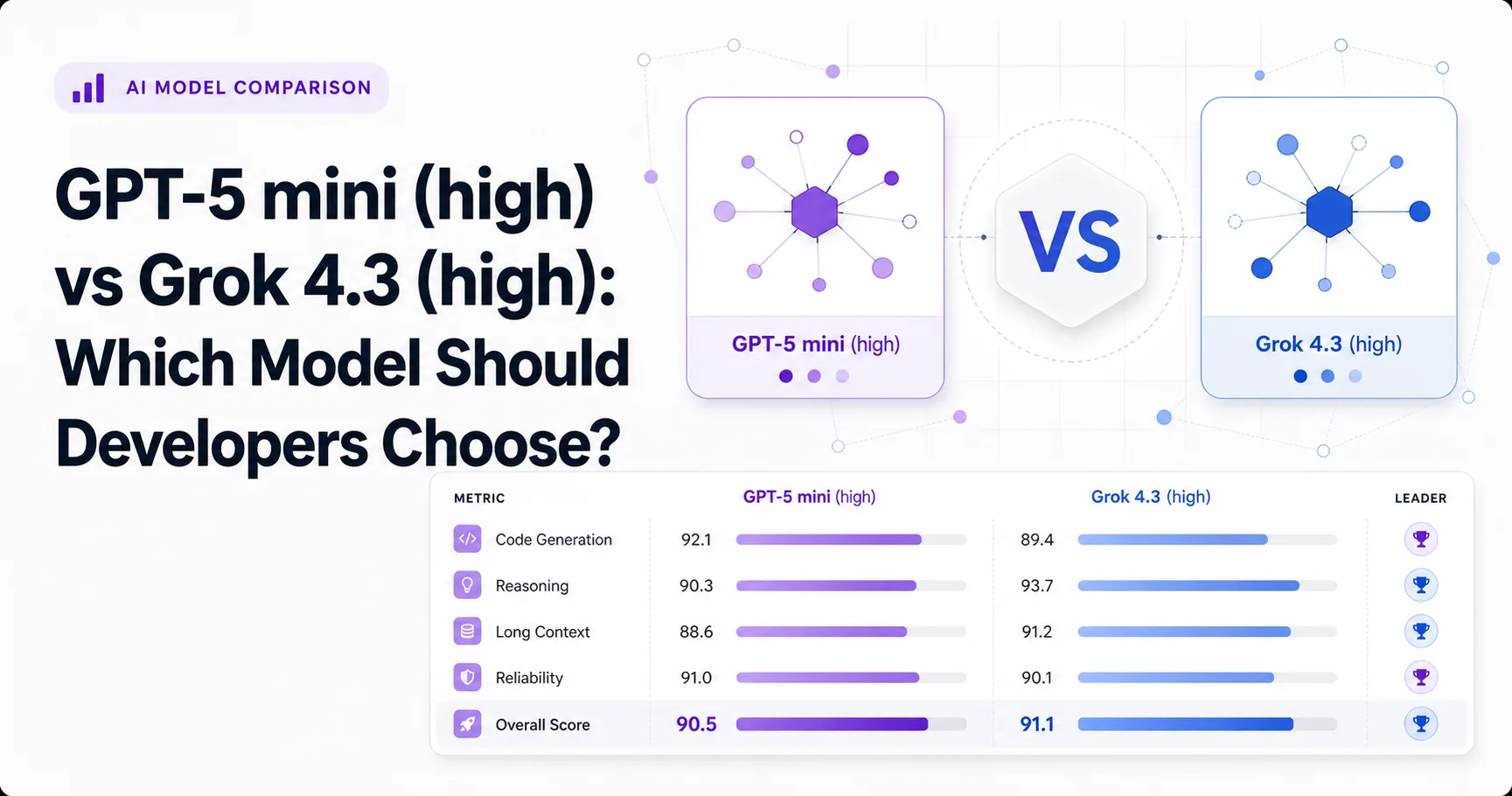
GPT-5 mini (high) is the safer cost-first choice, while Grok 4.3 (high) has the stronger measured coding and general intelligence results. The available data gives Grok 4.3 (high) a coding index of 42.2, compared with 15.6 for GPT-5 mini (high). Its intelligence index is 37.6, compared with 25.3. GPT-5 mini (high) retains a major price advantage, costing $0.6875 per 1M blended tokens versus $1.5625 for Grok 4.3 (high). Both models show latency of 0.3 seconds in the supplied snapshot.
The comparison has an important limitation. The research does not provide a verified vendor page for Grok 4.3 (high), and the current OpenAI Models page does not list GPT-5 mini as an independent current entry. The supplied data therefore supports a practical benchmark and price comparison, but not a complete production-readiness verdict.
Developers should read the result as a decision under incomplete evidence. Grok 4.3 (high) is the performance pick for coding-oriented work. GPT-5 mini (high) is the budget pick, with a notable math result that has no matching Grok score in the snapshot.
Grok 4.3 (high) leads the comparable intelligence and coding measures, but GPT-5 mini (high) offers substantially lower token pricing and the only reported math result. The largest measured gap appears in coding: Grok 4.3 (high) scores 42.2, while GPT-5 mini (high) scores 15.6. That difference is large enough to make Grok the stronger initial candidate for code generation, repository changes, debugging, and technical reasoning, subject to task-level validation.
GPT-5 mini (high) scores 90.7 on the Artificial Analysis math index. Grok 4.3 (high) has no math value in the supplied data, so the comparison cannot establish a math winner. The missing value is evidence absence, not evidence that Grok performs poorly.
Cost changes the operational decision. GPT-5 mini (high) costs $0.25 per 1M input tokens and $2 per 1M output tokens. Grok 4.3 (high) costs $1.25 for input and $2.5 for output. GPT-5 mini (high) is therefore more attractive for high-volume prompts, retrieval-heavy systems, and workflows where input tokens dominate.
The official documentation evidence is asymmetric. OpenAI Pricing does not currently provide a standard, Batch, Flex, or Fast mode price for GPT-5 mini, according to the research brief. The supplied benchmark price may therefore describe a dataset entry rather than a currently confirmed public API offer. No verified Grok documentation was found. Selection teams should confirm access, model IDs, limits, and billing before committing.
Grok 4.3 (high) is the stronger measured coding model, with a 42.2 coding index compared with GPT-5 mini (high) at 15.6. A coding-index advantage of this size can matter when the model must produce coherent multi-file changes, reason about unfamiliar code, or recover from a failed implementation. It does not prove that Grok will win every repository task, because the research brief provides no task examples, test pass rates, or methodology details for the individual coding scores.
Grok 4.3 (high) also leads the comparable intelligence index, scoring 37.6 against GPT-5 mini (high) at 25.3. That result supports Grok as the first model to test for broad technical workflows that combine planning, code interpretation, and implementation. Developers should still evaluate their own prompts, repository conventions, tool loop, and acceptance tests. The supplied research found no reliable community evidence about either model's coding experience, speed perception, or recurring model behavior.
GPT-5 mini (high) has the only reported math result, at 90.7. That makes it a credible candidate for math-heavy routing, but the missing Grok value prevents a direct conclusion. The latency result is a tie at 0.3 seconds for each model. Output speed is unavailable for both models, so the data cannot establish which model streams tokens faster or delivers better interactive throughput.
The official OpenAI Models page does not independently confirm GPT-5 mini's context window, output limit, API parameters, tool support, or benchmark profile. No verified official or community source confirms those details for Grok 4.3 (high) either.
GPT-5 mini (high) is the clear price leader, but Grok 4.3 (high) can still be cheaper at the system level if its coding advantage reduces retries and human review. GPT-5 mini (high) costs $0.6875 per 1M blended tokens, compared with $1.5625 for Grok 4.3 (high). Its input price is $0.25, versus $1.25 for Grok 4.3 (high), while output prices are $2 and $2.5 respectively.
Those prices favor GPT-5 mini (high) for large prompt payloads. Retrieval-augmented applications, repository context injection, long user histories, and automated classification can accumulate input tokens quickly. In such workloads, the input price difference may matter more than the output price difference. GPT-5 mini (high) is also easier to justify for broad experimentation when each request does not need the strongest measured coding result.
Grok 4.3 (high) may justify its higher price when an incorrect or incomplete answer creates downstream engineering work. A model with a 42.2 coding index may require fewer repair turns than one scoring 15.6, but the brief provides no retry counts, pass rates, or production cost study. That economic conclusion remains unverified.
Availability is another cost variable that the supplied materials do not resolve. The current OpenAI Pricing page does not list GPT-5 mini, and no verified Grok pricing page was found. Teams should treat the snapshot prices as comparison inputs, then confirm current billing and access before forecasting spend.
GPT-5 mini (high) leads on 3 of 3 metrics
Grok 4.3 (high) is the better first choice for coding-intensive development, while GPT-5 mini (high) is the better default for cost-sensitive and math-oriented workloads. Choose Grok 4.3 (high) when the main risk is weak implementation quality, difficult code comprehension, or repeated debugging. Its coding index of 42.2 and intelligence index of 37.6 are the strongest comparable signals in the supplied data.
Choose GPT-5 mini (high) when request volume, prompt size, or budget is the main constraint. Its blended price is $0.6875 per 1M tokens, and its input price is $0.25. Those values make it suitable for routing layers, bulk transformations, retrieval-heavy prompts, and lower-cost assistants. Its math index of 90.7 also makes it worth testing for quantitative tasks, although Grok has no corresponding value for a direct comparison.
A two-model strategy is reasonable if the application can route by task. Use GPT-5 mini (high) for inexpensive screening, extraction, or math-focused work, then reserve Grok 4.3 (high) for code generation and higher-risk technical changes. This recommendation is conditional because neither model has a verified context window, output ceiling, stable public model ID, or complete current availability record in the research.
Before production adoption, verify the exact API identifier, tool behavior, context limits, billing, and failure recovery with a private evaluation set. The supplied materials do not establish whether the displayed “high” label is a model variant, a reasoning setting, or a benchmark configuration.
GPT-5 mini (high) should be validated against the application's actual prompts before teams treat its benchmark profile as a production guarantee. The data supports a strong math result and lower pricing, but the research does not verify current API availability or model-specific limits.
Grok 4.3 (high) should be tested on repository-level tasks before teams pay its higher token price. Its coding and intelligence scores are stronger in the supplied comparison, but the research provides no verified vendor documentation, community test methodology, or operational reliability evidence.
Both models require an access and billing check before launch. The current OpenAI model and pricing pages do not independently confirm GPT-5 mini as a current listed model, while no valid official Grok source was found in the brief.
Grok 4.3 (high) is the better benchmark-led choice for coding because its coding index is 42.2 versus 15.6 for GPT-5 mini (high). The research does not provide repository pass rates, retry counts, or verified community tests, so developers should confirm the result on their own codebase.
GPT-5 mini (high) is cheaper at $0.6875 per 1M blended tokens, compared with $1.5625 for Grok 4.3 (high). GPT-5 mini (high) also has the lower input price, $0.25 versus $1.25, and the lower output price, $2 versus $2.5. Current public availability and billing still require verification.
Neither model is faster in the supplied latency data because GPT-5 mini (high) and Grok 4.3 (high) are both listed at 0.3 seconds. Output speed is unavailable for both models, so this comparison cannot determine streaming throughput, token generation speed, or interactive responsiveness.
GPT-5 mini (high) has a reported Artificial Analysis math index of 90.7, which makes it worth testing for math-oriented tasks. Grok 4.3 (high) has no math value in the supplied data, so the evidence cannot prove that GPT-5 mini (high) is better than Grok on a direct basis.
The supplied research does not support a confident production-readiness claim for either model. The current OpenAI model and pricing pages do not list GPT-5 mini as an independent current entry, and no verified official or community source confirms Grok 4.3 (high)'s API identity, limits, pricing, or operational behavior.