
Time to First Token · GPT-5 mini (high)
0ms
Time to First Token · Inkling (xhigh)
2416ms
Deep dive into reasoning, benchmarks, and latency insights.
The current catalog does not contain complete performance evidence for both models, so this page does not declare an overall winner. Use the available fields as comparison signals and validate the models on your own workload.
Key decision metrics at a glance.
| Model | Metric | Value | Unit | Source / snapshot |
|---|---|---|---|---|
| GPT-5 mini (high) | Reasoning | 9.0 | benchmark or capability score | Artificial Analysis · current catalog |
| Inkling (xhigh) | Reasoning | 6.0 | benchmark or capability score | Artificial Analysis · current catalog |
| GPT-5 mini (high) | Coding | 2.0 | benchmark or capability score | Artificial Analysis · current catalog |
| Inkling (xhigh) | Coding | 5.0 | benchmark or capability score | Artificial Analysis · current catalog |
| GPT-5 mini (high) | Multimodal | 2.0 | benchmark or capability score | Artificial Analysis · current catalog |
| Inkling (xhigh) | Multimodal | 4.0 | benchmark or capability score | Artificial Analysis · current catalog |
| GPT-5 mini (high) | Long Context | 3.0 | benchmark or capability score | Artificial Analysis · current catalog |
| Inkling (xhigh) | Long Context | 5.0 | benchmark or capability score | Artificial Analysis · current catalog |
| GPT-5 mini (high) | Blended Price / 1M tokens | $0.688 | USD per 1M tokens | Artificial Analysis · current catalog |
| Inkling (xhigh) | Blended Price / 1M tokens | $1.762 | USD per 1M tokens | Artificial Analysis · current catalog |
| GPT-5 mini (high) | P95 Latency | — | milliseconds | Artificial Analysis · current catalog |
| Inkling (xhigh) | P95 Latency | — | milliseconds | Artificial Analysis · current catalog |
| GPT-5 mini (high) | Tokens per second | 0 | tokens per second | Artificial Analysis · current catalog |
| Inkling (xhigh) | Tokens per second | 69.777 | tokens per second | Artificial Analysis · current catalog |
Data provided by Artificial Analysis; live values use the current catalog.
This radar chart visually maps the core capabilities (reasoning, coding, math proxy, multimodal, long context) of `GPT-5 mini (high)` vs `Inkling (xhigh)`.
This grouped bar chart provides a side-by-side comparison for each benchmark metric.
Lower time to first token is better; higher tokens per second is better.
Compare input and output pricing in USD per 1M tokens.
GPT-5 mini (high)$0.75
Inkling (xhigh)$2.013
GPT-5 mini (high) costs $1.263 less per run
This article is a dated snapshot published on 2026-08-07. Live cards above use the current catalog; missing live fields are not inferred.
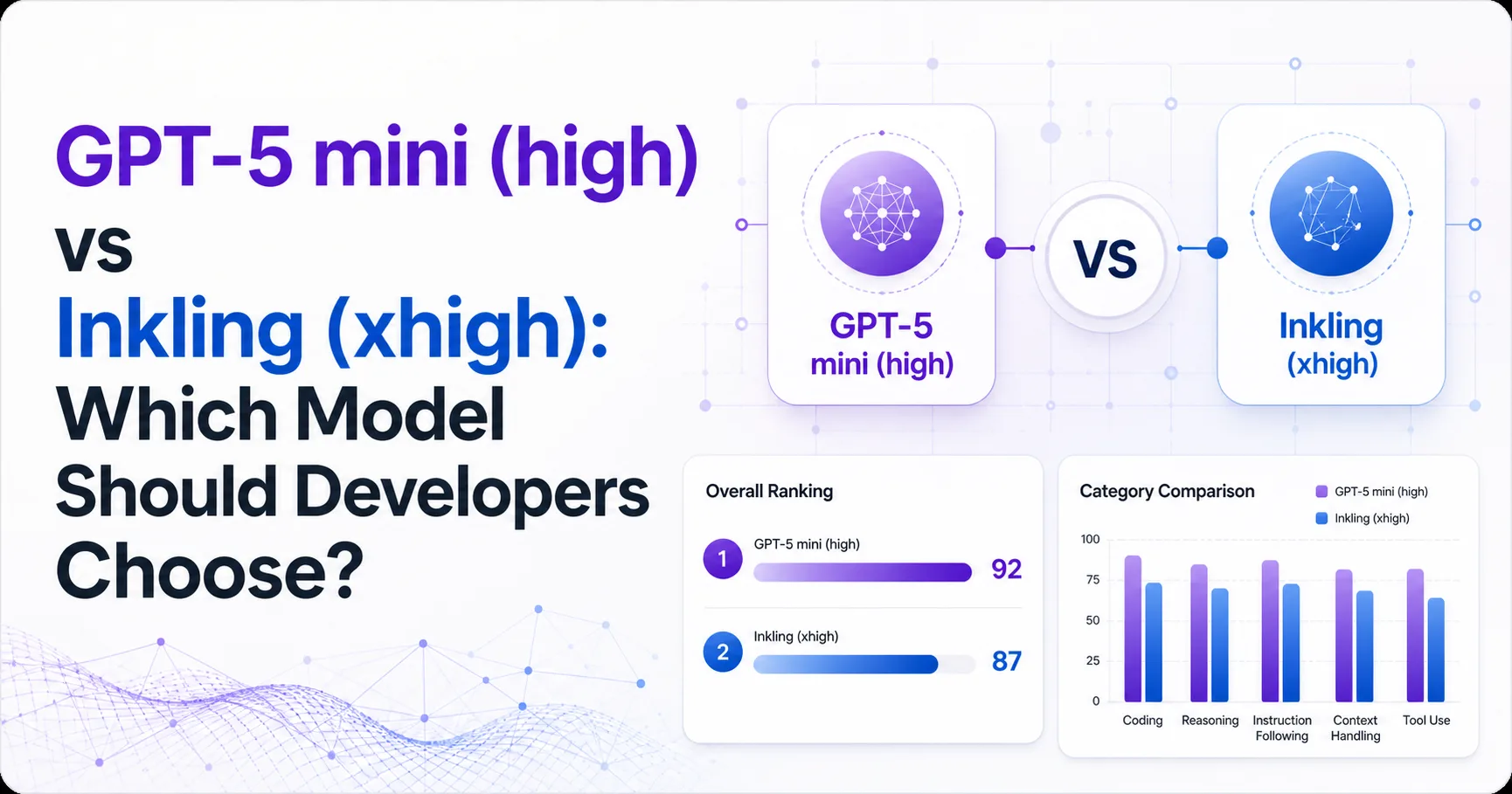
GPT-5 mini (high) is the safer cost-conscious choice, while Inkling (xhigh) has the stronger measured coding and general intelligence results. The data brief gives Inkling a coding index of 52.1 and an intelligence index of 40.7. GPT-5 mini (high) records 15.6 for coding and 25.3 for intelligence, but reaches 90.7 on the available math index.
The comparison has an important qualification: neither model has a fully verified public product profile in the supplied research. OpenAI's current model directory does not list gpt-5-mini or GPT-5 mini (high) as an independent entry. The research also found no verifiable official documentation for Inkling (xhigh).
For developers, the practical decision is therefore not simply capability versus price. It is measured capability versus deployment certainty. Inkling appears better suited to coding-heavy workloads if the benchmark reflects the target tasks. GPT-5 mini (high) is more attractive for workloads where lower token cost and the available math evidence dominate. Neither choice should proceed without confirming access, model identity, and production behavior.
Inkling (xhigh) leads the available shared evaluations, while GPT-5 mini (high) offers a materially lower blended token price and the only reported math result.
| Decision factor | GPT-5 mini (high) | Inkling (xhigh) | What it means |
|---|---|---|---|
| Intelligence index | 25.3 | 40.7 | Inkling has the stronger reported general result |
| Coding index | 15.6 | 52.1 | Inkling has the stronger reported coding result |
| Math index | 90.7 | Not reported | GPT-5 mini (high) has the only available math evidence |
| Blended price per 1M tokens | $0.6875 | $2.5725000000000002 | GPT-5 mini (high) is cheaper |
| Median latency | 0.3 seconds | 0.3 seconds | The reported latency is tied |
The scores do not establish that Inkling will win every engineering task. The research contains no verifiable benchmark methodology, task mix, context setup, or community reproduction for Inkling. It also does not establish whether GPT-5 mini (high) remains directly callable, because the current OpenAI model documentation omits it.
The strongest defensible conclusion is narrower. Inkling has the better measured profile on the shared intelligence and coding indicators. GPT-5 mini (high) has the better price profile and a strong reported math result. Deployment confidence remains unresolved for both models, with the public evidence especially thin for Inkling.
Inkling (xhigh) is the performance pick for coding and broad intelligence based on the available evaluation data, but the evidence does not show how that advantage behaves in production.
The coding result is the clearest signal. Inkling reaches 52.1 on the coding index, while GPT-5 mini (high) reaches 15.6. For a developer choosing a model for code generation, debugging, repository navigation, or implementation planning, that gap suggests Inkling may produce more useful first attempts or require fewer corrective turns. The result is still conditional because the supplied research does not describe the benchmark tasks or confirm that they resemble the developer's workload.
The intelligence index points in the same direction. Inkling records 40.7, compared with 25.3 for GPT-5 mini (high). That alignment makes Inkling's coding lead more meaningful than an isolated score. It still cannot answer questions about tool calling, structured output, long-context repository work, or reliability under repeated agent loops. No verified Inkling documentation or community testing was found for those behaviors.
GPT-5 mini (high) has the only reported math index, at 90.7. That evidence may matter for symbolic work, quantitative reasoning, or validation steps, but it cannot be compared directly with Inkling because no Inkling math result is supplied. Treating the missing value as a weakness would overstate the evidence.
Reported median latency is 0.3 seconds for both models. That tie means the selection should not assume that Inkling's higher coding score automatically creates a faster user experience. The data brief does not provide a comparable output-speed value for GPT-5 mini (high), while Inkling's median output speed is 84.899 tokens per second. Streaming behavior, time to first token, queueing, retries, and tool latency remain unknown.
The research also found no verified community discussions that establish either model's coding feel, stability, failure patterns, or context behavior. Developers should therefore validate representative tasks locally before treating the benchmark ordering as a production guarantee.
GPT-5 mini (high) is the clear cost choice because its blended price is $0.6875 per 1M tokens, compared with $2.5725000000000002 for Inkling (xhigh).
That price difference changes the economics of iterative development. Coding agents often generate intermediate plans, inspect files, retry failed edits, and ask for confirmation before producing a final answer. A cheaper model can absorb more exploratory turns before token spend becomes a constraint. GPT-5 mini (high) also has lower listed input pricing at $0.25 per 1M tokens and lower output pricing at $2 per 1M tokens. Inkling is listed at $1.87 for input and $4.68 for output.
The cheaper model is not automatically cheaper for the finished task. If Inkling's coding advantage reduces retries, review time, or failed tool actions, its higher token price could be offset by lower workflow overhead. The supplied data does not measure completion rates, correction turns, engineering time, or total task cost, so that inversion remains possible but unproven.
The opposite risk applies to GPT-5 mini (high). Its low blended price is attractive only if the model can be accessed reliably and performs adequately on the target workload. The current OpenAI pricing page does not list gpt-5-mini, so the supplied price should be treated as comparison data rather than confirmation of current purchasability.
Developers should also avoid projecting a stable budget from the model display name alone. The research found no official explanation connecting “GPT-5 mini (high)” to a current API model ID, and no verified pricing or API profile for Inkling. Cost modeling should therefore include access verification, fallback routing, and a small representative task evaluation.
GPT-5 mini (high) leads on 3 of 3 metrics
GPT-5 mini (high) is the better default for cost-sensitive workloads, while Inkling (xhigh) deserves a controlled trial for coding-heavy tasks.
Choose GPT-5 mini (high) when the application makes many model calls, input volume is high, or the workflow depends on predictable token economics. Its $0.6875 blended price and $0.25 input price create room for repository context, iterative prompts, and validation requests. The reported math index of 90.7 also makes it the more evidence-backed option for quantitative tasks, although the absence of a comparable Inkling result prevents a complete ranking.
Choose Inkling (xhigh) when code quality is the main bottleneck and the application can tolerate higher token prices. Its 52.1 coding index and 40.7 intelligence index are the strongest shared performance signals in the brief. A short trial should test the exact activities that matter: patch correctness, test repair, unfamiliar code comprehension, tool-use discipline, and behavior after an incorrect first attempt.
Use neither model as an unquestioned production dependency until access is confirmed. The current OpenAI model directory does not independently list GPT-5 mini (high), and the research found no official or community source for Inkling. That uncertainty affects model routing, version stability, support expectations, and incident response.
A sensible selection process is evidence-gated. First verify that the displayed model maps to a callable, stable identifier. Then run representative tasks with the same prompts, tools, context, and acceptance tests. Finally compare total workflow cost, not token price alone. The supplied data supports a provisional split: GPT-5 mini (high) for economical general use and Inkling (xhigh) for performance-oriented coding experiments.
GPT-5 mini (high) and Inkling (xhigh) both require access and reproducibility checks before a developer can make a confident production decision.
The central unresolved issue is identity. The supplied research does not connect either display name to a complete, durable API contract. The OpenAI model page and OpenAI pricing page provide current official references, but neither page verifies the GPT-5 mini (high) entry described in the data brief. Inkling has no verified source in the research at all.
The second unresolved issue is task transfer. Inkling leads the shared coding and intelligence indicators, while GPT-5 mini (high) has the only math result. Those signals help prioritize testing, but they do not replace evaluation on the developer's own repository, tools, latency tolerance, and review process.
Inkling (xhigh) is the stronger coding candidate because its reported coding index is 52.1 versus 15.6 for GPT-5 mini (high), although the benchmark method and production behavior are unverified.
GPT-5 mini (high) is cheaper at $0.6875 per 1M blended tokens, compared with $2.5725000000000002 for Inkling (xhigh), based on the supplied data.
Neither model is faster on the reported latency measure because GPT-5 mini (high) and Inkling (xhigh) both show 0.3 seconds of median latency.
Developers should verify access and run representative acceptance tests first because GPT-5 mini (high) is absent from the current OpenAI catalog and Inkling has no verifiable public documentation.