
Time to First Token · GPT-5 mini (high)
0ms
Time to First Token · Kimi K3 (max)
2585ms
Deep dive into reasoning, benchmarks, and latency insights.
The current catalog does not contain complete performance evidence for both models, so this page does not declare an overall winner. Use the available fields as comparison signals and validate the models on your own workload.
Key decision metrics at a glance.
| Model | Metric | Value | Unit | Source / snapshot |
|---|---|---|---|---|
| GPT-5 mini (high) | Reasoning | 9.0 | benchmark or capability score | Artificial Analysis · current catalog |
| Kimi K3 (max) | Reasoning | 6.0 | benchmark or capability score | Artificial Analysis · current catalog |
| GPT-5 mini (high) | Coding | 2.0 | benchmark or capability score | Artificial Analysis · current catalog |
| Kimi K3 (max) | Coding | 8.0 | benchmark or capability score | Artificial Analysis · current catalog |
| GPT-5 mini (high) | Multimodal | 2.0 | benchmark or capability score | Artificial Analysis · current catalog |
| Kimi K3 (max) | Multimodal | 5.0 | benchmark or capability score | Artificial Analysis · current catalog |
| GPT-5 mini (high) | Long Context | 3.0 | benchmark or capability score | Artificial Analysis · current catalog |
| Kimi K3 (max) | Long Context | 7.0 | benchmark or capability score | Artificial Analysis · current catalog |
| GPT-5 mini (high) | Blended Price / 1M tokens | $0.688 | USD per 1M tokens | Artificial Analysis · current catalog |
| Kimi K3 (max) | Blended Price / 1M tokens | $6 | USD per 1M tokens | Artificial Analysis · current catalog |
| GPT-5 mini (high) | P95 Latency | — | milliseconds | Artificial Analysis · current catalog |
| Kimi K3 (max) | P95 Latency | — | milliseconds | Artificial Analysis · current catalog |
| GPT-5 mini (high) | Tokens per second | 0 | tokens per second | Artificial Analysis · current catalog |
| Kimi K3 (max) | Tokens per second | 38.637 | tokens per second | Artificial Analysis · current catalog |
Data provided by Artificial Analysis; live values use the current catalog.
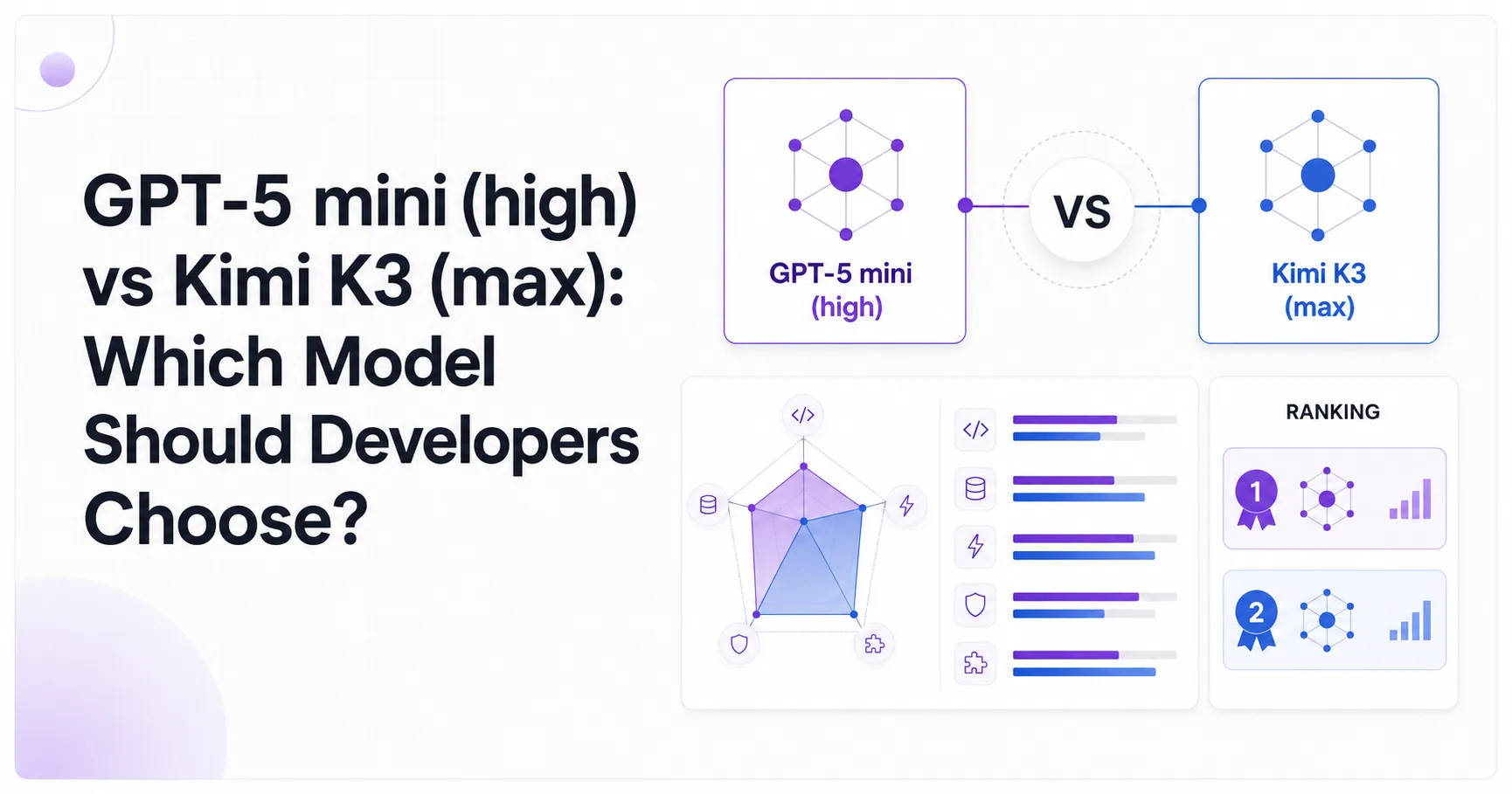
This radar chart visually maps the core capabilities (reasoning, coding, math proxy, multimodal, long context) of `GPT-5 mini (high)` vs `Kimi K3 (max)`.
This grouped bar chart provides a side-by-side comparison for each benchmark metric.
Lower time to first token is better; higher tokens per second is better.
Compare input and output pricing in USD per 1M tokens.
GPT-5 mini (high)$0.75
Kimi K3 (max)$6.75
GPT-5 mini (high) costs $6 less per run
This article is a dated snapshot published on 2026-08-07. Live cards above use the current catalog; missing live fields are not inferred.
Kimi K3 (max) is the stronger measured choice for demanding development work, while GPT-5 mini (high) is the safer cost choice only if its reported identity and availability can be verified.
The data brief gives Kimi K3 (max) a 76.2 coding index and a 57.1 intelligence index. GPT-5 mini (high) scores 15.6 and 25.3 on those same measures. GPT-5 mini (high) leads the available math comparison with a 90.7 score, but Kimi K3 (max) has no corresponding math value in the brief.
The commercial decision is less ambiguous. GPT-5 mini (high) costs $0.6875 per 1M blended tokens, compared with $6 for Kimi K3 (max). Yet the official OpenAI model directory and pricing page do not currently list gpt-5-mini, so the lower price does not by itself establish a dependable production option. OpenAI Models OpenAI Pricing
Kimi K3 is currently documented as kimi-k3, and its max label represents a reasoning setting rather than a separate model name. Kimi K3 Quickstart
Kimi K3 (max) offers the clearer capability case, while GPT-5 mini (high) offers the clearer price case.
| Decision factor | GPT-5 mini (high) | Kimi K3 (max) | What it means |
|---|---|---|---|
| Intelligence index | 25.3 | 57.1 | Kimi has the stronger measured general capability result |
| Coding index | 15.6 | 76.2 | Kimi is the stronger candidate for repository work and coding agents |
| Math index | 90.7 | Not reported | GPT has the only available result, but this is not a complete head-to-head |
| Blended token price | $0.6875 | $6 | GPT is the much cheaper serving option in the data brief |
| Input price | $0.25 | $3 | Repeated context and high-volume prompts favor GPT on price |
| Output price | $2 | $15 | Long generated answers are substantially more expensive with Kimi |
| Latency | 0.3 seconds | 0.3 seconds | The measured latency result is a tie |
| Output speed | Not reported | 34.453 tokens per second | Only Kimi has a reported median output-speed value |
The evidence is asymmetric in another important way. Kimi has a current model listing, documented API name, quickstart, pricing page, and technical blog. Model List Kimi K3 official technical blog GPT-5 mini (high) has benchmark and price values in the data brief, but the supplied official sources do not verify a matching public model entry, API identifier, or high model variant.
That means the comparison supports a capability and cost judgment, but not a fully verified procurement judgment for GPT-5 mini (high).
Kimi K3 (max) is the stronger performance choice for coding and broad reasoning, despite identical reported latency.
The coding gap is large enough to change architecture decisions. Kimi K3 (max) reaches a 76.2 coding index, while GPT-5 mini (high) reaches 15.6. For developers, that difference can affect how much work must be split into smaller prompts, how often generated patches need repair, and whether an agent can sustain a multi-step repository task. The benchmark does not prove success on every codebase, but it makes Kimi the more credible first candidate for coding-heavy workflows.
The intelligence index points in the same direction. Kimi K3 (max) scores 57.1 against GPT-5 mini (high) at 25.3. This supports Kimi for tasks that combine planning, tool use, code interpretation, and ambiguous requirements. It does not establish that Kimi wins every specialized task. GPT-5 mini (high) has the only reported math score, 90.7, so math-focused selection remains unresolved rather than a Kimi victory.
Speed requires careful interpretation. Both models show 0.3 seconds of latency, but only Kimi has a reported median output speed, 34.453 tokens per second. GPT-5 mini (high) has no output-speed value in the data brief. The available evidence therefore supports a latency tie, not a general speed win.
Kimi’s official documentation also adds useful capability boundaries. Kimi K3 supports native vision, video files, tool calls, JSON Mode, JSON Schema outputs, partial mode, dynamic tool loading, and automatic context caching. Kimi K3 Quickstart However, its web search is currently being updated and is not recommended for production workflows. The supplied material does not provide equivalent verified feature documentation for GPT-5 mini (high).
GPT-5 mini (high) is the clear cost winner, but Kimi K3 (max) can be cheaper overall when better task completion reduces engineering rework.
The data brief prices GPT-5 mini (high) at $0.6875 per 1M blended tokens. Kimi K3 (max) costs $6 on the same blended measure. GPT also has lower input and output prices, at $0.25 and $2, compared with Kimi at $3 and $15. For high-volume classification, routine extraction, short transformations, or workloads where every request is already tightly constrained, GPT’s price advantage is decisive if the model is actually available under the expected API contract.
The price graph cannot show the cost of failure. A coding agent that produces weaker patches may consume more review time, more repair calls, and more human attention. Kimi’s 76.2 coding index gives it a stronger case for tasks where one successful long-running attempt matters more than the nominal token rate. That is a workload hypothesis, not a measured total-cost result, because the supplied data does not include task success rates, retry counts, or engineering labor.
Kimi’s caching also changes the shape of repeated-context workloads. Its official pricing page lists separate prices for cache-hit input, cache-miss input, and output. Flagship Model Kimi K3 Pricing The supplied data brief uses a blended comparison, so developers should not treat the two pricing presentations as directly interchangeable.
The biggest cost risk for GPT is operational uncertainty. The supplied OpenAI directory and pricing page do not currently list gpt-5-mini. OpenAI Models OpenAI Pricing The evidence does not establish whether the data-brief price is a current public offer, a stable alias, or a historical measurement.
GPT-5 mini (high) leads on 3 of 3 metrics
Kimi K3 (max) should be the default shortlist choice for serious coding agents, while GPT-5 mini (high) should be considered only after its production access is confirmed.
Choose Kimi K3 (max) when the workload includes repository-wide changes, multi-step planning, tool calls, long-lived context, visual inputs, or difficult coding decisions. Its official materials describe a 1,048,576-token context window, native visual understanding, and an API model name of kimi-k3. Kimi K3 official technical blog Kimi K3 Quickstart The technical blog also reports a 67.3 DeepSWE result and a 90.4 BrowseComp result under the stated evaluation setups. Kimi K3 official technical blog
Choose GPT-5 mini (high) when serving cost dominates, the workflow is short and repeatable, and a verified endpoint exposes the expected model and behavior. Its 0.6875 blended price and 90.7 math index make it attractive for inexpensive, math-heavy or high-volume workloads. The math result is not enough to establish a broad advantage because the comparison lacks a Kimi math score.
Treat Kimi’s model naming as clearer. The official model list presents kimi-k3, while the quickstart explains that max is the reasoning_effort setting. Model List Kimi K3 Quickstart GPT-5 mini (high) has no equivalent verified explanation in the supplied official materials.
For a production decision, validate four items with a small internal test: endpoint availability, task completion, retry behavior, and total spend. The supplied sources do not answer those operational questions directly. Kimi’s documentation warns that incomplete reasoning history or mid-session model switching can make generation unstable, and its technical blog says the model can act too aggressively when requirements are unclear. Kimi K3 official technical blog
Kimi K3 (max) has documented integration constraints, while GPT-5 mini (high) has a more fundamental availability evidence gap.
Kimi K3 should be integrated through a compatible harness that preserves the expected reasoning history. Switching models inside an existing session can create unstable output, according to the official technical blog. Kimi K3 official technical blog Developers should also define explicit behavior boundaries in the system prompt or AGENTS.md, because the model may make decisions that exceed the user’s unstated intent.
Multimodal integration needs its own adapter work. Kimi does not accept a public image URL directly. Images must use Base64 or an ms://<file-id> reference, and the message content must use the documented object-array structure. Kimi K3 Quickstart That is manageable, but it can break an integration designed around URL-only image messages.
A community report describes Kimi completing substantial work on a personal hardware project through Hermes, then reaching its token limit before the task was fully complete. The author still needed manual review and another model. Just tested Kimi K3 with Hermes The report discloses its setup, but it does not provide a reproducible benchmark or success rate, so it should be treated as a warning rather than a measured limit.
GPT-5 mini (high) has the opposite problem in the supplied material. Its benchmark and price values are present, but the cited OpenAI pages do not currently verify its model entry, API name, context, output limit, or high semantics. OpenAI Models OpenAI Pricing
The evidence supports a practical shortlist, but several questions remain unresolved by the supplied sources.
Kimi K3 (max) is the stronger coding-agent candidate because its coding index is 76.2 versus 15.6 for GPT-5 mini (high). The result does not guarantee success on every repository, and the supplied benchmark does not report repair rates, task completion rates, or harness-neutral testing.
GPT-5 mini (high) is cheaper in the supplied data, costing $0.6875 per 1M blended tokens versus $6 for Kimi K3 (max). Developers should first verify that the GPT model and its quoted price are currently available through a stable production endpoint.
The supplied evidence does not establish a general speed winner. Both models have 0.3-second latency, Kimi K3 (max) reports 34.453 median output tokens per second, and GPT-5 mini (high) has no comparable output-speed value.
GPT-5 mini (high) has the only reported math result, with a 90.7 index, so it is the provisional choice for math-focused evaluation. The comparison cannot prove superiority because Kimi K3 (max) has no math index in the supplied data.
Kimi K3 (max) is not documented as an independent model identifier. The official quickstart describes max as the reasoning_effort setting, while the documented API model name is kimi-k3. Kimi K3 Quickstart
The largest unresolved risk is GPT-5 mini (high) availability and API identity. The supplied OpenAI model and pricing pages do not currently list gpt-5-mini, so developers cannot confirm its stable alias, context, output limit, or high behavior from those sources. OpenAI Models OpenAI Pricing