
Time to First Token · GPT-5 mini (high)
0ms
Time to First Token · Qwen3.6 Plus
0ms
Deep dive into reasoning, benchmarks, and latency insights.
The current catalog does not contain complete performance evidence for both models, so this page does not declare an overall winner. Use the available fields as comparison signals and validate the models on your own workload.
Key decision metrics at a glance.
| Model | Metric | Value | Unit | Source / snapshot |
|---|---|---|---|---|
| GPT-5 mini (high) | Reasoning | 9.0 | benchmark or capability score | Artificial Analysis · current catalog |
| Qwen3.6 Plus | Reasoning | 6.0 | benchmark or capability score | Artificial Analysis · current catalog |
| GPT-5 mini (high) | Coding | 2.0 | benchmark or capability score | Artificial Analysis · current catalog |
| Qwen3.6 Plus | Coding | 5.0 | benchmark or capability score | Artificial Analysis · current catalog |
| GPT-5 mini (high) | Multimodal | 2.0 | benchmark or capability score | Artificial Analysis · current catalog |
| Qwen3.6 Plus | Multimodal | 3.0 | benchmark or capability score | Artificial Analysis · current catalog |
| GPT-5 mini (high) | Long Context | 3.0 | benchmark or capability score | Artificial Analysis · current catalog |
| Qwen3.6 Plus | Long Context | 5.0 | benchmark or capability score | Artificial Analysis · current catalog |
| GPT-5 mini (high) | Blended Price / 1M tokens | $0.688 | USD per 1M tokens | Artificial Analysis · current catalog |
| Qwen3.6 Plus | Blended Price / 1M tokens | $1.125 | USD per 1M tokens | Artificial Analysis · current catalog |
| GPT-5 mini (high) | P95 Latency | — | milliseconds | Artificial Analysis · current catalog |
| Qwen3.6 Plus | P95 Latency | — | milliseconds | Artificial Analysis · current catalog |
| GPT-5 mini (high) | Tokens per second | 0 | tokens per second | Artificial Analysis · current catalog |
| Qwen3.6 Plus | Tokens per second | 0 | tokens per second | Artificial Analysis · current catalog |
Data provided by Artificial Analysis; live values use the current catalog.
This radar chart visually maps the core capabilities (reasoning, coding, math proxy, multimodal, long context) of `GPT-5 mini (high)` vs `Qwen3.6 Plus`.
This grouped bar chart provides a side-by-side comparison for each benchmark metric.
Lower time to first token is better; higher tokens per second is better.
Compare input and output pricing in USD per 1M tokens.
GPT-5 mini (high)$0.75
Qwen3.6 Plus$1.25
GPT-5 mini (high) costs $0.5 less per run
This article is a dated snapshot published on 2026-08-07. Live cards above use the current catalog; missing live fields are not inferred.
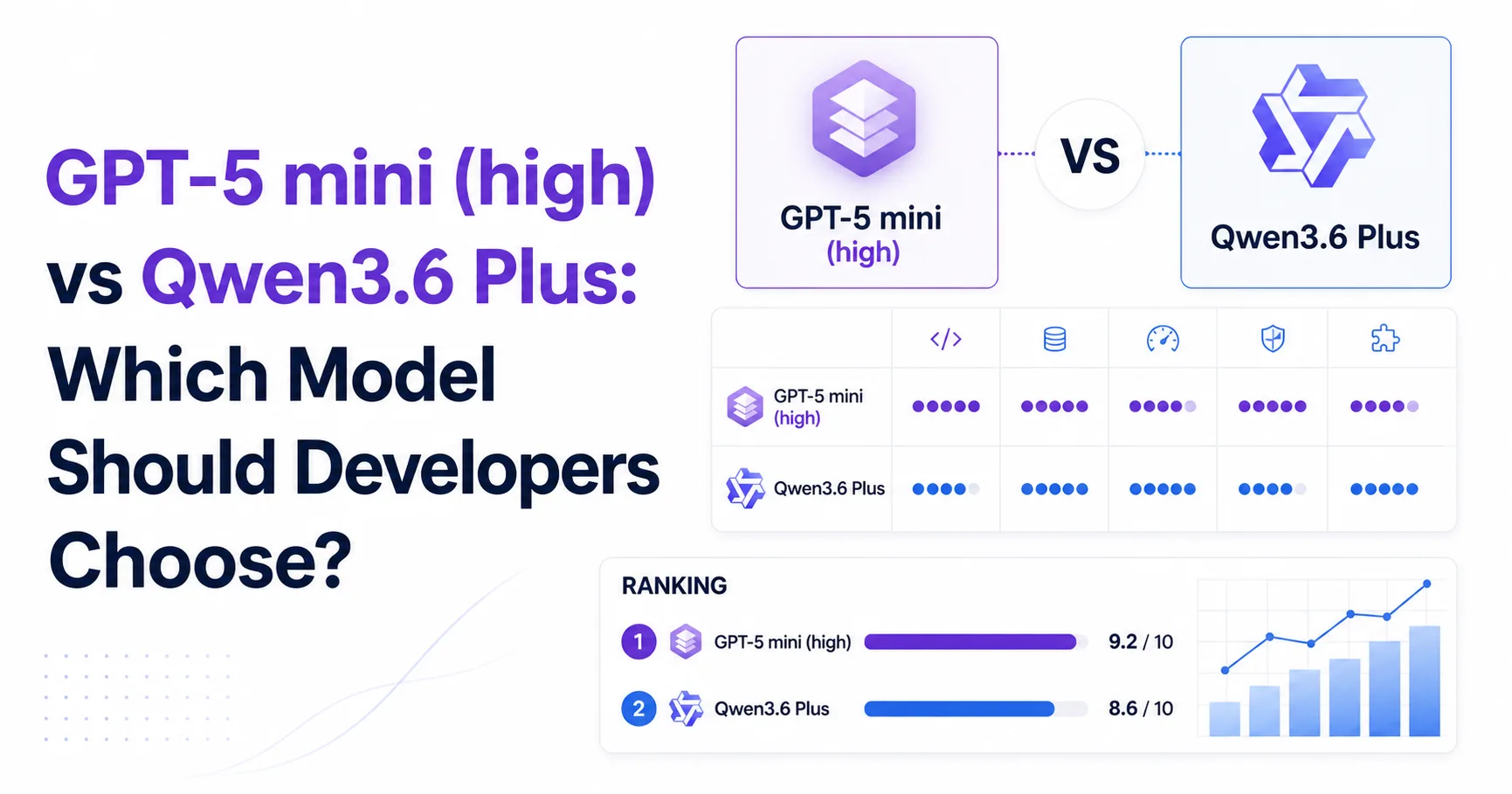
GPT-5 mini (high) is the lower-cost option, while Qwen3.6 Plus is the stronger measured choice for general intelligence and coding. The supplied data gives GPT-5 mini (high) an Artificial Analysis Intelligence Index of 25.3 and Coding Index of 15.6. Qwen3.6 Plus reaches 39.6 on the Intelligence Index and 54.5 on the Coding Index. The same data reports a latency of 0.3 seconds for both models, while only Qwen3.6 Plus has a reported median output speed, at 55.475 tokens per second. Artificial Analysis provides the evaluation and pricing snapshot used in this comparison.
The evidence has an important limitation. The supplied research brief does not include a verifiable official announcement, documentation page, pricing page, or community test for Qwen3.6 Plus. OpenAI’s current model directory and pricing page also do not list GPT-5 mini or GPT-5 mini (high) as an independent current entry. Developers should therefore treat this comparison as a decision aid based on the supplied benchmark snapshot, not as confirmation of present-day API availability.
Qwen3.6 Plus is the better measured default for coding and broad task performance, but GPT-5 mini (high) is the safer cost choice in the supplied snapshot. Qwen3.6 Plus leads the Artificial Analysis Intelligence Index at 39.6 versus 25.3. Its Coding Index lead is larger, at 54.5 versus 15.6. That difference suggests a more meaningful separation for code generation, repository changes, debugging, and implementation-oriented prompts, although the brief does not describe the benchmark tasks or test methodology.
GPT-5 mini (high) has the only reported mathematics score, 90.7. That result cannot establish a head-to-head mathematics winner because Qwen3.6 Plus has no corresponding value in the data brief. A developer building a math-heavy workflow should not convert the available score into a general capability claim.
The commercial trade-off is clear in the supplied pricing data. GPT-5 mini (high) costs $0.6875 per 1M blended tokens, compared with $1.1250000000000002 for Qwen3.6 Plus. GPT-5 mini (high) is also listed at $0.25 per 1M input tokens and $2 per 1M output tokens, versus $0.5 and $3 for Qwen3.6 Plus. Those prices favor GPT-5 mini (high), provided the model can actually be called through a stable supported endpoint.
Qwen3.6 Plus is the stronger measured performance choice for coding and general intelligence, while GPT-5 mini (high) retains an important unpaired mathematics result. The Coding Index gap is 54.5 versus 15.6. For a developer, that gap matters most when the model must produce usable code, follow implementation constraints, or revise an existing solution rather than merely explain programming concepts. The benchmark still does not reveal whether the difference holds across the languages, repository sizes, tool workflows, or test suites used by a particular team.
Qwen3.6 Plus also leads the Intelligence Index, at 39.6 versus 25.3. This supports choosing it for mixed workloads that combine planning, coding, analysis, and instruction following. It does not prove that Qwen3.6 Plus wins every task, because the research brief contains no verified failure cases, qualitative tests, or official capability documentation for that model.
The latency result does not separate the models. Both are listed at 0.3 seconds. Qwen3.6 Plus is the only model with a reported median output speed, at 55.475 tokens per second. That makes Qwen3.6 Plus the only speed result available for comparison, not proof that GPT-5 mini (high) is slower. Streaming user interfaces may benefit from Qwen3.6 Plus, but the supplied evidence is insufficient to assess time to first token, sustained throughput, rate limits, or tool-call overhead.
GPT-5 mini (high) records a Math Index of 90.7, while Qwen3.6 Plus has no reported mathematics value. The evidence therefore supports a conditional math preference for GPT-5 mini (high), not a complete performance verdict.
GPT-5 mini (high) is the lower-priced model in every listed token-pricing category, but its economic advantage depends on verified access and acceptable task quality. Its blended price is $0.6875 per 1M tokens, compared with $1.1250000000000002 for Qwen3.6 Plus. Input pricing is $0.25 versus $0.5, and output pricing is $2 versus $3. The chart makes the price difference easy to see, but it cannot show how many retries, corrections, reviews, or fallback calls a real workflow requires.
A cheaper model can cost more operationally when it produces code that needs repeated repair or when it fails to complete a task in one pass. The available Coding Index values, 15.6 for GPT-5 mini (high) and 54.5 for Qwen3.6 Plus, make that risk relevant for software development workloads. The data does not provide pass rates, token consumption per successful task, or rework measurements, so the brief cannot quantify total cost per accepted change.
Qwen3.6 Plus may justify its higher token price for coding-heavy workloads if its measured coding advantage reduces retries or engineering review time. That remains a hypothesis, not a verified cost conclusion. GPT-5 mini (high) is more attractive for high-volume prompts, short responses, or workloads where the lower listed price outweighs uncertain task-quality differences.
Availability is the largest unresolved cost variable. OpenAI’s current pricing documentation does not list GPT-5 mini, and the supplied research brief offers no verifiable Qwen3.6 Plus pricing page. Developers should confirm effective provider pricing before committing to a production budget.
GPT-5 mini (high) leads on 3 of 3 metrics
Qwen3.6 Plus is the recommended first candidate for coding-centric applications, while GPT-5 mini (high) fits cost-sensitive or mathematics-focused experiments when access is confirmed. The recommendation follows the supplied benchmark evidence: Qwen3.6 Plus scores 54.5 on coding and 39.6 on intelligence, compared with 15.6 and 25.3 for GPT-5 mini (high). The models share a listed latency of 0.3 seconds, so latency alone should not decide the selection.
Choose Qwen3.6 Plus for code generation, debugging assistants, repository-level changes, and mixed developer agents where measured coding performance is the main selection criterion. Its reported median output speed of 55.475 tokens per second also makes it the more attractive candidate for streaming responses, although the brief does not provide a GPT-5 mini (high) speed value or any time-to-first-token measurement.
Choose GPT-5 mini (high) for workloads where listed token price is the dominant constraint. The blended price is $0.6875 per 1M tokens, and the input and output prices are $0.25 and $2. The model is also the only one with a reported Math Index, at 90.7. That makes it worth testing for mathematics-oriented tasks, but the missing Qwen3.6 Plus mathematics result prevents a direct winner claim.
Before production adoption, validate model IDs, endpoint availability, context limits, output limits, tool support, rate limits, and failure behavior. The current OpenAI model directory does not independently verify GPT-5 mini (high), while the research brief provides no verifiable official Qwen3.6 Plus source. This availability uncertainty is more important than a small benchmark advantage.
GPT-5 mini (high) and Qwen3.6 Plus require direct provider verification before a production decision because the supplied research brief leaves availability and specification evidence incomplete. The benchmark snapshot is useful for prioritizing tests, but it does not replace endpoint validation or workload-specific evaluation.
Qwen3.6 Plus is the better measured coding choice because its Artificial Analysis Coding Index is 54.5, compared with 15.6 for GPT-5 mini (high). The brief does not identify benchmark tasks, programming languages, or repository conditions, so teams should confirm the result on representative codebases.
GPT-5 mini (high) is cheaper in the supplied pricing snapshot, at $0.6875 per 1M blended tokens versus $1.1250000000000002 for Qwen3.6 Plus. Its listed input price is $0.25 and output price is $2, compared with $0.5 and $3 for Qwen3.6 Plus.
Qwen3.6 Plus is the only model with a reported median output speed, at 55.475 tokens per second. Both models have a listed latency of 0.3 seconds, while GPT-5 mini (high) has no supplied output-speed value, so the evidence cannot prove an overall speed winner.
GPT-5 mini (high) has the only reported mathematics result, an Artificial Analysis Math Index of 90.7. Qwen3.6 Plus has no corresponding mathematics value in the supplied data, so the evidence supports testing GPT-5 mini (high) rather than declaring a direct mathematics winner.
The supplied evidence does not establish production availability for either model. OpenAI’s current model directory and pricing page do not list GPT-5 mini or GPT-5 mini (high), and the brief provides no verifiable official documentation or pricing source for Qwen3.6 Plus.