
Time to First Token · GPT-5 mini (high)
0ms
Time to First Token · Qwen3.7 Plus
1365ms
Deep dive into reasoning, benchmarks, and latency insights.
The current catalog does not contain complete performance evidence for both models, so this page does not declare an overall winner. Use the available fields as comparison signals and validate the models on your own workload.
Key decision metrics at a glance.
| Model | Metric | Value | Unit | Source / snapshot |
|---|---|---|---|---|
| GPT-5 mini (high) | Reasoning | 9.0 | benchmark or capability score | Artificial Analysis · current catalog |
| Qwen3.7 Plus | Reasoning | 6.0 | benchmark or capability score | Artificial Analysis · current catalog |
| GPT-5 mini (high) | Coding | 2.0 | benchmark or capability score | Artificial Analysis · current catalog |
| Qwen3.7 Plus | Coding | 6.0 | benchmark or capability score | Artificial Analysis · current catalog |
| GPT-5 mini (high) | Multimodal | 2.0 | benchmark or capability score | Artificial Analysis · current catalog |
| Qwen3.7 Plus | Multimodal | 3.0 | benchmark or capability score | Artificial Analysis · current catalog |
| GPT-5 mini (high) | Long Context | 3.0 | benchmark or capability score | Artificial Analysis · current catalog |
| Qwen3.7 Plus | Long Context | 5.0 | benchmark or capability score | Artificial Analysis · current catalog |
| GPT-5 mini (high) | Blended Price / 1M tokens | $0.688 | USD per 1M tokens | Artificial Analysis · current catalog |
| Qwen3.7 Plus | Blended Price / 1M tokens | $0.7 | USD per 1M tokens | Artificial Analysis · current catalog |
| GPT-5 mini (high) | P95 Latency | — | milliseconds | Artificial Analysis · current catalog |
| Qwen3.7 Plus | P95 Latency | — | milliseconds | Artificial Analysis · current catalog |
| GPT-5 mini (high) | Tokens per second | 0 | tokens per second | Artificial Analysis · current catalog |
| Qwen3.7 Plus | Tokens per second | 55.609 | tokens per second | Artificial Analysis · current catalog |
Data provided by Artificial Analysis; live values use the current catalog.
This radar chart visually maps the core capabilities (reasoning, coding, math proxy, multimodal, long context) of `GPT-5 mini (high)` vs `Qwen3.7 Plus`.
This grouped bar chart provides a side-by-side comparison for each benchmark metric.
Lower time to first token is better; higher tokens per second is better.
Compare input and output pricing in USD per 1M tokens.
GPT-5 mini (high)$0.75
Qwen3.7 Plus$0.8
GPT-5 mini (high) costs $0.05 less per run
This article is a dated snapshot published on 2026-08-07. Live cards above use the current catalog; missing live fields are not inferred.
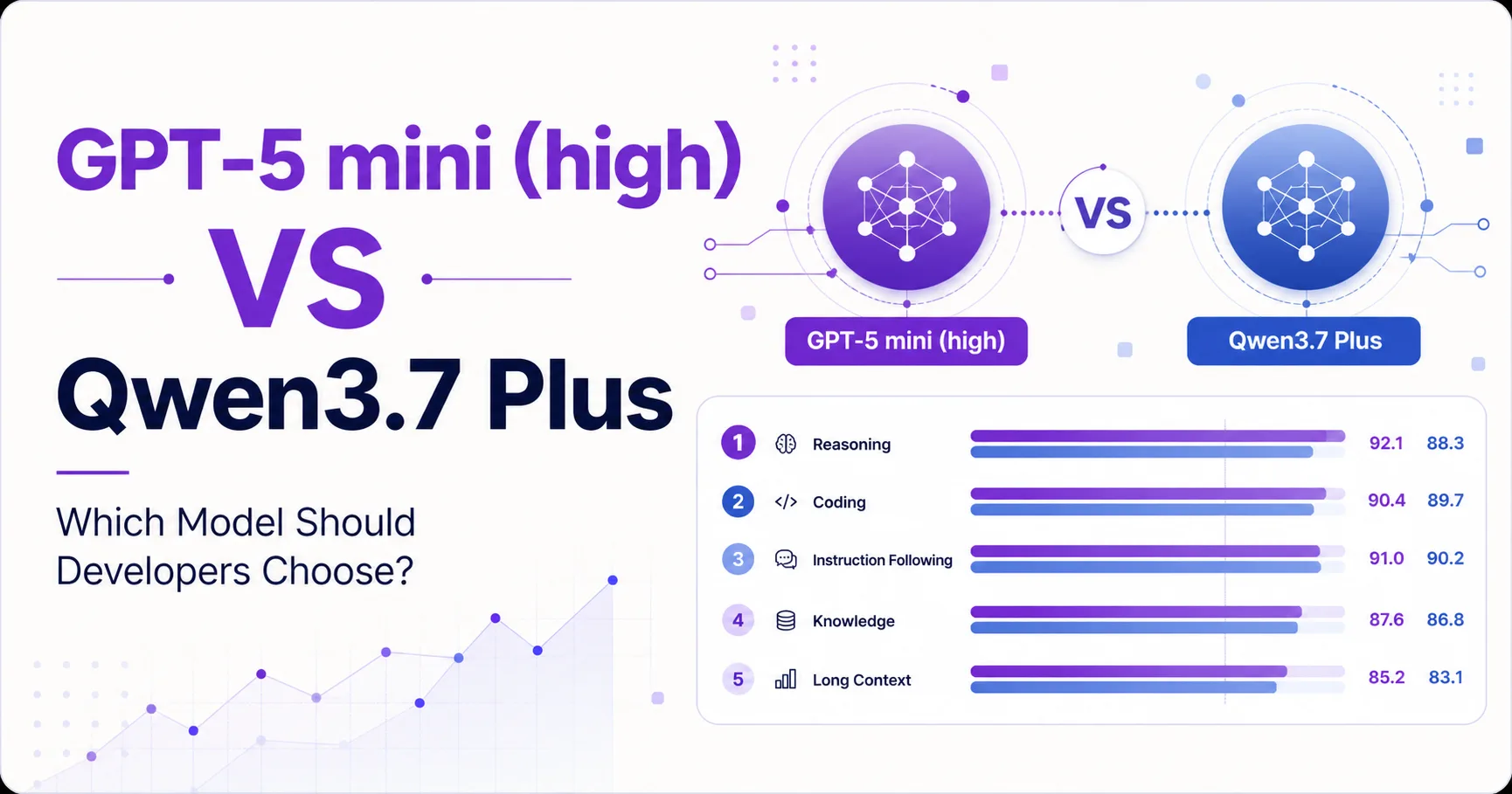
GPT-5 mini (high) is the safer math-oriented choice, while Qwen3.7 Plus is the stronger measured coding and general-intelligence choice. The benchmark snapshot gives Qwen3.7 Plus a coding index of 55.9 versus 15.6 for GPT-5 mini (high), and an intelligence index of 39 versus 25.3. GPT-5 mini (high) is the only model with a reported math index, at 90.7. That asymmetry matters because it prevents a complete capability ranking.
The operational picture is also split. Qwen3.7 Plus reports a median output speed of 52.107 tokens per second, while GPT-5 mini (high) has no value in that field. Both models show latency of 0.3 seconds. GPT-5 mini (high) has the lower blended price, at 0.6875 per 1M tokens, compared with 0.7000000000000001 for Qwen3.7 Plus.
Developers should treat this as a selection decision under incomplete evidence. OpenAI’s current model catalog does not list GPT-5 mini (high) as an independent current entry. No verifiable official or community source is available for Qwen3.7 Plus. The measured numbers are useful, but model availability, reproducibility, and task fit remain unresolved.
Qwen3.7 Plus has the stronger available capability signal, but GPT-5 mini (high) has the more useful evidence point for mathematical work. The coding index favors Qwen3.7 Plus at 55.9, compared with 15.6 for GPT-5 mini (high). The intelligence index also favors Qwen3.7 Plus at 39, compared with 25.3. These results make Qwen3.7 Plus the better first candidate for coding-heavy assistants, repository changes, and broad technical tasks.
GPT-5 mini (high) remains relevant because its math index is 90.7, while Qwen3.7 Plus has no reported value for that evaluation. The missing Qwen3.7 Plus math result is not evidence of weak mathematics. It is evidence that the comparison is incomplete. A developer choosing for symbolic reasoning, quantitative verification, or math tutoring cannot infer a winner from the available snapshot.
Release timing does not resolve the uncertainty. The data lists GPT-5 mini (high) with a release date of 2025-08-07 and Qwen3.7 Plus with a release date of 2026-06-01. However, the current OpenAI model catalog does not independently verify the GPT-5 mini (high) name, model ID, context window, output limit, or tool support. No comparable official source verifies Qwen3.7 Plus. The result is a performance lead for Qwen3.7 Plus, paired with deployment risk for both models.
Qwen3.7 Plus is the stronger measured choice for coding and broad capability, while GPT-5 mini (high) owns the only reported mathematics signal. The coding index difference is large enough to affect model selection, not merely benchmark ordering. A score of 55.9 for Qwen3.7 Plus versus 15.6 for GPT-5 mini (high) suggests that Qwen3.7 Plus deserves priority in experiments involving code generation, debugging, refactoring, and implementation planning. The benchmark does not establish how either model behaves on a specific repository, language, framework, or tool loop.
The intelligence index points in the same direction. Qwen3.7 Plus records 39, while GPT-5 mini (high) records 25.3. That alignment strengthens the case for Qwen3.7 Plus in mixed workloads where coding is combined with explanation, planning, and general problem solving. It still does not prove that Qwen3.7 Plus will produce better production outcomes. The snapshot does not disclose prompts, sampling settings, evaluation composition, or variance.
GPT-5 mini (high) should not be dismissed for quantitative tasks. Its math index is 90.7, and Qwen3.7 Plus has no corresponding reported value. That missing result blocks a complete ranking for mathematics. It also means that a coding benchmark winner may not be the right model for an application dominated by calculations or formal reasoning.
Qwen3.7 Plus reports 52.107 median output tokens per second. GPT-5 mini (high) has no reported output-speed value, so the data cannot prove that Qwen3.7 Plus is faster in a direct comparison. Both models report 0.3 seconds of latency. The practical speed advantage therefore remains workload-dependent, especially for short requests where latency dominates generation time. The OpenAI model catalog also does not confirm GPT-5 mini (high) as a current standalone model or document its performance behavior.
GPT-5 mini (high) has the lower blended token price, while Qwen3.7 Plus has the lower output-token price. The blended figures are 0.6875 for GPT-5 mini (high) and 0.7000000000000001 for Qwen3.7 Plus per 1M blended tokens. That small gap favors GPT-5 mini (high) for workloads whose input and output proportions resemble the stated blend.
The per-token structure creates a more important tradeoff. GPT-5 mini (high) costs 0.25 per 1M input tokens and 2 per 1M output tokens. Qwen3.7 Plus costs 0.4 per 1M input tokens and 1.6 per 1M output tokens. GPT-5 mini (high) is therefore better positioned for input-heavy traffic, such as document classification, retrieval-augmented prompts, and large context inspection. Qwen3.7 Plus is better positioned for output-heavy traffic, such as code generation, long explanations, and multi-step agent responses.
The cheaper model can become more expensive at the application level if it requires more retries, longer prompts, or additional validation. The available data does not measure retry rates, output quality, tool-call frequency, or production token distributions. Developers should therefore avoid treating the blended price as a guaranteed total-cost winner.
OpenAI’s pricing page does not list GPT-5 mini (high), so the snapshot price cannot be independently reconciled with the current public catalog. Qwen3.7 Plus also lacks a verifiable pricing source. Cost comparisons are consequently useful for the supplied snapshot, but availability and billing behavior require direct account-level testing.
GPT-5 mini (high) leads on 2 of 3 metrics
Qwen3.7 Plus is the recommended first test for coding-heavy applications, while GPT-5 mini (high) is the targeted candidate for math-heavy workloads. Qwen3.7 Plus leads the reported coding index at 55.9 and the intelligence index at 39. Its reported output speed of 52.107 tokens per second may also suit interactive generation, although GPT-5 mini (high) has no comparable speed measurement. Both models show 0.3 seconds of latency, so neither has a measured latency advantage.
Choose GPT-5 mini (high) when the workload is input-heavy, price-sensitive under the supplied blended metric, or centered on mathematical reasoning. Its input price is 0.25 per 1M tokens, its blended price is 0.6875, and its math index is 90.7. Those advantages are meaningful only if the model can be called reliably and the displayed name maps to a usable API identifier.
Choose Qwen3.7 Plus when coding quality is the main decision criterion and output generation is a large part of usage. Its output price is 1.6 per 1M tokens, and its coding index is 55.9. The missing official documentation means developers must validate endpoint ownership, model identity, context behavior, tool support, and service stability themselves.
The most important unresolved issue is not another benchmark score. The current OpenAI catalog does not list GPT-5 mini (high), and no verifiable source supports Qwen3.7 Plus. The evidence is insufficient to recommend either model for an irrevocable production dependency without an access and regression test.
GPT-5 mini (high) and Qwen3.7 Plus require an access check before production adoption because the supplied evidence does not establish stable public availability for either model. The benchmark snapshot can guide a shortlist, but it cannot replace endpoint testing, response validation, and billing confirmation. OpenAI’s model documentation and OpenAI’s pricing documentation are the available primary references for OpenAI, while no verifiable source is supplied for Qwen3.7 Plus.
A practical evaluation should test the application’s actual prompts, codebase, output length, retry behavior, and failure handling. Developers should record quality and effective cost together, because the lower listed price may not remain lower after retries or validation steps. The missing math result for Qwen3.7 Plus and missing output-speed result for GPT-5 mini (high) should remain explicit gaps in any decision record.
Qwen3.7 Plus is the better measured coding candidate because its coding index is 55.9 versus 15.6 for GPT-5 mini (high), although repository-specific testing is still required.
GPT-5 mini (high) is cheaper under the supplied blended metric at 0.6875 per 1M tokens versus 0.7000000000000001 for Qwen3.7 Plus, but output-heavy usage can favor Qwen3.7 Plus.
Qwen3.7 Plus has the only reported generation-speed value, at 52.107 median output tokens per second, while both models report latency of 0.3 seconds.
GPT-5 mini (high) is the only model with a reported math index, at 90.7, so it is the more defensible math candidate; Qwen3.7 Plus lacks a comparable reported result.
Developers should not commit without access validation because GPT-5 mini (high) is absent from the current OpenAI catalog and Qwen3.7 Plus has no verifiable official documentation in the supplied research.