
Time to First Token · GPT-5 nano (high)
0ms
Time to First Token · Kimi K3 (low)
2520ms
Deep dive into reasoning, benchmarks, and latency insights.
The current catalog does not contain complete performance evidence for both models, so this page does not declare an overall winner. Use the available fields as comparison signals and validate the models on your own workload.
Key decision metrics at a glance.
| Model | Metric | Value | Unit | Source / snapshot |
|---|---|---|---|---|
| GPT-5 nano (high) | Reasoning | 8.0 | benchmark or capability score | Artificial Analysis · current catalog |
| Kimi K3 (low) | Reasoning | 6.0 | benchmark or capability score | Artificial Analysis · current catalog |
| GPT-5 nano (high) | Coding | 6.0 | benchmark or capability score | Artificial Analysis · current catalog |
| Kimi K3 (low) | Coding | 7.0 | benchmark or capability score | Artificial Analysis · current catalog |
| GPT-5 nano (high) | Multimodal | 2.0 | benchmark or capability score | Artificial Analysis · current catalog |
| Kimi K3 (low) | Multimodal | 4.0 | benchmark or capability score | Artificial Analysis · current catalog |
| GPT-5 nano (high) | Long Context | 3.0 | benchmark or capability score | Artificial Analysis · current catalog |
| Kimi K3 (low) | Long Context | 6.0 | benchmark or capability score | Artificial Analysis · current catalog |
| GPT-5 nano (high) | Blended Price / 1M tokens | $0.138 | USD per 1M tokens | Artificial Analysis · current catalog |
| Kimi K3 (low) | Blended Price / 1M tokens | $6 | USD per 1M tokens | Artificial Analysis · current catalog |
| GPT-5 nano (high) | P95 Latency | — | milliseconds | Artificial Analysis · current catalog |
| Kimi K3 (low) | P95 Latency | — | milliseconds | Artificial Analysis · current catalog |
| GPT-5 nano (high) | Tokens per second | 0 | tokens per second | Artificial Analysis · current catalog |
| Kimi K3 (low) | Tokens per second | 40.313 | tokens per second | Artificial Analysis · current catalog |
Data provided by Artificial Analysis; live values use the current catalog.
This radar chart visually maps the core capabilities (reasoning, coding, math proxy, multimodal, long context) of `GPT-5 nano (high)` vs `Kimi K3 (low)`.
This grouped bar chart provides a side-by-side comparison for each benchmark metric.
Lower time to first token is better; higher tokens per second is better.
Compare input and output pricing in USD per 1M tokens.
GPT-5 nano (high)$0.15
Kimi K3 (low)$6.75
GPT-5 nano (high) costs $6.6 less per run
This article is a dated snapshot published on 2026-08-07. Live cards above use the current catalog; missing live fields are not inferred.
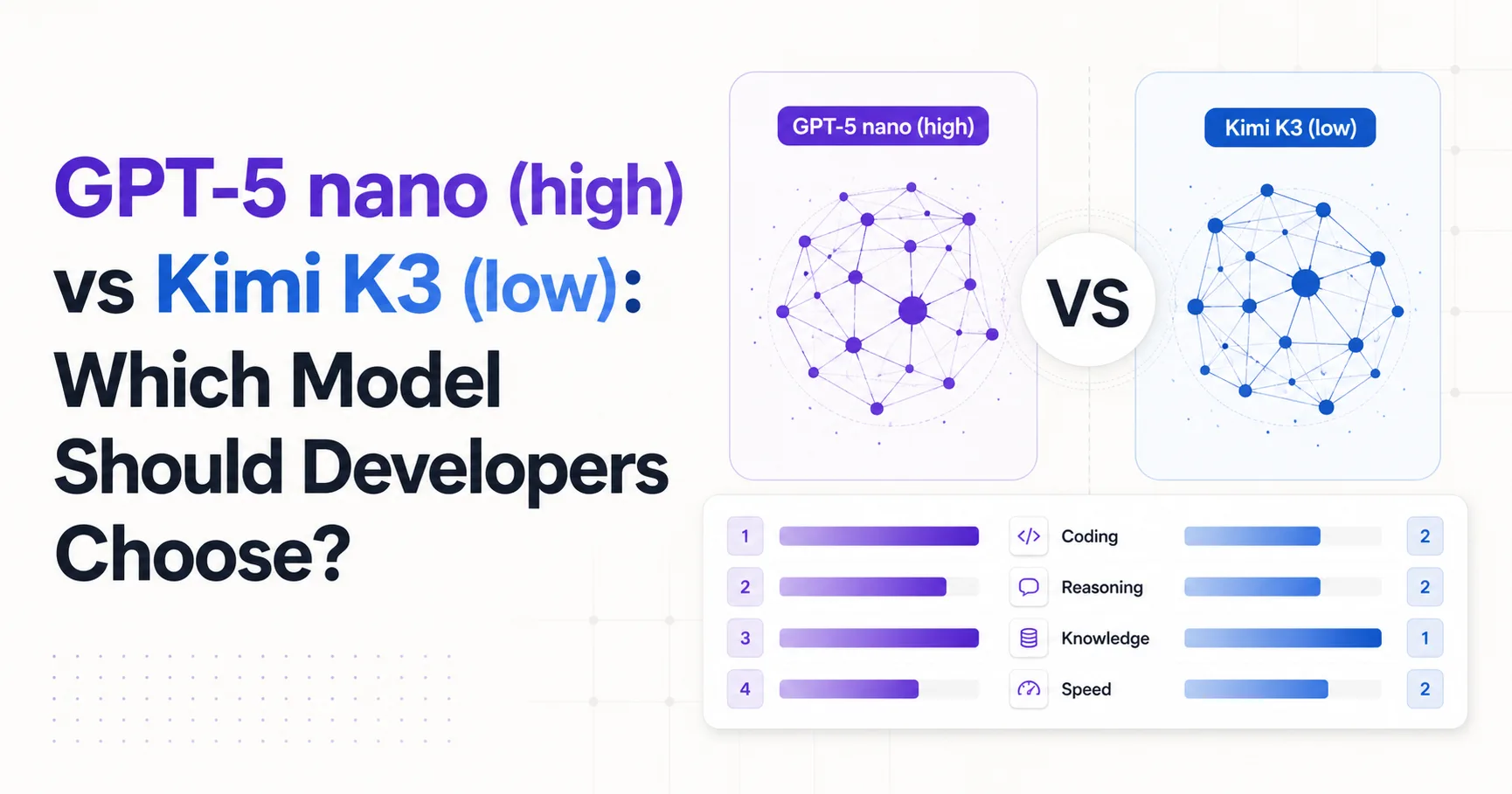
GPT-5 nano (high) is the more defensible default for developers who need low cost and measurable math performance, while Kimi K3 (low) offers stronger available intelligence and coding evidence at a much higher price.\n\nThe comparison has an important evidence gap. The data snapshot identifies GPT-5 nano (high) with a blended price of $0.1375 per 1M tokens and a math index of 83.7. It identifies Kimi K3 (low) with an intelligence index of 46.6, a coding index of 72, and a median output speed of 35.898 tokens per second.\n\nNeither model has a complete, publicly verifiable product profile in the supplied research. OpenAI's current model directory does not list GPT-5 nano or its reported aliases, and the research found no verifiable official material for Kimi K3 (low) OpenAI Models.
GPT-5 nano (high) is the stronger value choice, but Kimi K3 (low) has the stronger available general-intelligence and coding signals.\n\nThe models do not win on the same evidence. GPT-5 nano (high) has an Artificial Analysis math index of 83.7, while Kimi K3 (low) has an Artificial Analysis intelligence index of 46.6 and a coding index of 72. The intelligence comparison favors Kimi K3 (low), whose score is 46.6 versus 19.9 for GPT-5 nano (high). The supplied comparison does not provide a coding score for GPT-5 nano (high) or a math score for Kimi K3 (low), so neither result proves broad superiority.\n\nThe economic difference is much clearer. GPT-5 nano (high) is listed at $0.1375 per 1M blended tokens, compared with $6 for Kimi K3 (low). GPT-5 nano (high) is also listed at $0.05 for input tokens and $0.4 for output tokens, compared with $3 and $15 for Kimi K3 (low).\n\nLatency does not separate the models in the data snapshot, with each listed at 0.3 seconds. Kimi K3 (low) is the only model with a reported median output speed, at 35.898 tokens per second. That makes Kimi attractive for interactive generation, but the absence of a GPT-5 nano speed value prevents a direct speed ranking.\n\nOpenAI's current documentation describes newer OpenAI models in general terms, including text and image input, text output, multilingual capability, Responses API access, and official SDK access. The wording does not explicitly establish that GPT-5 nano (high) has those properties OpenAI Models.
Kimi K3 (low) has the stronger broad-intelligence and coding evidence, while GPT-5 nano (high) has the only reported math result.\n\nThe intelligence index is the clearest directional signal in the snapshot. Kimi K3 (low) records 46.6, compared with 19.9 for GPT-5 nano (high). A developer could interpret that gap as a reason to test Kimi for tasks involving varied reasoning, planning, or code-oriented judgment. The interpretation remains bounded because the research does not provide the benchmark methodology, task mix, or a matching coding result for GPT-5 nano (high).\n\nGPT-5 nano (high) records a math index of 83.7. That result makes it the more interesting candidate for arithmetic-heavy workflows, structured calculations, and evaluation suites where mathematical accuracy is central. It does not establish that GPT-5 nano (high) is better at general coding, because Kimi K3 (low) alone has a reported coding index of 72.\n\nThe speed evidence is asymmetric. Kimi K3 (low) reports 35.898 median output tokens per second, while GPT-5 nano (high) has no reported value in the snapshot. A team that values visible streaming behavior can therefore test Kimi first, but cannot claim that Kimi is faster overall. Both models list 0.3 seconds of latency, which makes initial responsiveness appear tied in the available data.\n\nThe practical conclusion is to map each model to a narrow evaluation set. Use math-focused tests for GPT-5 nano (high), coding and mixed-reasoning tests for Kimi K3 (low), and identical latency and streaming tests for both. The supplied research offers no verified failure modes, context limits, output limits, or API parameter constraints for either model. OpenAI's model directory also does not provide GPT-5 nano-specific limits or an explicit deprecation explanation OpenAI Models.
GPT-5 nano (high) is dramatically cheaper in the supplied snapshot, but its missing official price listing makes deployment cost a verification issue.\n\nThe chart makes the nominal difference clear: GPT-5 nano (high) is listed at $0.1375 per 1M blended tokens, while Kimi K3 (low) is listed at $6. GPT-5 nano (high) also has lower listed input and output rates, at $0.05 and $0.4, compared with Kimi K3 (low) at $3 and $15. Those figures make GPT-5 nano (high) the natural candidate for high-volume classification, extraction, routing, summarization, and other workloads where every request has a small margin.\n\nPrice alone can still mislead. A cheaper model becomes more expensive in practice if it produces more retries, requires additional validation, or cannot meet the task's quality threshold. The available research does not report failure rates, task-level accuracy, context limits, or production reliability for either model. Those missing variables prevent a total-cost conclusion for complex coding or reasoning workloads.\n\nThe official documentation creates a second cost risk. OpenAI's current pricing page does not list gpt-5-nano. It lists gpt-5.4-nano at $0.20 per 1M input tokens, $0.02 for cached input, and $1.25 per 1M output tokens, but the research explicitly says those prices must not be attributed to GPT-5 nano (high) OpenAI API Pricing.\n\nTreat the snapshot price as a comparison input, not as a procurement guarantee. Confirm the exact model identifier, account-level availability, billing terms, and effective rate before production commitment.
GPT-5 nano (high) leads on 3 of 3 metrics
GPT-5 nano (high) is the best first choice for cost-sensitive production, while Kimi K3 (low) deserves targeted trials for coding and broad reasoning.\n\nChoose GPT-5 nano (high) when request volume is high, mathematical work is important, and the supplied price snapshot is representative of your account. Its $0.1375 blended price and 83.7 math index create a compelling starting point for automation that must remain inexpensive. The recommendation is conditional because the current OpenAI model directory does not list the model or confirm a stable alias OpenAI Models.\n\nChoose Kimi K3 (low) when your evaluation emphasizes general intelligence or coding and the budget can absorb its $6 blended price. Its 46.6 intelligence index and 72 coding index are the strongest available signals for those workloads. Its 35.898 median output tokens per second may also make it worth testing for interfaces where streaming generation matters. The research provides no public official documentation for Kimi K3 (low), so model access, API behavior, and operational support remain unverified.\n\nUse a two-stage selection process. First, verify that each exact model identifier can be called under the intended account. Next, run representative prompts with strict scoring for correctness, code execution, refusal behavior, latency, output length, retries, and cost. The supplied materials do not establish which model handles long context, tools, multimodal input, or production failures better.\n\nFor most teams, start with GPT-5 nano (high) as the economic baseline and add Kimi K3 (low) where its intelligence or coding result earns the additional spend. Do not promote either model to a universal winner from the available evidence.
GPT-5 nano (high) and Kimi K3 (low) both require identity and capability verification before production use.\n\nThe central unresolved question is availability. The current OpenAI model directory does not list GPT-5 nano or its reported aliases, while the research found no publicly verifiable official source for Kimi K3 (low). The snapshot supplies comparative data, but it does not confirm that either model has stable public access, documented limits, or production support.\n\nTeams should therefore validate the exact endpoint, pricing, context behavior, output limits, parameter support, and failure handling before treating the benchmark and cost results as an implementation decision.
GPT-5 nano (high) is the better default for cost-sensitive workloads and math-heavy tasks, but Kimi K3 (low) has stronger available intelligence and coding evidence. The data does not support a universal winner because each model lacks a directly comparable benchmark category, and neither model has a complete verified product profile.
Choose Kimi K3 (low) when broad reasoning, coding evidence, or streaming output matters more than minimum token cost. Its intelligence index is 46.6 and its coding index is 72, while GPT-5 nano (high) has no supplied coding score. The higher price still requires task-level validation.
Developers should treat the listed GPT-5 nano (high) price as a snapshot comparison value, not a guaranteed production rate. The data gives $0.1375 per 1M blended tokens, but OpenAI's current pricing page does not list gpt-5-nano and instead lists a different model, gpt-5.4-nano.
Kimi K3 (low) has the only reported median output speed, at 35.898 tokens per second, so it is the stronger candidate for an initial streaming test. Both models list 0.3 seconds of latency, while GPT-5 nano (high) has no comparable output-speed value.
The materials show a coding index of 72 for Kimi K3 (low), but they do not provide a coding score for GPT-5 nano (high). That makes Kimi the only evidenced coding candidate, not a proven universal coding winner. Teams still need representative repository-level tests.
Context windows and API limits are not reliably established for either model in the supplied research. The data snapshot leaves both context windows blank, and the research found no verified model-specific limits, output caps, parameter support, or failure documentation.