
Time to First Token · GPT-5 nano (high)
0ms
Time to First Token · Motif 3 (Beta)
0ms
Deep dive into reasoning, benchmarks, and latency insights.
The current catalog does not contain complete performance evidence for both models, so this page does not declare an overall winner. Use the available fields as comparison signals and validate the models on your own workload.
Key decision metrics at a glance.
| Model | Metric | Value | Unit | Source / snapshot |
|---|---|---|---|---|
| GPT-5 nano (high) | Reasoning | 8.0 | benchmark or capability score | Artificial Analysis · current catalog |
| Motif 3 (Beta) | Reasoning | 6.0 | benchmark or capability score | Artificial Analysis · current catalog |
| GPT-5 nano (high) | Coding | 6.0 | benchmark or capability score | Artificial Analysis · current catalog |
| Motif 3 (Beta) | Coding | 6.0 | benchmark or capability score | Artificial Analysis · current catalog |
| GPT-5 nano (high) | Multimodal | 2.0 | benchmark or capability score | Artificial Analysis · current catalog |
| Motif 3 (Beta) | Multimodal | 4.0 | benchmark or capability score | Artificial Analysis · current catalog |
| GPT-5 nano (high) | Long Context | 3.0 | benchmark or capability score | Artificial Analysis · current catalog |
| Motif 3 (Beta) | Long Context | 6.0 | benchmark or capability score | Artificial Analysis · current catalog |
| GPT-5 nano (high) | Blended Price / 1M tokens | $0.138 | USD per 1M tokens | Artificial Analysis · current catalog |
| Motif 3 (Beta) | Blended Price / 1M tokens | $0 | USD per 1M tokens | Artificial Analysis · current catalog |
| GPT-5 nano (high) | P95 Latency | — | milliseconds | Artificial Analysis · current catalog |
| Motif 3 (Beta) | P95 Latency | — | milliseconds | Artificial Analysis · current catalog |
| GPT-5 nano (high) | Tokens per second | 0 | tokens per second | Artificial Analysis · current catalog |
| Motif 3 (Beta) | Tokens per second | 0 | tokens per second | Artificial Analysis · current catalog |
Data provided by Artificial Analysis; live values use the current catalog.
This radar chart visually maps the core capabilities (reasoning, coding, math proxy, multimodal, long context) of `GPT-5 nano (high)` vs `Motif 3 (Beta)`.
This grouped bar chart provides a side-by-side comparison for each benchmark metric.
Lower time to first token is better; higher tokens per second is better.
Compare input and output pricing in USD per 1M tokens.
GPT-5 nano (high)$0.15
Motif 3 (Beta)$0
Motif 3 (Beta) costs $0.15 less per run
This article is a dated snapshot published on 2026-08-07. Live cards above use the current catalog; missing live fields are not inferred.
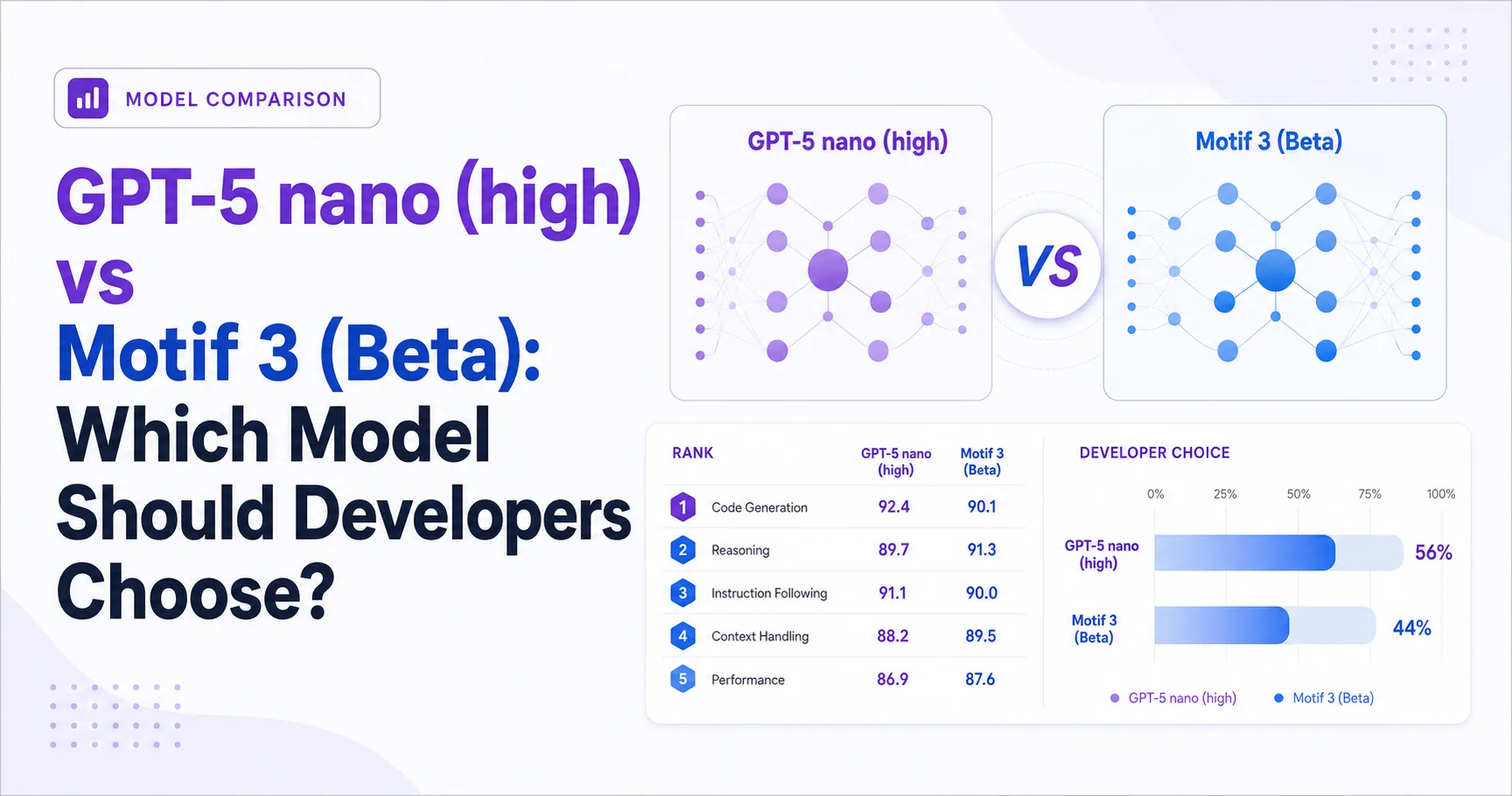
GPT-5 nano (high) is the safer economic choice, while Motif 3 (Beta) has the stronger available general-intelligence evidence. The comparison is constrained by asymmetric documentation: OpenAI’s current model directory does not list GPT-5 nano, gpt-5-nano, or gpt-5-nano-2025-08-07 (OpenAI Models), and no verifiable official source was found for Motif 3 (Beta).\n\nThe available data points in different directions. GPT-5 nano (high) records 19.9 on the Artificial Analysis Intelligence Index and 83.7 on the Artificial Analysis Math Index. Motif 3 (Beta) records 44.1 on the Intelligence Index and 62 on the Artificial Analysis Coding Index. Both models show 0.3 seconds latency.\n\nThe practical decision is therefore not simply “which score is higher?” Developers must balance measured capability, task fit, price certainty, operational availability, and evidence quality. GPT-5 nano (high) has listed benchmark and pricing data in the supplied snapshot, but its current API status is unconfirmed. Motif 3 (Beta) has a higher intelligence score, but its vendor, documentation, pricing provenance, and production stability are not independently verifiable from the research brief.\n\nData provided by https://artificialanalysis.ai/.
Motif 3 (Beta) leads the available intelligence evidence, but GPT-5 nano (high) offers the clearer value case for high-volume applications.\n\n| Decision factor | GPT-5 nano (high) | Motif 3 (Beta) | What it means | |---|---:|---:|---| | Intelligence Index | 19.9 | 44.1 | Motif has the stronger available score for broad intelligence tasks | | Math Index | 83.7 | Not provided | GPT-5 nano (high) has the only available math result | | Coding Index | Not provided | 62 | Motif has the only available coding result | | Latency | 0.3 seconds | 0.3 seconds | The supplied snapshot shows a tie | | Blended price | $0.1375 | $15 | GPT-5 nano (high) is the clear cost choice in the snapshot | | Input price | $0.05 | $10 | Input-heavy workloads strongly favor GPT-5 nano (high) | | Output price | $0.4 | $30 | Output-heavy workloads also favor GPT-5 nano (high) | \nThe scores do not establish a universal winner because the models do not share a complete evaluation set. Motif’s coding result cannot be compared directly with a GPT-5 nano (high) coding result because none is provided. GPT-5 nano (high)’s math result cannot be compared directly with a Motif math result for the same reason.\n\nThe official evidence also creates a deployment distinction. OpenAI’s documentation describes current models as supporting text and image input, text output, multilingual use, the Responses API, and official SDKs, but the page does not explicitly confirm that those statements apply to GPT-5 nano (OpenAI Models). Motif 3 (Beta) has no verifiable official documentation in the supplied research. Developers should treat both availability claims as requiring direct pre-deployment validation.
Motif 3 (Beta) has the stronger available general-intelligence score, while GPT-5 nano (high) has the only available math score.\n\nMotif’s 44.1 Artificial Analysis Intelligence Index score versus GPT-5 nano (high)’s 19.9 indicates a meaningful difference in the supplied general-intelligence measurement. For developers, that result supports testing Motif on tasks that require broader reasoning, interpretation, or open-ended problem solving. It does not prove that Motif will produce better code, because the only coding result shown is Motif’s 62 and no corresponding GPT-5 nano (high) coding score is available.\n\nGPT-5 nano (high)’s 83.7 Artificial Analysis Math Index score is the strongest specific capability signal in the comparison. It supports considering GPT-5 nano (high) for structured mathematical workloads, provided the model can be reached reliably. That qualification matters because the current OpenAI model directory does not list the model or confirm its API alias (OpenAI Models).\n\nLatency does not separate the choices in the supplied data. Both models are recorded at 0.3 seconds. Median output tokens per second are unavailable for both models, so the snapshot cannot answer which model streams longer responses faster. It also cannot establish time-to-first-token behavior under concurrency, regional load, prompt length, or tool use.\n\nThe evidence gap is especially important for production evaluation. Neither model has a complete, directly matched benchmark profile here. Developers should run representative prompts before treating the Intelligence, Math, or Coding Index results as an application-level conclusion. The available data identifies test priorities, not a complete performance verdict.\n\nData provided by https://artificialanalysis.ai/.
GPT-5 nano (high) is the economic default because its supplied prices are far below Motif 3 (Beta)’s prices.\n\nThe chart makes the price separation clear, but the operational meaning depends on workload shape. GPT-5 nano (high) is listed at $0.05 per 1M input tokens and $0.4 per 1M output tokens. Motif 3 (Beta) is listed at $10 per 1M input tokens and $30 per 1M output tokens. The blended figures are $0.1375 and $15 respectively, using the supplied 3-to-1 input-to-output convention.\n\nThat difference favors GPT-5 nano (high) for classification, extraction, routing, summarization, batch enrichment, and other high-volume tasks where each request has modest business value. It also makes repeated retries, evaluation runs, and prompt experimentation less expensive. However, low unit cost does not guarantee lower total cost. An unavailable model can create engineering delay, migration work, failed deployments, or duplicated testing.\n\nOpenAI’s current pricing page does not list gpt-5-nano. It lists gpt-5.4-nano at $0.20 per 1M input tokens, $0.02 per 1M cached input tokens, and $1.25 per 1M output tokens, but those prices are not GPT-5 nano prices (OpenAI API Pricing). Developers must not substitute the listed successor or neighboring model for the supplied GPT-5 nano snapshot.\n\nMotif 3 (Beta) could still be cheaper in a workload where its higher measured capability prevents costly downstream review or repeated generation. The brief provides no task-level quality, retry, or human-review data, so that possible reversal cannot be quantified.\n\nData provided by https://artificialanalysis.ai/.
Motif 3 (Beta) leads on 3 of 3 metrics
GPT-5 nano (high) is the better first candidate for cost-sensitive production workloads, while Motif 3 (Beta) deserves targeted trials for broader reasoning tasks.\n\nChoose GPT-5 nano (high) when the workload is high volume, math-oriented, or tolerant of a model-status verification step. Its supplied price is $0.1375 per 1M blended tokens, its latency is 0.3 seconds, and its available Math Index score is 83.7. Those facts make it attractive for deterministic pipelines, lightweight automation, and applications where infrastructure cost dominates model selection. The main condition is operational: the current OpenAI model directory does not confirm that GPT-5 nano remains directly callable (OpenAI Models).\n\nChoose Motif 3 (Beta) when the product depends on broad reasoning and the team can accept beta-level evidence risk. Its available Intelligence Index score is 44.1, compared with 19.9 for GPT-5 nano (high), and its supplied Coding Index score is 62. That profile justifies a focused evaluation on complex developer workflows, but it does not justify assuming production readiness. No verifiable official website, developer documentation, pricing page, stable alias, or community evidence was found in the research brief.\n\nA sensible selection process has three gates:\n\n1. Availability gate: confirm the exact model identifier, access permissions, retention policy, and limits directly with the provider.\n2. Task gate: test representative prompts for the intended coding, math, reasoning, refusal, and structured-output tasks.\n3. Economics gate: measure retries, review requirements, latency under expected traffic, and total request cost.\n\nThe evidence is insufficient to declare a universal winner. The strongest defensible conclusion is narrower: Motif 3 (Beta) leads the available intelligence signal, while GPT-5 nano (high) leads the available cost signal and owns the only available math result.\n\nData provided by https://artificialanalysis.ai/.
GPT-5 nano (high) and Motif 3 (Beta) require direct validation because the supplied evidence does not provide a complete, symmetric production profile.\n\n### Is Motif 3 (Beta) better than GPT-5 nano (high)?\n\nMotif 3 (Beta) has the higher available Artificial Analysis Intelligence Index score, at 44.1 versus 19.9, but the evidence does not establish a universal winner because the benchmark coverage is incomplete and Motif lacks verifiable official documentation.\n\n### Which model is cheaper for developers?\n\nGPT-5 nano (high) is cheaper in the supplied pricing snapshot, at $0.1375 per 1M blended tokens versus $15 for Motif 3 (Beta), although GPT-5 nano (high)’s current official availability and exact API status still require confirmation.\n\n### Which model is better for mathematics?\n\nGPT-5 nano (high) is the only model with a supplied Artificial Analysis Math Index score, at 83.7, so it is the stronger documented candidate for math testing, while Motif 3 (Beta) has no corresponding math score in the brief.\n\n### Which model is better for coding?\n\nMotif 3 (Beta) is the only model with a supplied Artificial Analysis Coding Index score, at 62, so it deserves coding trials, but the missing GPT-5 nano (high) coding score prevents a direct comparison.\n\n### Are the models equally fast?\n\nGPT-5 nano (high) and Motif 3 (Beta) are tied at 0.3 seconds latency in the supplied snapshot, but median output tokens per second are unavailable, so streaming performance remains unproven.\n\n### Can developers use GPT-5 nano (high) through the current OpenAI API?\n\nGPT-5 nano (high) cannot be confirmed as currently callable from the supplied official documentation because the model directory does not list the model, its alias, its limits, or its API-specific details.\n\n### Should a production team adopt Motif 3 (Beta) now?\n\nA production team should adopt Motif 3 (Beta) only after direct provider verification and representative testing, because the brief contains no verifiable official source for its availability, limits, pricing provenance, or stability.
Motif 3 (Beta) has the higher available Artificial Analysis Intelligence Index score, at 44.1 versus 19.9, but the evidence does not establish a universal winner because benchmark coverage is incomplete and Motif lacks verifiable official documentation.
GPT-5 nano (high) is cheaper in the supplied pricing snapshot, at $0.1375 per 1M blended tokens versus $15 for Motif 3 (Beta), although GPT-5 nano (high)’s current official availability and exact API status still require confirmation.
GPT-5 nano (high) is the only model with a supplied Artificial Analysis Math Index score, at 83.7, so it is the stronger documented candidate for math testing, while Motif 3 (Beta) has no corresponding math score in the brief.
Motif 3 (Beta) is the only model with a supplied Artificial Analysis Coding Index score, at 62, so it deserves coding trials, but the missing GPT-5 nano (high) coding score prevents a direct comparison.
GPT-5 nano (high) and Motif 3 (Beta) are tied at 0.3 seconds latency in the supplied snapshot, but median output tokens per second are unavailable, so streaming performance remains unproven.
GPT-5 nano (high) cannot be confirmed as currently callable from the supplied official documentation because the model directory does not list the model, its alias, its limits, or its API-specific details.