
Time to First Token · GPT-5 (high)
0ms
Time to First Token · GPT-5.1 Codex (high)
0ms
Deep dive into reasoning, benchmarks, and latency insights.
The current catalog does not contain complete performance evidence for both models, so this page does not declare an overall winner. Use the available fields as comparison signals and validate the models on your own workload.
Key decision metrics at a glance.
| Model | Metric | Value | Unit | Source / snapshot |
|---|---|---|---|---|
| GPT-5 (high) | Reasoning | 9.0 | benchmark or capability score | Artificial Analysis · current catalog |
| GPT-5.1 Codex (high) | Reasoning | 10.0 | benchmark or capability score | Artificial Analysis · current catalog |
| GPT-5 (high) | Coding | 4.0 | benchmark or capability score | Artificial Analysis · current catalog |
| GPT-5.1 Codex (high) | Coding | 6.0 | benchmark or capability score | Artificial Analysis · current catalog |
| GPT-5 (high) | Multimodal | 3.0 | benchmark or capability score | Artificial Analysis · current catalog |
| GPT-5.1 Codex (high) | Multimodal | 3.0 | benchmark or capability score | Artificial Analysis · current catalog |
| GPT-5 (high) | Long Context | 4.0 | benchmark or capability score | Artificial Analysis · current catalog |
| GPT-5.1 Codex (high) | Long Context | 4.0 | benchmark or capability score | Artificial Analysis · current catalog |
| GPT-5 (high) | Blended Price / 1M tokens | $3.438 | USD per 1M tokens | Artificial Analysis · current catalog |
| GPT-5.1 Codex (high) | Blended Price / 1M tokens | $3.438 | USD per 1M tokens | Artificial Analysis · current catalog |
| GPT-5 (high) | P95 Latency | — | milliseconds | Artificial Analysis · current catalog |
| GPT-5.1 Codex (high) | P95 Latency | — | milliseconds | Artificial Analysis · current catalog |
| GPT-5 (high) | Tokens per second | 0 | tokens per second | Artificial Analysis · current catalog |
| GPT-5.1 Codex (high) | Tokens per second | 0 | tokens per second | Artificial Analysis · current catalog |
Data provided by Artificial Analysis; live values use the current catalog.
This radar chart visually maps the core capabilities (reasoning, coding, math proxy, multimodal, long context) of `GPT-5 (high)` vs `GPT-5.1 Codex (high)`.
This grouped bar chart provides a side-by-side comparison for each benchmark metric.
Lower time to first token is better; higher tokens per second is better.
Compare input and output pricing in USD per 1M tokens.
GPT-5 (high)$3.75
GPT-5.1 Codex (high)$3.75
This article is a dated snapshot published on 2026-08-07. Live cards above use the current catalog; missing live fields are not inferred.
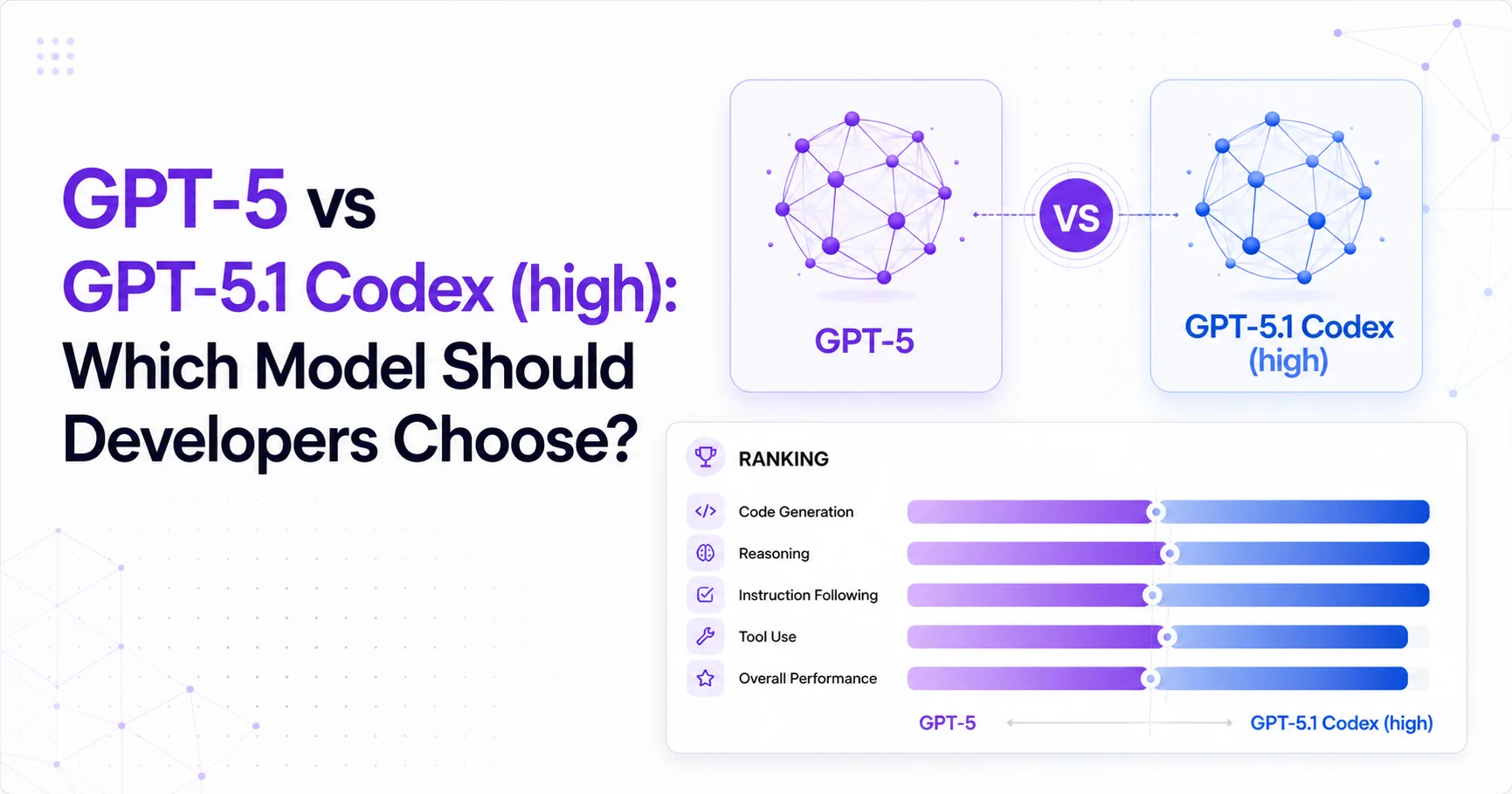
GPT-5 is the safer production choice because OpenAI documents its API identity, capabilities, pricing, and lifecycle status, while GPT-5.1 Codex (high) lacks a verified dedicated model entry. OpenAI describes GPT-5 as a reasoning model for coding, reasoning, and agentic tasks in GPT-5 for developers. The official GPT-5 model documentation lists gpt-5 as a callable alias, with a fixed snapshot named gpt-5-2025-08-07.
The comparison is not a clean contest between two equally documented API products. The data brief labels GPT-5.1 Codex (high) with a release date of 2025-11-13, but OpenAI Models does not list a dedicated gpt-5.1-codex entry. OpenAI Pricing lists gpt-5.3-codex, not gpt-5.1-codex.
That makes the central selection question operational rather than purely technical: can your team identify, call, support, and monitor GPT-5.1 Codex (high) through an official interface? The supplied evidence does not establish that answer. GPT-5 therefore wins on verifiability, even though the available evaluation data does not show a broad performance win.
GPT-5.1 Codex (high) has a narrow math-index advantage, while GPT-5 has the stronger documented product position. Artificial Analysis reports an Intelligence Index score of 34.7 for both models. It reports a Math Index score of 94.3 for GPT-5 and 95.7 for GPT-5.1 Codex (high). The data brief provides a Coding Index score of 37.8 for GPT-5, but no corresponding value for GPT-5.1 Codex (high), so no coding winner can be established.
The equal Intelligence Index scores weaken any claim that GPT-5.1 Codex (high) is broadly more capable. The higher Math Index may matter for mathematical reasoning, but it does not prove better repository work, tool use, code editing, or agent reliability. Those areas require evidence that the supplied materials do not provide.
GPT-5 also has public documentation for text and image input, text output, function calling, structured outputs, streaming, and custom tools. The documentation states that audio and video input or output are unsupported. GPT-5.1 Codex (high) has no verified model-specific documentation for these capabilities. The OpenAI Models page offers general model guidance, but it does not clearly identify the comparison target.
For developers, this creates an evidence asymmetry. GPT-5 can be assessed as a real API dependency. GPT-5.1 Codex (high) can be assessed only as a dataset label plus an unverified product name.
GPT-5.1 Codex (high) leads the available math evaluation, but GPT-5 remains the only model with directly documented coding benchmarks. Artificial Analysis gives GPT-5.1 Codex (high) a Math Index of 95.7, compared with 94.3 for GPT-5. That gap could favor GPT-5.1 Codex (high) in workloads dominated by mathematical reasoning, formal derivations, or numerical verification.
The same dataset gives both models an Intelligence Index of 34.7. It lists GPT-5 at 37.8 on the Coding Index, while GPT-5.1 Codex (high) has no Coding Index value. The missing value is more important than the label “Codex” when choosing a coding model. A product name does not substitute for a comparable coding evaluation.
OpenAI reports GPT-5 results of 74.9% on SWE-bench Verified, 88% on Aider polyglot, 96.7% on τ²-bench telecom, and 69.6% on Scale MultiChallenge in GPT-5 for developers. OpenAI notes that the SWE-bench result excluded 23 problems from 500 because they could not be passed reliably on its infrastructure. Aider used high reasoning effort. No equivalent official benchmark evidence is supplied for GPT-5.1 Codex (high).
Latency is tied at 0.3 seconds in the data brief. Median output speed is unavailable for both models. Therefore, the supplied evidence cannot establish a speed advantage, coding advantage, or agent-task advantage for GPT-5.1 Codex (high). Teams should test their own repositories and tool loops before treating the math score as a general performance signal.
GPT-5 and GPT-5.1 Codex (high) have identical supplied token prices, so model availability and failure handling will determine practical cost. The data brief lists both models at $1.25 per 1M input tokens, $10 per 1M output tokens, and $3.4375 per 1M blended tokens under a 3-to-1 mix. The chart below can show the equality directly; the important question is what happens around those prices.
GPT-5 has a confirmed price listing in the GPT-5 model documentation. GPT-5.1 Codex (high) does not have a confirmed current price listing in the supplied official materials. OpenAI Pricing lists gpt-5.3-codex at different Standard and Fast mode prices, but those values do not apply to GPT-5.1 Codex (high).
Equal benchmark economics do not guarantee equal application economics. A model that requires extra retries, manual review, or fallback routing can cost more even when its token price matches another model. The supplied research does not measure retry rates, correction effort, tool-call failures, or production throughput for GPT-5.1 Codex (high). Those are material cost unknowns.
GPT-5 also carries lifecycle risk because the fixed snapshot gpt-5-2025-08-07 is marked Deprecated, while the gpt-5 alias remains listed. That distinction matters for reproducibility. A team choosing GPT-5 should pin and monitor the documented model status. A team choosing GPT-5.1 Codex (high) must first verify that an official callable identifier and billing path exist.
GPT-5 is the recommended default for production developers who need a documented OpenAI API dependency today. OpenAI documents its alias, snapshot, context window, output limit, modalities, parameters, tools, endpoints, and pricing in GPT-5 model documentation. The same documentation says GPT-5 supports a 400,000-token context window and a maximum output of 128,000 tokens.
Choose GPT-5 for coding assistants, repository diagnosis, structured tool workflows, and agentic tasks where reproducibility and integration support matter. Its official materials define reasoning_effort values of minimal, low, medium, and high, alongside verbosity controls. Fine-tuning and Predicted outputs are marked unsupported, so those omissions should be part of the architecture decision.
Consider GPT-5.1 Codex (high) only after confirming its exact model identifier, access route, lifecycle policy, and coding performance in your environment. The supplied data suggests a Math Index advantage at 95.7 versus 94.3, but it does not establish a coding score, API contract, or reliable community experience. OpenAI Models does not provide that model-specific confirmation.
GPT-5 is not risk-free. The fixed snapshot is marked Deprecated, and a Reddit report describes faster small-bug work but less complete UI and application generation, plus possible incorrect modifications in complex existing codebases. That report is a single uncontrolled user experience, as documented in Tried GPT-5 Here Are My First Impressions. Use review gates for repository edits, and do not infer a broad consensus from that post.
GPT-5 is the only comparison model with a clearly documented callable API, so API verification should precede capability testing. OpenAI Models does not identify GPT-5.1 Codex (high) as a dedicated current model entry.
GPT-5.1 Codex (high) cannot be called the coding winner because the supplied data has no Coding Index value for it. GPT-5 has a Coding Index of 37.8, while the comparison value for GPT-5.1 Codex (high) is unavailable.
GPT-5 and GPT-5.1 Codex (high) tie on the supplied latency measure at 0.3 seconds. Median output tokens per second are unavailable for both, so the evidence does not support a faster-model claim.
GPT-5.1 Codex (high) may be preferable for math-heavy work if its access and identity are verified. Its supplied Math Index is 95.7, compared with 94.3 for GPT-5, but the evidence does not show whether that advantage transfers to coding or agents.
GPT-5.1 Codex (high) is not verified as a current callable OpenAI API model in the supplied evidence. The official model directory does not list a dedicated entry, and the pricing page lists gpt-5.3-codex instead. Confirm the exact identifier, endpoint, access permissions, and billing behavior before building a dependency.
GPT-5 is the safer software-development choice because OpenAI publishes coding-oriented benchmarks and documents its API behavior. GPT-5.1 Codex (high) has no comparable Coding Index value or verified model-specific documentation, so its apparent specialization cannot establish superior repository work.
GPT-5.1 Codex (high) has the higher supplied Math Index, scoring 95.7 versus GPT-5 at 94.3. That result supports considering it for math-heavy workloads, but the evidence does not prove a broader advantage in coding, tool use, or agentic tasks.
GPT-5 and GPT-5.1 Codex (high) have identical supplied prices: $1.25 per 1M input tokens, $10 per 1M output tokens, and $3.4375 per 1M blended tokens. However, GPT-5.1 Codex (high) lacks a confirmed official current price listing, so actual availability must be verified.
Neither model is proven faster by the supplied data. GPT-5 and GPT-5.1 Codex (high) both show 0.3 seconds of latency, while median output tokens per second are unavailable for both. A workload-specific test is required to compare streaming and tool-loop responsiveness.