
Time to First Token · GPT-5 (high)
0ms
Time to First Token · GPT-5.1 Codex mini (high)
0ms
Deep dive into reasoning, benchmarks, and latency insights.
The current catalog does not contain complete performance evidence for both models, so this page does not declare an overall winner. Use the available fields as comparison signals and validate the models on your own workload.
Key decision metrics at a glance.
| Model | Metric | Value | Unit | Source / snapshot |
|---|---|---|---|---|
| GPT-5 (high) | Reasoning | 9.0 | benchmark or capability score | Artificial Analysis · current catalog |
| GPT-5.1 Codex mini (high) | Reasoning | 9.0 | benchmark or capability score | Artificial Analysis · current catalog |
| GPT-5 (high) | Coding | 4.0 | benchmark or capability score | Artificial Analysis · current catalog |
| GPT-5.1 Codex mini (high) | Coding | 6.0 | benchmark or capability score | Artificial Analysis · current catalog |
| GPT-5 (high) | Multimodal | 3.0 | benchmark or capability score | Artificial Analysis · current catalog |
| GPT-5.1 Codex mini (high) | Multimodal | 3.0 | benchmark or capability score | Artificial Analysis · current catalog |
| GPT-5 (high) | Long Context | 4.0 | benchmark or capability score | Artificial Analysis · current catalog |
| GPT-5.1 Codex mini (high) | Long Context | 4.0 | benchmark or capability score | Artificial Analysis · current catalog |
| GPT-5 (high) | Blended Price / 1M tokens | $3.438 | USD per 1M tokens | Artificial Analysis · current catalog |
| GPT-5.1 Codex mini (high) | Blended Price / 1M tokens | $0.688 | USD per 1M tokens | Artificial Analysis · current catalog |
| GPT-5 (high) | P95 Latency | — | milliseconds | Artificial Analysis · current catalog |
| GPT-5.1 Codex mini (high) | P95 Latency | — | milliseconds | Artificial Analysis · current catalog |
| GPT-5 (high) | Tokens per second | 0 | tokens per second | Artificial Analysis · current catalog |
| GPT-5.1 Codex mini (high) | Tokens per second | 0 | tokens per second | Artificial Analysis · current catalog |
Data provided by Artificial Analysis; live values use the current catalog.
This radar chart visually maps the core capabilities (reasoning, coding, math proxy, multimodal, long context) of `GPT-5 (high)` vs `GPT-5.1 Codex mini (high)`.
This grouped bar chart provides a side-by-side comparison for each benchmark metric.
Lower time to first token is better; higher tokens per second is better.
Compare input and output pricing in USD per 1M tokens.
GPT-5 (high)$3.75
GPT-5.1 Codex mini (high)$0.75
GPT-5.1 Codex mini (high) costs $3 less per run
This article is a dated snapshot published on 2026-08-07. Live cards above use the current catalog; missing live fields are not inferred.
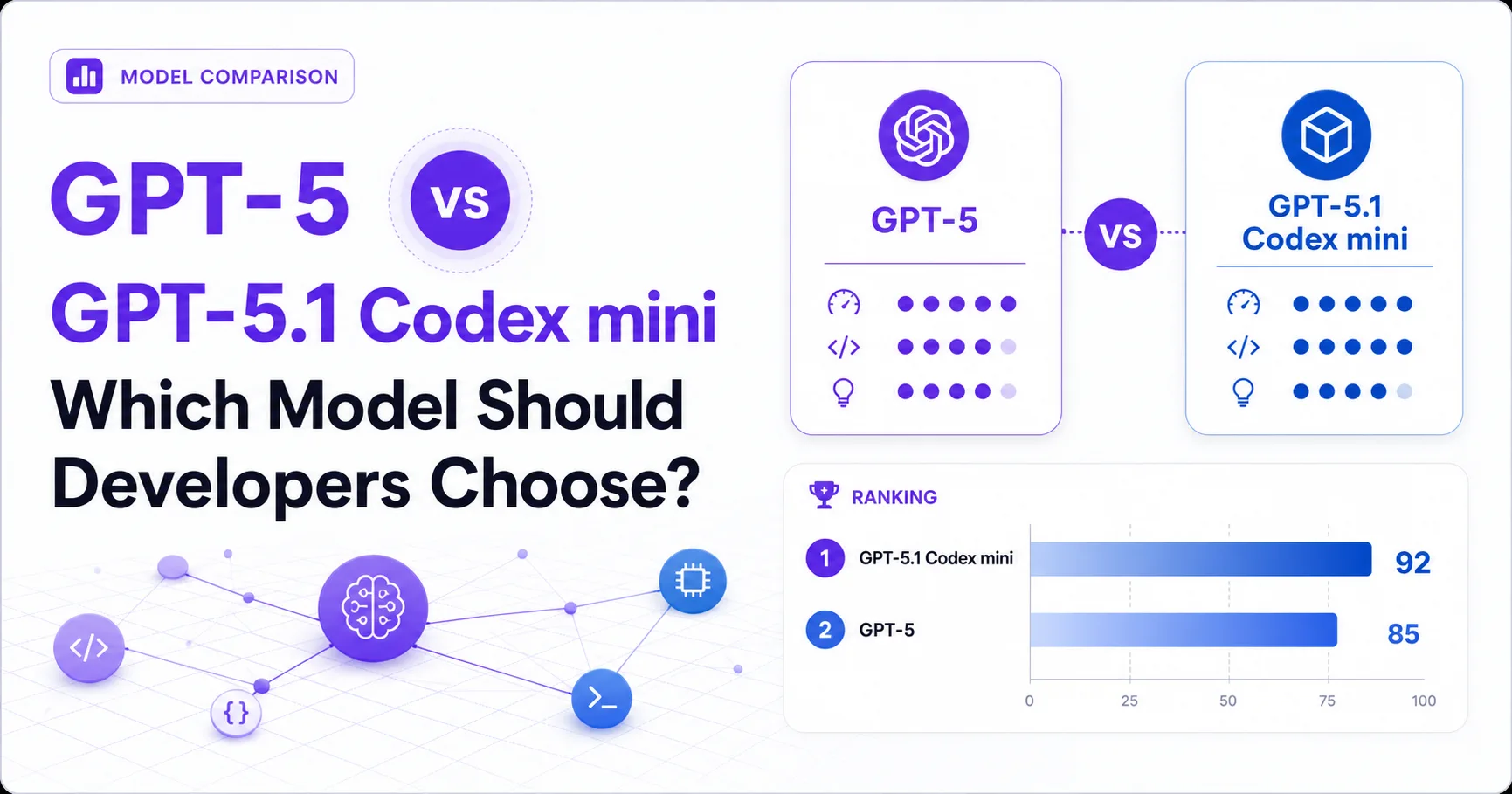
GPT-5 is the safer documented choice, while GPT-5.1 Codex mini is the cheaper but substantially less verifiable option for production development.
The comparison has an unusual evidence gap: GPT-5 has an official model page, public API positioning, published benchmarks, and documented limitations, while GPT-5.1 Codex mini does not appear as a standalone entry in the current OpenAI model directory. OpenAI describes GPT-5 as a reasoning model for coding, reasoning, and agentic tasks, but the available material does not establish an equivalent official positioning for GPT-5.1 Codex mini.
| Decision factor | GPT-5 | GPT-5.1 Codex mini |
|---|---|---|
| Documented API identity | gpt-5 and a fixed snapshot |
Not confirmed in the current model directory |
| Intelligence Index | 34.7 | 30.6 |
| Math Index | 94.3 | 91.7 |
| Coding Index | 37.8 | Not provided |
| Blended price per 1M tokens | $3.4375 | $0.6875 |
| Latency | 0.3 seconds | 0.3 seconds |
Data provided by https://artificialanalysis.ai/.
GPT-5 offers stronger measured general and mathematical performance, whereas GPT-5.1 Codex mini offers a lower reported cost without enough official evidence to confirm what developers are buying.
The Artificial Analysis data gives GPT-5 the higher Intelligence Index at 34.7, compared with 30.6 for GPT-5.1 Codex mini. GPT-5 also leads the Math Index at 94.3, compared with 91.7. A Coding Index of 37.8 is provided for GPT-5, but no corresponding value is provided for GPT-5.1 Codex mini. The missing coding score prevents a clean claim that the mini model is better or worse specifically for software engineering.
The price difference is clear. GPT-5.1 Codex mini is listed at $0.6875 per 1M blended tokens, while GPT-5 is listed at $3.4375. That makes the mini model attractive for high-volume workloads, but price alone does not establish lower total cost. A model that produces incomplete patches, needs more retries, or requires additional validation can consume the saved budget through extra calls and engineering review.
GPT-5 has documented support for function calling, structured outputs, streaming, and custom tools. OpenAI also documents reasoning effort and verbosity controls for GPT-5. The available sources do not confirm whether GPT-5.1 Codex mini exposes the same controls or tool behavior.
The practical conclusion is conditional. Choose GPT-5 when API certainty, documented behavior, and measured capability matter more than unit price. Consider GPT-5.1 Codex mini only after a direct availability check and a task-specific evaluation in your own integration.
GPT-5 has the stronger measured reasoning profile, but GPT-5.1 Codex mini cannot be judged fairly on coding performance because its corresponding coding result is missing.
The available evaluation data points to a meaningful capability advantage for GPT-5 in general intelligence and mathematics. GPT-5 records 34.7 on the Intelligence Index and 94.3 on the Math Index. GPT-5.1 Codex mini records 30.6 and 91.7 on those same measures. These results support GPT-5 for tasks where broad reasoning quality, mathematical reliability, or difficult decision chains are central.
The coding comparison is less decisive than the model names suggest. GPT-5 has a Coding Index value of 37.8, while the mini model has no reported value in the supplied data. The label “Codex mini” may suggest a coding specialization, but the current evidence does not prove that specialization translates into better repository work, patch accuracy, or agent completion rates.
GPT-5’s official developer material reports 74.9% on SWE-bench Verified, 88% on Aider polyglot, 96.7% on τ²-bench telecom, and 69.6% on Scale MultiChallenge. OpenAI states that the SWE-bench result excluded 23 problems that could not reliably pass within its infrastructure, and that the Aider evaluation used high reasoning effort. Those qualifications matter because benchmark performance depends on setup, effort level, and task selection.
Latency does not separate the models in the supplied snapshot. Each is listed at 0.3 seconds. Median output speed is unavailable for both models, so the data cannot support a claim that either model streams tokens faster in practice.
GPT-5 is documented for text and image input with text output, but not audio or video input and output. The GPT-5 model documentation records those modality boundaries. No equivalent modality statement is confirmed for GPT-5.1 Codex mini.
GPT-5.1 Codex mini has the lower listed token price, but GPT-5 can still be the cheaper operational choice when retries, review, and failure recovery dominate usage.
The reported blended price is $0.6875 per 1M tokens for GPT-5.1 Codex mini and $3.4375 for GPT-5. GPT-5.1 Codex mini also has listed input pricing of $0.25 per 1M tokens and output pricing of $2 per 1M tokens, compared with $1.25 input and $10 output for GPT-5. The gap is large enough to matter for workloads that generate many routine completions.
That price advantage is strongest when the task is narrow, the output contract is easy to validate, and failed attempts are inexpensive. Examples include short transformations, repetitive code edits, classification-like routing, or preliminary drafts that a stronger model does not need to inspect deeply. The supplied evidence does not establish whether GPT-5.1 Codex mini handles those workloads reliably, so developers still need a local test.
GPT-5 becomes easier to justify when one successful call replaces several weaker attempts. A repository agent may need to inspect context, preserve existing behavior, produce a coherent patch, and explain the change. If the cheaper model causes repeated calls or manual correction, the token price understates the real cost. Community evidence for GPT-5 is mixed: one Reddit author found it useful for locating and fixing small bugs, but described weaker completion and design detail for full applications, while comments reported possible hallucinations or incorrect changes in complex existing repositories. These observations come from an uncontrolled user discussion rather than a reproducible benchmark.
The equal latency value of 0.3 seconds also means the cost decision is not obviously a speed trade. The decisive unknown is task success per call, and the supplied sources do not measure that for GPT-5.1 Codex mini.
GPT-5.1 Codex mini (high) leads on 3 of 3 metrics
GPT-5.1 Codex mini carries the larger deployment risk because current OpenAI documentation does not confirm it as a callable standalone model.
The current OpenAI model directory does not list GPT-5.1 Codex mini (high) or gpt-5-1-codex-mini. The directory is the relevant source for checking documented model identity, capabilities, and API availability. The supplied research therefore cannot confirm a stable alias, direct API access, supported parameters, context window, maximum output, or official multimodal behavior for the mini model.
The pricing situation is similarly unresolved. The current OpenAI pricing page does not list gpt-5-1-codex-mini. It lists gpt-5.3-codex in the Specialized models and Codex category, but that does not prove inheritance, replacement, compatibility, or equivalence. The pricing page is the source used to verify the currently listed model prices and product categories.
GPT-5 is not risk-free. OpenAI’s model documentation still lists the gpt-5 alias, but the fixed snapshot gpt-5-2025-08-07 is marked Deprecated, and the page describes GPT-5 as a previous-generation model while recommending GPT-5.6. The GPT-5 documentation records the alias, snapshot status, endpoints, pricing, and model limitations.
This creates two different forms of risk. GPT-5 has known lifecycle pressure but documented integration details. GPT-5.1 Codex mini has an attractive data snapshot but an unresolved product identity. Developers should treat the mini model’s price and performance data as a comparison input, not as proof of a currently supported API contract.
GPT-5 is the default production recommendation, while GPT-5.1 Codex mini is worth testing as a cost-focused candidate behind an availability and quality gate.
Pick GPT-5 for repository agents, multi-step debugging, tool-rich workflows, and systems where an incorrect patch is more expensive than a higher token bill. Its official positioning targets coding, reasoning, and agentic tasks, and its documented tool surface includes function calling, structured outputs, streaming, and custom tools. OpenAI describes these developer capabilities in its GPT-5 launch material.
Pick GPT-5.1 Codex mini for high-volume, lower-risk work only if your environment can actually call the model. The listed price of $0.6875 per 1M blended tokens makes it a compelling candidate for routing, simple edits, and tasks with strong automated checks. The absence of a supplied Coding Index value means that coding-specific suitability must be demonstrated through your own test set.
Use a two-stage evaluation before committing either model. First, verify the exact model ID, endpoint, authentication path, supported parameters, and lifecycle status. Second, compare successful task completion, retry count, patch validity, and human review time on representative repositories. The research brief does not provide these operational measurements, so no universal winner can be declared for real-world coding agents.
GPT-5 should remain the fallback when the mini model is unavailable, undocumented, or inconsistent. GPT-5.1 Codex mini should remain an experiment until OpenAI publishes a direct model entry or your own integration confirms stable behavior. This recommendation follows the evidence boundary rather than assuming that a smaller Codex-branded model is automatically better at code.
GPT-5 is easier to approve immediately because its identity and limitations are documented, while GPT-5.1 Codex mini requires additional verification before production use.
The unanswered questions are more important than the model labels. The available material does not establish whether GPT-5.1 Codex mini is still callable, what API contract it follows, or how it performs on repository-level coding tasks. Those gaps should shape the evaluation plan.
GPT-5 is the better-supported overall choice because it has documented API behavior, official coding and reasoning positioning, and higher supplied Intelligence and Math Index values. GPT-5.1 Codex mini lacks a confirmed standalone model entry and a coding-specific comparison score.
GPT-5.1 Codex mini is cheaper on the supplied token pricing, at $0.6875 per 1M blended tokens versus $3.4375 for GPT-5. That advantage matters most when outputs are easy to validate and retries remain limited.
The supplied data does not show a speed advantage for GPT-5.1 Codex mini. Both models have a listed latency of 0.3 seconds, while median output tokens per second are unavailable for both, preventing a streaming-speed conclusion.
The available OpenAI model directory does not list GPT-5.1 Codex mini or gpt-5-1-codex-mini, so direct API availability, a stable alias, and supported parameters remain unconfirmed. Developers should verify access in their own account before designing around it.
A coding agent should start with GPT-5 when patch correctness, tool behavior, and documented support matter most. GPT-5.1 Codex mini is reasonable for controlled experiments, but its missing coding score and undocumented API status require local validation before production use.