
Time to First Token · GPT-5 (high)
0ms
Time to First Token · GPT-5.4 Pro (xhigh)
0ms
Deep dive into reasoning, benchmarks, and latency insights.
The current catalog does not contain complete performance evidence for both models, so this page does not declare an overall winner. Use the available fields as comparison signals and validate the models on your own workload.
Key decision metrics at a glance.
| Model | Metric | Value | Unit | Source / snapshot |
|---|---|---|---|---|
| GPT-5 (high) | Reasoning | 9.0 | benchmark or capability score | Artificial Analysis · current catalog |
| GPT-5.4 Pro (xhigh) | Reasoning | 6.0 | benchmark or capability score | Artificial Analysis · current catalog |
| GPT-5 (high) | Coding | 4.0 | benchmark or capability score | Artificial Analysis · current catalog |
| GPT-5.4 Pro (xhigh) | Coding | 6.0 | benchmark or capability score | Artificial Analysis · current catalog |
| GPT-5 (high) | Multimodal | 3.0 | benchmark or capability score | Artificial Analysis · current catalog |
| GPT-5.4 Pro (xhigh) | Multimodal | 5.0 | benchmark or capability score | Artificial Analysis · current catalog |
| GPT-5 (high) | Long Context | 4.0 | benchmark or capability score | Artificial Analysis · current catalog |
| GPT-5.4 Pro (xhigh) | Long Context | 8.0 | benchmark or capability score | Artificial Analysis · current catalog |
| GPT-5 (high) | Blended Price / 1M tokens | $3.438 | USD per 1M tokens | Artificial Analysis · current catalog |
| GPT-5.4 Pro (xhigh) | Blended Price / 1M tokens | $67.5 | USD per 1M tokens | Artificial Analysis · current catalog |
| GPT-5 (high) | P95 Latency | — | milliseconds | Artificial Analysis · current catalog |
| GPT-5.4 Pro (xhigh) | P95 Latency | — | milliseconds | Artificial Analysis · current catalog |
| GPT-5 (high) | Tokens per second | 0 | tokens per second | Artificial Analysis · current catalog |
| GPT-5.4 Pro (xhigh) | Tokens per second | 0 | tokens per second | Artificial Analysis · current catalog |
Data provided by Artificial Analysis; live values use the current catalog.
This radar chart visually maps the core capabilities (reasoning, coding, math proxy, multimodal, long context) of `GPT-5 (high)` vs `GPT-5.4 Pro (xhigh)`.
This grouped bar chart provides a side-by-side comparison for each benchmark metric.
Lower time to first token is better; higher tokens per second is better.
Compare input and output pricing in USD per 1M tokens.
GPT-5 (high)$3.75
GPT-5.4 Pro (xhigh)$75
GPT-5 (high) costs $71.25 less per run
This article is a dated snapshot published on 2026-08-16. Live cards above use the current catalog; missing live fields are not inferred.
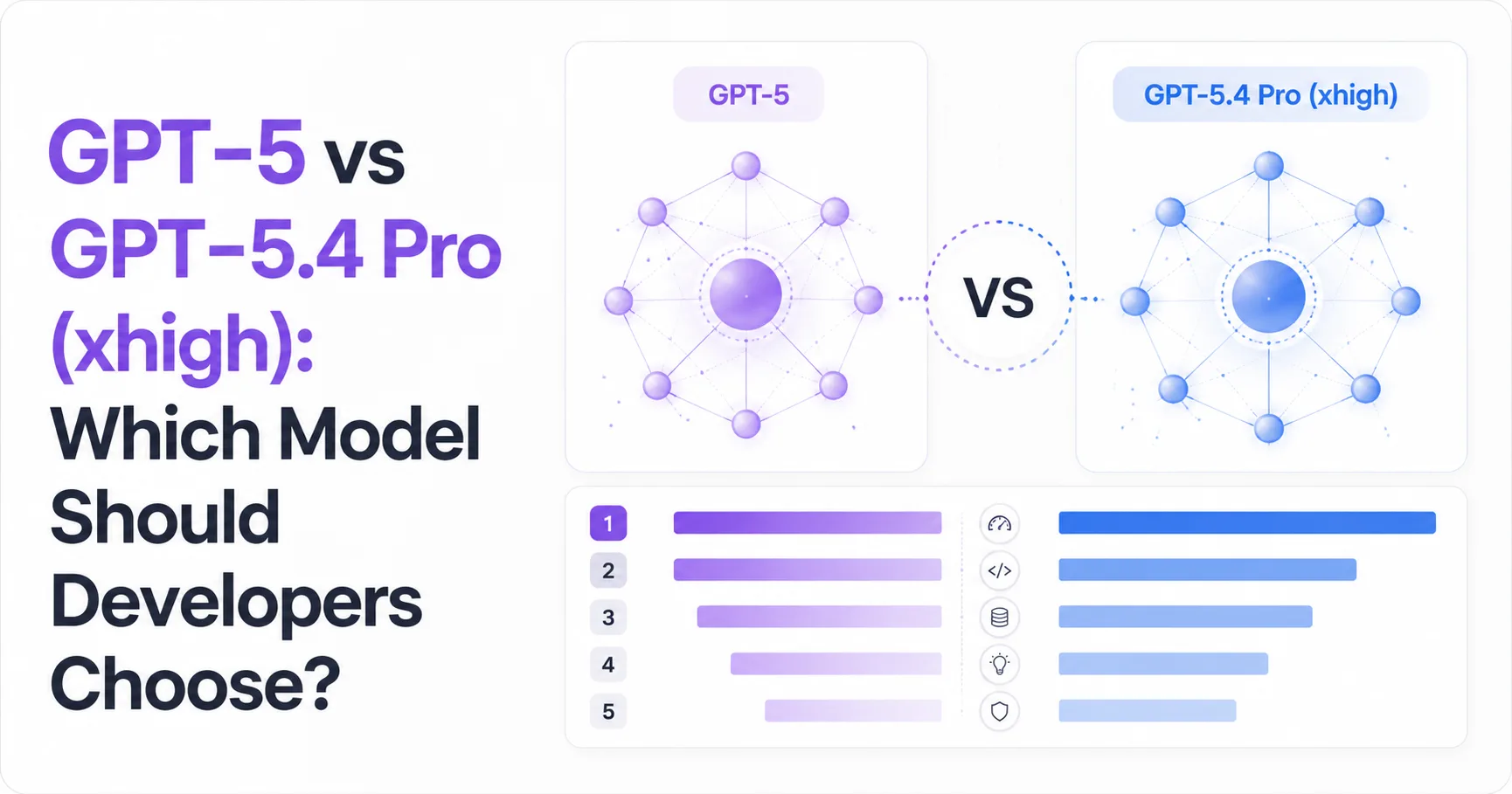
GPT-5 is the only defensible production choice because GPT-5.4 Pro (xhigh) lacks verified public API, pricing, and benchmark evidence.
OpenAI positions GPT-5 as a reasoning model for coding, reasoning, and agentic tasks in its developer announcement. The official GPT-5 model documentation identifies gpt-5 as a callable alias and documents its interface, limits, and price.
The supplied data snapshot lists GPT-5.4 Pro (xhigh) with a release date of 2026-03-05, but the research brief could not match that name to an official model entry. The OpenAI Models directory does not list gpt-5-4-pro or “GPT-5.4 Pro (xhigh)”. The OpenAI Pricing page also does not list it.
That difference changes the selection question. GPT-5 can be assessed as a documented service with known tradeoffs. GPT-5.4 Pro (xhigh) can only be treated as an unverified candidate until its identity, endpoint, limits, and billing are confirmed.
GPT-5 is the stronger recommendation because its evidence is complete enough for an informed engineering decision.
GPT-5 has a 400,000-token context window and a maximum output of 128,000 tokens, according to the official model documentation. It accepts text and image input and produces text output. It also supports function calling, structured outputs, streaming, and custom tools. The developer announcement documents adjustable reasoning_effort values of minimal, low, medium, and high, plus verbosity controls.
GPT-5.4 Pro (xhigh) has no verified context limit, maximum output, modality description, parameter list, or tool-calling specification in the supplied research. The official directory only gives broad information about current OpenAI models. It does not establish that those capabilities apply to this exact model name. That is evidence of uncertainty, not evidence that the model lacks the capabilities.
The practical result is simple. Choose GPT-5 if you need an API contract that engineers can implement and monitor. Consider GPT-5.4 Pro (xhigh) only after OpenAI or your provider confirms the exact model identifier and commercial terms.
Data provided by https://artificialanalysis.ai/.
GPT-5 is the only model with comparable published performance evidence, so the performance winner cannot be established for this matchup.
The data brief records GPT-5 at 37.8 on the Artificial Analysis coding index and 35.3 on its intelligence index. It also records 94.3 on its math index, 0.846 on LiveCodeBench, and 0.429 on SciCode. These results suggest that GPT-5 is a credible general coding and reasoning option, but they do not predict every production workload.
For developers, the important question is what the score does to work. Stronger coding results can reduce the number of repair cycles for code generation, debugging, and repository changes. They do not guarantee correct edits in a complex codebase. A Reddit practitioner reported that GPT-5 was useful for locating and fixing small bugs, while also describing weaker completion and design detail in full application and UI generation. The report was a subjective, uncontrolled test, as described in the original Reddit post.
OpenAI reports GPT-5 at 74.9% on SWE-bench Verified, 88% on Aider polyglot, 96.7% on τ²-bench telecom, and 69.6% on Scale MultiChallenge in its developer announcement. The announcement notes that the SWE-bench result excluded 23 of 500 problems that could not pass reliably on OpenAI's infrastructure. A benchmark result therefore needs to be read with its test conditions.
The supplied snapshot lists both models at 0 median output tokens per second and 0 seconds of latency. Those values do not provide a useful speed decision. The research brief also found no reliable community consensus about GPT-5.4 Pro (xhigh) speed or behavior. Evidence is insufficient to claim that the newer label is faster, more accurate, or better for repository-scale work.
GPT-5 is the clear cost choice because its $3.438 blended price per 1M tokens is the only price supported by a documented model entry.
The data brief lists GPT-5.4 Pro (xhigh) at $67.5 per 1M blended tokens, compared with $3.438 for GPT-5. That figure makes GPT-5.4 Pro (xhigh) materially more expensive in the supplied comparison. The component prices point in the same direction: GPT-5 is listed at $1.25 per 1M input tokens and $10 per 1M output tokens, while GPT-5.4 Pro (xhigh) is listed at $30 and $180.
The chart can show the price gap, but it cannot show whether the expensive model saves enough engineering time to justify it. That business case cannot be calculated from the brief because GPT-5.4 Pro (xhigh) has no verified benchmark or task-completion evidence. A model that reduces review, retry, or debugging work could still justify a higher price, but the supplied sources do not establish that outcome.
GPT-5 also has documented cached-input pricing of $0.125 per 1M tokens in the official model documentation. That detail matters for applications that repeatedly send stable instructions or shared context. GPT-5.4 Pro (xhigh) has no verified cached-input price in the official pricing directory.
The cheaper option could become more expensive in a real system if it requires many more retries or human corrections. The evidence does not show that this happens with GPT-5, and it does not show that GPT-5.4 Pro (xhigh) avoids it. Treat the listed price as the starting point, then measure cost per accepted task in your own workload.
GPT-5 (high) leads on 3 of 3 metrics
GPT-5 should be the default selection for production development because it combines documented access, known controls, published results, and a lower listed price.
Pick GPT-5 for coding assistants, debugging workflows, structured automation, and agents that need function calls or streaming. Its documented reasoning_effort setting lets a team trade reasoning depth against operational needs. Its documented verbosity setting can also help control response shape. These controls are described in OpenAI's developer announcement and model documentation.
Pick GPT-5 when operational certainty matters more than an unverified newer label. OpenAI currently describes the fixed snapshot gpt-5-2025-08-07 as Deprecated and recommends GPT-5.6 in the model documentation. Teams using a pinned snapshot should therefore plan for migration and avoid treating the snapshot as permanent infrastructure.
Do not select GPT-5.4 Pro (xhigh) solely because its supplied release date is newer. The official model directory does not confirm its API identity, and the official pricing page does not confirm its commercial terms. The research also found no reproducible community evaluation for this exact name. The right next step is provider verification, not a performance assumption.
GPT-5 is a poor fit when an application requires audio or video input or output because the official documentation lists text and image input with text output only. GPT-5 also does not support fine-tuning or predicted outputs, according to the model page. Those limits may matter more than benchmark strength for specialized products.
A controlled internal test should compare accepted-task rate, correction effort, response time, and total spend after GPT-5.4 Pro (xhigh) becomes verifiable. The current evidence cannot support a claim that it wins any of those categories.
GPT-5.4 Pro (xhigh) cannot be ranked on capability because the supplied sources do not verify its public existence as a callable model.
The research brief found no official entry for gpt-5-4-pro in the OpenAI Models directory. It also found no price for the model in the OpenAI Pricing page. The brief found no official benchmark results, no reproducible community tests, and no reliable reports about speed, coding quality, or failure modes.
That gap prevents several common conclusions. The available material does not prove that GPT-5.4 Pro (xhigh) is better because it has a newer listed release date. It does not prove that the model is unavailable, because a provider-specific or temporary label could exist outside the reviewed pages. It does not prove that the model is worse, because missing documentation is not a failed evaluation.
GPT-5 also has unresolved production questions. The supplied community evidence is based on one uncontrolled Reddit discussion, so it cannot establish a stable rate of hallucinations, incorrect edits, or UI quality. OpenAI's published benchmark results provide useful signals, but they do not replace tests on a team's own repositories and workflows.
The selection is therefore asymmetric. GPT-5 has evidence-backed strengths and known constraints. GPT-5.4 Pro (xhigh) has an evidence deficit large enough to block a responsible head-to-head capability claim.
GPT-5 is the safer default for developers because its API identity, features, benchmarks, and pricing are documented in accessible official sources.
The questions below focus on decisions that the supplied model materials do not answer directly. Each answer separates verified facts from assumptions that still require a provider check or internal test.
GPT-5.4 Pro (xhigh) is not verified as an officially listed OpenAI API model in the supplied evidence. The OpenAI Models directory does not show gpt-5-4-pro, so confirm the exact provider, endpoint, and account access before building against it.
GPT-5 is cheaper in the supplied comparison, at $3.438 per 1M blended tokens versus $67.5 for GPT-5.4 Pro (xhigh). GPT-5 also has documented input pricing of $1.25 and output pricing of $10 per 1M tokens.
GPT-5 is the only model with coding evidence in this comparison, including a 37.8 Artificial Analysis coding index and published SWE-bench Verified results. GPT-5.4 Pro (xhigh) has no verified benchmark evidence, so a capability winner cannot be proven.
GPT-5.4 Pro (xhigh) cannot be shown to be faster because the supplied data lists both models at 0 median output tokens per second and 0 seconds of latency. The research also found no reliable community speed test for the newer label.
Teams should treat gpt-5-2025-08-07 as migration-sensitive because OpenAI marks that fixed snapshot Deprecated and recommends GPT-5.6. Use the documented gpt-5 alias only after reviewing the team's versioning and regression-testing needs.
GPT-5 cannot directly handle audio or video inputs through the documented API capabilities. The official model documentation lists text and image input with text output, so products requiring audio or video need another model or processing path.