
Time to First Token · GPT-5 (high)
0ms
Time to First Token · GPT-5.5 (high)
0ms
Deep dive into reasoning, benchmarks, and latency insights.
The current catalog does not contain complete performance evidence for both models, so this page does not declare an overall winner. Use the available fields as comparison signals and validate the models on your own workload.
Key decision metrics at a glance.
| Model | Metric | Value | Unit | Source / snapshot |
|---|---|---|---|---|
| GPT-5 (high) | Reasoning | 9.0 | benchmark or capability score | Artificial Analysis · current catalog |
| GPT-5.5 (high) | Reasoning | 6.0 | benchmark or capability score | Artificial Analysis · current catalog |
| GPT-5 (high) | Coding | 4.0 | benchmark or capability score | Artificial Analysis · current catalog |
| GPT-5.5 (high) | Coding | 7.0 | benchmark or capability score | Artificial Analysis · current catalog |
| GPT-5 (high) | Multimodal | 3.0 | benchmark or capability score | Artificial Analysis · current catalog |
| GPT-5.5 (high) | Multimodal | 5.0 | benchmark or capability score | Artificial Analysis · current catalog |
| GPT-5 (high) | Long Context | 4.0 | benchmark or capability score | Artificial Analysis · current catalog |
| GPT-5.5 (high) | Long Context | 7.0 | benchmark or capability score | Artificial Analysis · current catalog |
| GPT-5 (high) | Blended Price / 1M tokens | $3.438 | USD per 1M tokens | Artificial Analysis · current catalog |
| GPT-5.5 (high) | Blended Price / 1M tokens | $11.25 | USD per 1M tokens | Artificial Analysis · current catalog |
| GPT-5 (high) | P95 Latency | — | milliseconds | Artificial Analysis · current catalog |
| GPT-5.5 (high) | P95 Latency | — | milliseconds | Artificial Analysis · current catalog |
| GPT-5 (high) | Tokens per second | 0 | tokens per second | Artificial Analysis · current catalog |
| GPT-5.5 (high) | Tokens per second | 0 | tokens per second | Artificial Analysis · current catalog |
Data provided by Artificial Analysis; live values use the current catalog.
This radar chart visually maps the core capabilities (reasoning, coding, math proxy, multimodal, long context) of `GPT-5 (high)` vs `GPT-5.5 (high)`.
This grouped bar chart provides a side-by-side comparison for each benchmark metric.
Lower time to first token is better; higher tokens per second is better.
Compare input and output pricing in USD per 1M tokens.
GPT-5 (high)$3.75
GPT-5.5 (high)$12.5
GPT-5 (high) costs $8.75 less per run
This article is a dated snapshot published on 2026-08-07. Live cards above use the current catalog; missing live fields are not inferred.
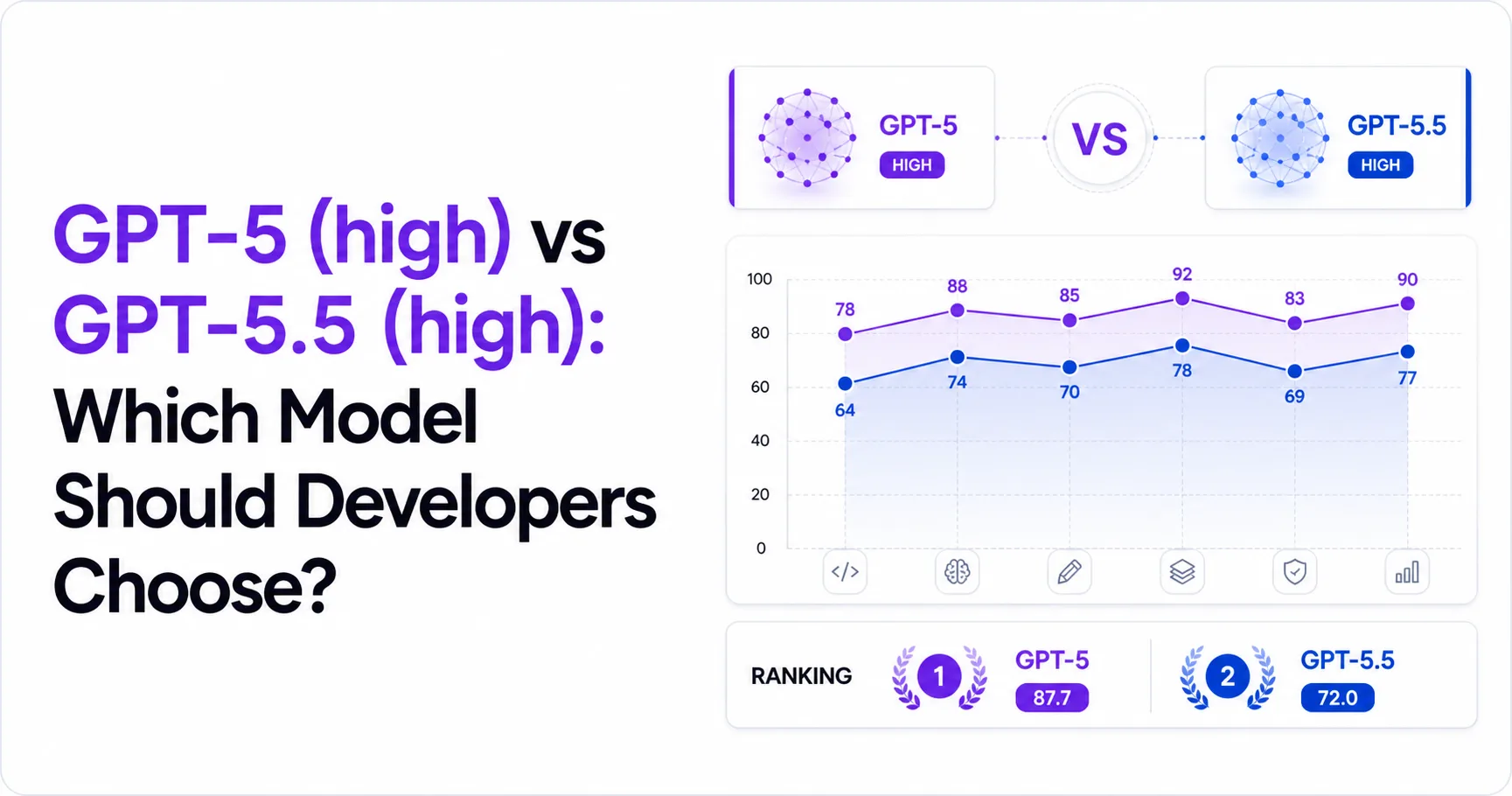
GPT-5.5 (high) is the stronger default for demanding development work, while GPT-5 (high) remains the practical choice when cost control matters most. The Artificial Analysis Coding Index places GPT-5.5 (high) at 71.6 and GPT-5 (high) at 37.8, a gap large enough to matter for code generation, debugging, and agent tasks. GPT-5 (high) costs $3.4375 per 1M blended tokens, compared with $11.25 for GPT-5.5 (high). Both models show 0.3 seconds latency in the supplied data, so the decision is driven mainly by quality, workload complexity, and budget. Data provided by https://artificialanalysis.ai/.
GPT-5.5 (high) wins capability-sensitive workloads, but GPT-5 (high) wins straightforward cost-sensitive workloads. The supplied Artificial Analysis data gives GPT-5.5 (high) a Coding Index of 71.6 versus 37.8 for GPT-5 (high), and an Intelligence Index of 53.1 versus 34.7. GPT-5 (high) has a Math Index of 94.3, while the brief provides no comparable GPT-5.5 (high) Math Index. That missing value prevents a complete claim about mathematical superiority.
The price difference is substantial. GPT-5 (high) costs $1.25 per 1M input tokens and $10 per 1M output tokens. GPT-5.5 (high) costs $5 per 1M input tokens and $30 per 1M output tokens. The blended comparison is $3.4375 versus $11.25 per 1M tokens. Both models have 0.3 seconds latency, and neither has a supplied median output-speed value.
GPT-5.5 (high) is positioned by OpenAI for complex professional work, coding, tool-based agents, long-context retrieval, computer operation, knowledge work, and scientific research. OpenAI describes GPT-5.5 as a frontier reasoning model for these workloads. GPT-5 (high) is positioned for coding, reasoning, and agentic tasks, with a stable gpt-5 alias and configurable reasoning effort. OpenAI documents that positioning and configuration.
For most new systems, GPT-5.5 (high) is the better quality-first starting point. GPT-5 (high) is easier to justify for high-volume classification, bounded transformations, and tasks where a human or deterministic system already supplies most of the reasoning.
GPT-5.5 (high) is more compelling for code-heavy and multi-step workflows, but the supplied evidence does not prove that it is faster. The Coding Index gap, 71.6 for GPT-5.5 (high) versus 37.8 for GPT-5 (high), is the clearest signal in the comparison. Developers should interpret that gap as a reason to test repository changes, debugging plans, refactoring, and tool orchestration with real tasks rather than assuming equal engineering output from equal prompts.
The Intelligence Index also favors GPT-5.5 (high), at 53.1 versus 34.7. That supports a quality-first hypothesis for tasks requiring planning, synthesis, and decisions across several tool results. The hypothesis still needs application-level validation. Artificial Analysis scores are useful directional evidence, but they do not specify your repository, test suite, architecture constraints, or acceptance criteria. Data provided by https://artificialanalysis.ai/.
GPT-5 (high) has one supplied advantage in the evidence: a Math Index of 94.3. GPT-5.5 (high) has no comparable Math Index in the brief, so developers should not infer that GPT-5.5 (high) dominates every reasoning domain. OpenAI reports GPT-5 (high) results on SWE-bench Verified, Aider polyglot, and other evaluations, while GPT-5.5 uses a different published evaluation set. Those official benchmark disclosures use different tests and conditions. GPT-5.5's announcement lists its own benchmark results.
Latency does not separate the models in the supplied snapshot. Both are listed at 0.3 seconds, and median output tokens per second are unavailable for both. That means interactive feel, time to first useful action, and total completion time remain evidence gaps. Developers should measure those dimensions under their own prompt lengths, tool calls, retries, and reasoning settings.
GPT-5.5 (high) also exposes a wider operational surface, including file search, web search, code interpretation, hosted shell, apply patch, computer use, and MCP. OpenAI lists these capabilities in the GPT-5.5 model documentation. GPT-5 (high) supports function calling, structured outputs, streaming, and custom tools with grammar constraints. OpenAI documents those controls for GPT-5. More tools can improve task coverage, but they also make stop conditions, permissions, and verification more important. OpenAI explicitly warns that higher reasoning effort can produce overthinking or unnecessary searches when task controls are weak.
GPT-5 (high) is the clear cost winner, but GPT-5.5 (high) can be economically preferable when better first-pass work reduces human review and rework. The supplied blended price is $3.4375 for GPT-5 (high) versus $11.25 for GPT-5.5 (high). GPT-5.5 (high) therefore needs to create enough additional value per request to justify a much higher token bill.
The raw price comparison favors GPT-5 (high) for workloads with predictable prompts, short outputs, high request volume, and limited decision complexity. Examples include extraction, normalization, routing, simple code explanation, and transformations where a validator can cheaply reject bad output. GPT-5.5 (high) is harder to justify when every request produces similar low-risk work and quality gains do not change downstream labor.
The cost decision changes when failures are expensive. A model that produces a better patch, asks for fewer corrective turns, or completes a tool workflow with fewer retries may have a lower total cost even when its token price is higher. The brief does not provide retry rates, completion rates, human review time, or production error costs, so it cannot establish a break-even point. Treat the blended price as an input to a pilot, not as a complete unit-economics result. Data provided by https://artificialanalysis.ai/.
GPT-5.5 (high) also supports multiple pricing modes and applies different treatment to short and long contexts. OpenAI's pricing documentation lists Standard, Batch, Flex, and Fast mode prices. The GPT-5.5 model page warns that very large inputs can increase the price applied to the session. These options can make GPT-5.5 (high) more attractive for asynchronous workloads, but only if latency, throughput, and scheduling constraints fit the product.
GPT-5 (high) has cheaper input, cached input, and output pricing in the supplied official model listing. OpenAI lists GPT-5 pricing and endpoint support in its model documentation. Developers should compare the actual input-to-output mix instead of relying only on the blended figure, especially for applications that generate long code patches or verbose agent traces.
GPT-5 (high) leads on 3 of 3 metrics
GPT-5.5 (high) should be the first production candidate for complex coding and agent workflows, while GPT-5 (high) should be the first candidate for cost-sensitive, bounded work. GPT-5.5 (high) has the stronger supplied Coding Index and Intelligence Index, plus a broader documented tool surface for professional workflows. OpenAI recommends the Responses API for GPT-5.5 reasoning, tool calls, and multi-turn state. That makes it a sensible fit for repository-level changes, tool-mediated investigation, long-context synthesis, and tasks where planning quality affects the final result.
Choose GPT-5 (high) when the workload is repetitive, the output is easy to validate, or the budget is the dominant constraint. Its $3.4375 blended price can support more generous routing, retries, or parallel candidates than GPT-5.5 (high) at $11.25, assuming the quality gap does not increase review work. GPT-5 (high) is also a reasonable option for math-oriented workloads because the supplied data includes a Math Index of 94.3. That result is not directly comparable to a GPT-5.5 (high) math score because the latter is absent.
Use a two-tier router when the application contains clearly different task classes. Send bounded transformations and low-risk explanations to GPT-5 (high). Escalate repository edits, ambiguous debugging, multi-tool plans, and high-cost failures to GPT-5.5 (high). Keep the router simple. The current evidence supports a quality and cost split, but it does not support a latency-based split because both models show 0.3 seconds latency and output-speed data is unavailable.
Operational safeguards matter more for GPT-5.5 (high) because its broader tool access increases the consequences of weak task boundaries. Define success criteria, stop conditions, permitted tools, and verification steps. OpenAI recommends those controls for long-running and tool-based GPT-5.5 tasks. Community reports describe oversized files, duplicated logic, poor database design, instruction drift, regressions, and premature completion, but the reports lack reproducible test methods. One Reddit discussion reports maintainability risks without a controlled comparison. Another developer discussion reports regressions and workflow failures while explicitly describing the evidence as subjective.
Do not build a new system around the GPT-5 fixed snapshot without a migration plan. OpenAI marks gpt-5-2025-08-07 as Deprecated, while the gpt-5 alias remains documented. The GPT-5 model page shows that distinction. GPT-5.5 is currently listed as callable, and no supplied source marks it as Deprecated. The current model directory lists GPT-5.5 in the active catalog.
GPT-5.5 (high) has the stronger available general and coding evidence, but the comparison cannot answer every production question. The supplied snapshot lacks median output tokens per second for both models, so it cannot establish a throughput winner. It reports equal latency of 0.3 seconds, but latency alone does not describe long generations, tool pauses, queueing, or total task completion time.
The math comparison is also incomplete. GPT-5 (high) has a Math Index of 94.3, while GPT-5.5 (high) has no supplied value. Developers with symbolic reasoning, quantitative analysis, or verification-heavy workloads should run a domain test instead of transferring the coding result to mathematics.
Community evidence is directional rather than decisive. GPT-5 users report useful small-bug fixes but also shorter, less complete application and UI outputs. The cited Reddit post describes a personal, uncontrolled experience. GPT-5.5 users report maintainability problems, regressions, and instruction drift, but the reports disagree and do not provide a reproducible benchmark. The available community discussions do not establish stable consensus.
A useful evaluation should therefore compare accepted patches, test-pass rate, correction turns, reviewer minutes, tool errors, and total completion time on representative tasks. Those measurements are not present in the brief, so the final choice should remain conditional until a pilot supplies them.
GPT-5.5 (high) is the stronger starting point for developers who value coding quality and agent capability over raw token price. The supplied Coding Index favors GPT-5.5 (high), while the supplied cost data favors GPT-5 (high).
GPT-5.5 (high) is the better default for complex coding, repository changes, and tool-based agents because its supplied Coding Index is 71.6 versus 37.8 for GPT-5 (high).
GPT-5 (high) remains worth choosing for bounded, high-volume, or cost-sensitive workloads because its blended price is $3.4375 versus $11.25 for GPT-5.5 (high).
Neither model is faster in the supplied snapshot because GPT-5 (high) and GPT-5.5 (high) both show 0.3 seconds latency, while median output-speed data is unavailable.
The evidence is insufficient to answer that question because GPT-5 (high) has a Math Index of 94.3, while the supplied data provides no comparable GPT-5.5 (high) Math Index.
GPT-5.5 (high) can create larger operational consequences when tool permissions, success criteria, stop conditions, and verification steps are weak, according to OpenAI guidance and unverified community reports.