
Time to First Token · GPT-5 (high)
0ms
Time to First Token · GPT-5.5 (Non-reasoning)
0ms
Deep dive into reasoning, benchmarks, and latency insights.
The current catalog does not contain complete performance evidence for both models, so this page does not declare an overall winner. Use the available fields as comparison signals and validate the models on your own workload.
Key decision metrics at a glance.
| Model | Metric | Value | Unit | Source / snapshot |
|---|---|---|---|---|
| GPT-5 (high) | Reasoning | 9.0 | benchmark or capability score | Artificial Analysis · current catalog |
| GPT-5.5 (Non-reasoning) | Reasoning | 6.0 | benchmark or capability score | Artificial Analysis · current catalog |
| GPT-5 (high) | Coding | 4.0 | benchmark or capability score | Artificial Analysis · current catalog |
| GPT-5.5 (Non-reasoning) | Coding | 6.0 | benchmark or capability score | Artificial Analysis · current catalog |
| GPT-5 (high) | Multimodal | 3.0 | benchmark or capability score | Artificial Analysis · current catalog |
| GPT-5.5 (Non-reasoning) | Multimodal | 3.0 | benchmark or capability score | Artificial Analysis · current catalog |
| GPT-5 (high) | Long Context | 4.0 | benchmark or capability score | Artificial Analysis · current catalog |
| GPT-5.5 (Non-reasoning) | Long Context | 4.0 | benchmark or capability score | Artificial Analysis · current catalog |
| GPT-5 (high) | Blended Price / 1M tokens | $3.438 | USD per 1M tokens | Artificial Analysis · current catalog |
| GPT-5.5 (Non-reasoning) | Blended Price / 1M tokens | $11.25 | USD per 1M tokens | Artificial Analysis · current catalog |
| GPT-5 (high) | P95 Latency | — | milliseconds | Artificial Analysis · current catalog |
| GPT-5.5 (Non-reasoning) | P95 Latency | — | milliseconds | Artificial Analysis · current catalog |
| GPT-5 (high) | Tokens per second | 0 | tokens per second | Artificial Analysis · current catalog |
| GPT-5.5 (Non-reasoning) | Tokens per second | 0 | tokens per second | Artificial Analysis · current catalog |
Data provided by Artificial Analysis; live values use the current catalog.
This radar chart visually maps the core capabilities (reasoning, coding, math proxy, multimodal, long context) of `GPT-5 (high)` vs `GPT-5.5 (Non-reasoning)`.
This grouped bar chart provides a side-by-side comparison for each benchmark metric.
Lower time to first token is better; higher tokens per second is better.
Compare input and output pricing in USD per 1M tokens.
GPT-5 (high)$3.75
GPT-5.5 (Non-reasoning)$12.5
GPT-5 (high) costs $8.75 less per run
This article is a dated snapshot published on 2026-08-07. Live cards above use the current catalog; missing live fields are not inferred.
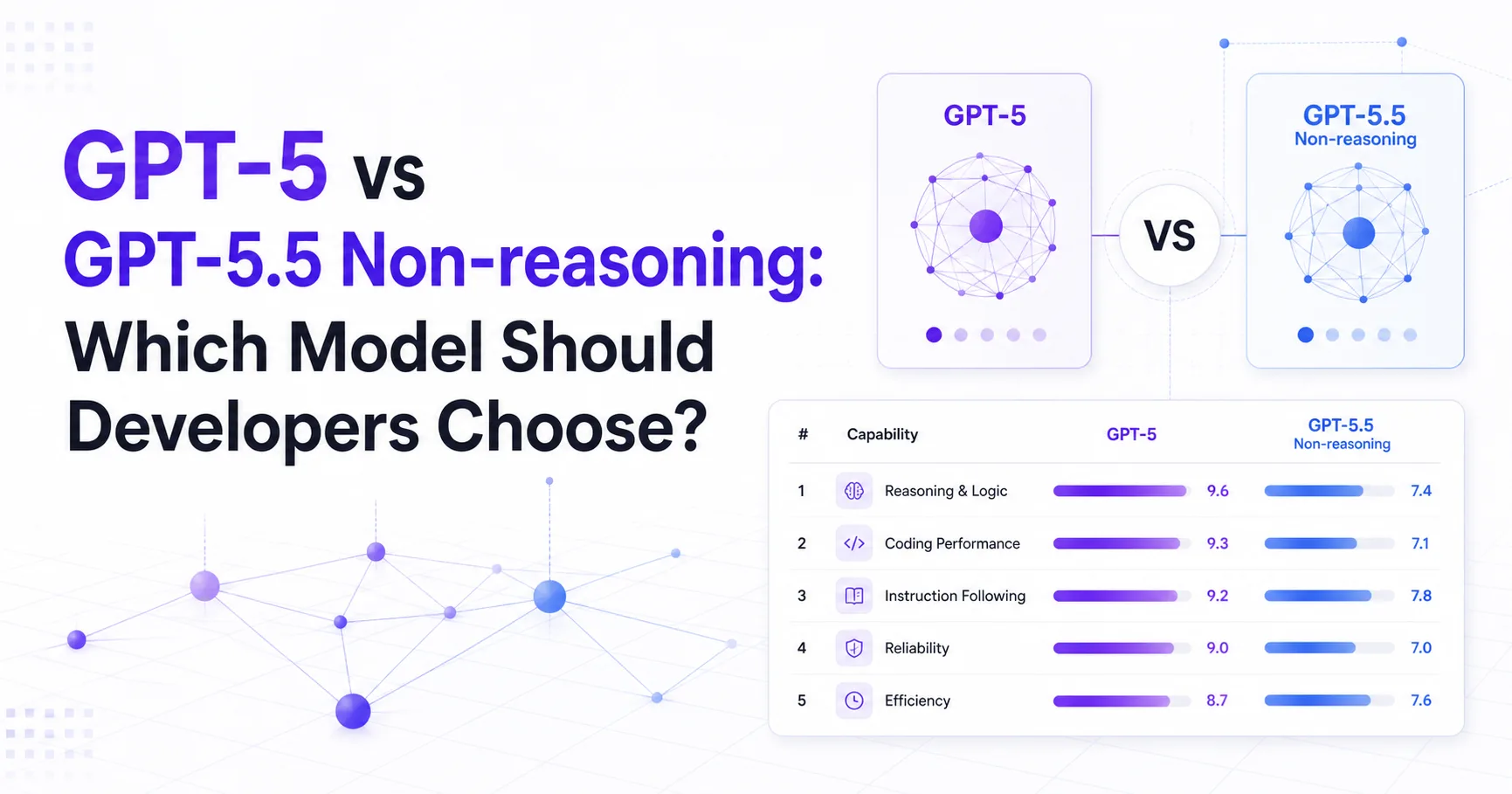
GPT-5.5 (Non-reasoning) is the stronger coding candidate, while GPT-5 remains the clearer value choice for cost-sensitive systems.
The Artificial Analysis data gives GPT-5.5 (Non-reasoning) a coding index of 56.5, compared with 37.8 for GPT-5. That gap is large enough to influence model selection for code generation, repository changes, and developer tooling. The same dataset gives GPT-5.5 (Non-reasoning) a general intelligence index of 35.4, only slightly above GPT-5 at 34.7.
GPT-5 has one major measured advantage: price. Its blended cost is $3.4375 per 1M tokens, compared with $11.25 for GPT-5.5 (Non-reasoning). Both models show 0.3 seconds of latency in the supplied comparison, and neither has a reported median output speed.
The comparison is not fully symmetrical. GPT-5 has public technical documentation, official benchmark claims, and community discussion. GPT-5.5 (Non-reasoning) has public pricing, but the supplied research does not establish its context window, output limit, adjustable parameters, modalities, official benchmark results, or reliable community behavior. Data provided by https://artificialanalysis.ai/.
GPT-5.5 (Non-reasoning) wins measured coding quality, but GPT-5 offers the more defensible default when budget, documentation, and migration risk matter.
| Decision factor | Better choice | Why |
|---|---|---|
| Coding benchmark | GPT-5.5 (Non-reasoning) | Its coding index is 56.5 versus 37.8. |
| General intelligence benchmark | GPT-5.5 (Non-reasoning) | Its index is 35.4 versus 34.7, a narrow lead. |
| Mathematics evidence | GPT-5 | GPT-5 has a reported math index of 94.3; the comparison has no GPT-5.5 value. |
| Blended cost | GPT-5 | $3.4375 versus $11.25 per 1M tokens. |
| Input cost | GPT-5 | $1.25 versus $5 per 1M input tokens. |
| Output cost | GPT-5 | $10 versus $30 per 1M output tokens. |
| Measured latency | Tie | Each model is listed at 0.3 seconds. |
| Documentation confidence | GPT-5 | OpenAI documents its API behavior and limitations more fully. |
The coding result should not be treated as proof that GPT-5.5 (Non-reasoning) is better for every engineering workflow. The data does not provide a math score for GPT-5.5, output-speed measurements for either model, or a direct task-level explanation of the coding gap.
OpenAI positions GPT-5 as a reasoning model for coding, reasoning, and agentic tasks, with documented tool-calling and structured-output support. GPT-5 for developers describes that positioning. The current model documentation also marks the fixed GPT-5 snapshot as Deprecated and recommends a newer product line. GPT-5 model documentation therefore makes lifecycle planning part of the GPT-5 decision.
GPT-5.5 (Non-reasoning) has the stronger measured coding profile, but the available evidence cannot show whether it is faster, more reliable, or better at repository-level changes.
A coding index of 56.5 versus 37.8 suggests that GPT-5.5 (Non-reasoning) deserves priority in evaluations involving implementation work. In practice, that could matter when a model must produce a multi-file change, interpret unfamiliar code, or preserve behavior across an existing feature. The score alone does not identify which task types create the advantage, so teams should test their own repositories before treating it as a production guarantee.
The general intelligence difference is much smaller. GPT-5.5 (Non-reasoning) records 35.4 against GPT-5 at 34.7. That narrow separation suggests that coding should drive the choice more than a broad claim of overall intelligence. GPT-5 also has a reported math index of 94.3, while no corresponding GPT-5.5 result is supplied. A winner cannot be declared for mathematical workloads from this dataset.
Latency does not separate the models in the supplied data. Each is listed at 0.3 seconds, while median output tokens per second are unavailable for both. That means the comparison cannot answer whether either model feels faster during long responses, streaming, or interactive coding sessions.
OpenAI reports GPT-5 results on SWE-bench Verified, Aider polyglot, τ²-bench telecom, and Scale MultiChallenge, but the reported SWE-bench result excluded 23 problems and the Aider evaluation used high reasoning effort. GPT-5 for developers provides those conditions. No equivalent official GPT-5.5 benchmark evidence appears in the supplied research.
GPT-5 is the cost winner by a wide margin, but GPT-5.5 (Non-reasoning) can still be cheaper at the system level if its coding advantage reduces retries, review, and repair work.
The supplied blended price is $3.4375 for GPT-5 and $11.25 for GPT-5.5 (Non-reasoning). GPT-5 also costs $1.25 versus $5 per 1M input tokens, and $10 versus $30 per 1M output tokens. Those differences favor GPT-5 for high-volume assistants, batch processing, simple transformations, and applications where model calls dominate the operating budget.
Price alone becomes misleading when generated code often needs correction. A cheaper response that requires another prompt, manual review, or a failed deployment can consume more engineering time than a costlier response that is accepted earlier. The coding index gap gives GPT-5.5 a reason to compete in repository maintenance and implementation tasks, but the research does not provide retry rates, acceptance rates, token consumption by task, or total engineering cost.
GPT-5.5 pricing is also operationally less transparent in the supplied sources. OpenAI Pricing lists standard, Batch, Flex, and Fast mode prices for the gpt-5.5 alias. The page does not establish whether the alias is precisely the product described here as GPT-5.5 (Non-reasoning), nor does it explain the missing Fast mode long-context price. That missing information should be treated as an evidence gap, not as proof of a model limitation.
For a production decision, compare accepted changes per dollar, not tokens alone. Until that measurement exists, GPT-5 is the safer budget assumption and GPT-5.5 is the quality-focused experiment.
GPT-5 (high) leads on 3 of 3 metrics
GPT-5.5 (Non-reasoning) is the better first candidate for coding-heavy workflows, while GPT-5 is the better default for predictable cost and documented capabilities.
Choose GPT-5.5 (Non-reasoning) when the application generates or edits meaningful amounts of code, the team can run a repository-specific evaluation, and higher API prices are acceptable. Its coding index of 56.5 is the strongest measured signal in this comparison. The choice is especially reasonable when correction effort is expensive and the model’s higher output quality can reduce human review.
Choose GPT-5 when request volume is high, the workload is cost-sensitive, or the application depends on documented reasoning controls and tool behavior. OpenAI documents GPT-5 as supporting function calling, structured outputs, streaming, and custom tools. GPT-5 for developers and GPT-5 model documentation provide the relevant API evidence.
Do not select GPT-5.5 solely because its name suggests a newer or better version. The supplied research does not confirm its context window, maximum output, input modalities, configurable parameters, official benchmark results, or stable mapping to a non-reasoning model identifier. OpenAI Models lists newer GPT-5.6 products and does not provide the missing GPT-5.5 details.
Treat GPT-5’s fixed snapshot as a lifecycle risk. The model documentation marks gpt-5-2025-08-07 as Deprecated, even though gpt-5 remains listed as a callable alias. Teams choosing GPT-5 should isolate the model identifier, maintain regression tests, and plan migration before the snapshot becomes unavailable.
The most responsible decision is therefore conditional: use GPT-5.5 for measured coding value, use GPT-5 for cost and API confidence, and validate either choice against acceptance rate, retries, and real repository tasks.
GPT-5 and GPT-5.5 (Non-reasoning) require different validation priorities because the public evidence is much richer for GPT-5.
The supplied comparison can rank coding quality and price, but it cannot establish a universal winner. Developers should test the exact prompt format, repository size, tool loop, review process, and output acceptance criteria used in production.
A practical evaluation should record whether a change is accepted, how often the model needs correction, how many tokens the task consumes, and whether the model preserves existing behavior. Those measurements are not included in the research brief, so they must come from the application team.
GPT-5 also has explicit modality boundaries. The model documentation says it supports text and image input with text output, but not audio or video input or output. GPT-5 model documentation should be checked before building a multimodal workflow around it.
Community evidence should be weighted carefully. One Reddit post reports useful small-bug debugging but describes less complete UI and application generation, plus possible incorrect changes in complex codebases. The post is a subjective, uncontrolled test rather than a reproducible benchmark. Tried GPT-5 Here Are My First Impressions is useful as a risk signal, not as a general performance estimate.
GPT-5.5 (Non-reasoning) is the better measured coding choice because its Artificial Analysis coding index is 56.5 versus 37.8, although repository-specific testing is still required before deployment.
GPT-5 is cheaper for the supplied pricing comparison, costing $3.4375 versus $11.25 per 1M blended tokens, with lower input and output prices as well.
Neither model is faster in the supplied latency data because GPT-5 and GPT-5.5 (Non-reasoning) are both listed at 0.3 seconds, while output-speed measurements are unavailable.
Developers can use GPT-5 when documented API behavior and lower cost matter, but they should account for the Deprecated status of its fixed snapshot and maintain migration tests.
The supplied research cannot answer that question because OpenAI’s available materials do not provide a GPT-5.5 (Non-reasoning) context-window value or maximum output limit.