
Time to First Token · GPT-5 (high)
0ms
Time to First Token · GPT-5.5 Pro (xhigh)
0ms
Deep dive into reasoning, benchmarks, and latency insights.
The current catalog does not contain complete performance evidence for both models, so this page does not declare an overall winner. Use the available fields as comparison signals and validate the models on your own workload.
Key decision metrics at a glance.
| Model | Metric | Value | Unit | Source / snapshot |
|---|---|---|---|---|
| GPT-5 (high) | Reasoning | 9.0 | benchmark or capability score | Artificial Analysis · current catalog |
| GPT-5.5 Pro (xhigh) | Reasoning | 6.0 | benchmark or capability score | Artificial Analysis · current catalog |
| GPT-5 (high) | Coding | 4.0 | benchmark or capability score | Artificial Analysis · current catalog |
| GPT-5.5 Pro (xhigh) | Coding | 6.0 | benchmark or capability score | Artificial Analysis · current catalog |
| GPT-5 (high) | Multimodal | 3.0 | benchmark or capability score | Artificial Analysis · current catalog |
| GPT-5.5 Pro (xhigh) | Multimodal | 5.0 | benchmark or capability score | Artificial Analysis · current catalog |
| GPT-5 (high) | Long Context | 4.0 | benchmark or capability score | Artificial Analysis · current catalog |
| GPT-5.5 Pro (xhigh) | Long Context | 8.0 | benchmark or capability score | Artificial Analysis · current catalog |
| GPT-5 (high) | Blended Price / 1M tokens | $3.438 | USD per 1M tokens | Artificial Analysis · current catalog |
| GPT-5.5 Pro (xhigh) | Blended Price / 1M tokens | $0 | USD per 1M tokens | Artificial Analysis · current catalog |
| GPT-5 (high) | P95 Latency | — | milliseconds | Artificial Analysis · current catalog |
| GPT-5.5 Pro (xhigh) | P95 Latency | — | milliseconds | Artificial Analysis · current catalog |
| GPT-5 (high) | Tokens per second | 0 | tokens per second | Artificial Analysis · current catalog |
| GPT-5.5 Pro (xhigh) | Tokens per second | 0 | tokens per second | Artificial Analysis · current catalog |
Data provided by Artificial Analysis; live values use the current catalog.
This radar chart visually maps the core capabilities (reasoning, coding, math proxy, multimodal, long context) of `GPT-5 (high)` vs `GPT-5.5 Pro (xhigh)`.
This grouped bar chart provides a side-by-side comparison for each benchmark metric.
Lower time to first token is better; higher tokens per second is better.
Compare input and output pricing in USD per 1M tokens.
GPT-5 (high)$3.75
GPT-5.5 Pro (xhigh)$0
GPT-5.5 Pro (xhigh) costs $3.75 less per run
This article is a dated snapshot published on 2026-08-16. Live cards above use the current catalog; missing live fields are not inferred.
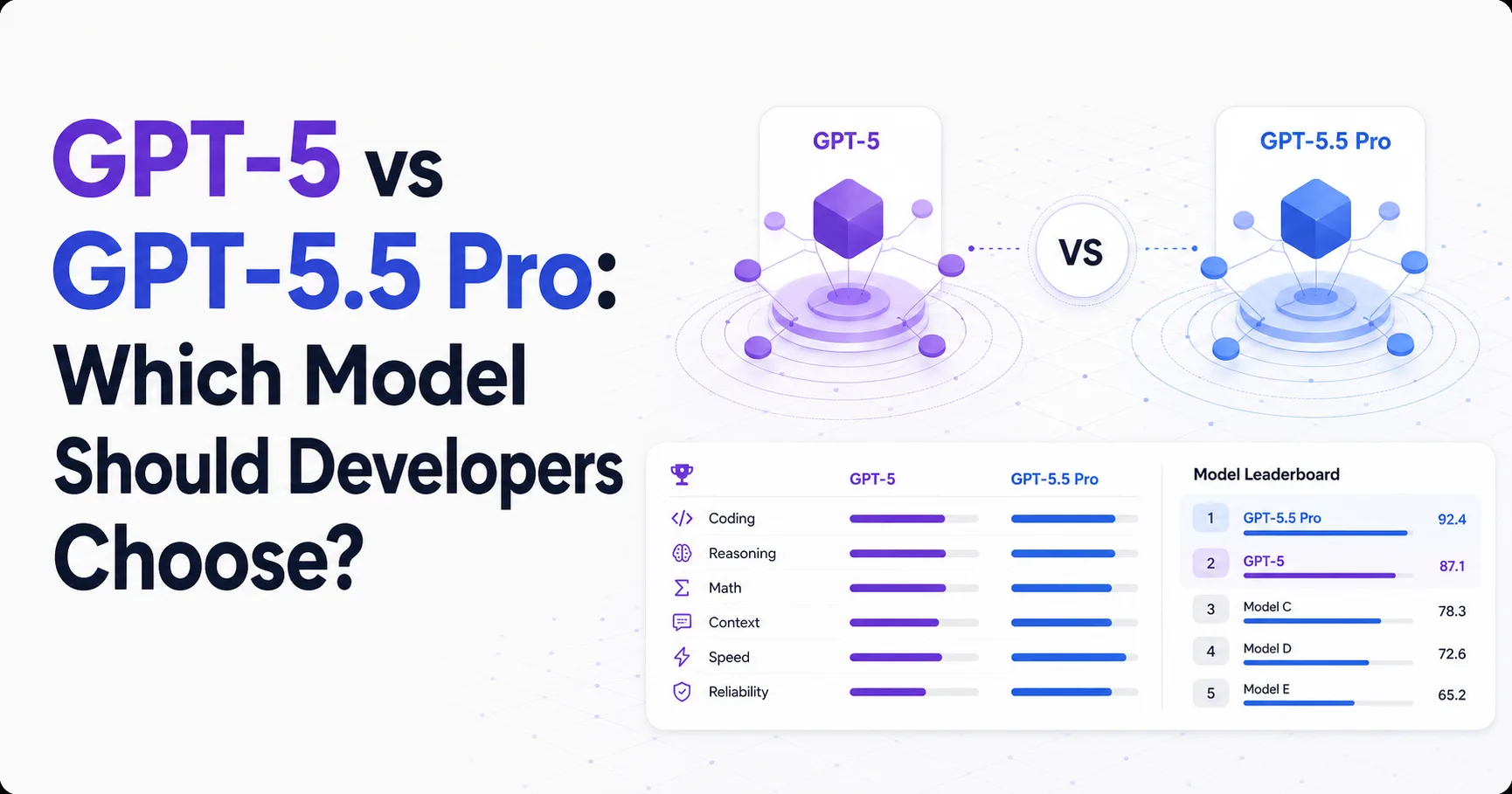
GPT-5 is the safer developer choice because OpenAI documents its API identity, capabilities, pricing, and benchmark results, while GPT-5.5 Pro lacks comparable public evidence. OpenAI positions GPT-5 as a reasoning model for coding, reasoning, and agentic tasks in its developer announcement. The documented API model uses the stable alias gpt-5, with the fixed snapshot gpt-5-2025-08-07, released on 2025-08-07, according to the GPT-5 model documentation.
The label “GPT-5.5 Pro (xhigh)” should therefore be treated as an evaluated or catalog label whose production status is unclear. The supplied research found no official model card, release announcement, dedicated API alias, benchmark record, or reliable community test for that exact model. OpenAI’s current model directory lists other frontier models but does not list gpt-5-5-pro. That absence does not prove that GPT-5.5 Pro cannot be accessed somewhere. It does mean a developer cannot make a confident production decision from the available evidence.
Data provided by https://artificialanalysis.ai/ records measurable results for GPT-5 and null results for GPT-5.5 Pro. The comparison is consequently an evidence-quality decision as much as a capability comparison.
GPT-5 has a documented capability surface, while GPT-5.5 Pro has an unresolved identity and availability question. GPT-5 supports text and image input with text output, and the model documentation lists a 400,000-token context window and a maximum output of 128,000 tokens. It does not support audio or video input and output. The same documentation describes support for Chat Completions, Responses, and Batch endpoints, alongside function calling, structured outputs, and streaming. OpenAI also documents reasoning_effort values of minimal, low, medium, and high, plus verbosity controls in its developer announcement.
GPT-5.5 Pro has no matching official specification in the supplied material. OpenAI’s general models documentation discusses current model capabilities at a broad level, including text and image input, text output, multilingual ability, and vision. It does not establish that those capabilities belong to gpt-5-5-pro. Developers should not silently transfer GPT-5.6 documentation to GPT-5.5 Pro, because the research explicitly found no basis for that inference.
The version timeline also changes the risk assessment. OpenAI marks the fixed GPT-5 snapshot as Deprecated and describes GPT-5 as a previous-generation model in the GPT-5 model documentation. GPT-5 therefore has a known migration risk. GPT-5.5 Pro has a larger discovery risk, because its callable status and replacement path are not established.
GPT-5 is the only model with usable performance evidence, so GPT-5.5 Pro cannot be called the performance winner from the supplied comparison. Artificial Analysis reports a GPT-5 coding index of 37.8, an intelligence index of 35.3, and a math index of 94.3. It also reports 0.846 on LiveCodeBench, 0.429 on SciCode, and 0.325757575757576 on TerminalBench Hard. These values suggest that GPT-5 has meaningful evidence across general reasoning, software tasks, mathematical reasoning, and terminal-oriented work, but they do not establish how the undocumented alternative behaves.
The practical meaning depends on the task. A strong math result can help with algorithm design, validation logic, and technical explanation, but it does not guarantee reliable edits inside a large repository. The supplied community material describes GPT-5 as useful for locating and fixing small bugs, while one Reddit author found complete application and user-interface generation more abbreviated and less detailed. The same post and comments mention possible hallucinations or incorrect changes in complex existing codebases. Those observations come from an uncontrolled test, so they should inform guardrails rather than serve as a benchmark. See the Reddit first-impressions post.
GPT-5.5 Pro has null values across the supplied evaluation set. That is evidence of missing measurement, not evidence of weak performance. The comparison cannot answer whether GPT-5.5 Pro is better at coding, more reliable in agents, or stronger on difficult reasoning tasks. Teams should require a representative private test before treating the label as an upgrade.
GPT-5.5 Pro appears cheaper in the data snapshot only because its listed prices are 0, not because a verified public price of $0 has been found. Artificial Analysis lists GPT-5 at $3.438 per 1M blended tokens, with $1.25 for input tokens and $10 for output tokens. It lists GPT-5.5 Pro at $0 for blended, input, and output pricing. The supplied research separately found that OpenAI’s current pricing page does not list GPT-5.5 Pro or gpt-5-5-pro.
That distinction matters for procurement. A zero value can represent missing, unavailable, or unconfirmed pricing in a comparison dataset. It should not be used to approve a budget, forecast unit economics, or claim that GPT-5.5 Pro is free. GPT-5 has a price that developers can inspect in the GPT-5 model documentation, which makes cost modeling possible even though output tokens are materially more expensive than input tokens.
The cheaper model can also become more expensive in practice if it requires extra retries, manual review, migration work, or a different integration path. The supplied material does not provide retry rates, task-completion costs, or production reliability data for either model, so it cannot identify a total-cost winner. For a real selection, compare successful task cost, review time, and migration risk after confirming that the target model is callable and contractually priced.
GPT-5.5 Pro (xhigh) leads on 3 of 3 metrics
GPT-5 is the appropriate default for production selection when traceable documentation and measurable behavior matter more than an unverified model label. Choose GPT-5 for coding assistants, repository diagnosis, structured tool workflows, and agentic tasks that need documented API controls. Its reasoning_effort setting lets teams trade reasoning depth against operational requirements, while structured outputs, function calling, streaming, and custom tools support controlled integrations. These capabilities are documented in OpenAI’s developer announcement and model documentation.
Treat GPT-5.5 Pro as a candidate for validation, not as a confirmed successor. Before adoption, confirm the exact provider, API model ID, access method, price, context behavior, output limits, and deprecation policy. Then test the tasks that decide business value: modifying an existing codebase, preserving tests, following repository conventions, calling tools correctly, and producing complete user-facing work. The supplied evidence does not answer any of those questions for GPT-5.5 Pro.
GPT-5 also needs a lifecycle plan. The fixed snapshot gpt-5-2025-08-07 is marked Deprecated, so teams that depend on it should monitor migration requirements. A stable alias may reduce snapshot-management work, but it can introduce behavior changes over time. Pin versions where reproducibility is critical, record evaluation results, and keep a rollback path. For audio or video workflows, neither documented GPT-5 support nor GPT-5.5 Pro support is established by the supplied comparison, so select a model only after verifying modality requirements.
GPT-5 deserves a controlled production trial because its documented strengths and limitations are visible, while GPT-5.5 Pro requires basic identity and access verification before meaningful testing. The questions below focus on decisions that the supplied material cannot resolve through side-by-side benchmark results.
The supplied evidence cannot establish that GPT-5.5 Pro is better for coding because it has no reported coding index, benchmark score, official model card, or reliable community test for the exact model label. GPT-5 has documented coding evidence and should remain the baseline until a private evaluation shows otherwise.
No verified free price is established. The data snapshot lists $0 for GPT-5.5 Pro, but the supplied OpenAI pricing research does not list the model, so the value may indicate missing or unconfirmed pricing rather than a purchasable $0 rate.
A new application should start with GPT-5 when it needs a documented API, published performance evidence, and inspectable pricing. A team can evaluate GPT-5.5 Pro in parallel, but it should not make the application depend on a model whose API identity and availability remain unverified.
GPT-5 supports image input and text input with text output, but the supplied OpenAI model documentation says it does not support audio or video input and output. Developers building media workflows should verify another model rather than assume those modalities are available.
GPT-5 can still be considered when its documented API behavior fits the application, but the deprecated fixed snapshot creates migration risk. Teams should monitor OpenAI’s model documentation, test the stable alias separately, and preserve evaluation results before changing versions.