
Time to First Token · GPT-5 (high)
0ms
Time to First Token · GPT-5.6 Luna (max)
65591ms
Deep dive into reasoning, benchmarks, and latency insights.
The current catalog does not contain complete performance evidence for both models, so this page does not declare an overall winner. Use the available fields as comparison signals and validate the models on your own workload.
Key decision metrics at a glance.
| Model | Metric | Value | Unit | Source / snapshot |
|---|---|---|---|---|
| GPT-5 (high) | Reasoning | 9.0 | benchmark or capability score | Artificial Analysis · current catalog |
| GPT-5.6 Luna (max) | Reasoning | 6.0 | benchmark or capability score | Artificial Analysis · current catalog |
| GPT-5 (high) | Coding | 4.0 | benchmark or capability score | Artificial Analysis · current catalog |
| GPT-5.6 Luna (max) | Coding | 7.0 | benchmark or capability score | Artificial Analysis · current catalog |
| GPT-5 (high) | Multimodal | 3.0 | benchmark or capability score | Artificial Analysis · current catalog |
| GPT-5.6 Luna (max) | Multimodal | 4.0 | benchmark or capability score | Artificial Analysis · current catalog |
| GPT-5 (high) | Long Context | 4.0 | benchmark or capability score | Artificial Analysis · current catalog |
| GPT-5.6 Luna (max) | Long Context | 7.0 | benchmark or capability score | Artificial Analysis · current catalog |
| GPT-5 (high) | Blended Price / 1M tokens | $3.438 | USD per 1M tokens | Artificial Analysis · current catalog |
| GPT-5.6 Luna (max) | Blended Price / 1M tokens | $0.45 | USD per 1M tokens | Artificial Analysis · current catalog |
| GPT-5 (high) | P95 Latency | — | milliseconds | Artificial Analysis · current catalog |
| GPT-5.6 Luna (max) | P95 Latency | — | milliseconds | Artificial Analysis · current catalog |
| GPT-5 (high) | Tokens per second | 0 | tokens per second | Artificial Analysis · current catalog |
| GPT-5.6 Luna (max) | Tokens per second | 165.045 | tokens per second | Artificial Analysis · current catalog |
Data provided by Artificial Analysis; live values use the current catalog.
This radar chart visually maps the core capabilities (reasoning, coding, math proxy, multimodal, long context) of `GPT-5 (high)` vs `GPT-5.6 Luna (max)`.
This grouped bar chart provides a side-by-side comparison for each benchmark metric.
Lower time to first token is better; higher tokens per second is better.
Compare input and output pricing in USD per 1M tokens.
GPT-5 (high)$3.75
GPT-5.6 Luna (max)$0.5
GPT-5.6 Luna (max) costs $3.25 less per run
This article is a dated snapshot published on 2026-08-07. Live cards above use the current catalog; missing live fields are not inferred.
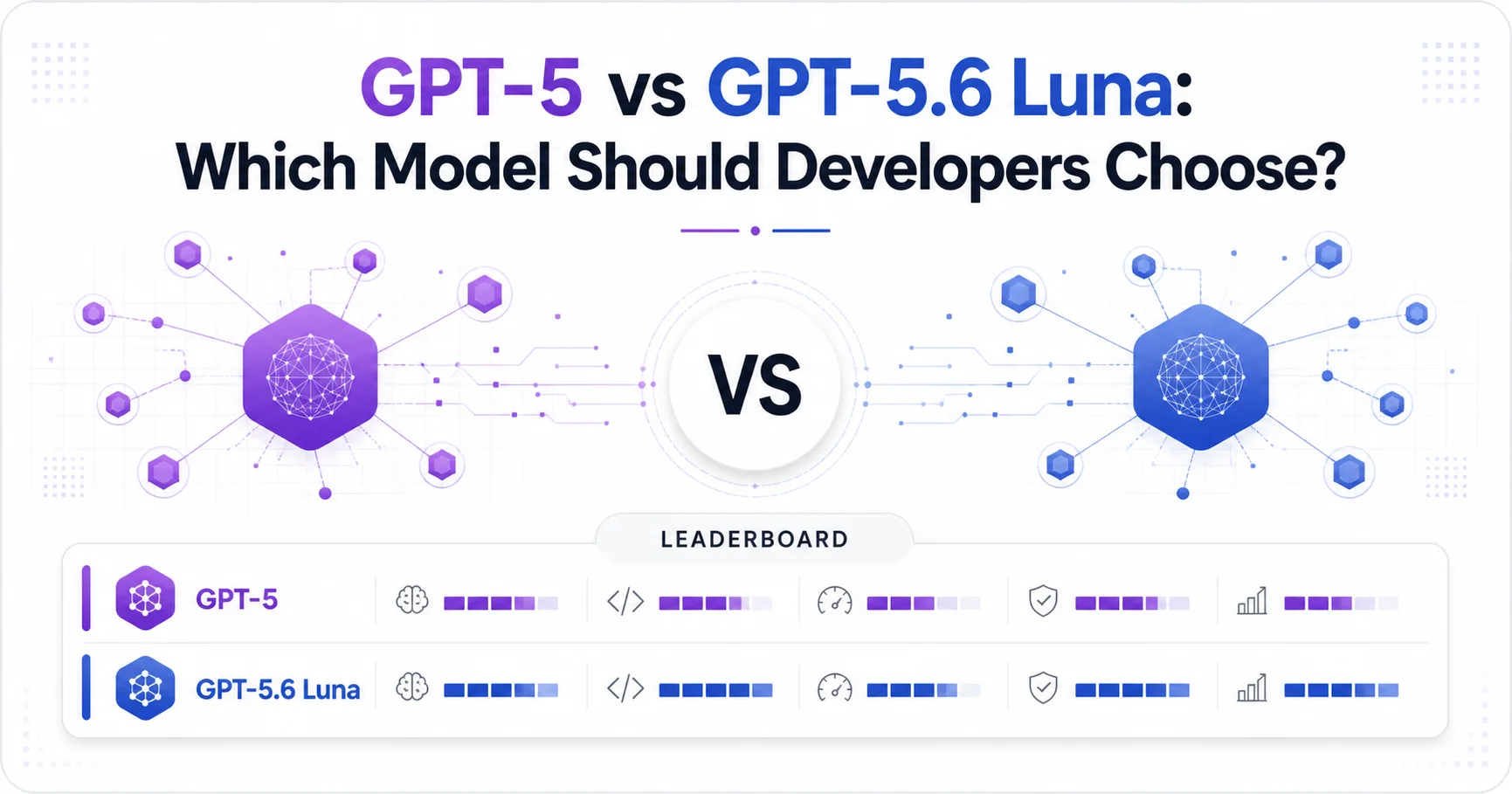
GPT-5.6 Luna (max) is the stronger default for most new developer workloads because it combines higher measured intelligence and coding scores with a much lower blended token price. The Artificial Analysis snapshot reports a 51.2 intelligence index and a 71.4 coding index for GPT-5.6 Luna, compared with 34.7 and 37.8 for GPT-5. GPT-5 still has one meaningful evidence advantage: its reported math index is 94.3, while no corresponding GPT-5.6 Luna score is available.\n\nThe product context also matters. OpenAI positions GPT-5 as a reasoning model for coding, reasoning, and agentic tasks in GPT-5 for developers. OpenAI presents GPT-5.6 Luna as a cost-sensitive, high-volume reasoning model in its GPT-5.6 Luna model documentation. That difference in positioning matches the pricing data, but it does not prove that Luna wins every specialized task.
GPT-5.6 Luna (max) offers the better capability-to-cost profile for new applications, while GPT-5 remains easier to justify when math evidence or existing production compatibility matters.\n\n| Decision factor | Better-supported choice | Why it matters | |---|---|---| | General intelligence | GPT-5.6 Luna (max) | Its Artificial Analysis intelligence index is 51.2, versus 34.7 for GPT-5. | | Coding | GPT-5.6 Luna (max) | Its coding index is 71.4, versus 37.8 for GPT-5. | | Math evidence | GPT-5 | GPT-5 has a reported math index of 94.3; Luna has no matching published value. | | Blended cost | GPT-5.6 Luna (max) | The blended price is $0.45, versus $3.4375 per 1M tokens. | | Reported generation speed | GPT-5.6 Luna (max) | Luna reports 175.726 median output tokens per second; GPT-5 has no value in the snapshot. | | Request latency | Tie | Both models report 0.3 seconds in the supplied data. | | Lifecycle confidence | GPT-5.6 Luna (max) | The supplied research found no deprecation notice for Luna, while the fixed GPT-5 snapshot is marked Deprecated. | \nOpenAI’s model directory lists GPT-5.6 Luna as a current model, while GPT-5 documentation describes GPT-5 as a previous-generation model and marks its fixed snapshot as Deprecated. Developers should therefore separate benchmark selection from migration risk. A model can be technically capable and still be a poor long-term choice if its exact snapshot requires near-term replacement.
GPT-5.6 Luna (max) has the stronger measured coding and general-intelligence profile, but the available evidence does not establish a universal winner for every programming or reasoning workload.\n\nThe coding index gap is substantial: GPT-5.6 Luna scores 71.4, while GPT-5 scores 37.8. For developers, that should increase confidence in Luna for code transformation, repository navigation, implementation planning, and multi-step engineering tasks. It does not guarantee fewer regressions. Production quality still depends on repository context, test coverage, tool permissions, and the model’s ability to follow local conventions.\n\nThe intelligence index tells a similar story. Luna scores 51.2 against GPT-5 at 34.7, suggesting a broader advantage across the evaluated intelligence mix. The score is useful for prioritizing an evaluation, not for replacing one. Teams should test their own tasks, especially if the application depends on strict schemas, external tools, or long-running agent loops.\n\nGPT-5 retains the only supplied math-specific result, at 94.3. GPT-5.6 Luna has no published math score in the supplied research or data snapshot. That missing value is not evidence that Luna performs worse, but it prevents a confident claim that Luna is better for symbolic mathematics, quantitative verification, or math-heavy reasoning.\n\nThe speed picture is incomplete. Luna reports 175.726 median output tokens per second, while GPT-5 has no corresponding output-speed value. Both models report 0.3 seconds of latency. Developers should not interpret Luna’s reported throughput as a guaranteed end-to-end response-time advantage, because the snapshot does not provide matching speed data for GPT-5 or a workload-specific latency breakdown.\n\nOpenAI reports GPT-5 benchmark results in GPT-5 for developers, but the supplied research found no independent Luna benchmark results. The safest conclusion is narrow: Luna has the better available comparative signal for coding and general intelligence, while math and task-specific reliability remain open validation questions.
GPT-5.6 Luna (max) is dramatically cheaper in the supplied blended-cost comparison, but long-context billing and output behavior can still change the business case.\n\nThe blended price is $0.45 per 1M tokens for Luna, compared with $3.4375 for GPT-5. That difference favors Luna for high-volume classification, coding assistance, agentic workflows, and applications where many model calls are required. Input pricing also favors Luna at $0.2 versus GPT-5 at $1.25, while output pricing favors Luna at $1.2 versus GPT-5 at $10.\n\nPrice per token is not the same as cost per completed task. A cheaper model can become more expensive if it needs more retries, produces unusable patches, calls tools inefficiently, or requires a second model to verify its output. The supplied research includes community reports of GPT-5 producing incorrect modifications in complex existing codebases, but those reports are anecdotal and not directly comparable with Luna. No reliable public community evidence was found for Luna’s coding behavior.\n\nLuna also has a specific long-context cost hazard. Requests above 272K input tokens receive higher billing multipliers, according to the GPT-5.6 Luna model page. A team sending large repositories, long transcripts, or accumulated agent state should model the actual token distribution rather than applying the short-context price to every request.\n\nThe OpenAI pricing documentation also lists separate Standard, Batch, Flex, and Fast mode prices for Luna. That gives batch-oriented systems more room to optimize, but the correct mode depends on freshness, latency, and operational requirements. GPT-5’s higher output price may still be rational for a narrow workflow if its validated math behavior avoids costly downstream verification. The supplied data is not enough to quantify that break-even point.
GPT-5.6 Luna (max) leads on 3 of 3 metrics
GPT-5.6 Luna (max) should be the starting point for most new developer-facing systems, while GPT-5 deserves a targeted role where its math evidence or existing integration is decisive.\n\nChoose GPT-5.6 Luna for a new coding assistant, repository agent, structured automation service, or high-volume reasoning workflow. Its 71.4 coding index, 51.2 intelligence index, $0.45 blended price, and reported 175.726 median output tokens per second create the strongest available default. Its current model-page presence also reduces the immediate lifecycle concern identified for the fixed GPT-5 snapshot.\n\nChoose GPT-5 when an existing application already depends on its behavior, when the documented 94.3 math index matches the core workload, or when your internal tests show that GPT-5 produces more acceptable outputs for a specific task. The cost premium is large, so the decision should be supported by measured task success rather than familiarity alone.\n\nTreat the model ID as part of the architecture. GPT-5 has a stable alias and a fixed snapshot, but the fixed snapshot is marked Deprecated in GPT-5 model documentation. Luna currently has the model ID gpt-5.6-luna, and the supplied research found no separate stable latest alias. Teams should pin the identifier they test, record prompt and tool behavior, and maintain a migration test before production rollout.\n\nA practical evaluation should compare completed-task success, invalid tool calls, patch acceptance, retry rate, verification cost, and long-context billing. The supplied evidence supports Luna as the default choice. It does not support claiming that Luna wins math, every framework, every language, or every agent design.
GPT-5.6 Luna (max) lacks enough independent task-level evidence to settle several questions that matter in production.\n\nOpenAI has not published a Luna-specific benchmark score in the supplied research. No reliable Reddit, Hacker News, or X post was found that documents Luna’s coding quality, speed experience, or failure patterns with a reproducible method. GPT-5 has more public evidence, but its community feedback is also based on an uncontrolled Reddit experience.\n\nThat leaves three unresolved areas: Luna’s math performance, its reliability in complex existing repositories, and its real end-to-end latency under tool-heavy workloads. These gaps should become explicit acceptance tests before a team treats the headline comparison as a production guarantee.
Yes, GPT-5.6 Luna is the stronger starting point for most new applications because it has higher reported intelligence and coding scores, much lower token pricing, and no reported deprecation notice in the supplied research.
Yes, GPT-5 remains useful when an application depends on its established behavior, internal tests favor it, or its documented 94.3 math index matches a math-heavy workflow that Luna has not yet benchmarked.
No, the available data reports 175.726 median output tokens per second for Luna but no matching GPT-5 value, while both models report 0.3 seconds of latency.
GPT-5.6 Luna is cheaper on every supplied headline pricing measure, including $0.45 versus $3.4375 per 1M blended tokens, but retries, verification, and long-context billing can change total task cost.
No, the comparison cannot prove that result because GPT-5 has a reported 94.3 math index while GPT-5.6 Luna has no corresponding published math score in the supplied data.
Teams should treat GPT-5’s fixed snapshot as a migration risk because it is marked Deprecated, while Luna currently appears available without a listed deprecation plan, although future availability still requires monitoring.