
Time to First Token · GPT-5 (high)
0ms
Time to First Token · GPT-5.6 Luna (xhigh)
17511ms
Deep dive into reasoning, benchmarks, and latency insights.
The current catalog does not contain complete performance evidence for both models, so this page does not declare an overall winner. Use the available fields as comparison signals and validate the models on your own workload.
Key decision metrics at a glance.
| Model | Metric | Value | Unit | Source / snapshot |
|---|---|---|---|---|
| GPT-5 (high) | Reasoning | 9.0 | benchmark or capability score | Artificial Analysis · current catalog |
| GPT-5.6 Luna (xhigh) | Reasoning | 6.0 | benchmark or capability score | Artificial Analysis · current catalog |
| GPT-5 (high) | Coding | 4.0 | benchmark or capability score | Artificial Analysis · current catalog |
| GPT-5.6 Luna (xhigh) | Coding | 7.0 | benchmark or capability score | Artificial Analysis · current catalog |
| GPT-5 (high) | Multimodal | 3.0 | benchmark or capability score | Artificial Analysis · current catalog |
| GPT-5.6 Luna (xhigh) | Multimodal | 4.0 | benchmark or capability score | Artificial Analysis · current catalog |
| GPT-5 (high) | Long Context | 4.0 | benchmark or capability score | Artificial Analysis · current catalog |
| GPT-5.6 Luna (xhigh) | Long Context | 6.0 | benchmark or capability score | Artificial Analysis · current catalog |
| GPT-5 (high) | Blended Price / 1M tokens | $3.438 | USD per 1M tokens | Artificial Analysis · current catalog |
| GPT-5.6 Luna (xhigh) | Blended Price / 1M tokens | $0.45 | USD per 1M tokens | Artificial Analysis · current catalog |
| GPT-5 (high) | P95 Latency | — | milliseconds | Artificial Analysis · current catalog |
| GPT-5.6 Luna (xhigh) | P95 Latency | — | milliseconds | Artificial Analysis · current catalog |
| GPT-5 (high) | Tokens per second | 0 | tokens per second | Artificial Analysis · current catalog |
| GPT-5.6 Luna (xhigh) | Tokens per second | 144.706 | tokens per second | Artificial Analysis · current catalog |
Data provided by Artificial Analysis; live values use the current catalog.
This radar chart visually maps the core capabilities (reasoning, coding, math proxy, multimodal, long context) of `GPT-5 (high)` vs `GPT-5.6 Luna (xhigh)`.
This grouped bar chart provides a side-by-side comparison for each benchmark metric.
Lower time to first token is better; higher tokens per second is better.
Compare input and output pricing in USD per 1M tokens.
GPT-5 (high)$3.75
GPT-5.6 Luna (xhigh)$0.5
GPT-5.6 Luna (xhigh) costs $3.25 less per run
This article is a dated snapshot published on 2026-08-07. Live cards above use the current catalog; missing live fields are not inferred.
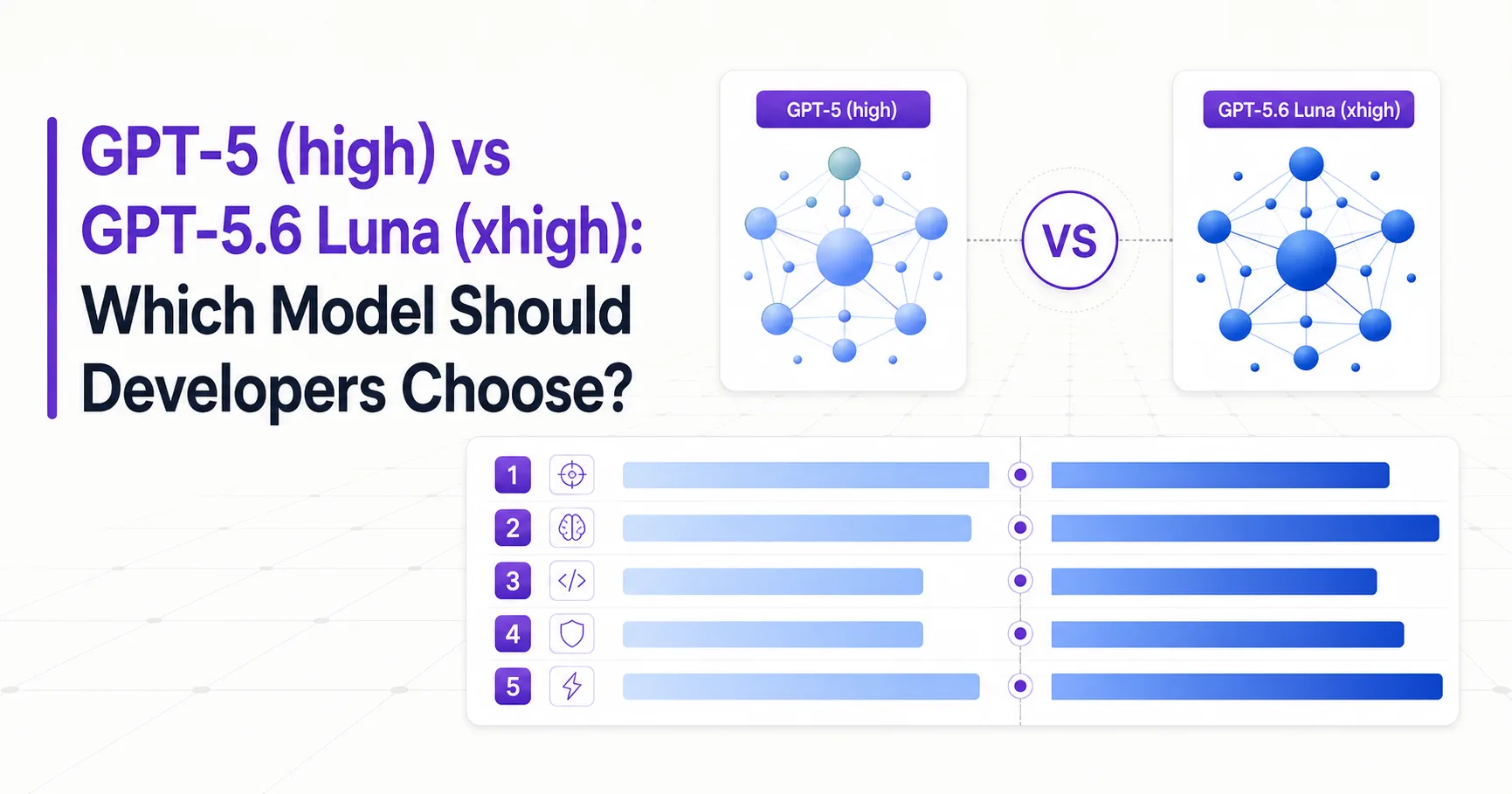
GPT-5.6 Luna (xhigh) is the stronger default for most new developer workloads because it combines higher reported coding and intelligence scores with a lower blended price. The Artificial Analysis snapshot gives GPT-5.6 Luna (xhigh) a Coding Index of 68.6 and an Intelligence Index of 49.1, compared with 37.8 and 34.7 for GPT-5 (high). Its blended price is $0.45 per 1M tokens, compared with $3.4375 for GPT-5 (high).\n\nGPT-5 (high) remains easier to evaluate for demanding reasoning because OpenAI publishes detailed developer benchmarks and documents the reasoning_effort=high setting. GPT-5.6 Luna has a much thinner public record, so its apparent lead is persuasive for coding and cost, but incomplete for mathematical reasoning, context-heavy workflows, and production reliability.
GPT-5.6 Luna (xhigh) wins the measurable comparison for coding, general intelligence, blended cost, and reported output speed. The Artificial Analysis Coding Index is 68.6 for GPT-5.6 Luna (xhigh) and 37.8 for GPT-5 (high). The Intelligence Index is 49.1 and 34.7 respectively. GPT-5.6 Luna (xhigh) also reports 172.255 median output tokens per second, while GPT-5 has no reported value.\n\nThe models share a reported latency of 0.3 seconds, so Luna's advantage is not a lower initial response delay. Its advantage is sustained generation speed and lower token cost.\n\nThe naming requires care. OpenAI documents gpt-5 and describes high reasoning as a parameter, not a separate gpt-5-high API model, in GPT-5 for developers and the GPT-5 model documentation. OpenAI's model directory lists gpt-5.6-luna, while the comparison dataset names the model GPT-5.6 Luna (xhigh), as shown in OpenAI Models. The materials do not prove that the dataset label is an official API identifier.\n\nFor a new application, Luna is the practical starting point. For a regulated or reasoning-critical system, GPT-5 has better documented behavior, but its fixed snapshot is marked Deprecated in the model documentation.
GPT-5.6 Luna (xhigh) is the better-supported choice for coding throughput, but GPT-5 (high) has stronger publicly documented evidence for reasoning behavior. The Artificial Analysis scores point to a large coding difference: Luna records 68.6, while GPT-5 records 37.8. That gap should matter in repository edits, code generation, test-writing, and repetitive engineering assistance, where a stronger coding score can reduce the number of correction cycles. It does not guarantee that every codebase will receive fewer defects.\n\nThe general intelligence result also favors Luna, at 49.1 versus 34.7. This supports using Luna for mixed workloads that combine implementation, explanation, and routine analysis. The comparison does not include a Luna math score, so the available data cannot establish whether Luna matches GPT-5's reported Artificial Analysis Math Index of 94.3. That missing value is a material gap for scientific, quantitative, or proof-oriented applications.\n\nGPT-5 has a richer official performance record. OpenAI reports 74.9% on SWE-bench Verified, 88% on Aider polyglot, 96.7% on τ²-bench telecom, and 69.6% on Scale MultiChallenge in GPT-5 for developers. OpenAI states that the SWE-bench result excluded 23 of 500 issues that could not be passed reliably on its infrastructure, and that the Aider evaluation used high reasoning effort. Luna has no model-specific official benchmark results in the supplied research.\n\nThe equal 0.3-second latency means neither model has a measured first-response advantage in this snapshot. Luna's reported 172.255 median output tokens per second may improve perceived speed during long answers, but GPT-5 has no corresponding speed value. The evidence does not show whether that advantage holds under identical prompts, tools, context lengths, or service modes.\n\nCommunity evidence changes the risk assessment. One Reddit post describes GPT-5 as useful for locating and fixing small bugs, while criticizing shorter, less detailed output for complete applications and UI generation. The same post and comments mention possible hallucinations or incorrect edits in complex existing repositories, but provide no controlled or reproducible experiment. See Tried GPT-5 Here Are My First Impressions. No reliable public community testing was found for Luna, so Luna's real-world failure rate is unknown rather than demonstrably lower.
GPT-5.6 Luna (xhigh) is the clear cost choice for workloads where token volume, retries, or parallel calls dominate the bill. Its blended price is $0.45 per 1M tokens, compared with $3.4375 for GPT-5 (high). Its listed input price is $0.20 and output price is $1.20, versus $1.25 and $10 for GPT-5. The output difference is especially important for coding agents that generate patches, tests, explanations, and tool results across many turns.\n\nThe cheaper model can still become more expensive in practice if it creates additional review cycles, incorrect patches, or repeated context uploads. The supplied research provides no controlled measurement of Luna's defect rate, retry rate, tool-call efficiency, or task completion cost. A team should therefore compare cost per accepted change, not only cost per token, before moving a high-risk workflow.\n\nPricing mode also affects the decision. OpenAI lists Luna Standard prices of $0.20 input and $1.20 output for short context, with separate long-context, Batch, Flex, and Fast mode prices in OpenAI Pricing. The Artificial Analysis snapshot uses $0.45 as the blended comparison value for Luna and $3.4375 for GPT-5. Those figures are useful for ranking the models, but they are not a complete invoice model for every endpoint or service mode.\n\nGPT-5's cached input price is $0.125 per 1M tokens, while Luna's supplied Standard short-context cached input price is $0.02. Repeated system instructions and repository context therefore favor Luna financially, assuming the application can use the listed pricing mode and maintain comparable task quality. Fine-tuning is not supported for GPT-5 according to the GPT-5 model documentation, while no Luna-specific fine-tuning statement was found.
GPT-5.6 Luna (xhigh) leads on 3 of 3 metrics
GPT-5.6 Luna (xhigh) is the recommended default for new, cost-sensitive developer products with measurable coding workloads. Its reported Coding Index of 68.6, Intelligence Index of 49.1, blended price of $0.45, and output speed of 172.255 tokens per second make a strong case for high-volume assistants, code transformation pipelines, test generation, and interactive development tools.\n\nChoose GPT-5 (high) when official benchmark visibility, documented reasoning controls, or an established GPT-5 integration matters more than token cost. OpenAI documents text and image input, text output, function calling, structured outputs, streaming, custom tools, reasoning_effort, and verbosity in GPT-5 for developers and GPT-5 model documentation. GPT-5 does not support audio or video input and output, and the model documentation marks the fixed snapshot gpt-5-2025-08-07 as Deprecated.\n\nChoose Luna for a production rollout only after validating the missing properties that could reverse the decision: context window, maximum output, tool support, rate limits, xhigh semantics, math performance, and failure behavior. The supplied research found no Luna-specific official benchmark, dedicated xhigh model specification, reliable community evaluation, or public release announcement tied to 2026-07-09.\n\nA sensible evaluation should use the application's own tasks. Include repository edits, test repairs, structured tool calls, long-context questions, and quantitative prompts. Track accepted changes, review time, retries, latency, output speed, and total spend. The current evidence supports Luna as the value leader, but it does not establish Luna as the universal reasoning leader.
GPT-5.6 Luna (xhigh) is the better first candidate for most new developer workloads, but the missing model-specific documentation should shape the rollout plan. The comparison clearly supports Luna on reported coding score, intelligence score, cost, and output speed. It does not settle math quality, context capacity, xhigh behavior, or reliability in complex repositories.\n\nTeams should treat the comparison label as an analytical name until the official API alias is confirmed. The supplied official material identifies gpt-5.6-luna, while the data snapshot identifies GPT-5.6 Luna (xhigh). That distinction affects implementation, monitoring, and migration planning.
GPT-5.6 Luna (xhigh) is the better-supported coding choice in the supplied comparison because its Artificial Analysis Coding Index is 68.6 versus 37.8 for GPT-5 (high). The score does not prove lower defect rates for every repository, and Luna lacks controlled community testing in the supplied research.
GPT-5.6 Luna (xhigh) is cheaper on the supplied blended comparison, at $0.45 per 1M tokens versus $3.4375 for GPT-5 (high). Its listed short-context Standard prices are $0.20 input and $1.20 output, but actual cost still depends on caching, context length, service mode, retries, and output quality.
GPT-5 has better public reasoning evidence because OpenAI publishes several official benchmark results and documents its reasoning controls. GPT-5.6 Luna has a higher Intelligence Index of 49.1 versus 34.7, but no supplied official benchmark or Luna math score proves that it is stronger across reasoning-heavy tasks.
Developers should verify the production identifier before using it because the supplied official OpenAI material lists gpt-5.6-luna, not gpt-5-6-luna-xhigh. The research found no official record that xhigh is an independent API model name, so the dataset label should not be treated as confirmed API syntax.
GPT-5.6 Luna's biggest unresolved risk is the lack of model-specific documentation for context limits, output limits, tools, rate limits, xhigh behavior, math performance, and failure modes. The available evidence strongly supports its cost and coding position, but it cannot establish production reliability or universal task superiority.