
Time to First Token · GPT-5 (high)
0ms
Time to First Token · GPT-5.6 Sol (medium)
4237ms
Deep dive into reasoning, benchmarks, and latency insights.
The current catalog does not contain complete performance evidence for both models, so this page does not declare an overall winner. Use the available fields as comparison signals and validate the models on your own workload.
Key decision metrics at a glance.
| Model | Metric | Value | Unit | Source / snapshot |
|---|---|---|---|---|
| GPT-5 (high) | Reasoning | 9.0 | benchmark or capability score | Artificial Analysis · current catalog |
| GPT-5.6 Sol (medium) | Reasoning | 6.0 | benchmark or capability score | Artificial Analysis · current catalog |
| GPT-5 (high) | Coding | 4.0 | benchmark or capability score | Artificial Analysis · current catalog |
| GPT-5.6 Sol (medium) | Coding | 8.0 | benchmark or capability score | Artificial Analysis · current catalog |
| GPT-5 (high) | Multimodal | 3.0 | benchmark or capability score | Artificial Analysis · current catalog |
| GPT-5.6 Sol (medium) | Multimodal | 5.0 | benchmark or capability score | Artificial Analysis · current catalog |
| GPT-5 (high) | Long Context | 4.0 | benchmark or capability score | Artificial Analysis · current catalog |
| GPT-5.6 Sol (medium) | Long Context | 7.0 | benchmark or capability score | Artificial Analysis · current catalog |
| GPT-5 (high) | Blended Price / 1M tokens | $3.438 | USD per 1M tokens | Artificial Analysis · current catalog |
| GPT-5.6 Sol (medium) | Blended Price / 1M tokens | $11.25 | USD per 1M tokens | Artificial Analysis · current catalog |
| GPT-5 (high) | P95 Latency | — | milliseconds | Artificial Analysis · current catalog |
| GPT-5.6 Sol (medium) | P95 Latency | — | milliseconds | Artificial Analysis · current catalog |
| GPT-5 (high) | Tokens per second | 0 | tokens per second | Artificial Analysis · current catalog |
| GPT-5.6 Sol (medium) | Tokens per second | 55.669 | tokens per second | Artificial Analysis · current catalog |
Data provided by Artificial Analysis; live values use the current catalog.
This radar chart visually maps the core capabilities (reasoning, coding, math proxy, multimodal, long context) of `GPT-5 (high)` vs `GPT-5.6 Sol (medium)`.
This grouped bar chart provides a side-by-side comparison for each benchmark metric.
Lower time to first token is better; higher tokens per second is better.
Compare input and output pricing in USD per 1M tokens.
GPT-5 (high)$3.75
GPT-5.6 Sol (medium)$12.5
GPT-5 (high) costs $8.75 less per run
This article is a dated snapshot published on 2026-08-07. Live cards above use the current catalog; missing live fields are not inferred.
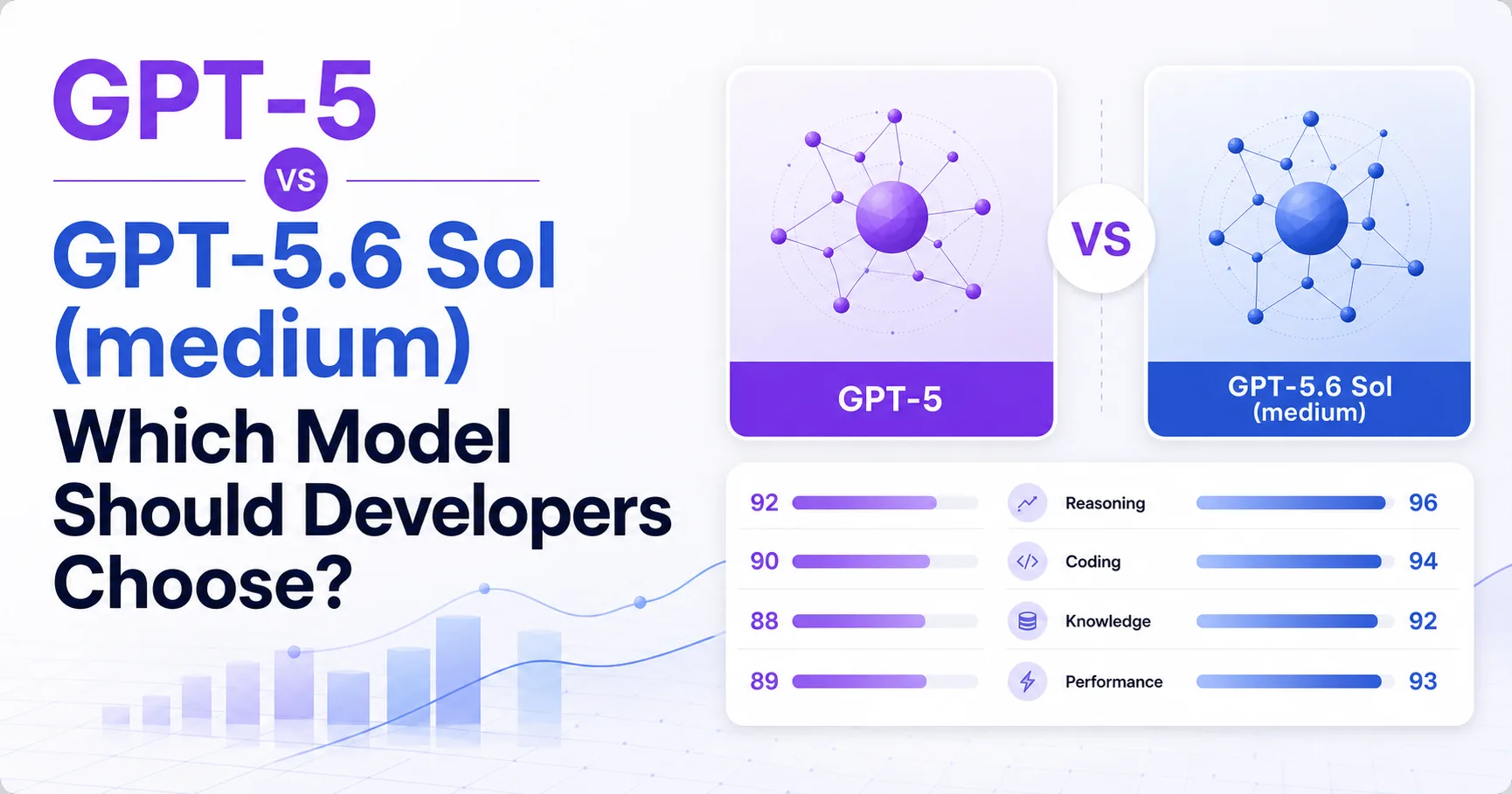
GPT-5.6 Sol (medium) is the stronger default for demanding coding and reasoning workflows, while GPT-5 remains the more economical choice for cost-sensitive applications.
The Artificial Analysis comparison gives GPT-5.6 Sol (medium) a coding index of 76.3, compared with 37.8 for GPT-5. Its intelligence index is 53.6 versus 34.7. Those results point toward a substantial capability advantage for repository work, multi-step implementation, and agent tasks.
GPT-5 answers a different procurement question. Its blended price is $3.4375 per 1M tokens, compared with $11.25 for GPT-5.6 Sol (medium). GPT-5.6 Sol (medium) also has a reported median output speed of 69.865 tokens per second, while GPT-5 has no reported value in the supplied dataset. Latency is 0.3 seconds for both models.
The practical choice depends on whether model quality or unit economics creates the larger business constraint. Developers building code agents should begin with GPT-5.6 Sol (medium) if their workload can absorb the price. Teams serving high request volume, lightweight transformations, or budget-limited products should test whether GPT-5 delivers sufficient quality at its lower rate.
Data provided by https://artificialanalysis.ai/; the comparison dataset is Artificial Analysis.
GPT-5.6 Sol (medium) offers the clearest quality lead, but GPT-5 offers the clearest cost advantage and a stronger measured math signal.
| Decision area | GPT-5 | GPT-5.6 Sol (medium) | Selection meaning |
|---|---|---|---|
| Coding index | 37.8 | 76.3 | GPT-5.6 Sol (medium) is the stronger starting point for coding agents |
| Intelligence index | 34.7 | 53.6 | GPT-5.6 Sol (medium) has the higher general capability signal |
| Math index | 94.3 | Not reported | The supplied data does not support a direct math comparison |
| Blended price per 1M tokens | $3.4375 | $11.25 | GPT-5 is materially easier to operate at high volume |
| Median output speed | Not reported | 69.865 tokens per second | GPT-5.6 Sol (medium) has the only supplied speed measurement |
| Latency | 0.3 seconds | 0.3 seconds | The measured request latency is tied |
OpenAI positions GPT-5 around coding, reasoning, and agentic tasks in its developer announcement. OpenAI positions GPT-5.6 Sol as a flagship model for complex reasoning and coding in the model catalog and its GPT-5.6 Sol model page. The positioning therefore agrees with the supplied coding result, although official GPT-5.6 Sol benchmark detail is not provided in the research material.
The version status also changes the operational comparison. OpenAI's GPT-5 documentation marks the fixed GPT-5 snapshot as deprecated and describes GPT-5 as a previous-generation model. The supplied sources do not identify GPT-5.6 Sol as deprecated. That does not prove long-term availability, but it makes GPT-5.6 Sol the safer starting point for a new integration that expects a current model family.
Community evidence is weaker than the index data. One GPT-5 Reddit report describes useful small bug fixes but less complete application and interface generation. A separate GPT-5.6 Sol Reddit report describes excessive output and slow task progress, while commenters question the test quality. Neither discussion establishes a reproducible consensus.
GPT-5.6 Sol (medium) is the better first candidate for coding agents because its coding index is 76.3 versus GPT-5 at 37.8.
That gap matters most when the model must maintain a plan across several edits, understand unfamiliar code, select an implementation strategy, and recover from failed tests. A higher coding index does not guarantee correct patches in every repository. It does make GPT-5.6 Sol (medium) the more rational starting point for workflows where a weak first attempt creates expensive human review or repeated agent turns.
GPT-5 remains relevant for narrower engineering tasks. A small bug fix, a focused transformation, or a well-specified code explanation may not require the stronger model. The community report about GPT-5 describes value in small debugging and modification tasks, but it also reports weaker completeness in full application and interface generation. That evidence comes from a single uncontrolled experience, so it should guide testing rather than serve as a benchmark. The details appear in the reported GPT-5 experience.
GPT-5.6 Sol (medium) has the only supplied output-speed measurement, at 69.865 median output tokens per second. GPT-5 has no reported output-speed value, so the dataset cannot establish a speed winner. Both models show 0.3 seconds of latency, which means faster generation does not automatically mean faster completion. Tool calls, retries, context preparation, and validation can dominate total workflow time.
GPT-5.6 Sol supports a broader tool surface, including file search, web search, code interpreter, hosted shell, computer use, MCP, and tool search, according to its official model page. GPT-5 supports function calling, structured outputs, streaming, and custom tools according to OpenAI's GPT-5 developer documentation and the GPT-5 model documentation. The model with the higher score is therefore also the more natural fit for tool-rich agent orchestration, but the supplied evidence does not quantify tool reliability.
GPT-5 is the economic winner at $3.4375 per 1M blended tokens versus $11.25 for GPT-5.6 Sol (medium), but lower token pricing does not guarantee lower task cost.
GPT-5 charges $1.25 per 1M input tokens and $10 per 1M output tokens. GPT-5.6 Sol (medium) charges $5 per 1M input tokens and $30 per 1M output tokens under the comparison's standard pricing basis. The price gap is especially important for products with frequent calls, long generated answers, or large agent traces. The detailed service tiers are documented on the OpenAI API pricing page.
The cheaper model can become more expensive at the workflow level if it needs additional retries, produces incomplete patches, or requires more human correction. The supplied research reports those risks for both models, but neither report provides reproducible failure rates. GPT-5.6 Sol has a personal report describing excessive output and incomplete results, while GPT-5 has a personal report describing hallucinations or incorrect modifications in complex existing repositories. These are reasons to measure completion cost on representative tasks, not reasons to claim a verified failure-rate difference.
GPT-5.6 Sol also introduces a specific long-context cost risk. Its official model page states that requests above 272K input tokens receive higher pricing for the full request. That rule matters for large repositories, long conversations, and document-heavy agents. A model with stronger coding capability can still lose on total cost if the application routinely sends oversized context or asks it to generate unnecessary detail.
For a high-volume product, GPT-5 should be the baseline in an evaluation because its price advantage is substantial. For a code agent, compare cost per accepted change, not cost per request. The research material does not provide that metric, so the break-even point between the models remains unknown.
GPT-5 (high) leads on 3 of 3 metrics
GPT-5.6 Sol (medium) is the recommended default for complex coding and agent workflows, while GPT-5 is the recommended default for high-volume and cost-constrained workloads.
Choose GPT-5.6 Sol (medium) when the model must work through a substantial repository, coordinate several tools, or produce a difficult implementation with limited supervision. Its coding index of 76.3 is the strongest supplied signal in this comparison. Its intelligence index of 53.6 also exceeds GPT-5's 34.7, which supports using it for broader reasoning tasks. OpenAI describes the model as suitable for complex professional work, reasoning, and coding in the GPT-5.6 Sol documentation.
Choose GPT-5 when unit cost, deployment simplicity, or a focused task matters more than maximum coding performance. Its blended price of $3.4375 per 1M tokens is far below GPT-5.6 Sol's $11.25. GPT-5 also has a reported math index of 94.3, while GPT-5.6 Sol has no reported math index. That missing value prevents a direct conclusion about math-heavy workloads.
Treat the model identifier as part of the recommendation. OpenAI documents GPT-5 as an available alias, but its fixed snapshot is marked deprecated in the GPT-5 model documentation. GPT-5.6 Sol is listed as a current flagship model, and its stable alias is described in the latest model guide. Teams starting a new integration should therefore account for migration risk before standardizing on GPT-5.
A sensible rollout is to evaluate both models on the same representative task set. Track accepted code changes, retry count, reviewer time, output tokens, and end-to-end completion time. The supplied materials do not include those operational measurements. They establish a capability and price direction, but they do not identify the exact workload threshold where GPT-5.6 Sol pays for itself.
GPT-5.6 Sol also has documented safety and image-processing caveats. Its guide says safety classifiers can pause generation for several seconds in some dual-use domains, and higher-detail image inputs can consume more input tokens and add latency. Those constraints are described in the latest model guide.
GPT-5.6 Sol (medium) has the stronger supplied coding signal, but the evidence does not settle every production decision.
The missing math index is the clearest gap. GPT-5 records 94.3, while GPT-5.6 Sol has no corresponding value in the data brief. The comparison therefore supports a coding recommendation, not a universal claim across every reasoning category.
The speed evidence is also incomplete. GPT-5.6 Sol reports 69.865 median output tokens per second, but GPT-5 has no supplied output-speed result. The shared 0.3-second latency indicates a tie only for the reported latency measure. It does not predict total response time for tool use, long prompts, retries, or safety pauses.
Community reports should receive limited weight. The GPT-5 and GPT-5.6 Sol discussions describe useful observations, but neither provides a reproducible task set or independent measurement. The GPT-5.6 Sol Reddit discussion includes disagreement about testing quality. The available material therefore supports a controlled pilot, not a claim of stable community consensus.
GPT-5.6 Sol (medium) is the stronger supplied coding choice, with a 76.3 coding index versus GPT-5 at 37.8, although repository-specific testing remains necessary.
GPT-5 is cheaper for the supplied blended pricing comparison, costing $3.4375 per 1M blended tokens versus $11.25 for GPT-5.6 Sol (medium).
GPT-5.6 Sol (medium) has the only supplied output-speed measurement at 69.865 median output tokens per second, while both models report 0.3 seconds of latency.
A new application should start with GPT-5.6 Sol (medium) for complex coding and agent work, but choose GPT-5 when volume and token cost dominate the decision.
The comparison does not prove that conclusion because GPT-5 has a reported math index of 94.3, while GPT-5.6 Sol has no supplied math index.
GPT-5 remains listed as an available alias, but its fixed snapshot is marked deprecated, so new integrations should include migration planning and validate current availability.