
Time to First Token · GPT-5 (high)
0ms
Time to First Token · GPT-5.6 Sol (xhigh)
31324ms
Deep dive into reasoning, benchmarks, and latency insights.
The current catalog does not contain complete performance evidence for both models, so this page does not declare an overall winner. Use the available fields as comparison signals and validate the models on your own workload.
Key decision metrics at a glance.
| Model | Metric | Value | Unit | Source / snapshot |
|---|---|---|---|---|
| GPT-5 (high) | Reasoning | 9.0 | benchmark or capability score | Artificial Analysis · current catalog |
| GPT-5.6 Sol (xhigh) | Reasoning | 6.0 | benchmark or capability score | Artificial Analysis · current catalog |
| GPT-5 (high) | Coding | 4.0 | benchmark or capability score | Artificial Analysis · current catalog |
| GPT-5.6 Sol (xhigh) | Coding | 8.0 | benchmark or capability score | Artificial Analysis · current catalog |
| GPT-5 (high) | Multimodal | 3.0 | benchmark or capability score | Artificial Analysis · current catalog |
| GPT-5.6 Sol (xhigh) | Multimodal | 5.0 | benchmark or capability score | Artificial Analysis · current catalog |
| GPT-5 (high) | Long Context | 4.0 | benchmark or capability score | Artificial Analysis · current catalog |
| GPT-5.6 Sol (xhigh) | Long Context | 7.0 | benchmark or capability score | Artificial Analysis · current catalog |
| GPT-5 (high) | Blended Price / 1M tokens | $3.438 | USD per 1M tokens | Artificial Analysis · current catalog |
| GPT-5.6 Sol (xhigh) | Blended Price / 1M tokens | $11.25 | USD per 1M tokens | Artificial Analysis · current catalog |
| GPT-5 (high) | P95 Latency | — | milliseconds | Artificial Analysis · current catalog |
| GPT-5.6 Sol (xhigh) | P95 Latency | — | milliseconds | Artificial Analysis · current catalog |
| GPT-5 (high) | Tokens per second | 0 | tokens per second | Artificial Analysis · current catalog |
| GPT-5.6 Sol (xhigh) | Tokens per second | 64.533 | tokens per second | Artificial Analysis · current catalog |
Data provided by Artificial Analysis; live values use the current catalog.
This radar chart visually maps the core capabilities (reasoning, coding, math proxy, multimodal, long context) of `GPT-5 (high)` vs `GPT-5.6 Sol (xhigh)`.
This grouped bar chart provides a side-by-side comparison for each benchmark metric.
Lower time to first token is better; higher tokens per second is better.
Compare input and output pricing in USD per 1M tokens.
GPT-5 (high)$3.75
GPT-5.6 Sol (xhigh)$12.5
GPT-5 (high) costs $8.75 less per run
This article is a dated snapshot published on 2026-08-06. Live cards above use the current catalog; missing live fields are not inferred.
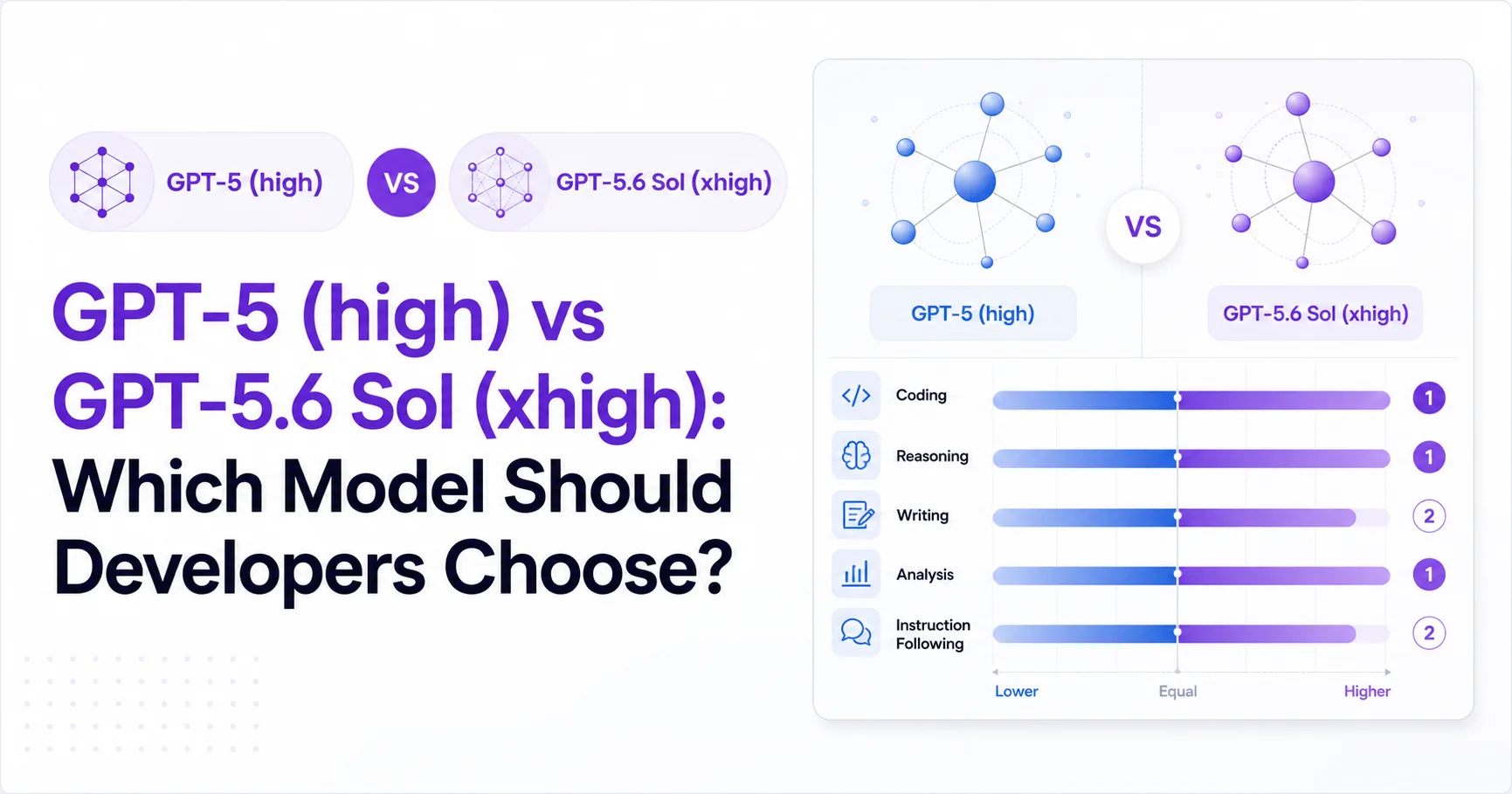
GPT-5.6 Sol (xhigh) is the stronger default for demanding coding and reasoning, while GPT-5 (high) remains the more economical choice for cost-sensitive applications. The Artificial Analysis Coding Index places GPT-5.6 Sol (xhigh) at 78.3 and GPT-5 (high) at 37.8, while the Artificial Analysis Intelligence Index places them at 57.7 and 34.7. The comparison therefore favors GPT-5.6 Sol (xhigh) on broad capability, but not on price.
The names also describe configurations rather than two perfectly equivalent model IDs. OpenAI identifies the first model as gpt-5, with high representing reasoning_effort=high, according to GPT-5 for developers. OpenAI identifies the second as gpt-5.6-sol, with gpt-5.6 as its stable alias and xhigh as a reasoning setting, according to the GPT-5.6 Sol model page and Reasoning models.
Data provided by https://artificialanalysis.ai/
GPT-5.6 Sol (xhigh) is the better fit for complex software work, while GPT-5 (high) is easier to justify for high-volume workloads with strict budget limits. GPT-5.6 Sol (xhigh) scores higher on the listed coding and intelligence measures, and the data brief reports a median output speed of 73.479 tokens per second. GPT-5 (high) has the lower blended price at $3.4375 per 1M tokens.
GPT-5.6 Sol (xhigh) also offers a substantially larger documented context window. Its model page specifies 1,050,000 tokens, compared with 400,000 tokens for GPT-5 in the GPT-5 model documentation. Both models support text and image input with text output. Neither supports audio or video input and output, so neither is the right direct choice for applications that require native audio or video processing.
The lifecycle picture is less balanced than the capability picture. OpenAI currently marks the fixed GPT-5 snapshot gpt-5-2025-08-07 as Deprecated and describes GPT-5 as a previous-generation model in its GPT-5 model documentation. The OpenAI model directory still lists gpt-5.6-sol as an available flagship model. That difference makes GPT-5.6 Sol (xhigh) the safer starting point for a new long-lived integration, subject to normal migration testing.
The evidence does not establish that GPT-5.6 Sol (xhigh) is universally better in every developer workflow. The data brief has no comparable math index for GPT-5.6 Sol, and community reports use uncontrolled methods. Treat the broad recommendation as a starting hypothesis for application-specific evaluation.
GPT-5.6 Sol (xhigh) is more compelling for complex coding agents because its coding index is 78.3, but that advantage does not guarantee fewer retries or better results in every repository. The score gap is large enough to matter for tasks that require planning across files, sustained debugging, tool coordination, and architectural judgment. It is less decisive for small edits, straightforward transformations, or tightly constrained generation where a cheaper model can already meet acceptance tests.
GPT-5 (high) still has a useful performance profile for focused debugging and bounded changes. One production-oriented Reddit account described GPT-5 as effective at locating and fixing small bugs, while criticizing its output for complete applications and user interfaces. The account used GPT-5 in Cursor with high reasoning effort, but the test was subjective and uncontrolled. See Tried GPT-5 Here Are My First Impressions.
GPT-5.6 Sol (xhigh) has more contradictory community evidence. One developer reported that it completed a code-architecture visualization feature after receiving about 2,500 lines of instructions, with a result they considered usable. The report also claimed roughly 15 minutes of work and 6% of a weekly allowance, but it did not publish code or a reproducible test. See 5.6 Sol finished the feature in one prompt.
Another two-week Reddit test reported over-engineering, excessive code generation, rapid allowance consumption, and remaining bugs in a LangChain/OpenCode sub-agent task. The discussion contained opposing experiences, so it supports a configuration warning rather than a stable quality ranking. See I spent two weeks testing GPT-5.6. Here’s what I found.
Both models report 0.3 seconds of latency in the data brief, so the available evidence does not show a latency winner. GPT-5.6 Sol (xhigh) has a reported output speed of 73.479 tokens per second, while no comparable GPT-5 value is supplied. That makes streaming experience, reasoning duration, and completion quality more important than the shared latency figure when designing a real evaluation.
GPT-5 (high) is the clear price winner for token-based workloads, with a blended price of $3.4375 per 1M tokens versus $11.25 for GPT-5.6 Sol (xhigh). The difference matters most when requests are frequent, outputs are long, or the workflow repeatedly calls the model during agent loops. GPT-5.6 Sol (xhigh) can still be economically superior if its stronger coding performance reduces retries, review time, failed deployments, or human intervention.
The price comparison is also sensitive to traffic shape. GPT-5 is listed at $1.25 per 1M input tokens and $10 per 1M output tokens. GPT-5.6 Sol is listed at $5 per 1M input tokens and $30 per 1M output tokens under the relevant standard pricing. The OpenAI API pricing page also distinguishes short and long context pricing, Batch and Flex processing, and Fast mode. Those options can change the operational decision even when the headline blended price stays the same.
GPT-5.6 Sol (xhigh) becomes especially risky for large-context agent sessions. Its documentation states that requests above 272K input tokens use higher input and output price multipliers, while reasoning tokens also consume context and are billed as output tokens. A prompt that looks efficient at the application level can therefore become expensive if it includes a large repository, repeated tool results, or excessive reasoning. The GPT-5.6 Sol model page and Reasoning models describe these constraints.
GPT-5.6 Sol (xhigh) also needs a sufficiently generous max_output_tokens setting because that limit covers reasoning, visible output, and formatting tokens. An incomplete response can still incur input and reasoning charges. Developers should compare cost per accepted task, not only cost per request. The data brief does not provide retry rates, token utilization, or task-success costs, so it cannot prove which model has the lower total cost for a particular product.
GPT-5 (high) leads on 3 of 3 metrics
GPT-5.6 Sol (xhigh) is the recommended starting point for new applications centered on complex coding, long-context analysis, or multi-step tool use. Its higher coding index, broader documented tool support, and current flagship availability make it the stronger candidate for agentic development workflows. OpenAI lists functions, structured outputs, web search, file search, image generation, Code Interpreter, hosted shell, computer use, MCP, Apply patch, and Skills among the supported Responses API tools on the GPT-5.6 Sol model page.
GPT-5 (high) is the better choice for mature, cost-sensitive systems that already perform well with its reasoning behavior. It is attractive for bounded bug fixes, classification with structured output, routine code transformations, and workloads where the lower blended price dominates the business case. Its support for function calling, structured outputs, streaming, and custom tools is documented in GPT-5 for developers and the GPT-5 model documentation.
GPT-5.6 Sol (xhigh) should not be selected solely because a community report describes a successful one-prompt feature. The same community material includes reports of over-engineering and bugs, and those reports lack controlled experiments. Developers should test representative repositories, tool loops, output limits, and rollback behavior before making a production commitment.
GPT-5 (high) should not be selected for a new long-lived integration without addressing its fixed-snapshot status. The stable alias may remain callable, but the documented deprecation of gpt-5-2025-08-07 creates migration work for systems that depend on reproducible snapshots. The available sources do not state how long the alias will remain supported.
The practical decision rule is simple: choose GPT-5.6 Sol (xhigh) when task success and complex reasoning justify higher spend; choose GPT-5 (high) when predictable cost and bounded work matter more. For either model, keep audio and video processing outside the model layer, and do not assume fine-tuning is available.
GPT-5.6 Sol (xhigh) is the stronger candidate for a new complex coding agent, but the decision still depends on measured task success and budget limits. The available evidence supports a structured pilot rather than a universal guarantee.
GPT-5.6 Sol (xhigh) is the stronger documented choice for complex coding because its Artificial Analysis Coding Index is 78.3 versus 37.8 for GPT-5 (high), although application-specific testing is still required.
GPT-5 (high) is the safer cost-sensitive choice because its blended price is $3.4375 per 1M tokens versus $11.25 for GPT-5.6 Sol (xhigh), especially for frequent bounded requests.
GPT-5.6 Sol (xhigh) has a reported median output speed of 73.479 tokens per second, but the data brief provides no comparable GPT-5 output-speed value and reports 0.3 seconds latency for each model.
Neither GPT-5 (high) nor GPT-5.6 Sol (xhigh) supports audio or video input and output according to their official model documentation, so those modalities require a separate processing layer.
Developers should not use xhigh for every request because OpenAI states that higher reasoning effort can increase time and token consumption, and recommends validating whether the quality gain offsets those costs.
GPT-5 can still fit an existing cost-sensitive integration, but developers should account for lifecycle risk because OpenAI marks the fixed GPT-5 snapshot as Deprecated and recommends a newer model.