
Time to First Token · GPT-5 (high)
0ms
Time to First Token · GPT-5.6 Terra (medium)
1518ms
Deep dive into reasoning, benchmarks, and latency insights.
The current catalog does not contain complete performance evidence for both models, so this page does not declare an overall winner. Use the available fields as comparison signals and validate the models on your own workload.
Key decision metrics at a glance.
| Model | Metric | Value | Unit | Source / snapshot |
|---|---|---|---|---|
| GPT-5 (high) | Reasoning | 9.0 | benchmark or capability score | Artificial Analysis · current catalog |
| GPT-5.6 Terra (medium) | Reasoning | 6.0 | benchmark or capability score | Artificial Analysis · current catalog |
| GPT-5 (high) | Coding | 4.0 | benchmark or capability score | Artificial Analysis · current catalog |
| GPT-5.6 Terra (medium) | Coding | 6.0 | benchmark or capability score | Artificial Analysis · current catalog |
| GPT-5 (high) | Multimodal | 3.0 | benchmark or capability score | Artificial Analysis · current catalog |
| GPT-5.6 Terra (medium) | Multimodal | 4.0 | benchmark or capability score | Artificial Analysis · current catalog |
| GPT-5 (high) | Long Context | 4.0 | benchmark or capability score | Artificial Analysis · current catalog |
| GPT-5.6 Terra (medium) | Long Context | 6.0 | benchmark or capability score | Artificial Analysis · current catalog |
| GPT-5 (high) | Blended Price / 1M tokens | $3.438 | USD per 1M tokens | Artificial Analysis · current catalog |
| GPT-5.6 Terra (medium) | Blended Price / 1M tokens | $4.5 | USD per 1M tokens | Artificial Analysis · current catalog |
| GPT-5 (high) | P95 Latency | — | milliseconds | Artificial Analysis · current catalog |
| GPT-5.6 Terra (medium) | P95 Latency | — | milliseconds | Artificial Analysis · current catalog |
| GPT-5 (high) | Tokens per second | 0 | tokens per second | Artificial Analysis · current catalog |
| GPT-5.6 Terra (medium) | Tokens per second | 98.278 | tokens per second | Artificial Analysis · current catalog |
Data provided by Artificial Analysis; live values use the current catalog.
This radar chart visually maps the core capabilities (reasoning, coding, math proxy, multimodal, long context) of `GPT-5 (high)` vs `GPT-5.6 Terra (medium)`.
This grouped bar chart provides a side-by-side comparison for each benchmark metric.
Lower time to first token is better; higher tokens per second is better.
Compare input and output pricing in USD per 1M tokens.
GPT-5 (high)$3.75
GPT-5.6 Terra (medium)$5
GPT-5 (high) costs $1.25 less per run
This article is a dated snapshot published on 2026-08-07. Live cards above use the current catalog; missing live fields are not inferred.
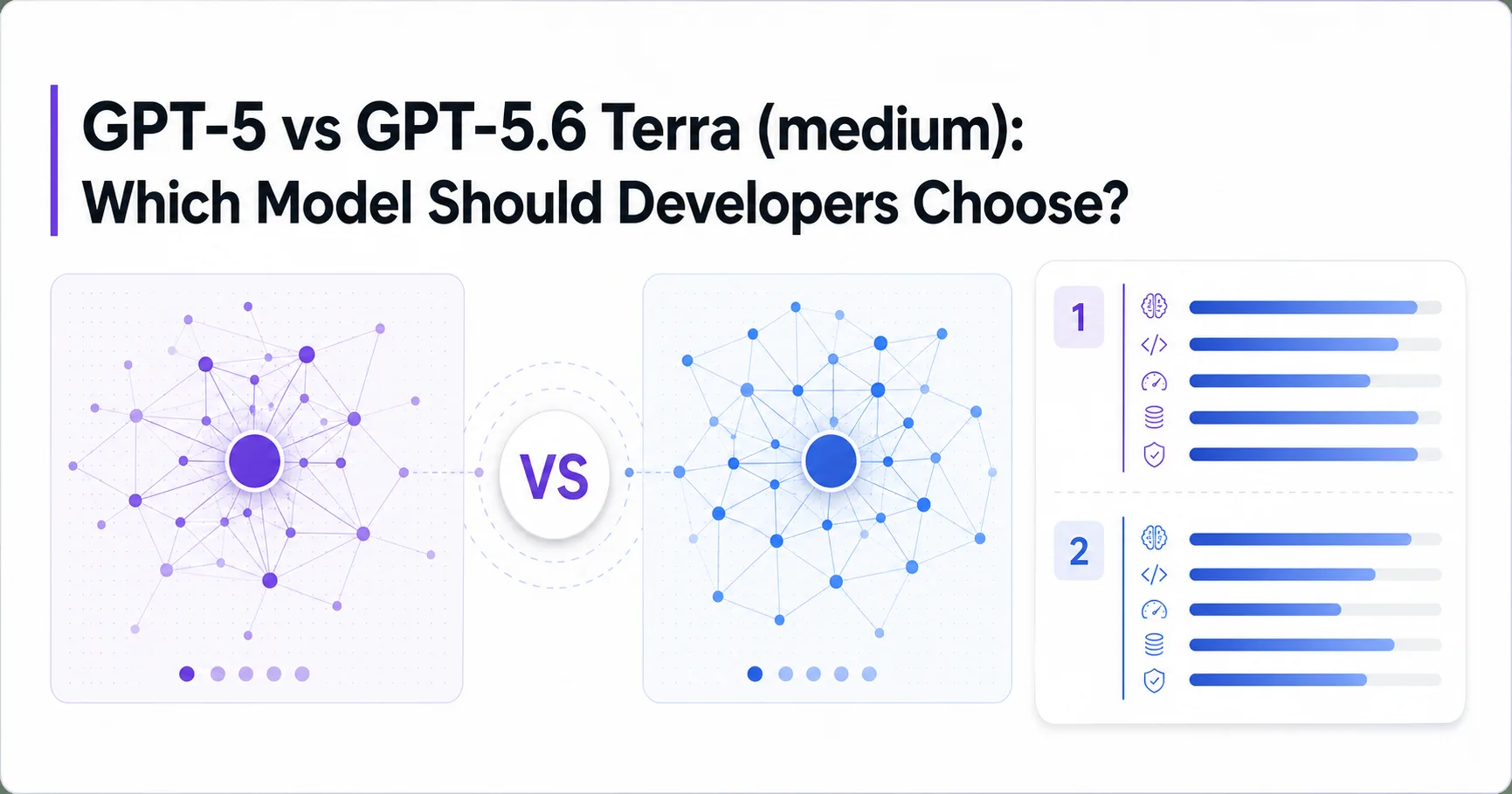
GPT-5.6 Terra (medium) is the stronger default for new developer workloads, while GPT-5 remains the lower-cost choice with more published technical detail.
The Artificial Analysis comparison gives GPT-5.6 Terra (medium) a coding index of 64.7, compared with 37.8 for GPT-5. Its intelligence index is 45.6, compared with 34.7 for GPT-5. GPT-5 has the only reported math index, at 94.3, so the evidence does not establish a math winner.
GPT-5.6 Terra (medium) also has a reported median output speed of 119.568 tokens per second. GPT-5 has no corresponding speed value in the supplied data, although both models show latency of 0.3 seconds. GPT-5 costs less on the supplied blended measure, at $3.4375 per 1M tokens versus $4.500000000000001.
The practical choice is therefore not simply newer versus older. GPT-5.6 Terra (medium) has better supplied coding and intelligence results, but its public documentation is less specific. GPT-5 has clearer limits, parameters, benchmarks, and operational caveats. The decision depends on whether measured task quality or documentation certainty carries more weight in the application.
GPT-5.6 Terra (medium) leads the available comparison for coding and general intelligence, but GPT-5 offers the more documented and cheaper operating profile.
OpenAI describes GPT-5 as a reasoning model for coding, reasoning, and agentic tasks in its GPT-5 for developers announcement. The model documentation lists gpt-5 as a callable alias and describes support for text and image input with text output in the GPT-5 model documentation. The same documentation marks the fixed snapshot gpt-5-2025-08-07 as Deprecated and recommends GPT-5.6, which creates migration risk for applications pinned to that snapshot.
The official OpenAI Models page presents gpt-5.6-terra as a Frontier model intended to balance intelligence and cost. However, the supplied research did not find a separate official capability description for gpt-5-6-terra-medium. The pricing page lists the family alias, but not that exact medium identifier, in the OpenAI API Pricing material.
That naming gap matters during implementation. Artificial Analysis reports a distinct comparison label, but the official material does not fully document the mapping. Developers should verify the exact endpoint, model identifier, and account availability before committing production traffic.
GPT-5.6 Terra (medium) is the evidence-backed performance choice for coding workflows, but the comparison cannot prove superiority for every task.
The coding index gap is large enough to change model selection for software agents. A score of 64.7 versus 37.8 suggests that GPT-5.6 Terra (medium) is more likely to produce useful first attempts across coding-oriented evaluation tasks. In a repository agent, that can reduce the number of repair loops, review cycles, and prompts needed before a patch becomes acceptable. The score does not guarantee correct changes in a specific codebase, and it does not reveal whether the advantage comes from planning, code editing, test repair, or another capability.
The intelligence index points in the same direction, with GPT-5.6 Terra (medium) at 45.6 and GPT-5 at 34.7. That supports using Terra for mixed workloads that combine implementation, analysis, and technical decision-making. GPT-5 still has a reported math index of 94.3, while Terra has no supplied math result. A team selecting for mathematical workloads therefore has an evidence gap rather than a demonstrated winner.
Speed changes the user experience. Terra reports 119.568 median output tokens per second, while GPT-5 has no supplied median output speed. Both report 0.3 seconds of latency, so faster generation should not be interpreted as faster request startup. The supplied data cannot establish total completion time, tool-call duration, or reliability under load.
Community evidence adds caution. One uncontrolled Reddit evaluation found GPT-5 useful for locating and fixing small bugs, but less complete for full applications and interface generation. The same post reported possible hallucinations or incorrect edits in complex existing repositories. Those observations are not a controlled comparison and cannot show that Terra avoids the same failures. No reliable community test was found for GPT-5.6 Terra (medium).
GPT-5 is cheaper on the supplied blended and per-token prices, but GPT-5.6 Terra (medium) can still be economically preferable when better outputs reduce engineering rework.
GPT-5 costs $3.4375 per 1M blended tokens, compared with $4.500000000000001 for GPT-5.6 Terra (medium). Its input price is $1.25 versus $2, and its output price is $10 versus $12. These figures make GPT-5 the straightforward choice for high-volume traffic where response quality is already sufficient and every request follows a predictable path.
The price difference becomes less decisive in agentic development workflows. A lower-priced model can become more expensive operationally if it needs additional prompts, repeated tool calls, test repairs, or human review. The supplied data does not quantify those secondary costs, so no exact break-even point can be calculated. The coding index difference supports investigating that possibility, but it does not prove that Terra will use fewer tokens or complete tasks with fewer calls.
Workload shape also matters. Short outputs, long outputs, cached input, batch processing, flex processing, fast processing, and long-context requests can produce different invoices. The official OpenAI API Pricing page lists separate processing modes and distinguishes short context from long context, but the supplied research does not provide the corresponding token thresholds for Terra.
GPT-5 has a simpler cost story in the supplied comparison, while Terra has more pricing paths to evaluate. Teams should measure cost per accepted change, not only cost per generated token. That metric should include failed patches, retries, review time, and the cost of routing uncertain tasks to another model.
GPT-5 (high) leads on 3 of 3 metrics
GPT-5.6 Terra (medium) should be the first production candidate for coding agents, while GPT-5 should remain the value option for cost-sensitive and well-bounded tasks.
Choose GPT-5.6 Terra (medium) when the system must generate or modify code, reason across several constraints, and produce useful results with limited intervention. The supplied coding index of 64.7 gives it the strongest direct evidence in this comparison. Its intelligence index of 45.6 also supports mixed developer assistants that explain architecture, investigate failures, and draft implementation plans.
Choose GPT-5 when token economics, documented controls, or established integrations matter most. OpenAI documents reasoning_effort values including high, along with verbosity controls, function calling, structured outputs, streaming, and custom tools in GPT-5 for developers and the GPT-5 model documentation. Those details make GPT-5 easier to configure deliberately, even though its supplied coding index is lower.
Use GPT-5 cautiously for full application generation and complex repository edits. The available community evidence is a single uncontrolled post, so it should inform a test plan rather than serve as a universal verdict. Terra has no comparable public community evidence, which means its absence of reported failures is not evidence of safer behavior.
Do not select either model for direct audio or video input and output based on the supplied official material. GPT-5 is explicitly documented around text and image input with text output. Terra is described more generally as supporting text and image input with text output, but the medium variant is not separately specified.
Before rollout, run both models against representative repositories and record accepted changes, retries, tool-call count, review effort, and total latency. The supplied benchmark data can rank candidates, but it cannot answer those product-specific questions.
GPT-5.6 Terra (medium) deserves a controlled pilot before adoption because its measured advantages exceed the specificity of its public documentation.
The largest unresolved issue is model identity. The research found the official family alias gpt-5.6-terra, while the comparison uses gpt-5-6-terra-medium. The OpenAI Models page does not provide a separate medium-specific capability description. Teams should confirm that the evaluated model is the model they can actually call.
The next unresolved issue is operational behavior. GPT-5 has published parameters, benchmarks, modality information, and a documented Deprecated status for its fixed snapshot. Terra has no supplied model-specific context window, maximum output, benchmark suite, or reliability metric. That makes Terra harder to size and govern, even though its supplied coding and intelligence indices are higher.
The comparison also lacks a direct quality-to-cost measurement. Terra is more expensive per supplied blended token, but the available data does not say whether it completes repository tasks with fewer retries. A pilot should therefore evaluate accepted work rather than raw generation volume.
GPT-5.6 Terra (medium) is the stronger first candidate for a coding agent because its supplied coding index is 64.7 versus 37.8 for GPT-5, although teams should validate results on representative repositories before production use.
GPT-5 is the cheaper budget choice on the supplied pricing data, at $3.4375 per 1M blended tokens versus $4.500000000000001 for GPT-5.6 Terra (medium), but retries and review effort may change total cost.
GPT-5.6 Terra (medium) is the only model with a supplied median output speed, at 119.568 tokens per second, while both models report latency of 0.3 seconds and GPT-5 has no comparable speed value.
The available research cannot answer that question because no model-specific context limit was found for GPT-5.6 Terra (medium), and the pricing page does not disclose the token thresholds for short and long context.
The available evidence cannot establish a math winner because GPT-5 has a reported math index of 94.3, while GPT-5.6 Terra (medium) has no supplied math evaluation.
GPT-5 can be used with a fixed snapshot, but the documented gpt-5-2025-08-07 snapshot is marked Deprecated, so teams that pin it should plan migration and monitor model availability.