
Time to First Token · GPT-5 (high)
0ms
Time to First Token · GPT-5 Codex (high)
0ms
Deep dive into reasoning, benchmarks, and latency insights.
The current catalog does not contain complete performance evidence for both models, so this page does not declare an overall winner. Use the available fields as comparison signals and validate the models on your own workload.
Key decision metrics at a glance.
| Model | Metric | Value | Unit | Source / snapshot |
|---|---|---|---|---|
| GPT-5 (high) | Reasoning | 9.0 | benchmark or capability score | Artificial Analysis · current catalog |
| GPT-5 Codex (high) | Reasoning | 10.0 | benchmark or capability score | Artificial Analysis · current catalog |
| GPT-5 (high) | Coding | 4.0 | benchmark or capability score | Artificial Analysis · current catalog |
| GPT-5 Codex (high) | Coding | 6.0 | benchmark or capability score | Artificial Analysis · current catalog |
| GPT-5 (high) | Multimodal | 3.0 | benchmark or capability score | Artificial Analysis · current catalog |
| GPT-5 Codex (high) | Multimodal | 3.0 | benchmark or capability score | Artificial Analysis · current catalog |
| GPT-5 (high) | Long Context | 4.0 | benchmark or capability score | Artificial Analysis · current catalog |
| GPT-5 Codex (high) | Long Context | 5.0 | benchmark or capability score | Artificial Analysis · current catalog |
| GPT-5 (high) | Blended Price / 1M tokens | $3.438 | USD per 1M tokens | Artificial Analysis · current catalog |
| GPT-5 Codex (high) | Blended Price / 1M tokens | $3.438 | USD per 1M tokens | Artificial Analysis · current catalog |
| GPT-5 (high) | P95 Latency | — | milliseconds | Artificial Analysis · current catalog |
| GPT-5 Codex (high) | P95 Latency | — | milliseconds | Artificial Analysis · current catalog |
| GPT-5 (high) | Tokens per second | 0 | tokens per second | Artificial Analysis · current catalog |
| GPT-5 Codex (high) | Tokens per second | 0 | tokens per second | Artificial Analysis · current catalog |
Data provided by Artificial Analysis; live values use the current catalog.
This radar chart visually maps the core capabilities (reasoning, coding, math proxy, multimodal, long context) of `GPT-5 (high)` vs `GPT-5 Codex (high)`.
This grouped bar chart provides a side-by-side comparison for each benchmark metric.
Lower time to first token is better; higher tokens per second is better.
Compare input and output pricing in USD per 1M tokens.
GPT-5 (high)$3.75
GPT-5 Codex (high)$3.75
This article is a dated snapshot published on 2026-08-07. Live cards above use the current catalog; missing live fields are not inferred.
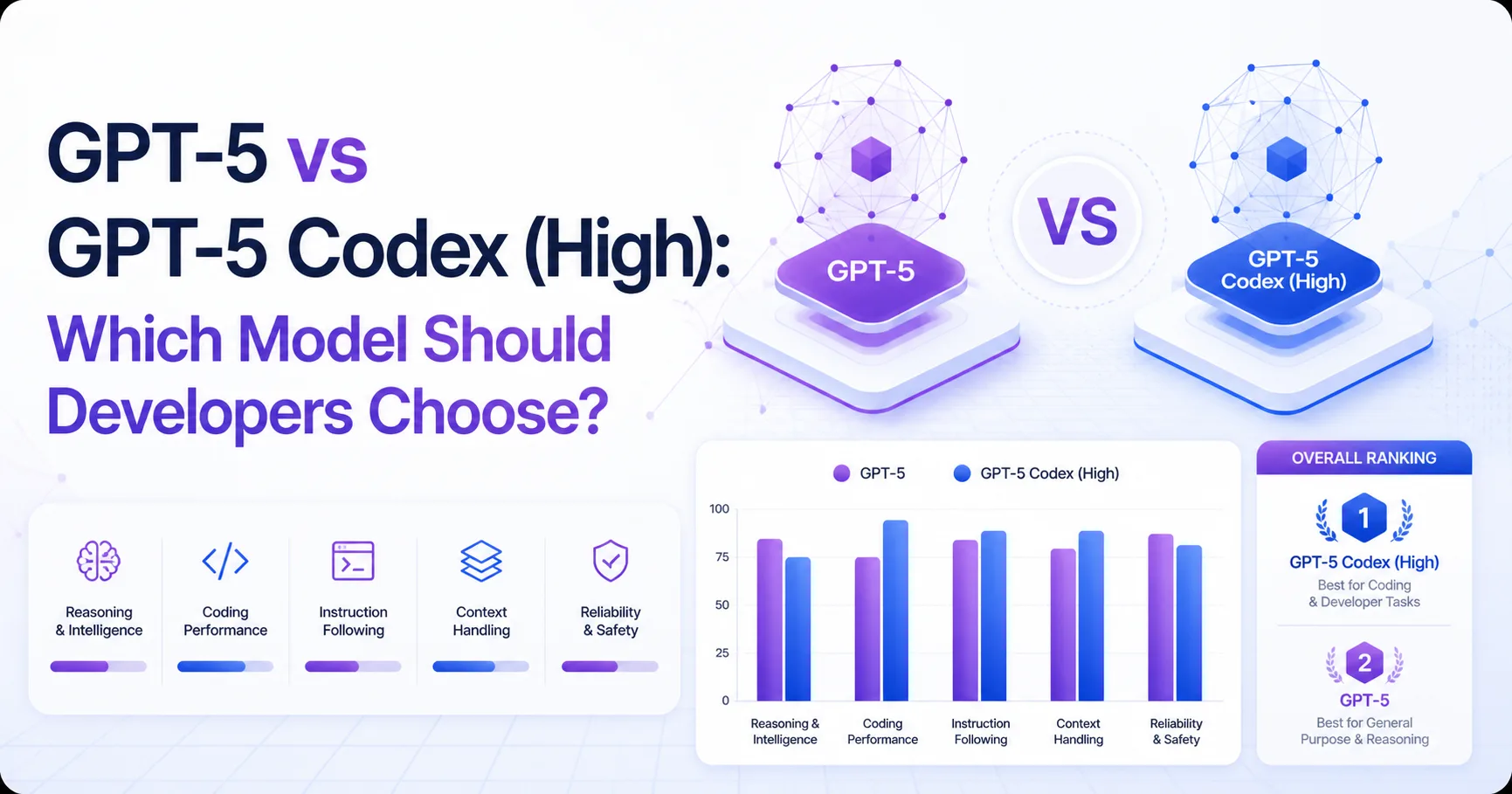
gpt-5 aliasgpt-5-codex model entry or its production behaviorGPT-5 Codex (high) leads the available measured comparison, but GPT-5 is the safer documented API choice for production teams. Artificial Analysis reports a 36.1 intelligence index and a 98.7 math index for GPT-5 Codex (high), compared with 34.7 and 94.3 for GPT-5, while the two models share the same reported pricing and latency. Artificial Analysis provides the comparison data.\n\nThe qualification matters because the public documentation does not clearly establish gpt-5-codex as an independently documented API model. The official OpenAI Models page does not list that exact model entry, and the official OpenAI Pricing page lists gpt-5.3-codex instead. GPT-5 therefore offers stronger documentation and clearer operational assumptions, while GPT-5 Codex offers the better measured result where the benchmark record is available.
GPT-5 Codex (high) is the measured capability winner, while GPT-5 is the evidence-backed integration winner.\n\nThe comparison has an unusual shape. GPT-5 Codex (high) scores 36.1 on the Artificial Analysis intelligence index and 98.7 on its math index. GPT-5 scores 34.7 and 94.3. The available data therefore favors Codex for broad reasoning and mathematical work. However, the coding comparison is incomplete because Artificial Analysis provides 37.8 for GPT-5 and no coding index value for GPT-5 Codex. A developer cannot responsibly convert that missing value into a coding victory for either model.\n\nThe cost picture is a complete tie in the supplied data. Each model is listed at $3.4375 per 1M blended tokens, $1.25 per 1M input tokens, and $10 per 1M output tokens. Reported latency is also tied at 0.3 seconds. The decision therefore depends on capability fit, API certainty, and failure tolerance rather than headline price or response latency.\n\nGPT-5 has a documented gpt-5 alias, reasoning controls, structured outputs, function calling, streaming, custom tools, text and image input, and text output according to GPT-5 for developers and the GPT-5 model documentation. The same documentation marks the fixed snapshot as Deprecated and recommends GPT-5.6, so teams choosing GPT-5 must also plan for model lifecycle management.\n\nThe central unanswered question is whether GPT-5 Codex (high) is a directly callable, stable production model with capabilities distinct from GPT-5. The supplied sources do not answer that question.
GPT-5 Codex (high) has the stronger measured reasoning profile, but the evidence does not prove that it is the better software-engineering model.\n\nThe clearest signal is mathematical performance. GPT-5 Codex (high) records 98.7 on the Artificial Analysis math index, while GPT-5 records 94.3. That difference supports Codex for workloads where mathematical reasoning, constraint handling, and exact intermediate logic dominate the task. It does not establish better debugging, repository navigation, code editing, or tool reliability. Those activities require a coding score, task protocol, and execution environment that the comparison does not provide.\n\nThe intelligence index points in the same direction. GPT-5 Codex (high) records 36.1, compared with 34.7 for GPT-5. This makes Codex the stronger candidate for difficult analytical prompts in the supplied dataset. It still does not reveal how much of the gain comes from model behavior, prompting, evaluator composition, or the meaning of the high reasoning configuration. Developers should treat the index as selection evidence, not as a guaranteed application-level improvement.\n\nGPT-5 has a different advantage: its public developer materials describe it as a reasoning model for coding, reasoning, and agentic tasks. Those materials document reasoning effort choices from minimal through high, verbosity controls, function calling, structured outputs, streaming, and grammar-constrained custom tools. GPT-5 for developers and the GPT-5 model documentation support those claims.\n\nThe coding result is the most important evidence gap. GPT-5 has an Artificial Analysis coding index of 37.8, but GPT-5 Codex has no supplied coding index. The official materials also do not provide a confirmed GPT-5 Codex-specific benchmark record. A team selecting an agent for code changes should run its own repository tasks before treating Codex as the default winner.\n\nThe reported latency tie at 0.3 seconds means neither model has a measured speed advantage in this dataset. It says little about total agent completion time, because tool calls, reasoning depth, retries, context size, and patch validation can dominate the user-visible wait.
GPT-5 and GPT-5 Codex have identical supplied token prices, so cost selection turns on task success and integration risk.\n\nThe chart shows no price advantage: both models are listed at $3.4375 per 1M blended tokens, with $1.25 for input and $10 for output. That makes a simple “choose the cheaper model” rule impossible. A team must instead ask whether the model completes the task with fewer retries, fewer corrective prompts, and fewer invalid patches. The supplied pricing data does not measure any of those costs.\n\nGPT-5 may be cheaper in practice when documentation reduces engineering time. Its official model page identifies the callable gpt-5 alias and describes supported endpoints, while the model documentation covers its API capabilities and limitations. GPT-5 model documentation provides that operational reference.\n\nGPT-5 Codex may be cheaper in practice if its stronger measured reasoning translates into fewer failed attempts on the team’s actual tasks. The brief does not contain retry counts, completion rates, repository benchmarks, or production telemetry, so that benefit remains unproven. The official pricing page lists gpt-5.3-codex, with different prices from the supplied GPT-5 Codex comparison, but it does not confirm that those prices apply to gpt-5-codex. See the OpenAI Pricing page.\n\nThe practical cost risk is therefore model identity. Paying the same listed rate does not guarantee equal availability, contract stability, or migration effort. Teams should verify the exact API identifier and billing behavior before committing to GPT-5 Codex.
GPT-5 is the default recommendation for production integration, while GPT-5 Codex (high) deserves a controlled trial for reasoning-heavy coding workflows.\n\nChoose GPT-5 when the application needs a clearly documented API contract. The official materials identify gpt-5, document reasoning effort and verbosity controls, and describe function calling, structured outputs, streaming, custom tools, and image input. Those capabilities make GPT-5 easier to evaluate as a general application component. The GPT-5 for developers page and GPT-5 model documentation are the relevant references.\n\nChoose GPT-5 Codex (high) for an experiment when the main objective is difficult reasoning, mathematical work, or code-agent behavior that can be measured inside a controlled repository. Its 98.7 math index and 36.1 intelligence index are stronger than GPT-5’s 94.3 and 34.7 in the supplied dataset. The experiment should measure accepted patches, test pass rate, rollback rate, human correction time, and total task time. Those measures are not present in the brief, so they must come from the team’s own evaluation.\n\nDo not choose GPT-5 Codex solely because its name suggests a coding advantage. The supplied comparison has no Codex coding index, and the official model directory does not list gpt-5-codex. The OpenAI Models page confirms the documentation gap.\n\nTreat GPT-5’s lifecycle status as a separate risk. The fixed GPT-5 snapshot is marked Deprecated, even though the gpt-5 alias remains documented. A team adopting GPT-5 should test alias behavior, record the exact model used, and maintain a migration path.\n\nFor multimodal workflows, GPT-5 supports text and image input with text output, but the model documentation does not support audio or video input or output. A workflow requiring those modalities needs another component. The brief does not establish equivalent modality support for GPT-5 Codex.\n\nThe final choice should follow this rule: use GPT-5 for documented production capability, and test GPT-5 Codex where its measured reasoning advantage could materially reduce task failure.
GPT-5 Codex (high) cannot be declared the better coding model because the supplied evidence does not include a comparable coding result or a confirmed model entry.\n\nThe research brief contains a direct coding index for GPT-5, but no corresponding value for GPT-5 Codex. It also contains official API documentation for GPT-5, while the cited official model directory does not list gpt-5-codex. Those gaps prevent a firm conclusion about Codex availability, API behavior, context limits, output limits, tool support, or production stability.\n\nCommunity evidence does not close the gap. The supplied GPT-5 Reddit discussion describes positive experiences with small bug fixes and concerns about incomplete application generation or incorrect changes in complex repositories, but it is a subjective, non-controlled account. The brief reports no reliable community material specifically about GPT-5 Codex (high). See the Reddit discussion.\n\nDevelopers should therefore separate measured capability from verified operability. The first supports a Codex trial. The second currently favors GPT-5.
GPT-5 Codex (high) cannot be confirmed as better for coding because the supplied data has no Codex coding index, while GPT-5 has a coding index of 37.8. Its stronger intelligence and math results justify a controlled coding trial, but they do not replace repository-level evidence. The official OpenAI Models page also does not confirm an independently documented gpt-5-codex entry.
GPT-5 and GPT-5 Codex cost the same in the supplied comparison: $3.4375 per 1M blended tokens, $1.25 per 1M input tokens, and $10 per 1M output tokens. Neither model wins on listed token price. Real project cost may still differ because retries, failed patches, human review, and model availability are not included in the supplied pricing data.
GPT-5 and GPT-5 Codex are tied at 0.3 seconds for the supplied latency measure. That result does not prove equal end-to-end agent speed, because tool calls, reasoning effort, context processing, retries, and validation can affect total completion time. The brief provides no median output-tokens-per-second value for either model.
A production team should adopt GPT-5 Codex (high) only after verifying the exact model identifier, API availability, billing, and repository-task performance. The supplied evidence shows stronger intelligence and math scores, but the official model directory does not list gpt-5-codex, and the brief provides no Codex-specific API contract, coding benchmark, or community validation. GPT-5 is the safer documented default.