
Time to First Token · GPT-5 (high)
0ms
Time to First Token · GPT-5 (medium)
0ms
Deep dive into reasoning, benchmarks, and latency insights.
The current catalog does not contain complete performance evidence for both models, so this page does not declare an overall winner. Use the available fields as comparison signals and validate the models on your own workload.
Key decision metrics at a glance.
| Model | Metric | Value | Unit | Source / snapshot |
|---|---|---|---|---|
| GPT-5 (high) | Reasoning | 9.0 | benchmark or capability score | Artificial Analysis · current catalog |
| GPT-5 (medium) | Reasoning | 9.0 | benchmark or capability score | Artificial Analysis · current catalog |
| GPT-5 (high) | Coding | 4.0 | benchmark or capability score | Artificial Analysis · current catalog |
| GPT-5 (medium) | Coding | 6.0 | benchmark or capability score | Artificial Analysis · current catalog |
| GPT-5 (high) | Multimodal | 3.0 | benchmark or capability score | Artificial Analysis · current catalog |
| GPT-5 (medium) | Multimodal | 3.0 | benchmark or capability score | Artificial Analysis · current catalog |
| GPT-5 (high) | Long Context | 4.0 | benchmark or capability score | Artificial Analysis · current catalog |
| GPT-5 (medium) | Long Context | 4.0 | benchmark or capability score | Artificial Analysis · current catalog |
| GPT-5 (high) | Blended Price / 1M tokens | $3.438 | USD per 1M tokens | Artificial Analysis · current catalog |
| GPT-5 (medium) | Blended Price / 1M tokens | $3.438 | USD per 1M tokens | Artificial Analysis · current catalog |
| GPT-5 (high) | P95 Latency | — | milliseconds | Artificial Analysis · current catalog |
| GPT-5 (medium) | P95 Latency | — | milliseconds | Artificial Analysis · current catalog |
| GPT-5 (high) | Tokens per second | 0 | tokens per second | Artificial Analysis · current catalog |
| GPT-5 (medium) | Tokens per second | 0 | tokens per second | Artificial Analysis · current catalog |
Data provided by Artificial Analysis; live values use the current catalog.
This radar chart visually maps the core capabilities (reasoning, coding, math proxy, multimodal, long context) of `GPT-5 (high)` vs `GPT-5 (medium)`.
This grouped bar chart provides a side-by-side comparison for each benchmark metric.
Lower time to first token is better; higher tokens per second is better.
Compare input and output pricing in USD per 1M tokens.
GPT-5 (high)$3.75
GPT-5 (medium)$3.75
This article is a dated snapshot published on 2026-08-07. Live cards above use the current catalog; missing live fields are not inferred.
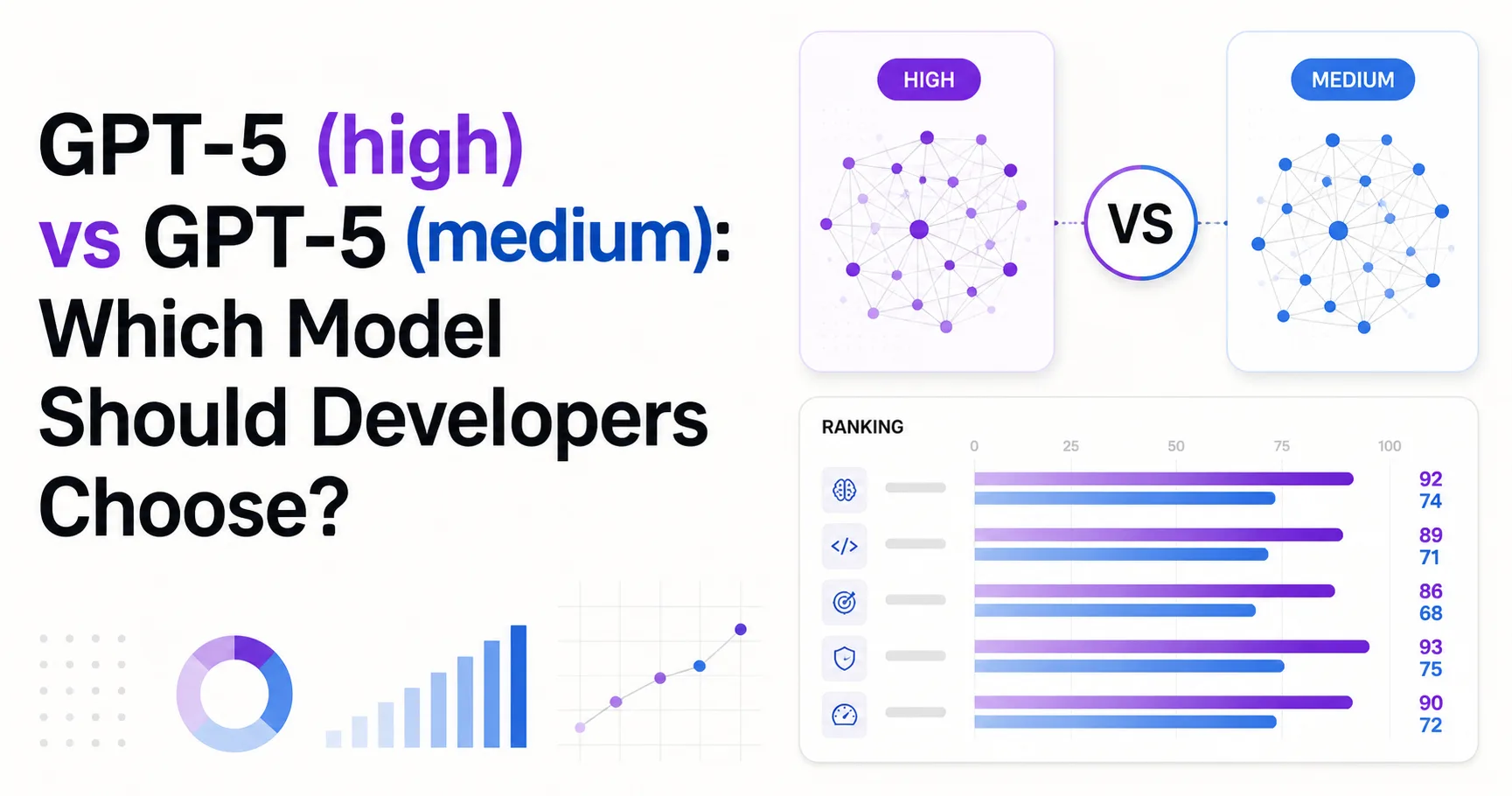
GPT-5 (high) is the safer developer choice because it has documented API behavior, public benchmark evidence, and a verified current price, while GPT-5 (medium) remains insufficiently documented. The supplied data gives GPT-5 (high) an Artificial Analysis Intelligence Index score of 34.7 and a Math Index score of 94.3. GPT-5 (medium) records 33.7 and 91.7 on those same indexes. The two entries share a blended price of $3.4375 per 1M tokens and latency of 0.3 seconds.\n\nThe central selection issue is therefore not a simple quality-versus-cost tradeoff. The measured comparison shows a modest general-intelligence advantage and a clearer mathematics advantage for GPT-5 (high), while the commercial data shows no price advantage for GPT-5 (medium). At the same time, the research does not verify that GPT-5 (medium) is a separately callable OpenAI model. OpenAI's model directory does not list it in the supplied research.\n\nData provided by https://artificialanalysis.ai/ supplies the comparable scores, prices, release dates, and latency values used in this article.
GPT-5 (high) offers the stronger evidence-backed profile, but the available comparison cannot establish a complete high-versus-medium product decision. The Artificial Analysis Intelligence Index favors GPT-5 (high) at 34.7 versus 33.7, and the Math Index favors it at 94.3 versus 91.7. The coding comparison is incomplete because the data provides 37.8 for GPT-5 (high) and no value for GPT-5 (medium).\n\nThe commercial decision is unusually straightforward in the supplied snapshot. GPT-5 (high) and GPT-5 (medium) have the same $3.4375 blended price per 1M tokens, the same $1.25 input price, and the same $10 output price. They also share 0.3-second latency. That means a team cannot justify choosing medium on measured price or latency savings.\n\nThe official evidence strengthens the case for GPT-5 (high). OpenAI describes GPT-5 as a reasoning model for coding, reasoning, and agentic tasks in GPT-5 for developers. The supplied research found no equivalent official description for GPT-5 (medium). It also found no reliable community testing for medium, so claims about its speed, behavior, or reliability would be speculation.
GPT-5 (high) has the stronger measured reasoning profile, with a 94.3 Math Index score versus 91.7 for GPT-5 (medium). The gap matters most for tasks where a wrong intermediate step can invalidate the final result, such as mathematical transformations, constraint-heavy planning, and agent workflows that must select the right action after several decisions. The score does not prove that every developer prompt will improve, but it supports preferring high when correctness is more valuable than minimal reasoning effort.\n\nGPT-5 (high) also has the only supplied coding score, 37.8 on the Artificial Analysis Coding Index. GPT-5 (medium) has no coding value in the data snapshot, so developers should not interpret the missing value as a failure or as parity. It is simply an evidence gap. OpenAI's published developer material reports GPT-5 results on SWE-bench Verified, Aider polyglot, τ²-bench telecom, and Scale MultiChallenge, but the supplied research does not provide corresponding medium results. The official developer announcement therefore supports GPT-5's general positioning, not a verified high-versus-medium benchmark conclusion.\n\nThe equal 0.3-second latency also changes the practical reading of the chart. Medium does not appear to buy a measured responsiveness advantage. Output speed is unavailable for both models, so streaming experience and time-to-complete remain unproven. Teams should test their own prompt lengths, tool loops, and output sizes before treating the latency tie as a full user-experience prediction.
GPT-5 (high) and GPT-5 (medium) are tied on every supplied price measure, so medium cannot be selected as the cheaper model on list price alone. Each is priced at $1.25 per 1M input tokens, $10 per 1M output tokens, and $3.4375 per 1M blended tokens. The absence of a price difference removes one common reason to route simple requests to a lower reasoning mode.\n\nApplication cost can still diverge if the models produce different amounts of text, invoke tools different numbers of times, or require different retry rates. The supplied data does not provide output tokens per second, prompt-specific token consumption, tool-call counts, or failure rates. Those missing variables prevent a reliable total-cost comparison. A model that costs the same per token can become more expensive operationally if it needs more corrective turns, while a shorter answer can reduce spend without changing the posted rate.\n\nDevelopers should therefore treat the displayed price tie as a procurement fact, not as proof of equal unit economics for a production workflow. OpenAI's pricing page does not list GPT-5 (medium) in the supplied research, and GPT-5 model documentation lists the GPT-5 price. The medium price shown in the comparison comes from the Artificial Analysis snapshot, not from a verified OpenAI pricing entry.
GPT-5 (high) should be the default choice for production coding, mathematical reasoning, and agentic workflows that need the strongest documented evidence. Its measured Intelligence Index score is 34.7, its Math Index score is 94.3, and it is the only model with a supplied coding score, 37.8. OpenAI also explicitly positions GPT-5 for coding, reasoning, and agentic tasks in its developer announcement.\n\nGPT-5 (medium) is reasonable only as an experimental routing label until its identity and behavior are verified. The supplied research found no gpt-5-medium entry in OpenAI's model directory, no dedicated official capability description, no official price listing in OpenAI's pricing documentation, and no reliable community test. That does not show that medium is unusable. It shows that a team cannot responsibly promise its availability, compatibility, or quality from the supplied sources.\n\nChoose GPT-5 (high) when a model decision must be made now and the workflow has meaningful correctness, maintenance, or tool-use risk. Consider medium only after confirming the actual model identifier, API access, and behavior in a controlled evaluation. Keep the test focused on the team's own tasks, because the supplied comparison does not expose medium's coding score, output speed, failure modes, or version status.\n\nThe main operational warning applies to fixed versions. GPT-5 model documentation marks the fixed snapshot gpt-5-2025-08-07 as Deprecated. A team choosing GPT-5 (high) should monitor migration requirements rather than assuming a fixed snapshot will remain available indefinitely.
GPT-5 (medium) cannot yet be judged as a fully specified production alternative because the supplied research does not establish its callable identity, official limits, or repeatable behavior. The comparison has useful measured values, but several questions that matter to developers remain open.\n\nThe data does not show whether medium is a distinct API model, a reasoning setting, or a label created by an external evaluation system. It also does not show whether the two entries share context limits, output limits, tool behavior, multimodal support, or deprecation policy. OpenAI's GPT-5 documentation describes the documented GPT-5 API, including its model status and capabilities, but that evidence cannot be transferred automatically to medium.\n\nCommunity evidence does not close the gap. A Reddit post reports useful small-bug debugging experiences with GPT-5, alongside concerns about abbreviated application generation and incorrect changes in complex codebases, but the post is a single uncontrolled experience and does not discuss medium separately. The Reddit discussion should inform test design, not serve as a medium benchmark.\n\nFor a real rollout, the missing evidence should be treated as a gating condition. Confirm the model ID, run representative coding and agent tasks, measure retries and token usage, and verify the lifecycle policy before routing production traffic.
GPT-5 (high) is the better-supported choice: it scores 34.7 versus 33.7 on the Intelligence Index and 94.3 versus 91.7 on the Math Index, while medium lacks equivalent official documentation.
GPT-5 (medium) is not cheaper in the supplied data: both models cost $3.4375 per 1M blended tokens, with identical input pricing of $1.25 and output pricing of $10.
Neither model is faster in the supplied comparison because both show 0.3-second latency, while output speed is unavailable, so streaming responsiveness and completion time remain unverified.
GPT-5 (medium) should not be treated as production-ready solely from this comparison because its official model identity, availability, capability limits, coding score, and lifecycle status remain unverified.
Developers should use the fixed GPT-5 snapshot only after checking migration requirements because the supplied OpenAI documentation marks gpt-5-2025-08-07 as Deprecated.