
Time to First Token · GPT-5 (high)
0ms
Time to First Token · Grok 4.5 (high)
13271ms
Deep dive into reasoning, benchmarks, and latency insights.
The current catalog does not contain complete performance evidence for both models, so this page does not declare an overall winner. Use the available fields as comparison signals and validate the models on your own workload.
Key decision metrics at a glance.
| Model | Metric | Value | Unit | Source / snapshot |
|---|---|---|---|---|
| GPT-5 (high) | Reasoning | 9.0 | benchmark or capability score | Artificial Analysis · current catalog |
| Grok 4.5 (high) | Reasoning | 6.0 | benchmark or capability score | Artificial Analysis · current catalog |
| GPT-5 (high) | Coding | 4.0 | benchmark or capability score | Artificial Analysis · current catalog |
| Grok 4.5 (high) | Coding | 7.0 | benchmark or capability score | Artificial Analysis · current catalog |
| GPT-5 (high) | Multimodal | 3.0 | benchmark or capability score | Artificial Analysis · current catalog |
| Grok 4.5 (high) | Multimodal | 5.0 | benchmark or capability score | Artificial Analysis · current catalog |
| GPT-5 (high) | Long Context | 4.0 | benchmark or capability score | Artificial Analysis · current catalog |
| Grok 4.5 (high) | Long Context | 7.0 | benchmark or capability score | Artificial Analysis · current catalog |
| GPT-5 (high) | Blended Price / 1M tokens | $3.438 | USD per 1M tokens | Artificial Analysis · current catalog |
| Grok 4.5 (high) | Blended Price / 1M tokens | $3 | USD per 1M tokens | Artificial Analysis · current catalog |
| GPT-5 (high) | P95 Latency | — | milliseconds | Artificial Analysis · current catalog |
| Grok 4.5 (high) | P95 Latency | — | milliseconds | Artificial Analysis · current catalog |
| GPT-5 (high) | Tokens per second | 0 | tokens per second | Artificial Analysis · current catalog |
| Grok 4.5 (high) | Tokens per second | 50.981 | tokens per second | Artificial Analysis · current catalog |
Data provided by Artificial Analysis; live values use the current catalog.
This radar chart visually maps the core capabilities (reasoning, coding, math proxy, multimodal, long context) of `GPT-5 (high)` vs `Grok 4.5 (high)`.
This grouped bar chart provides a side-by-side comparison for each benchmark metric.
Lower time to first token is better; higher tokens per second is better.
Compare input and output pricing in USD per 1M tokens.
GPT-5 (high)$3.75
Grok 4.5 (high)$3.5
Grok 4.5 (high) costs $0.25 less per run
This article is a dated snapshot published on 2026-08-07. Live cards above use the current catalog; missing live fields are not inferred.
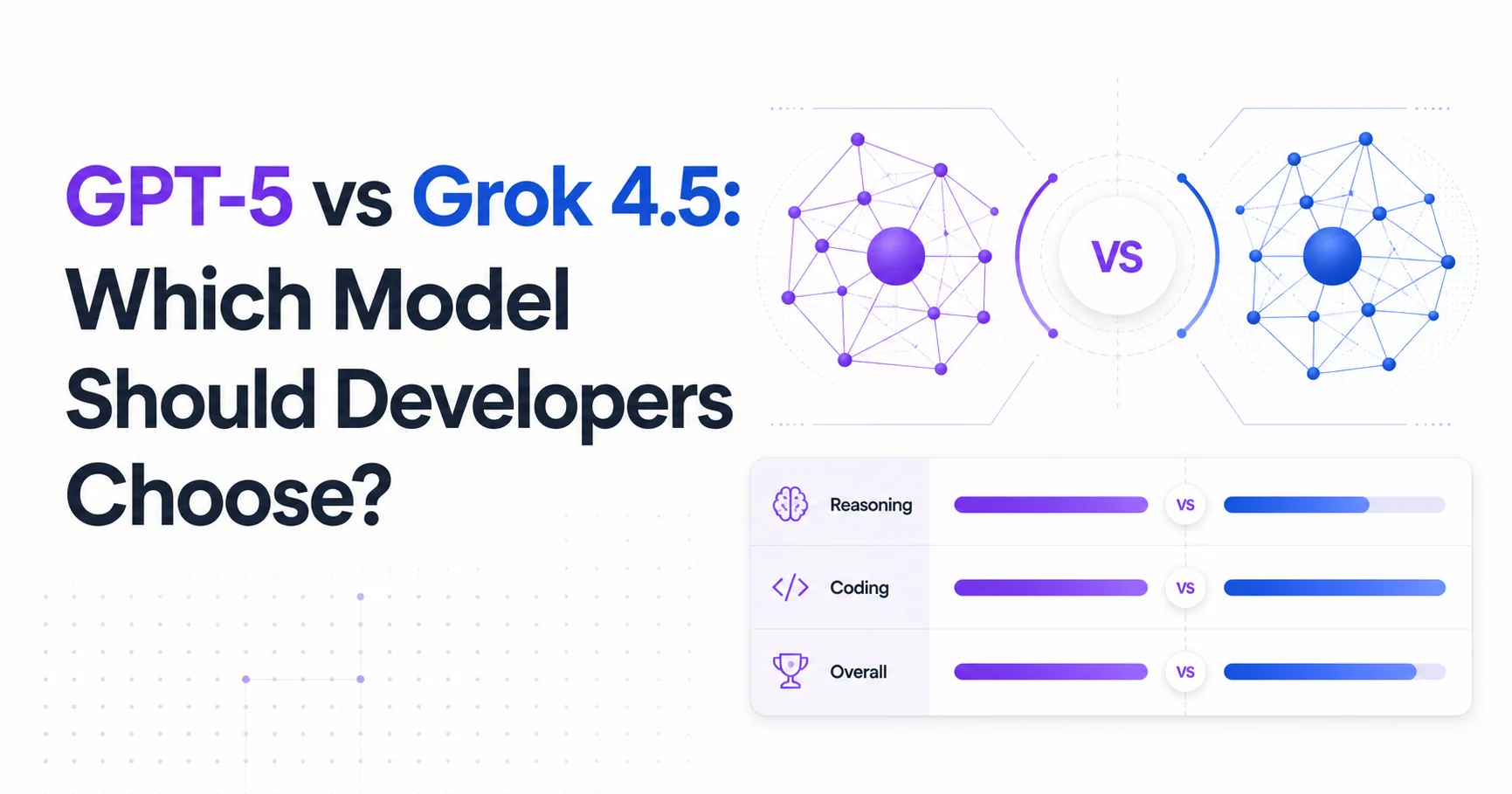
Grok 4.5 (high) is the stronger default for developers who prioritize coding capability, general intelligence, output speed, and blended API cost. The Artificial Analysis data brief gives Grok 4.5 a coding index of 72.4 and an intelligence index of 53.8, compared with GPT-5 at 37.8 and 34.7. Grok 4.5 also records 61.802 median output tokens per second, while the brief does not provide a comparable GPT-5 speed value. Both models show 0.3 seconds of latency in the brief.
GPT-5 remains the more defensible choice for workloads centered on mathematical reasoning, because its mathematics index is 94.3 and the data brief contains no comparable Grok 4.5 mathematics score. GPT-5 also costs $1.25 per 1M input tokens, compared with $2 for Grok 4.5. The cheaper input rate can matter for retrieval-heavy systems that send large prompts but generate short answers.
The lifecycle picture changes the recommendation. OpenAI's GPT-5 model documentation marks the fixed GPT-5 snapshot as Deprecated and describes GPT-5 as a previous-generation model. xAI's Grok 4.5 model details still list Grok 4.5 as available. Data provided by Artificial Analysis.
Grok 4.5 (high) offers the better broad engineering profile, while GPT-5 preserves important advantages for input cost and measured mathematics performance.
| Decision factor | Better choice | Why it matters |
|---|---|---|
| Coding-oriented work | Grok 4.5 (high) | Its coding index is 72.4 versus GPT-5 at 37.8. |
| Broad intelligence | Grok 4.5 (high) | Its intelligence index is 53.8 versus GPT-5 at 34.7. |
| Mathematical reasoning | GPT-5 | GPT-5 scores 94.3; no comparable Grok 4.5 value is provided. |
| Blended token economics | Grok 4.5 (high) | The blended price is $3 versus $3.4375 per 1M tokens. |
| Input-heavy prompts | GPT-5 | Input pricing is $1.25 versus $2 per 1M tokens. |
| Output-heavy workloads | Grok 4.5 (high) | Output pricing is $6 versus $10 per 1M tokens. |
| Measured generation speed | Grok 4.5 (high) | The brief reports 61.802 median output tokens per second. |
| Lifecycle certainty | Grok 4.5 (high) | GPT-5's fixed snapshot is marked Deprecated in OpenAI's documentation. |
These figures should guide routing decisions, not replace task-specific evaluation. The two vendors publish different benchmark families, and the data brief does not establish that every score is directly comparable across models. The strongest evidence is therefore directional: Grok 4.5 leads the available coding and intelligence indices, while GPT-5 leads only where the available evidence covers mathematics and input pricing.
Grok 4.5 (high) is the safer first candidate for software agents and code-generation workflows because the available coding index shows a large separation from GPT-5. A gap from 37.8 to 72.4 is unlikely to matter equally in every prompt, but it should matter in tasks that require repository navigation, multi-file edits, debugging, or sustained implementation. Developers should still test patch correctness, regression frequency, and review burden, because an index cannot reveal how often a model changes the wrong file or stops before a feature is complete.
GPT-5 (high) is more attractive when mathematical reasoning is a central acceptance criterion. Its mathematics index is 94.3, while the data brief provides no Grok 4.5 mathematics score. That is an evidence gap, not proof that Grok 4.5 is weaker at mathematics. A team selecting for formal derivations, numerical reasoning, or math-heavy scientific workflows should therefore run a matched evaluation instead of inferring a winner from the coding and intelligence indices.
Grok 4.5 has the only reported median output speed, at 61.802 tokens per second. The latency value is 0.3 seconds for both models in the brief, so the evidence suggests similar initial responsiveness but gives Grok 4.5 an advantage during longer generated responses. The conclusion may reverse for short answers, network-constrained deployments, streaming behavior, or prompts that trigger different reasoning paths.
Vendor documentation shows that GPT-5 supports function calling, structured outputs, streaming, and custom tools through OpenAI's developer announcement and model documentation. Grok 4.5 supports function calling, structured outputs, web search, X Search, and code execution according to xAI's developer documentation. Those tool differences may outweigh raw benchmark differences when the application depends on current web or X data.
Grok 4.5 (high) is cheaper for the blended workload represented by the data brief, but GPT-5 can still be cheaper for prompt-heavy applications. Grok 4.5 costs $3 per 1M blended tokens versus GPT-5 at $3.4375. Its output price is also lower, at $6 versus $10 per 1M output tokens. That combination favors coding agents, report generators, and other systems that spend substantial tokens producing plans, patches, explanations, or tool arguments.
GPT-5 costs $1.25 per 1M input tokens versus $2 for Grok 4.5. This matters when every request carries a large system prompt, retrieved repository context, conversation history, or repeated instructions. A model with the lower output price can become more expensive if the application mostly sends context and receives compact responses. The right comparison is therefore the application's observed input-to-output mix, not the blended figure alone.
Caching can further change the result. OpenAI lists cached input at $0.125 per 1M tokens, while xAI lists cached input at $0.30 per 1M tokens in its Grok 4.5 model details. xAI also warns developers to set a prompt cache key in its Grok 4.5 API documentation, because a cache miss can cause full input pricing. The data brief does not provide workload-specific cache-hit assumptions, so no universal cost winner can be declared for cached systems.
Long-context cost is another unresolved issue. xAI documents a higher pricing tier for requests beyond its standard context range, but the research brief does not provide the exact higher-tier amount. Teams using very large prompts should treat Grok's blended advantage as provisional until they measure real request distributions.
Grok 4.5 (high) leads on 2 of 3 metrics
Grok 4.5 (high) is the recommended starting point for general-purpose coding agents, repository maintenance, and output-heavy engineering workflows. Its available coding index is 72.4, its intelligence index is 53.8, its reported median output speed is 61.802 tokens per second, and its blended price is $3 per 1M tokens. These advantages align with systems that need the model to produce substantial implementation output while keeping average cost controlled.
Choose GPT-5 (high) for mathematics-first workloads, input-heavy applications, or teams already standardized on OpenAI's tool and API patterns. GPT-5's mathematics index is 94.3, input pricing is $1.25 per 1M tokens, and OpenAI documents support for structured outputs, function calling, streaming, and custom tools. GPT-5 also accepts image input, while neither model should be selected for direct audio or video input and output based on the documented modality limits.
Treat lifecycle risk as part of the selection. OpenAI's documentation still lists the gpt-5 alias, but marks the fixed snapshot as Deprecated and recommends a newer model. That creates migration work for systems requiring a fixed version. xAI currently lists grok-4.5 as available and provides aliases including grok-4.5-latest in its model details. A team that values stable model identity should verify retention policy, snapshot availability, and replacement behavior before launch.
Do not overread community reports. One Reddit report about GPT-5 describes useful small bug fixes but less complete application and interface generation. One Reddit report about Grok 4.5 describes an unexpected API usage experience, but the report was not independently reproduced. These accounts justify observability and regression tests, not a definitive reliability ranking.
The final choice should use a small private test set containing representative tickets, repository changes, mathematical tasks, tool calls, and long-context prompts. The provided evidence does not answer which model produces fewer production regressions, maintains quality over long agent loops, or has lower total cost for a specific application.
Grok 4.5 (high) is the default recommendation for most new developer-facing systems, but GPT-5 remains preferable when mathematics or input cost dominates the workload. The questions below address the selection points that the supplied evidence leaves partly unresolved.
Grok 4.5 is the stronger candidate for coding based on the available Artificial Analysis coding index, where it scores 72.4 versus GPT-5 at 37.8. Developers should still validate repository-specific correctness, test coverage, and regression behavior before committing.
Grok 4.5 is cheaper on the supplied blended measure at $3 per 1M tokens versus GPT-5 at $3.4375. GPT-5 can be cheaper for input-heavy workloads because its input price is $1.25 versus Grok 4.5 at $2.
GPT-5 is the safer evidence-based choice for mathematics because its mathematics index is 94.3 and the data brief supplies no comparable Grok 4.5 score. That missing value means the comparison remains incomplete rather than proving Grok 4.5 performs poorly.
Grok 4.5 is the only model with a reported median output speed in the data brief, at 61.802 tokens per second. Both models show 0.3 seconds of latency, so the evidence supports faster sustained generation but not a universal response-time victory.
GPT-5 can still fit a new integration, but its fixed snapshot is marked Deprecated in OpenAI's model documentation. Teams choosing it should plan migration review, while verifying that the stable alias provides the lifecycle behavior their application requires.