
Time to First Token · GPT-5 (high)
0ms
Time to First Token · Grok Build 0.1 0616
0ms
Deep dive into reasoning, benchmarks, and latency insights.
The current catalog does not contain complete performance evidence for both models, so this page does not declare an overall winner. Use the available fields as comparison signals and validate the models on your own workload.
Key decision metrics at a glance.
| Model | Metric | Value | Unit | Source / snapshot |
|---|---|---|---|---|
| GPT-5 (high) | Reasoning | 9.0 | benchmark or capability score | Artificial Analysis · current catalog |
| Grok Build 0.1 0616 | Reasoning | 6.0 | benchmark or capability score | Artificial Analysis · current catalog |
| GPT-5 (high) | Coding | 4.0 | benchmark or capability score | Artificial Analysis · current catalog |
| Grok Build 0.1 0616 | Coding | 5.0 | benchmark or capability score | Artificial Analysis · current catalog |
| GPT-5 (high) | Multimodal | 3.0 | benchmark or capability score | Artificial Analysis · current catalog |
| Grok Build 0.1 0616 | Multimodal | 3.0 | benchmark or capability score | Artificial Analysis · current catalog |
| GPT-5 (high) | Long Context | 4.0 | benchmark or capability score | Artificial Analysis · current catalog |
| Grok Build 0.1 0616 | Long Context | 5.0 | benchmark or capability score | Artificial Analysis · current catalog |
| GPT-5 (high) | Blended Price / 1M tokens | $3.438 | USD per 1M tokens | Artificial Analysis · current catalog |
| Grok Build 0.1 0616 | Blended Price / 1M tokens | $1.25 | USD per 1M tokens | Artificial Analysis · current catalog |
| GPT-5 (high) | P95 Latency | — | milliseconds | Artificial Analysis · current catalog |
| Grok Build 0.1 0616 | P95 Latency | — | milliseconds | Artificial Analysis · current catalog |
| GPT-5 (high) | Tokens per second | 0 | tokens per second | Artificial Analysis · current catalog |
| Grok Build 0.1 0616 | Tokens per second | 0 | tokens per second | Artificial Analysis · current catalog |
Data provided by Artificial Analysis; live values use the current catalog.
This radar chart visually maps the core capabilities (reasoning, coding, math proxy, multimodal, long context) of `GPT-5 (high)` vs `Grok Build 0.1 0616`.
This grouped bar chart provides a side-by-side comparison for each benchmark metric.
Lower time to first token is better; higher tokens per second is better.
Compare input and output pricing in USD per 1M tokens.
GPT-5 (high)$3.75
Grok Build 0.1 0616$1.5
Grok Build 0.1 0616 costs $2.25 less per run
This article is a dated snapshot published on 2026-08-07. Live cards above use the current catalog; missing live fields are not inferred.
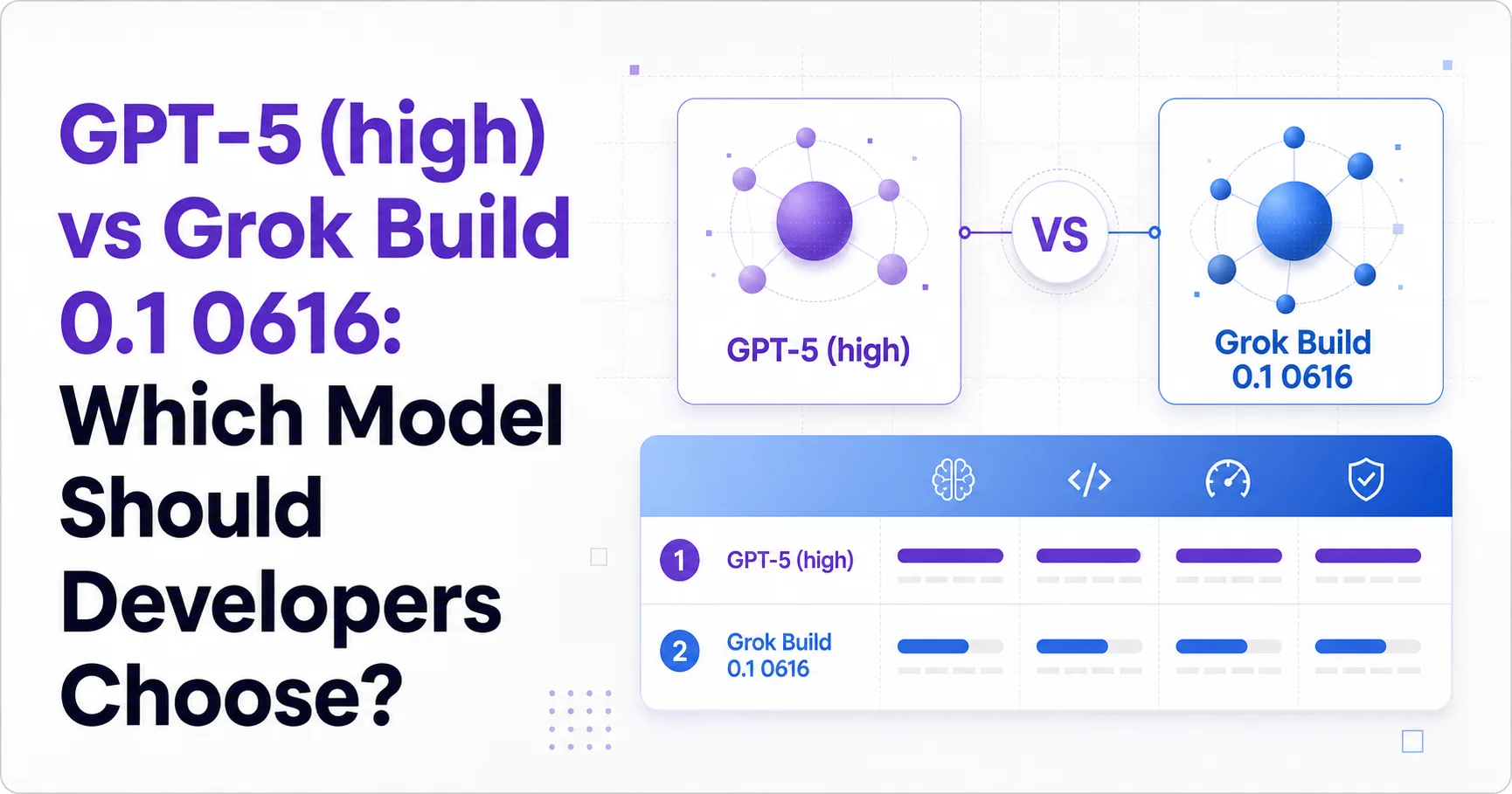
Grok Build 0.1 0616 is the stronger apparent value, but GPT-5 (high) is the safer documented engineering choice.\n\nThe supplied data brief gives Grok Build 0.1 0616 higher Artificial Analysis scores for intelligence and coding. Grok records a 39.8 intelligence index and a 51.5 coding index. GPT-5 (high) records 34.7 and 37.8 on those same measures.\n\nGrok also has the lower listed blended price, at $1.25 per 1M tokens versus GPT-5 (high) at $3.4375. The latency figure is 0.3 seconds for each model, so the supplied data does not establish a speed winner.\n\nThat apparent Grok advantage has a major qualification: the research brief found no verifiable vendor announcement, developer documentation, pricing page, model directory, benchmark publication, or community discussion for Grok Build 0.1 0616. GPT-5 has official documentation covering API behavior, tools, modalities, pricing, and lifecycle status.\n\nThe practical decision is therefore not simply “higher score versus lower score.” It is documented capability and operational certainty versus a cheaper model with stronger supplied benchmark results but insufficient evidence about how developers can access and operate it.\n\nData attribution: https://artificialanalysis.ai/.
Grok Build 0.1 0616 leads the supplied comparison, while GPT-5 (high) leads on verifiable product information.\n\nThe Artificial Analysis coding index favors Grok at 51.5 against GPT-5 (high) at 37.8. That gap makes Grok the more attractive candidate for coding workloads if the score is representative of the tasks your application sends. The intelligence index points in the same direction, with Grok at 39.8 and GPT-5 (high) at 34.7.\n\nGPT-5 (high) remains easier to evaluate as a production dependency. OpenAI describes GPT-5 as a reasoning model for coding, reasoning, and agentic tasks in GPT-5 for developers. Its model documentation documents the model alias, API endpoints, input modalities, output behavior, pricing, and lifecycle details.\n\nThe evidence does not support a confident conclusion about Grok’s context window, output limit, API parameters, multimodal support, reliability, or deployment path. That absence matters for developers because a benchmark result cannot answer whether a model fits an application’s integration and governance requirements.\n\nGPT-5 (high) also has a known lifecycle concern. The supplied research says the fixed snapshot is marked Deprecated, while the stable gpt-5 alias remains listed. Teams choosing GPT-5 should therefore plan around alias behavior and migration risk rather than treating the fixed snapshot as permanent.\n\nFor a quick prototype, Grok deserves validation because its supplied scores and price are favorable. For a production system that needs documented controls and supportable behavior, GPT-5 (high) has the stronger evidence base.
Grok Build 0.1 0616 appears better for coding and general intelligence, but the evidence does not show whether that advantage survives your workload.\n\nThe coding index difference is large enough to affect model selection. A higher coding score can indicate better performance on repository edits, implementation tasks, or code reasoning represented by the evaluation. It does not prove that Grok will make fewer unsafe changes in your codebase, because the supplied research contains no reproducible Grok test method or official benchmark description.\n\nGPT-5 has a more interpretable capability story. OpenAI reports results for SWE-bench Verified, Aider polyglot, τ²-bench telecom, and Scale MultiChallenge in GPT-5 for developers. The same source says the Aider result used high reasoning effort, and that the SWE-bench result excluded 23 questions that could not pass reliably on OpenAI’s infrastructure. Those qualifications make the official numbers useful evidence, but not a direct substitute for testing your own tasks.\n\nGPT-5 also exposes reasoning_effort and verbosity controls, according to GPT-5 for developers and GPT-5 model documentation. These controls give developers a documented way to trade response depth against practical workload needs. The research provides no equivalent Grok configuration details.\n\nThe latency evidence shows a tie at 0.3 seconds. Output speed is unavailable for both models, so neither model can be called faster from the supplied data.\n\nA developer should interpret Grok’s benchmark lead as a reason to run a task-specific trial, not as proof of production superiority. The decisive missing evidence is repeatable testing on representative repositories, tool calls, structured outputs, and failure recovery.
Grok Build 0.1 0616 has the lower listed token price, but GPT-5 (high) may be cheaper overall when integration risk creates engineering work.\n\nThe supplied pricing comparison lists Grok at $1.25 per 1M blended tokens and GPT-5 (high) at $3.4375. Grok also lists $1 per 1M input tokens and $2 per 1M output tokens, while GPT-5 (high) lists $1.25 and $10. The output price is the most important cost pressure for applications that generate long answers, patches, or agent traces.\n\nThose figures make Grok the clear first candidate for workloads with predictable access and similar token usage. The conclusion can reverse if Grok requires custom integration, lacks stable API documentation, or needs extra validation and fallback logic. The research brief does not establish whether Grok is directly callable, whether its listed price is currently actionable, or whether the model has a stable alias.\n\nGPT-5’s higher price buys more than tokens if the documented API capabilities reduce implementation effort. GPT-5 model documentation describes available endpoints and model behavior, while GPT-5 for developers documents tool-related features. A team can estimate those integration benefits more confidently than it can estimate Grok’s operational overhead.\n\nThe supplied data does not include cache usage, retries, routing, token distributions, or quality-adjusted cost. Developers should therefore compare cost per successful task, not price alone. A cheaper model that needs more retries, more human review, or a second model for missing capabilities can become the more expensive choice.
Grok Build 0.1 0616 leads on 3 of 3 metrics
GPT-5 (high) is the recommended default for production systems that require documented behavior, while Grok Build 0.1 0616 is the recommended experiment for cost-sensitive coding evaluation.\n\nChoose GPT-5 (high) when your team needs a known API contract, documented tool calling, structured outputs, image input, streaming, or configurable reasoning effort. OpenAI documents these capabilities in GPT-5 for developers and GPT-5 model documentation. GPT-5 does not support audio or video input and output, so those requirements need another component.\n\nChoose Grok Build 0.1 0616 for a controlled proof of concept when coding quality and token price dominate the decision. Its 51.5 coding index and $1.25 blended price are compelling in the supplied data. The team must first verify access, authentication, API semantics, output limits, tool support, and service continuity because the research found no authoritative Grok source.\n\nDo not select Grok solely because it ranks higher in the supplied indices. The research provides no Grok test methodology, no official release material, and no community evidence. That leaves important questions unanswered about reliability, migration, safety behavior, and performance on long-running agent workflows.\n\nDo not select GPT-5 solely because its official documentation is stronger. Its fixed snapshot is marked Deprecated, and its output price is materially higher. Teams should validate the stable alias, define a migration plan, and measure quality against their own acceptance tests.\n\nThe most defensible path is a two-stage decision: use Grok as a benchmark candidate, then promote it only if direct operational validation closes the evidence gap. Keep GPT-5 as the documented baseline for comparison and fallback planning.
GPT-5 (high) is easier to approve, while Grok Build 0.1 0616 requires unanswered operational questions before production adoption.\n\nThe central uncertainty is not the supplied score ranking. Grok leads the available Artificial Analysis indices, but the research contains no verifiable documentation for the model. GPT-5 has the opposite profile: its product surface is documented, yet its fixed snapshot has a deprecation warning and its token costs are higher.\n\nTeams should separate three decisions: whether the model can be accessed, whether it performs well on representative tasks, and whether it can be operated safely over time. The supplied materials answer those questions unevenly. GPT-5 has evidence for access and capabilities. Grok has stronger supplied comparison scores, but insufficient evidence for access and lifecycle.\n\nThe questions below focus on those gaps rather than repeating the chart values.
Grok Build 0.1 0616 is better according to the supplied coding index, scoring 51.5 compared with GPT-5 (high) at 37.8. That result should trigger task-specific validation because the research provides no Grok benchmark methodology or reproducible coding test.
GPT-5 (high) is the safer production starting point because OpenAI provides developer documentation for its API behavior, tools, modalities, pricing, and lifecycle. Grok Build 0.1 0616 may be cheaper and score higher, but its access path and operational contract remain unverified.
Grok Build 0.1 0616 is cheaper on the supplied token prices, at $1.25 per 1M blended tokens versus GPT-5 (high) at $3.4375. The real system cost remains uncertain because Grok’s integration and availability are undocumented in the supplied research.
Neither model is faster in the supplied comparison because both have a latency value of 0.3 seconds. Output-speed data is unavailable for both models, so developers should measure time to first useful result and complete task time themselves.
No separate gpt-5-high API model is verified in the research. The word “high” refers to GPT-5’s reasoning_effort=high setting, while the documented API alias is gpt-5.
The biggest risk is evidence insufficiency rather than a documented model limitation. The research does not verify Grok’s API, context window, output limit, parameters, modalities, pricing status, reliability, or migration path.