
Time to First Token · GPT-5 (high)
0ms
Time to First Token · Hy3
1831ms
Deep dive into reasoning, benchmarks, and latency insights.
The current catalog does not contain complete performance evidence for both models, so this page does not declare an overall winner. Use the available fields as comparison signals and validate the models on your own workload.
Key decision metrics at a glance.
| Model | Metric | Value | Unit | Source / snapshot |
|---|---|---|---|---|
| GPT-5 (high) | Reasoning | 9.0 | benchmark or capability score | Artificial Analysis · current catalog |
| Hy3 | Reasoning | 6.0 | benchmark or capability score | Artificial Analysis · current catalog |
| GPT-5 (high) | Coding | 4.0 | benchmark or capability score | Artificial Analysis · current catalog |
| Hy3 | Coding | 6.0 | benchmark or capability score | Artificial Analysis · current catalog |
| GPT-5 (high) | Multimodal | 3.0 | benchmark or capability score | Artificial Analysis · current catalog |
| Hy3 | Multimodal | 4.0 | benchmark or capability score | Artificial Analysis · current catalog |
| GPT-5 (high) | Long Context | 4.0 | benchmark or capability score | Artificial Analysis · current catalog |
| Hy3 | Long Context | 5.0 | benchmark or capability score | Artificial Analysis · current catalog |
| GPT-5 (high) | Blended Price / 1M tokens | $3.438 | USD per 1M tokens | Artificial Analysis · current catalog |
| Hy3 | Blended Price / 1M tokens | $0.241 | USD per 1M tokens | Artificial Analysis · current catalog |
| GPT-5 (high) | P95 Latency | — | milliseconds | Artificial Analysis · current catalog |
| Hy3 | P95 Latency | — | milliseconds | Artificial Analysis · current catalog |
| GPT-5 (high) | Tokens per second | 0 | tokens per second | Artificial Analysis · current catalog |
| Hy3 | Tokens per second | 74.815 | tokens per second | Artificial Analysis · current catalog |
Data provided by Artificial Analysis; live values use the current catalog.
This radar chart visually maps the core capabilities (reasoning, coding, math proxy, multimodal, long context) of `GPT-5 (high)` vs `Hy3`.
This grouped bar chart provides a side-by-side comparison for each benchmark metric.
Lower time to first token is better; higher tokens per second is better.
Compare input and output pricing in USD per 1M tokens.
GPT-5 (high)$3.75
Hy3$0.275
Hy3 costs $3.475 less per run
This article is a dated snapshot published on 2026-08-07. Live cards above use the current catalog; missing live fields are not inferred.
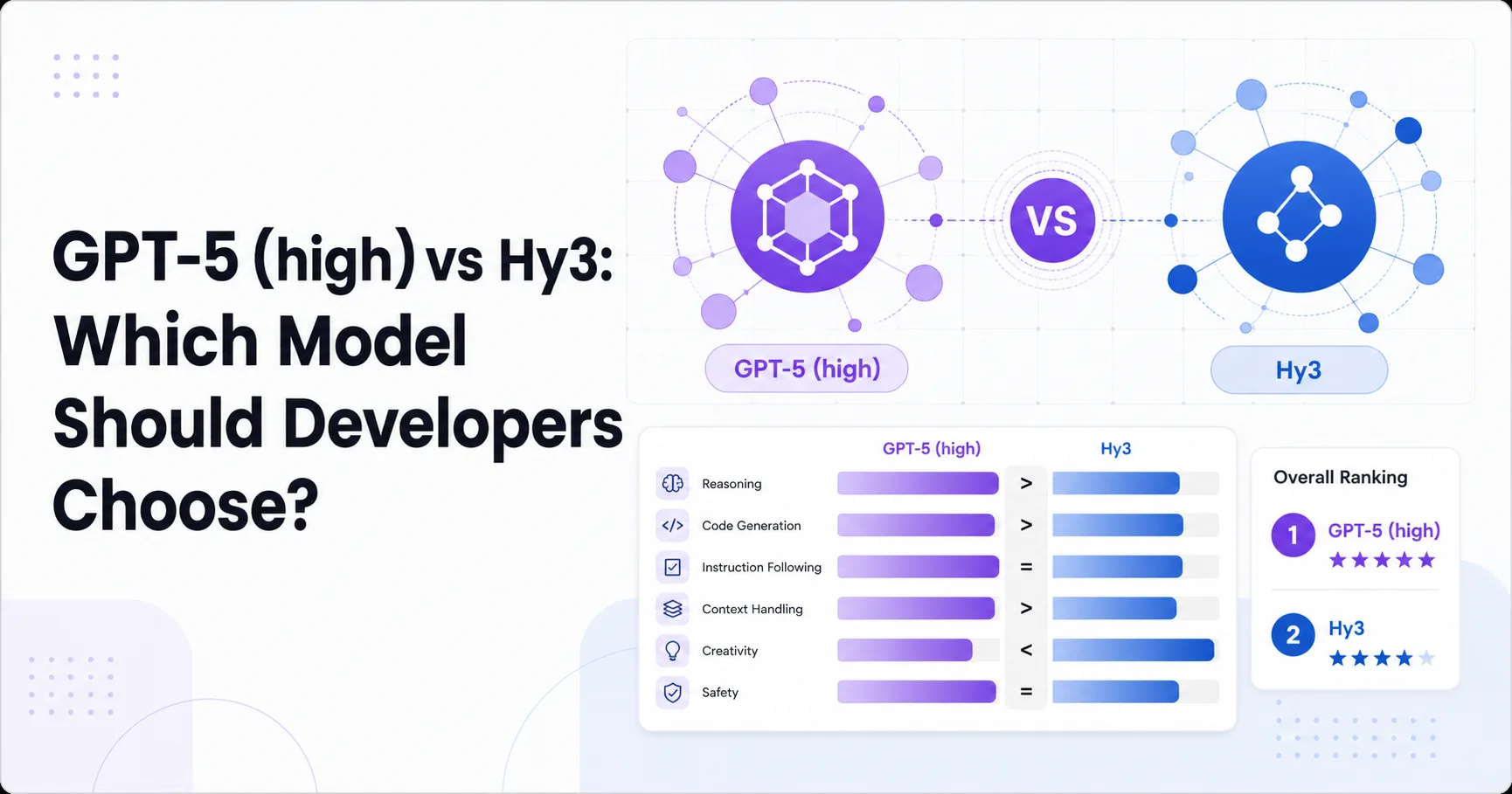
GPT-5 (high) is the safer documented choice, while Hy3 is the stronger apparent value for coding-heavy workloads. The supplied data gives Hy3 a 58.8 coding index and GPT-5 a 37.8 coding index, but the evidence behind Hy3 is not documented in the brief. Hy3 also costs $0.24125000000000005 per 1M blended tokens, compared with $3.4375 for GPT-5. That price gap can dominate a production decision if both models satisfy the same quality threshold.\n\nGPT-5 has a clearer product contract. OpenAI describes GPT-5 for developers as a reasoning model for coding, reasoning, and agentic tasks. Its documentation specifies text and image input, text output, tool calling, structured outputs, streaming, reasoning effort, and verbosity controls. The GPT-5 model documentation also identifies the current alias, pricing, limits, and deprecation status.\n\nHy3 has no official source in the supplied research. That means the comparison can identify a strong measured signal, but it cannot establish Hy3's API behavior, context limits, tool support, safety controls, or version stability. Data provided by Artificial Analysis supplies the comparative measurements used here.
Hy3 leads the supplied coding and intelligence measurements, but GPT-5 offers the only documented deployment surface and the only supplied math result.\n\n| Decision factor | GPT-5 (high) | Hy3 | What it means for developers | |---|---:|---:|---| | Coding index | 37.8 | 58.8 | Hy3 has the stronger supplied coding signal | | Intelligence index | 34.7 | 41.2 | Hy3 leads on the supplied general capability measure | | Math index | 94.3 | Not supplied | GPT-5 has a documented advantage only because Hy3 has no comparable value | | Blended price per 1M tokens | $3.4375 | $0.24125000000000005 | Hy3 is materially cheaper in the supplied pricing snapshot | | Input price per 1M tokens | $1.25 | $0.136 | Input-heavy workloads favor Hy3 on price | | Output price per 1M tokens | $10 | $0.557 | Long-answer workloads make GPT-5's cost premium more important | | Median output speed | Not supplied | 71.711 tokens per second | Hy3 has the only supplied throughput measurement | | Latency | 0.3 seconds | 0.3 seconds | The supplied latency result is a tie | \nThe table does not prove that Hy3 is better for every application. It shows where the supplied evidence points. The missing Hy3 documentation is itself a selection risk, especially for teams that need predictable integration behavior. GPT-5's fixed snapshot is also marked Deprecated in the supplied documentation, so documented does not mean risk-free.
Hy3 leads the supplied coding and intelligence indexes, but GPT-5 remains easier to evaluate for reasoning-led applications because its behavior and controls are documented. The coding gap is large enough to matter for repository edits, code generation, and developer workflows. It does not tell you whether Hy3 follows repository conventions, preserves tests, or makes safe changes in an existing codebase. Those outcomes depend on prompting, tool integration, context handling, and evaluation design.\n\nGPT-5's official benchmark evidence covers coding, reasoning, agentic tasks, and tool-oriented workloads. OpenAI reports GPT-5 results for SWE-bench Verified, Aider polyglot, τ²-bench telecom, and Scale MultiChallenge. The same source states that the Aider evaluation used high reasoning effort and that the SWE-bench result excluded problems that could not be passed reliably on OpenAI's infrastructure. Those qualifications make the results useful evidence, but not a direct forecast of every production workflow.\n\nGPT-5 also exposes reasoning_effort and verbosity, which gives developers explicit ways to trade response depth against latency and output size. Its support for function calling, structured outputs, streaming, and grammar-constrained custom tools is relevant when a model must act inside a controlled application. The model documentation confirms these capabilities and also states that audio and video input or output are unsupported.\n\nHy3's 71.711 median output tokens per second is the only supplied output-speed measurement, so it is a useful signal for interactive generation. It is not a complete latency profile. Both models show 0.3 seconds of supplied latency, while Hy3 has no supplied official explanation of how that measurement was produced. Hy3 may be the better choice for fast coding assistance, but the evidence is insufficient to judge tool-call reliability, long-context behavior, or production consistency.
Hy3 is the clear price leader in the supplied snapshot, yet GPT-5 can still be cheaper overall if it prevents enough retries, reviews, or failed tool actions. The blended price is $0.24125000000000005 for Hy3 and $3.4375 for GPT-5. That difference makes Hy3 attractive for high-volume autocomplete, routine transformations, batch coding suggestions, and workloads where developers can cheaply verify outputs.\n\nThe price comparison becomes less simple when output quality changes operational work. A cheaper response that requires repeated prompting, manual repair, or additional validation can consume more engineering time than its token price suggests. The supplied data does not measure retry rates, defect rates, review time, or task completion cost for either model. A buyer should therefore treat token price as a strong screening signal, not as a complete total-cost calculation.\n\nGPT-5's output price is $10 per 1M tokens, while Hy3's is $0.557. This matters most for agents that produce long plans, patches, explanations, or tool arguments. GPT-5's cached input price of $0.125 may improve repeated-context economics, but the brief does not provide a comparable Hy3 cached-input price. The cost conclusion can therefore flip for applications with very different input and output mixes.\n\nGPT-5 also has documented API support for Chat Completions, Responses, and Batch endpoints, according to the model documentation. Hy3 has no supplied source confirming endpoint availability, billing rules, caching, rate limits, or support terms. Until those details are verified, Hy3's low measured price should be treated as promising but operationally incomplete evidence.
Hy3 leads on 3 of 3 metrics
Hy3 is the first candidate for cost-sensitive coding workloads, while GPT-5 is the first candidate for documented agentic workflows and math-heavy reasoning.\n\nChoose Hy3 when the primary objective is maximizing coding throughput under a strict token budget. Its supplied coding index of 58.8, intelligence index of 41.2, output speed of 71.711 tokens per second, and blended price of $0.24125000000000005 create a compelling profile for interactive developer tools. Before production rollout, validate repository edits, test preservation, tool calls, structured output, context limits, and failure recovery in your own harness.\n\nChoose GPT-5 when integration requirements matter as much as benchmark position. OpenAI documents GPT-5 for coding, reasoning, and agentic tasks, with configurable reasoning effort and verbosity. The model documentation also provides the clearest supplied account of its modalities, endpoints, output limits, and tool behavior. GPT-5 is the better-supported option for teams that need a known API contract, image input, or a math-oriented evaluation signal of 94.3.\n\nDo not choose GPT-5 solely because it has official benchmark material. The supplied documentation marks the fixed snapshot gpt-5-2025-08-07 as Deprecated and recommends GPT-5.6, while the research identifies no separate gpt-5-high API model. The practical choice is the gpt-5 alias with reasoning_effort=high, subject to migration planning.\n\nDo not choose Hy3 solely because its chart is better or its price is lower. The research provides no Hy3 official documentation, no community evidence, no pricing source beyond the data snapshot, and no math index. Those gaps make Hy3 a strong test candidate, not a fully evidenced default. A staged evaluation with identical prompts, tools, repositories, and acceptance tests is required before committing to it.
GPT-5 has a documented surface, but neither model has enough supplied evidence to predict total production reliability. The brief does not provide a controlled head-to-head test using the same prompts, tools, repositories, or acceptance criteria. It also does not provide error rates, retry rates, hallucination rates, context-window values for the comparison snapshot, or cost per successfully completed task.\n\nHy3 has the larger supplied coding index, but the research does not identify the benchmark methodology, API provider, model documentation, release policy, or tool support. The absence of an official source is not evidence that Hy3 lacks these capabilities. It means the buyer cannot verify them from the supplied material.\n\nCommunity evidence is also asymmetric. A Reddit discussion about GPT-5 reports useful performance on small debugging tasks, while describing more limited completion and design detail in full application and UI generation. The same discussion mentions possible hallucinations or incorrect changes in complex existing codebases. These are subjective, uncontrolled observations, so they should guide test design rather than settle the verdict. No comparable Hy3 community evidence is supplied.\n\nThe most important unanswered question is whether Hy3's measured coding lead survives real repository work with tools and review gates. The supplied material does not answer that question. Teams should resolve it with a representative internal benchmark before selecting a default model.
GPT-5 is the better-documented option, while Hy3 is the better-supported option only in the supplied comparative measurements. The choice depends on whether API certainty or measured coding and cost signals carry more weight.
Hy3 leads the supplied coding index at 58.8 versus GPT-5 at 37.8, so Hy3 is the stronger measured coding candidate. The evidence does not show whether that lead persists across your repositories, tools, review process, or failure recovery requirements.
Hy3 is cheaper in the supplied snapshot at $0.24125000000000005 per 1M blended tokens versus GPT-5 at $3.4375. GPT-5 may still reduce total cost if its documented controls and behavior prevent enough retries, failed actions, or manual review.
GPT-5 is the safer starting point for agentic applications because OpenAI documents function calling, structured outputs, streaming, custom tools, reasoning effort, and verbosity controls. Hy3 may perform well, but the supplied research does not verify equivalent capabilities.
GPT-5 (high) is not identified as a separate official API model in the supplied research. The evidence describes high as the reasoning_effort=high parameter for GPT-5, while the callable model alias is gpt-5.
Developers should treat the fixed snapshot as a migration risk because the supplied model documentation marks gpt-5-2025-08-07 as Deprecated. Teams that need GPT-5 behavior should monitor the alias and maintain regression tests before changing versions.
Hy3 has the only supplied median output-speed measurement at 71.711 tokens per second, while both models have a supplied latency value of 0.3 seconds. The evidence is insufficient for a complete streaming or end-to-end speed comparison.