
Time to First Token · GPT-5 (high)
0ms
Time to First Token · Inkling Small
1862ms
Deep dive into reasoning, benchmarks, and latency insights.
The current catalog does not contain complete performance evidence for both models, so this page does not declare an overall winner. Use the available fields as comparison signals and validate the models on your own workload.
Key decision metrics at a glance.
| Model | Metric | Value | Unit | Source / snapshot |
|---|---|---|---|---|
| GPT-5 (high) | Reasoning | 9.0 | benchmark or capability score | Artificial Analysis · current catalog |
| Inkling Small | Reasoning | 6.0 | benchmark or capability score | Artificial Analysis · current catalog |
| GPT-5 (high) | Coding | 4.0 | benchmark or capability score | Artificial Analysis · current catalog |
| Inkling Small | Coding | 5.0 | benchmark or capability score | Artificial Analysis · current catalog |
| GPT-5 (high) | Multimodal | 3.0 | benchmark or capability score | Artificial Analysis · current catalog |
| Inkling Small | Multimodal | 3.0 | benchmark or capability score | Artificial Analysis · current catalog |
| GPT-5 (high) | Long Context | 4.0 | benchmark or capability score | Artificial Analysis · current catalog |
| Inkling Small | Long Context | 5.0 | benchmark or capability score | Artificial Analysis · current catalog |
| GPT-5 (high) | Blended Price / 1M tokens | $3.438 | USD per 1M tokens | Artificial Analysis · current catalog |
| Inkling Small | Blended Price / 1M tokens | $0.525 | USD per 1M tokens | Artificial Analysis · current catalog |
| GPT-5 (high) | P95 Latency | — | milliseconds | Artificial Analysis · current catalog |
| Inkling Small | P95 Latency | — | milliseconds | Artificial Analysis · current catalog |
| GPT-5 (high) | Tokens per second | 0 | tokens per second | Artificial Analysis · current catalog |
| Inkling Small | Tokens per second | 61.345 | tokens per second | Artificial Analysis · current catalog |
Data provided by Artificial Analysis; live values use the current catalog.
This radar chart visually maps the core capabilities (reasoning, coding, math proxy, multimodal, long context) of `GPT-5 (high)` vs `Inkling Small`.
This grouped bar chart provides a side-by-side comparison for each benchmark metric.
Lower time to first token is better; higher tokens per second is better.
Compare input and output pricing in USD per 1M tokens.
GPT-5 (high)$3.75
Inkling Small$0.6
Inkling Small costs $3.15 less per run
This article is a dated snapshot published on 2026-08-07. Live cards above use the current catalog; missing live fields are not inferred.
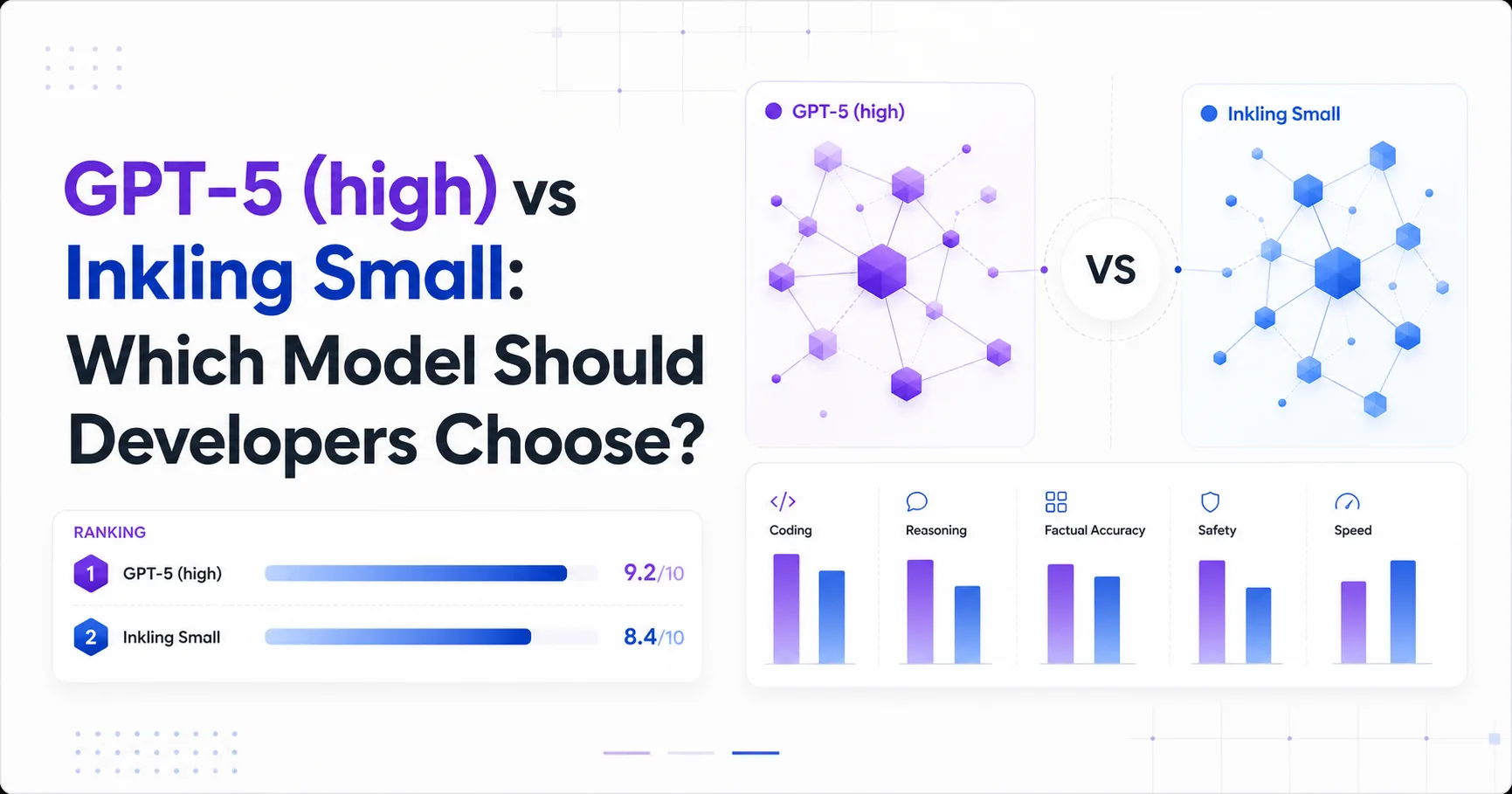
GPT-5 (high) is the safer documented choice, while Inkling Small is the stronger value signal in the supplied data.
Inkling Small leads the available Artificial Analysis scores for general intelligence and coding, with values of 40.2 and 52.9. GPT-5 records 34.7 and 37.8 on those same indexes. Inkling Small also has a blended price of $0.525 per 1M tokens, compared with $3.4375 for GPT-5. Data provided by https://artificialanalysis.ai/
That apparent win is not a complete product recommendation. The research brief contains no verifiable Inkling Small documentation, API catalog, pricing page, release announcement, benchmark method, or community discussion. Developers therefore have no supplied evidence for its context window, output limit, supported modalities, tool interface, reliability, or continued availability.
GPT-5 has the opposite profile. OpenAI documents its API identity, context window, output limit, modalities, reasoning controls, tool support, and limitations. OpenAI’s developer announcement positions GPT-5 for coding, reasoning, and agentic tasks. The GPT-5 model documentation lists the callable alias, endpoint support, pricing, and lifecycle status.
The decision is therefore asymmetric: Inkling Small looks better on price and the available comparative indexes, but GPT-5 offers much stronger evidence for integration planning. The best choice depends on whether measured value or operational certainty carries more risk in your application.
Inkling Small has the better measured profile, while GPT-5 has the better documented profile.
| Decision factor | GPT-5 (high) | Inkling Small | Practical reading |
|---|---|---|---|
| Intelligence index | 34.7 | 40.2 | Inkling Small leads the supplied comparison |
| Coding index | 37.8 | 52.9 | Inkling Small leads the supplied comparison |
| Math index | 94.3 | No value supplied | GPT-5 has the only comparable evidence |
| Blended price per 1M tokens | $3.4375 | $0.525 | Inkling Small is the lower-cost option |
| Input price per 1M tokens | $1.25 | $0.3 | Inkling Small is cheaper on input processing |
| Output price per 1M tokens | $10 | $1.2 | Inkling Small is cheaper on generated output |
| Latency | 0.3 seconds | 0.3 seconds | The supplied data shows a tie |
| Median output speed | No value supplied | 123.278 tokens per second | Only Inkling Small has a supplied speed value |
| Public API evidence | Documented | Not found in the brief | GPT-5 is easier to assess before integration |
The scores do not prove that Inkling Small is more capable in every developer workflow. They show that it leads on the supplied intelligence and coding indexes. They do not establish how either model behaves on your codebase, tool schemas, long context, structured output, or production error handling.
GPT-5’s official materials describe text and image input with text output, plus function calling, structured outputs, streaming, and custom tools. The developer announcement also documents reasoning effort and verbosity controls. Inkling Small has no corresponding evidence in the research brief.
That difference changes the meaning of the comparison. Inkling Small is the better candidate for a controlled trial with strict observability. GPT-5 is the better candidate when an integration needs documented behavior before the trial begins.
GPT-5 offers the stronger documented reasoning case, while Inkling Small leads the available broad performance indexes.
Inkling Small’s Coding Index is 52.9, compared with GPT-5’s 37.8. Its Intelligence Index is 40.2, compared with GPT-5’s 34.7. Those results make Inkling Small the clear leader in the supplied comparable measurements. Data provided by https://artificialanalysis.ai/
For a developer, the important question is what the coding lead changes in practice. A higher coding index may justify testing Inkling Small first for routine code generation, transformation, and implementation tasks. It does not reveal patch correctness, regression frequency, repository navigation quality, or how often the model changes unrelated files. The research brief provides no controlled evidence for those failure modes.
GPT-5 has a separate strength that the shared indexes do not capture. OpenAI reports a 94.3 result on the supplied math index, while Inkling Small has no corresponding value. OpenAI also reports 74.9% on SWE-bench Verified, 88% on Aider polyglot, 96.7% on τ²-bench telecom, and 69.6% on Scale MultiChallenge. The GPT-5 developer announcement explains that the SWE-bench result excluded 23 problems that could not run reliably in OpenAI’s infrastructure, and that the Aider result used high reasoning effort.
The speed evidence is similarly incomplete. Inkling Small has a supplied median output speed of 123.278 tokens per second. GPT-5 has no supplied output-speed value. Both models have a supplied latency value of 0.3 seconds, so the available data does not establish a latency advantage.
A responsible performance test should therefore measure task success, repair quality, tool-call validity, output completeness, and retry cost on your workload. The supplied evidence identifies candidates, not a final production winner.
Inkling Small is dramatically cheaper on the supplied token prices, but missing operational evidence can erase a nominal savings advantage.
Inkling Small costs $0.525 per 1M blended tokens, while GPT-5 costs $3.4375. Inkling Small also costs $0.3 per 1M input tokens and $1.2 per 1M output tokens, compared with GPT-5 at $1.25 and $10. Data provided by https://artificialanalysis.ai/
That price gap favors Inkling Small for high-volume workloads with predictable prompts and short feedback loops. It is especially attractive when the application can route routine tasks to a low-cost model and reserve more expensive reasoning for exceptions. The data brief does not establish whether Inkling Small supports that routing architecture, because it supplies no API or product documentation.
Token price is also only one part of developer economics. A cheaper model becomes more expensive when it needs repeated retries, larger corrective prompts, manual review, or application-side validation. The research brief contains no Inkling Small evidence for any of those factors. It also contains no controlled comparison of completion length, tool-call retries, or successful task rate.
GPT-5’s output price is materially higher, but documented controls may reduce integration uncertainty. OpenAI documents reasoning_effort values of minimal, low, medium, and high, plus verbosity controls. OpenAI’s developer materials describe these controls as part of the API model behavior. GPT-5 also supports cached input at $0.125 per 1M tokens, according to the model documentation.
The cost conclusion is conditional. Choose Inkling Small for a measured low-cost experiment. Choose GPT-5 when documented controls, supported tooling, or fewer unknowns can prevent expensive engineering work around the model.
Inkling Small leads on 3 of 3 metrics
GPT-5 is the better default for risk-sensitive integration, while Inkling Small deserves a low-cost benchmark before any broad commitment.
Choose GPT-5 when the application needs documented API behavior, structured outputs, function calling, streaming, or custom tools. OpenAI documents these capabilities in the GPT-5 developer announcement and the GPT-5 model documentation. GPT-5 also accepts image input and produces text output, which suits workflows that combine source code with screenshots or diagrams. The model does not support audio or video input or output, so those workflows require another component.
Choose Inkling Small when token spend is the main constraint and your team can validate the model behind a narrow interface. Its supplied blended price is $0.525 per 1M tokens, and its available Intelligence and Coding Index values are 40.2 and 52.9. Those numbers make it worth testing for high-volume coding assistance, classification, extraction, and other tasks where automated checks can reject weak responses.
Do not treat Inkling Small’s release date of 2026-07-30 as proof of maturity or freshness. The supplied brief provides no verifiable vendor identity, API availability, compatibility details, or lifecycle policy. That missing evidence is the central selection risk.
GPT-5 has its own lifecycle concern. The stable alias gpt-5 remains listed, but the fixed snapshot gpt-5-2025-08-07 is marked Deprecated, and the model page describes GPT-5 as a previous generation while recommending GPT-5.6. The model documentation supports that conclusion. Teams choosing GPT-5 should avoid assuming that a fixed snapshot is a long-term default.
The practical path is a gated comparison: test Inkling Small on representative tasks, retain GPT-5 as the documented fallback, and decide only after measuring successful task completion and maintenance effort. The supplied materials do not provide enough evidence to predict which model will win that trial.
Inkling Small needs stronger product evidence before developers can make a confident production decision.
The supplied research separates measurement from integration evidence. GPT-5 has official documentation and community observations with explicit limitations. Inkling Small has neither verifiable official material nor reliable community discussion in the brief. That does not show that Inkling Small is weak. It shows that its risks cannot currently be bounded from the supplied sources.
The most useful next step is a workload-specific evaluation. Include code edits, test repair, structured responses, tool calls, long prompts, image-assisted tasks, and failure recovery. Record successful completion, review time, retries, and total token use. The comparison data can identify the initial price and score tradeoff, but it cannot answer those production questions.
GPT-5 should also be evaluated against the exact alias and lifecycle policy your application will use. The official model page distinguishes the callable alias from the deprecated fixed snapshot. It also identifies unsupported fine-tuning and predicted outputs. The GPT-5 model documentation should be part of the implementation review.
A final decision should state what evidence was observed, what evidence was missing, and what fallback exists if availability or behavior changes. That discipline matters more here because the two models have radically different levels of public documentation.
Inkling Small leads the supplied Coding Index at 52.9 versus GPT-5 at 37.8, but the brief provides no reproducible task method or integration evidence, so developers should validate repository-level coding quality before adopting it.
Inkling Small is cheaper on every supplied token price, including $0.525 per 1M blended tokens, $0.3 for input, and $1.2 for output, but retry and review costs remain unmeasured.
Inkling Small is the only model with a supplied median output speed, at 123.278 tokens per second, while both models show 0.3 seconds of latency, so the evidence does not prove an overall speed winner.
Developers should not treat GPT-5 high as a separate model ID because the supplied OpenAI materials describe high as the reasoning_effort=high setting for gpt-5, not an independent gpt-5-high alias.
GPT-5’s biggest documented risk is lifecycle change: the fixed snapshot gpt-5-2025-08-07 is marked Deprecated, while the model documentation presents GPT-5 as a previous generation and recommends GPT-5.6.
Inkling Small’s biggest risk is evidence scarcity because the supplied brief contains no verifiable vendor documentation, API catalog, pricing page, benchmark method, modality details, or dependable community experience.