
Time to First Token · GPT-5 (high)
0ms
Time to First Token · Kimi K2 Thinking
0ms
Deep dive into reasoning, benchmarks, and latency insights.
The current catalog does not contain complete performance evidence for both models, so this page does not declare an overall winner. Use the available fields as comparison signals and validate the models on your own workload.
Key decision metrics at a glance.
| Model | Metric | Value | Unit | Source / snapshot |
|---|---|---|---|---|
| GPT-5 (high) | Reasoning | 9.0 | benchmark or capability score | Artificial Analysis · current catalog |
| Kimi K2 Thinking | Reasoning | 9.0 | benchmark or capability score | Artificial Analysis · current catalog |
| GPT-5 (high) | Coding | 4.0 | benchmark or capability score | Artificial Analysis · current catalog |
| Kimi K2 Thinking | Coding | 6.0 | benchmark or capability score | Artificial Analysis · current catalog |
| GPT-5 (high) | Multimodal | 3.0 | benchmark or capability score | Artificial Analysis · current catalog |
| Kimi K2 Thinking | Multimodal | 3.0 | benchmark or capability score | Artificial Analysis · current catalog |
| GPT-5 (high) | Long Context | 4.0 | benchmark or capability score | Artificial Analysis · current catalog |
| Kimi K2 Thinking | Long Context | 4.0 | benchmark or capability score | Artificial Analysis · current catalog |
| GPT-5 (high) | Blended Price / 1M tokens | $3.438 | USD per 1M tokens | Artificial Analysis · current catalog |
| Kimi K2 Thinking | Blended Price / 1M tokens | $1.075 | USD per 1M tokens | Artificial Analysis · current catalog |
| GPT-5 (high) | P95 Latency | — | milliseconds | Artificial Analysis · current catalog |
| Kimi K2 Thinking | P95 Latency | — | milliseconds | Artificial Analysis · current catalog |
| GPT-5 (high) | Tokens per second | 0 | tokens per second | Artificial Analysis · current catalog |
| Kimi K2 Thinking | Tokens per second | 0 | tokens per second | Artificial Analysis · current catalog |
Data provided by Artificial Analysis; live values use the current catalog.
This radar chart visually maps the core capabilities (reasoning, coding, math proxy, multimodal, long context) of `GPT-5 (high)` vs `Kimi K2 Thinking`.
This grouped bar chart provides a side-by-side comparison for each benchmark metric.
Lower time to first token is better; higher tokens per second is better.
Compare input and output pricing in USD per 1M tokens.
GPT-5 (high)$3.75
Kimi K2 Thinking$1.225
Kimi K2 Thinking costs $2.525 less per run
This article is a dated snapshot published on 2026-08-07. Live cards above use the current catalog; missing live fields are not inferred.
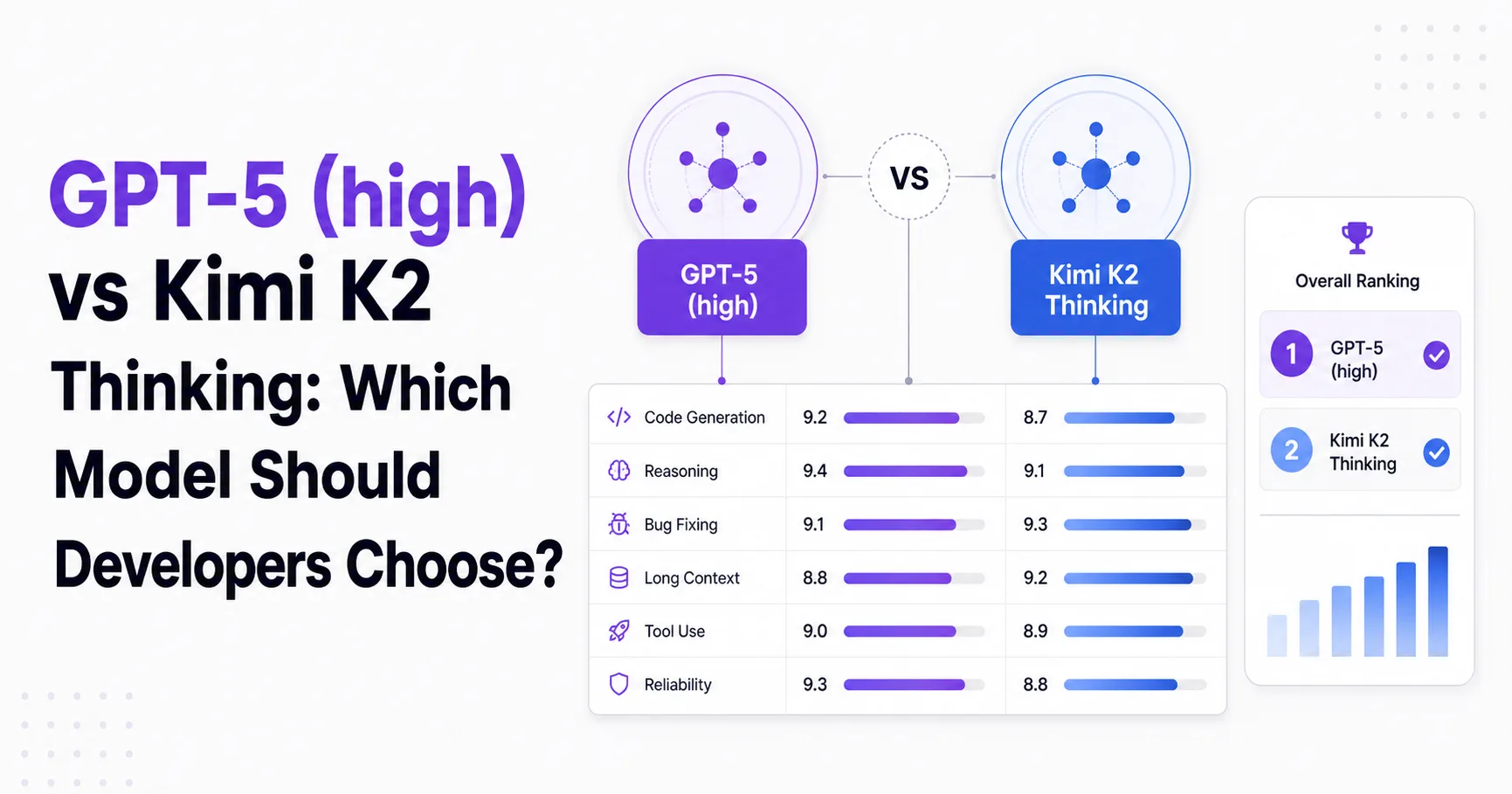
GPT-5 (high) is the safer developer choice when documented API behavior matters more than minimum token cost. OpenAI positions GPT-5 as a reasoning model for coding, reasoning, and agentic tasks in its developer announcement. Kimi K2 Thinking has a lower listed cost in the supplied benchmark data, but the research brief contains no verifiable vendor documentation for its API, context window, output limit, supported modalities, or operating status.
The comparison therefore has an important asymmetry. GPT-5 can be evaluated through public product documentation, official benchmark claims, and a limited community report. Kimi K2 Thinking can be compared quantitatively on the supplied Artificial Analysis snapshot, but its surrounding product surface remains unverified. The chart data is attributed to Artificial Analysis.
For a production developer, that distinction changes the buying question. Kimi may be the better price experiment if the integration path is already known and the workload is tolerant of uncertainty. GPT-5 is the stronger default when the team needs documented controls, explicit model identifiers, and evidence that maps to coding or agent workflows.
GPT-5 (high) has the stronger documented product case, while Kimi K2 Thinking has the stronger supplied cost case. The Artificial Analysis Intelligence Index gives GPT-5 (high) a score of 34.7 and Kimi K2 Thinking a score of 32.7, while the Math Index is 94.3 for GPT-5 (high) and 94.7 for Kimi K2 Thinking. Those results suggest a narrow general-intelligence advantage for GPT-5 and a narrow mathematics advantage for Kimi, not a decisive capability gap.
The more meaningful difference is evidence quality. OpenAI documents GPT-5 as gpt-5, with the fixed snapshot gpt-5-2025-08-07, supported reasoning effort values, verbosity controls, function calling, structured outputs, streaming, and custom tools. The GPT-5 model documentation also documents a 400,000-token context window and a maximum output of 128,000 tokens.
No comparable verified material is available for Kimi K2 Thinking in the research brief. The Google search entry is only an investigation path, not evidence of an official release, API contract, or price page. Developers should not interpret missing Kimi documentation as proof that the model lacks these capabilities. The evidence simply does not establish them.
That leads to a practical conclusion. Choose GPT-5 (high) for a documented production integration. Test Kimi K2 Thinking for cost-sensitive workloads only after confirming access, compatibility, limits, and behavior in the target environment.
GPT-5 (high) offers the more defensible performance choice because its coding and agent capabilities have public evidence, while Kimi K2 Thinking lacks verified coding evidence. OpenAI reports GPT-5 at 74.9% on SWE-bench Verified, 88% on Aider polyglot, 96.7% on τ²-bench telecom, and 69.6% on Scale MultiChallenge in its developer announcement. The announcement also states that the SWE-bench result excluded 23 problems from 500 because they could not be passed reliably on OpenAI's infrastructure, and that the Aider evaluation used high reasoning effort.
Those qualifications matter for implementation. The results support confidence in repository-level coding, agentic task execution, and structured problem solving, but they do not guarantee success on a specific codebase. A benchmark score cannot reveal whether a model will respect local conventions, preserve undocumented behavior, or make safe edits across unfamiliar modules.
The supplied comparison gives GPT-5 (high) an Artificial Analysis Coding Index of 37.8, while Kimi K2 Thinking has no coding value in the snapshot. That missing value prevents a fair coding winner declaration. Kimi's Math Index of 94.7 versus GPT-5's 94.3 indicates that Kimi should not be dismissed for mathematical reasoning, but mathematics is not a substitute for repository-level coding evidence.
Latency does not resolve the choice. Both models show 0.3 seconds in the supplied data, while median output tokens per second are unavailable for both. The evidence therefore cannot establish which model feels faster during long generations, tool loops, or multi-step coding tasks.
Kimi K2 Thinking is the clear price leader in the supplied data, but its lower token price does not by itself prove lower total application cost. Kimi is listed at $1.075 per 1M blended tokens, compared with $3.4375 for GPT-5 (high). Its input price is $0.6 per 1M tokens and its output price is $2.5, compared with GPT-5 prices of $1.25 for input and $10 for output.
The chart makes the unit-price gap easy to see. The harder question is whether the models produce comparable useful work per request. A cheaper model can cost more in practice if it needs extra retries, longer prompts, additional verification passes, or manual correction. The research brief offers no reliable Kimi coding evaluation, API documentation, or failure-rate evidence, so it cannot establish whether the price advantage survives a production workflow.
GPT-5's output price is especially relevant for agent systems that generate long plans, patches, tool arguments, or explanations. Kimi's lower output price may be attractive for high-volume generation, classification, or mathematical workloads, provided the model is reachable through a stable interface and meets the application's quality threshold.
The correct cost test is therefore task-level, not token-level. Measure accepted outputs, retry frequency, tool-loop completion, and engineering review time in a controlled pilot. The supplied data supports Kimi as the cheaper listed option. It does not prove Kimi is the cheaper option after integration and remediation costs.
Kimi K2 Thinking leads on 3 of 3 metrics
GPT-5 (high) is the recommended default for production coding and agent workflows that require documented behavior. OpenAI documents the gpt-5 alias, the fixed snapshot gpt-5-2025-08-07, Chat Completions, Responses, and Batch endpoints in the model documentation. The same documentation covers text and image input with text output, while audio and video input or output are not supported.
Choose GPT-5 (high) when the team needs explicit reasoning controls, structured outputs, function calling, streaming, or custom tools. Choose it also when a large documented context window matters, or when coding evidence is more important than the lowest listed price. Its official documentation is a meaningful operational advantage because it gives developers a concrete integration contract.
Consider Kimi K2 Thinking for a cost-focused evaluation when the team already has a verified access path and can run acceptance tests against representative tasks. Its Artificial Analysis Intelligence Index is close to GPT-5's, and its Math Index is slightly higher in the supplied snapshot. Those signals justify testing it for workloads where mathematical quality and token economics dominate.
Do not select Kimi solely because its listed token prices are lower. The research brief does not verify its API alias, context limit, output limit, modalities, vendor support, or current availability. Do not select GPT-5 solely because official benchmarks look strong either. A fixed GPT-5 snapshot is marked Deprecated in the model documentation, so teams using that snapshot need a migration plan.
The balanced decision is straightforward: GPT-5 (high) for documented production readiness, Kimi K2 Thinking for a controlled cost experiment, and neither model without task-specific acceptance tests.
Kimi K2 Thinking is the larger unknown because the research brief contains no verifiable official source describing its deployment contract. The supplied Google search page did not produce a source that could confirm its context window, output limit, API parameters, multimodal support, pricing page, or replacement model. That absence limits the comparison more than the small index differences do.
GPT-5 also has meaningful uncertainty. The fixed snapshot is marked Deprecated, while the stable gpt-5 alias remains listed. Developers should confirm which identifier their application will call and how migration will be handled. OpenAI also marks fine-tuning and predicted outputs as unsupported in the GPT-5 documentation.
Community evidence is directional rather than conclusive. A Reddit report describes useful small bug fixes, but also shorter and less complete results for full applications and UI generation. The same discussion mentions possible hallucinations or incorrect modifications in complex existing codebases. The report is a single user's uncontrolled experience, so it cannot establish a general failure rate or reliable speed ranking.
The unresolved questions are operational: Can Kimi be called reliably? What limits apply? How do retries and tool calls behave? How does either model perform on the team's own repositories? The current materials do not answer those questions.
GPT-5 (high) is the safer production choice because OpenAI documents its API identifiers, reasoning controls, tool features, context limits, and coding-related benchmark evidence. Kimi K2 Thinking needs a verified integration and task-specific evaluation first.
Kimi K2 Thinking is the cheaper listed option, but its lower prices do not prove lower total cost. Extra retries, weaker repository edits, missing documentation, or manual review could erase the token savings in production.
Neither model can be declared faster from the supplied evidence. The comparison lists 0.3 seconds latency for each model, while median output tokens per second are unavailable, so long-generation speed remains unverified.
Kimi K2 Thinking has a slightly higher supplied Math Index, at 94.7 versus 94.3, while GPT-5 has the higher Intelligence Index, at 34.7 versus 32.7. The evidence does not establish an overall reasoning winner.
GPT-5 (high) is not established as a separate API model identifier in the research brief. The evidence describes high as the reasoning_effort=high setting for GPT-5, rather than a distinct gpt-5-high alias.
The biggest risk is committing to an unverified integration assumption. Kimi lacks confirmed API and capability documentation, while the fixed GPT-5 snapshot is marked Deprecated, so either choice requires an explicit validation and migration plan.