
Time to First Token · GPT-5 (high)
0ms
Time to First Token · Kimi K3 (low)
2520ms
Deep dive into reasoning, benchmarks, and latency insights.
The current catalog does not contain complete performance evidence for both models, so this page does not declare an overall winner. Use the available fields as comparison signals and validate the models on your own workload.
Key decision metrics at a glance.
| Model | Metric | Value | Unit | Source / snapshot |
|---|---|---|---|---|
| GPT-5 (high) | Reasoning | 9.0 | benchmark or capability score | Artificial Analysis · current catalog |
| Kimi K3 (low) | Reasoning | 6.0 | benchmark or capability score | Artificial Analysis · current catalog |
| GPT-5 (high) | Coding | 4.0 | benchmark or capability score | Artificial Analysis · current catalog |
| Kimi K3 (low) | Coding | 7.0 | benchmark or capability score | Artificial Analysis · current catalog |
| GPT-5 (high) | Multimodal | 3.0 | benchmark or capability score | Artificial Analysis · current catalog |
| Kimi K3 (low) | Multimodal | 4.0 | benchmark or capability score | Artificial Analysis · current catalog |
| GPT-5 (high) | Long Context | 4.0 | benchmark or capability score | Artificial Analysis · current catalog |
| Kimi K3 (low) | Long Context | 6.0 | benchmark or capability score | Artificial Analysis · current catalog |
| GPT-5 (high) | Blended Price / 1M tokens | $3.438 | USD per 1M tokens | Artificial Analysis · current catalog |
| Kimi K3 (low) | Blended Price / 1M tokens | $6 | USD per 1M tokens | Artificial Analysis · current catalog |
| GPT-5 (high) | P95 Latency | — | milliseconds | Artificial Analysis · current catalog |
| Kimi K3 (low) | P95 Latency | — | milliseconds | Artificial Analysis · current catalog |
| GPT-5 (high) | Tokens per second | 0 | tokens per second | Artificial Analysis · current catalog |
| Kimi K3 (low) | Tokens per second | 40.313 | tokens per second | Artificial Analysis · current catalog |
Data provided by Artificial Analysis; live values use the current catalog.
This radar chart visually maps the core capabilities (reasoning, coding, math proxy, multimodal, long context) of `GPT-5 (high)` vs `Kimi K3 (low)`.
This grouped bar chart provides a side-by-side comparison for each benchmark metric.
Lower time to first token is better; higher tokens per second is better.
Compare input and output pricing in USD per 1M tokens.
GPT-5 (high)$3.75
Kimi K3 (low)$6.75
GPT-5 (high) costs $3 less per run
This article is a dated snapshot published on 2026-08-07. Live cards above use the current catalog; missing live fields are not inferred.
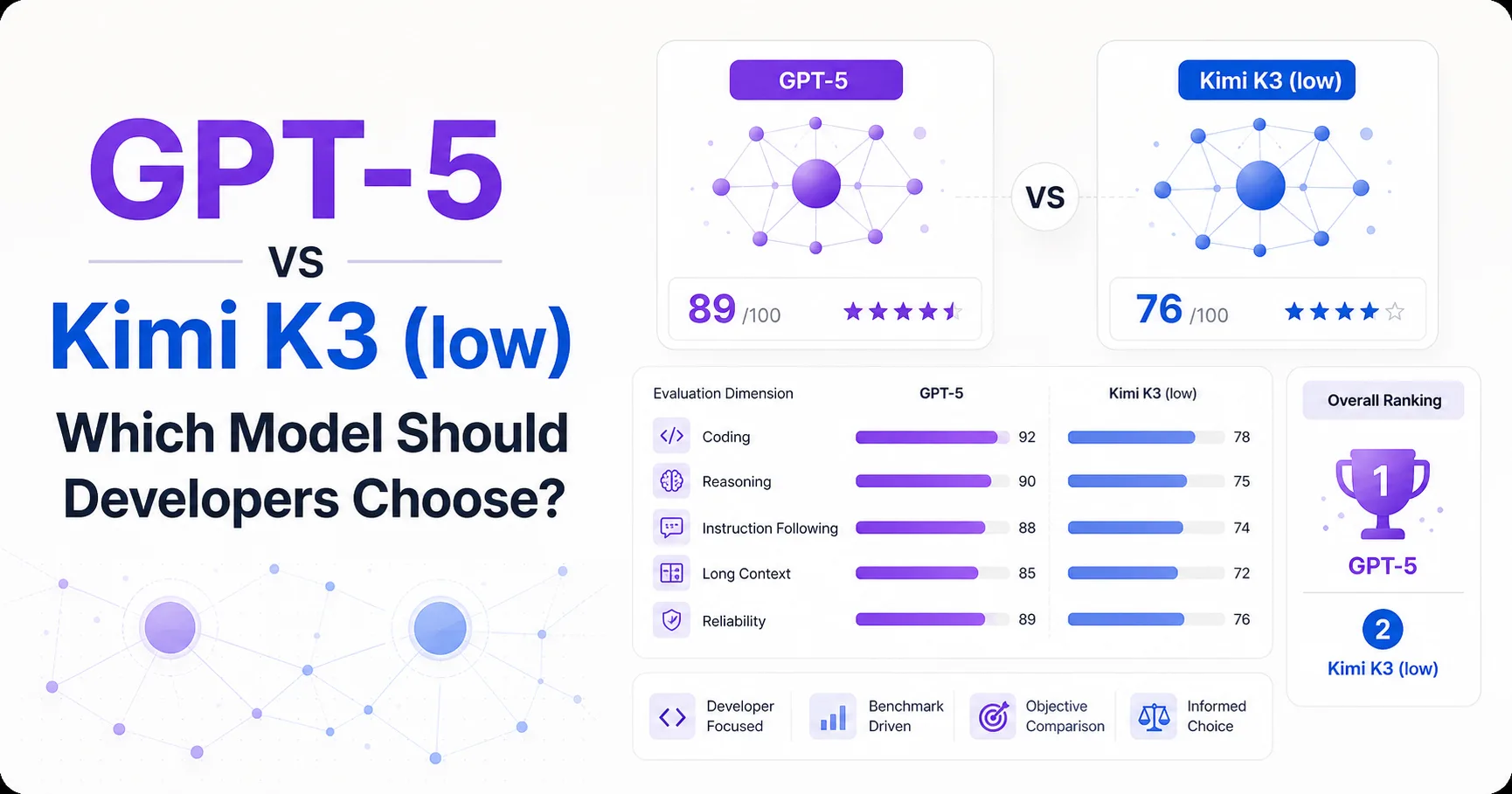
GPT-5 is the safer documented choice, while Kimi K3 (low) leads the available comparison scores but remains difficult to verify operationally.
The supplied data gives Kimi K3 (low) an Artificial Analysis Intelligence Index of 46.6 and a Coding Index of 72. GPT-5 records 34.7 and 37.8 on those same indexes. That makes Kimi K3 (low) the apparent performance leader for the measured comparison, especially for coding-oriented selection.
The evidence is not symmetrical. OpenAI publishes developer documentation, model identifiers, pricing, modality details, tool support, and benchmark disclosures for GPT-5 in GPT-5 for developers and the GPT-5 model documentation. The supplied research found no publicly verifiable official documentation, pricing page, or benchmark source for Kimi K3 (low).
Developers therefore face two different decisions. Choose based on the measured score, and Kimi K3 (low) is ahead. Choose based on deployability evidence, and GPT-5 has the stronger documented case. The research does not establish whether Kimi K3 (low) can match GPT-5 on context limits, output limits, API reliability, multimodal behavior, tool calling, or lifecycle guarantees.
Kimi K3 (low) is the stronger apparent performer, but GPT-5 is the only model in this comparison with a documented developer contract.
| Decision area | GPT-5 | Kimi K3 (low) |
|---|---|---|
| Artificial Analysis Intelligence Index | 34.7 | 46.6 |
| Artificial Analysis Coding Index | 37.8 | 72 |
| Artificial Analysis Math Index | 94.3 | Not reported |
| Blended price per 1M tokens | $3.4375 | $6 |
| Input price per 1M tokens | $1.25 | $3 |
| Output price per 1M tokens | $10 | $15 |
| Latency | 0.3 seconds | 0.3 seconds |
| Median output speed | Not reported | 35.898 tokens per second |
GPT-5 is positioned by OpenAI as a reasoning model for coding, reasoning, and agentic tasks, with support for function calling, structured outputs, streaming, and custom tools. Those claims come from GPT-5 for developers and GPT-5 model documentation.
Kimi K3 (low) has the higher available coding and intelligence scores, but the research supplies no reliable explanation of its API surface or test conditions. That missing information limits how confidently a team can turn the score into an architecture decision.
GPT-5 also has a documented math result of 94.3, while Kimi K3 (low) has no corresponding value in the data. This is missing evidence, not proof that GPT-5 is better at mathematics. The same distinction applies to speed, context, modalities, and production behavior.
Kimi K3 (low) has the stronger measured coding signal, but the available evidence cannot show whether that advantage survives a production workflow.
The coding index is 72 for Kimi K3 (low) and 37.8 for GPT-5. A gap of that size could matter for code generation, repository navigation, refactoring, and bug-fixing workloads. It does not identify which task types produced the difference, how the evaluation was constructed, or whether the models used comparable reasoning settings. The supplied Kimi research contains no benchmark methodology, so the score should guide a pilot rather than settle the decision.
GPT-5 has a broader documented performance record. OpenAI reports 74.9% on SWE-bench Verified, 88% on Aider polyglot, 96.7% on τ²-bench telecom, and 69.6% on Scale MultiChallenge in GPT-5 for developers. OpenAI also states that the SWE-bench result excluded 23 problems from 500 because they could not be passed reliably on its infrastructure, and that the Aider evaluation used high reasoning effort. Those disclosures make the results easier to interpret, although they do not make them directly comparable with the supplied Artificial Analysis indexes.
Latency is 0.3 seconds for both models, so the data does not establish a latency winner. Kimi K3 (low) has a reported median output speed of 35.898 tokens per second. GPT-5 has no reported value. That means Kimi may feel faster during long generations, but the supplied data cannot quantify GPT-5’s corresponding output rate.
Community evidence also remains uneven. One Reddit author reported that GPT-5 helped locate and fix small bugs quickly, while finding its full application and UI generation too concise. The same post and comments mention possible hallucinations or incorrect modifications in complex existing codebases, but the testing was uncontrolled and not reproducible from the supplied material. See Tried GPT-5 Here Are My First Impressions. No equivalent verified community evidence was found for Kimi K3 (low).
GPT-5 is materially cheaper on the published token prices, but Kimi K3 (low) could still justify its cost if its coding advantage reduces engineering work.
The blended price is $3.4375 per 1M tokens for GPT-5 and $6 for Kimi K3 (low). GPT-5 also costs $1.25 per 1M input tokens and $10 per 1M output tokens, compared with $3 and $15 for Kimi K3 (low). The chart below should be read as a usage-price comparison, not as a total cost-of-ownership result.
Token price becomes less important when a model’s answer requires repeated repair, review, retries, or manual integration. A cheaper model can cost more if it produces code that fails tests, misunderstands repository conventions, or needs additional prompting. The supplied research gives one uncontrolled Reddit report about GPT-5’s possible incorrect changes in complex existing codebases, but it gives no comparable evidence for Kimi K3 (low). Therefore, the evidence cannot show which model produces fewer costly retries.
GPT-5 has additional documented pricing context in GPT-5 model documentation, including cached input pricing of $0.125 per 1M tokens. The supplied data brief does not provide a corresponding cached-input figure for Kimi K3 (low), so no fair cached-input comparison is possible.
Teams should test cost per accepted change, not cost per request. That metric requires an agreed task set, a fixed review standard, and measured repair effort. The supplied materials do not contain those measurements, so any claim about total engineering cost would be speculative.
GPT-5 (high) leads on 3 of 3 metrics
GPT-5 is the better default for teams that require documented interfaces and operational evidence, while Kimi K3 (low) deserves a controlled trial for coding-heavy workloads.
Choose GPT-5 when API clarity is part of the product requirement. OpenAI documents the stable alias gpt-5, the fixed snapshot gpt-5-2025-08-07, a 400,000-token context window, a maximum output of 128,000 tokens, text and image input, and text output in GPT-5 model documentation. The same documentation marks fine-tuning and predicted outputs as unsupported. GPT-5 also supports reasoning effort and verbosity controls, structured outputs, function calling, streaming, and custom tools according to the linked OpenAI materials.
Choose Kimi K3 (low) when measured coding performance is the primary hypothesis to validate. Its Coding Index is 72, compared with GPT-5 at 37.8, and its Intelligence Index is 46.6, compared with 34.7. Those values make it a credible candidate for a bake-off. They do not establish its context window, tool behavior, modality support, API stability, or support policy.
Treat GPT-5’s lifecycle carefully. The stable alias remains listed, but the fixed snapshot gpt-5-2025-08-07 is marked Deprecated, and the model page describes GPT-5 as a previous-generation model while recommending GPT-5.6 in GPT-5 model documentation. A team choosing GPT-5 should therefore test alias behavior and plan snapshot migration.
Do not choose either model for audio or video processing based on this brief. GPT-5’s documented API supports text and image input, but not audio or video input and output. Kimi K3 (low) has no verified modality information. Do not infer that missing evidence means support or non-support.
Kimi K3 (low) lacks the public evidence needed to answer several deployment questions that developers normally treat as selection criteria.
The supplied research does not verify Kimi K3 (low)’s context window, maximum output, API endpoint, stable model identifier, reasoning controls, tool-calling format, structured-output support, multimodal capabilities, fine-tuning policy, or deprecation policy. It also contains no reliable Reddit, Hacker News, or X discussion with a reproducible test method.
GPT-5 has stronger documentation, but documentation does not remove every uncertainty. The supplied community evidence is based on one uncontrolled Reddit thread, and the benchmark disclosures do not provide a direct mapping to the Artificial Analysis indexes. The research also does not provide production error rates, accepted-change rates, retry rates, or total cost per completed task for either model.
A fair selection process should therefore separate verified facts from pilot questions. Verify Kimi K3 (low)’s API and lifecycle before committing architecture. Measure both models on the team’s real repository tasks. Record successful changes, review effort, retries, latency, and token usage. The available materials support that test plan, but they do not replace it.
Kimi K3 (low) has the higher supplied Coding Index at 72 versus GPT-5 at 37.8, but the evidence does not verify benchmark methodology or production reliability, so developers should validate it on representative repository tasks before adoption.
GPT-5 is cheaper on every supplied published token measure: $3.4375 versus $6 per 1M blended tokens, $1.25 versus $3 for input, and $10 versus $15 for output.
Kimi K3 (low) has the only supplied median output-speed measurement, at 35.898 tokens per second, while both models have latency listed at 0.3 seconds, so the evidence does not prove an overall speed winner.
GPT-5 is the safer default when documented API behavior, pricing, modalities, tools, and lifecycle information matter, but teams focused on coding performance should still test Kimi K3 (low) because its supplied Coding Index is higher.
GPT-5 supports text and image input with text output, but the supplied documentation says it does not support audio or video input and output, so those workflows require another model or processing layer.