
Time to First Token · GPT-5 (high)
0ms
Time to First Token · MiMo-V2.5
2031ms
Deep dive into reasoning, benchmarks, and latency insights.
The current catalog does not contain complete performance evidence for both models, so this page does not declare an overall winner. Use the available fields as comparison signals and validate the models on your own workload.
Key decision metrics at a glance.
| Model | Metric | Value | Unit | Source / snapshot |
|---|---|---|---|---|
| GPT-5 (high) | Reasoning | 9.0 | benchmark or capability score | Artificial Analysis · current catalog |
| MiMo-V2.5 | Reasoning | 6.0 | benchmark or capability score | Artificial Analysis · current catalog |
| GPT-5 (high) | Coding | 4.0 | benchmark or capability score | Artificial Analysis · current catalog |
| MiMo-V2.5 | Coding | 6.0 | benchmark or capability score | Artificial Analysis · current catalog |
| GPT-5 (high) | Multimodal | 3.0 | benchmark or capability score | Artificial Analysis · current catalog |
| MiMo-V2.5 | Multimodal | 3.0 | benchmark or capability score | Artificial Analysis · current catalog |
| GPT-5 (high) | Long Context | 4.0 | benchmark or capability score | Artificial Analysis · current catalog |
| MiMo-V2.5 | Long Context | 5.0 | benchmark or capability score | Artificial Analysis · current catalog |
| GPT-5 (high) | Blended Price / 1M tokens | $3.438 | USD per 1M tokens | Artificial Analysis · current catalog |
| MiMo-V2.5 | Blended Price / 1M tokens | $0.175 | USD per 1M tokens | Artificial Analysis · current catalog |
| GPT-5 (high) | P95 Latency | — | milliseconds | Artificial Analysis · current catalog |
| MiMo-V2.5 | P95 Latency | — | milliseconds | Artificial Analysis · current catalog |
| GPT-5 (high) | Tokens per second | 0 | tokens per second | Artificial Analysis · current catalog |
| MiMo-V2.5 | Tokens per second | 61.81 | tokens per second | Artificial Analysis · current catalog |
Data provided by Artificial Analysis; live values use the current catalog.
This radar chart visually maps the core capabilities (reasoning, coding, math proxy, multimodal, long context) of `GPT-5 (high)` vs `MiMo-V2.5`.
This grouped bar chart provides a side-by-side comparison for each benchmark metric.
Lower time to first token is better; higher tokens per second is better.
Compare input and output pricing in USD per 1M tokens.
GPT-5 (high)$3.75
MiMo-V2.5$0.21
MiMo-V2.5 costs $3.54 less per run
This article is a dated snapshot published on 2026-08-07. Live cards above use the current catalog; missing live fields are not inferred.
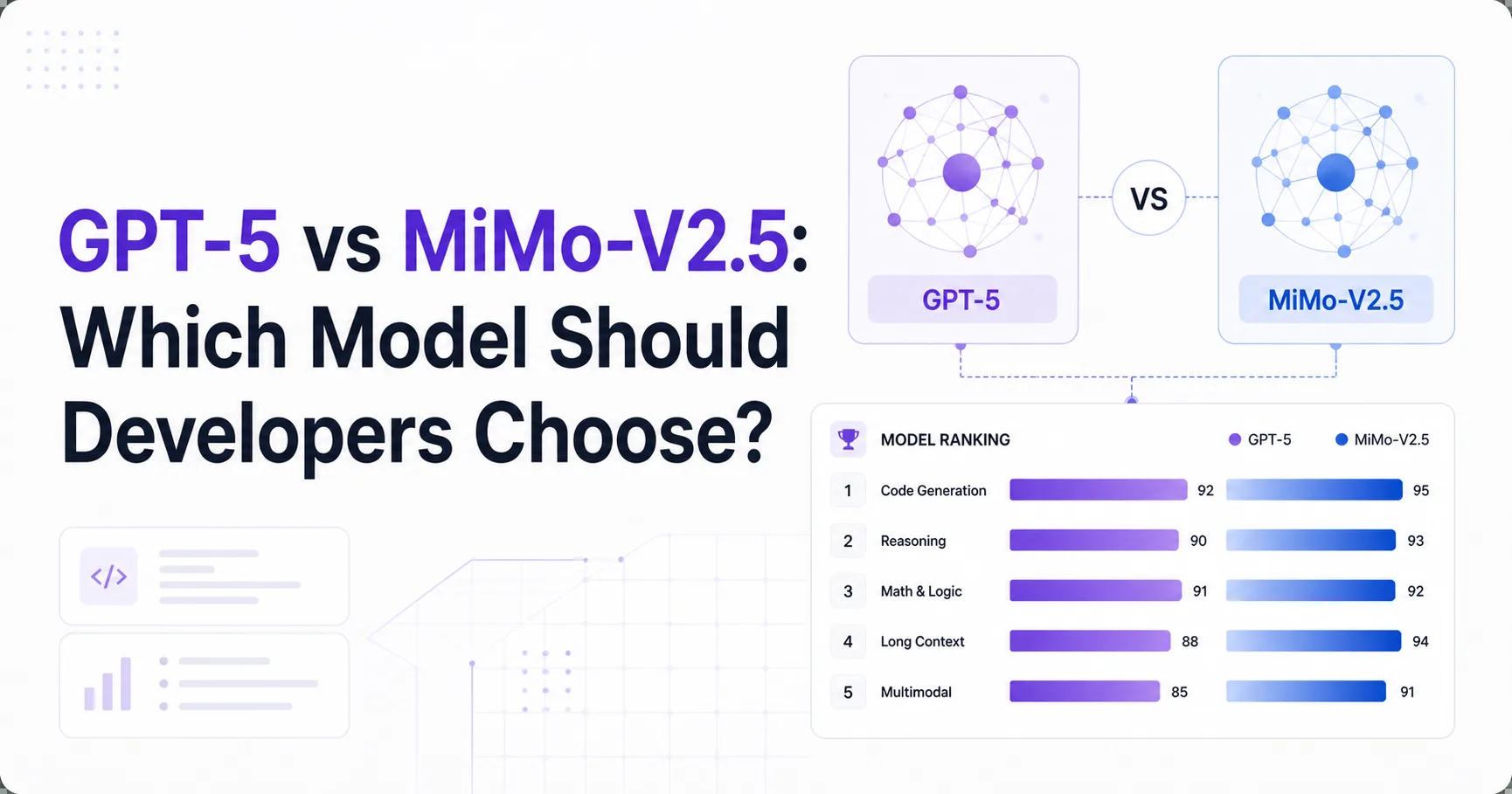
GPT-5 is the more documented choice, while MiMo-V2.5 leads the available coding and blended-cost data. OpenAI positions GPT-5 for coding, reasoning, and agentic tasks, and its model documentation describes a callable gpt-5 alias with established API endpoints. The supplied data reports a 37.8 coding index for GPT-5 and 56.8 for MiMo-V2.5. It also reports blended pricing of $3.4375 for GPT-5 and $0.17500000000000002 for MiMo-V2.5 per 1M blended tokens.
MiMo-V2.5 therefore looks stronger for cost-sensitive coding workloads, but that conclusion rests on a thinner evidence base. The brief contains no verified official source for MiMo-V2.5, including no confirmed API identity, context window, modality support, or pricing page. GPT-5 has a documented 400,000-token context window, a maximum output of 128,000 tokens, and text and image input support. Developers must treat the comparison as an evidence-weighted decision, not a complete feature parity test.
MiMo-V2.5 is the stronger measured value option, while GPT-5 is the safer documented integration option. The supplied benchmark data gives MiMo-V2.5 the higher artificial analysis coding index, at 56.8 versus 37.8 for GPT-5. MiMo-V2.5 also leads the available artificial analysis intelligence index, at 37.2 versus 34.7. GPT-5 is the only model with a reported artificial analysis math index, at 94.3, so no math comparison is established.
| Decision factor | GPT-5 | MiMo-V2.5 | Selection meaning |
|---|---|---|---|
| Coding index | 37.8 | 56.8 | MiMo-V2.5 leads the supplied coding measurement |
| Intelligence index | 34.7 | 37.2 | MiMo-V2.5 has a narrower reported lead |
| Math index | 94.3 | Not reported | GPT-5 has the only available math evidence |
| Blended price per 1M tokens | $3.4375 | $0.17500000000000002 | MiMo-V2.5 is the cost-focused candidate |
| Latency | 0.3 seconds | 0.3 seconds | The supplied latency data is tied |
Artificial Analysis provides the comparison data. These results do not establish that MiMo-V2.5 is universally better. They establish that MiMo-V2.5 is ahead on the reported coding and intelligence indexes, while GPT-5 has stronger documentation and a reported math result.
GPT-5 offers the stronger verified performance story, while MiMo-V2.5 has the better reported coding score but lacks corroborating product evidence. OpenAI reports GPT-5 at 74.9% on SWE-bench Verified, 88% on Aider polyglot, 96.7% on τ²-bench telecom, and 69.6% on Scale MultiChallenge. OpenAI also states that the SWE-bench result excluded 23 problems that could not reliably pass on its infrastructure, and that the Aider evaluation used high reasoning effort. Those qualifications matter because production behavior depends on task design, reasoning settings, repository quality, and tool orchestration.
The supplied comparison data gives MiMo-V2.5 a 56.8 coding index against GPT-5 at 37.8. That gap suggests MiMo-V2.5 deserves a serious trial for code generation, refactoring, and repository work. It does not show whether the models used equivalent prompts, tools, reasoning settings, or evaluation coverage. The brief provides no MiMo-V2.5 benchmark methodology, official release note, or reproducible community test.
The speed evidence is asymmetric. MiMo-V2.5 has a reported median output rate of 73.585 tokens per second, while GPT-5 has no reported value. Both models show 0.3 seconds of latency in the supplied data. The output-rate figure therefore supports an observable MiMo-V2.5 advantage, but it is not a controlled head-to-head speed result. Developers should test time to useful completion, not only token emission, because longer reasoning or more repair cycles can change the practical result.
The GPT-5 model documentation confirms support for function calling, structured outputs, streaming, and custom tools. The brief provides no equivalent MiMo-V2.5 evidence, so API-level performance and tool reliability remain unresolved.
MiMo-V2.5 is the clear price leader, but GPT-5 can still be the cheaper operational choice when reliability reduces retries and supervision. The supplied data lists blended pricing of $0.17500000000000002 per 1M tokens for MiMo-V2.5 and $3.4375 for GPT-5. It lists input pricing of $0.14 for MiMo-V2.5 and $1.25 for GPT-5, plus output pricing of $0.28 for MiMo-V2.5 and $10 for GPT-5.
The chart below this section should make the price gap obvious. The engineering question is what happens after the first response. A low token price loses its advantage if the model needs repeated corrections, produces unsafe edits, fails structured output validation, or requires a stronger secondary model for review. The research brief contains no MiMo-V2.5 reliability data, so those costs cannot be quantified here.
GPT-5 also supports cached input pricing of $0.125 per 1M tokens, according to the GPT-5 model documentation. That matters for applications repeatedly sending stable system instructions, repository context, schemas, or policy material. The brief does not provide comparable cached-input pricing for MiMo-V2.5, so the cost comparison is incomplete for cache-heavy workloads.
A practical selection process should separate token economics from task economics. MiMo-V2.5 is the natural first candidate for high-volume workloads where its coding score and reported output rate hold up in testing. GPT-5 is easier to budget around documented API behavior, but its output price makes unnecessary verbosity and repeated generation especially costly. No break-even point can be calculated from the supplied evidence because retry rates, output lengths, cache behavior, and operational review costs are missing.
MiMo-V2.5 leads on 3 of 3 metrics
GPT-5 is the better default for documented agent integrations, while MiMo-V2.5 is the better first experiment for economical coding workloads. OpenAI describes GPT-5 as a reasoning model for coding and agentic tasks, with reasoning_effort values including minimal, low, medium, and high. It also supports structured outputs, function calling, streaming, and custom tools. Those documented controls reduce uncertainty when an application depends on predictable tool contracts.
Choose GPT-5 when the application needs verified OpenAI API behavior, image input, long context, structured tool interaction, or math-focused evidence. The model documentation lists a 400,000-token context window, a maximum output of 128,000 tokens, and a 94.3 artificial analysis math index in the supplied data. GPT-5 does not support audio or video input and output, and the documentation marks fine-tuning and predicted outputs as unsupported.
Choose MiMo-V2.5 when coding throughput, low token cost, or high-volume experimentation dominates the decision. Its supplied coding index is 56.8, its blended price is $0.17500000000000002 per 1M tokens, and its reported median output rate is 73.585 tokens per second. These advantages are compelling, but the research brief provides no authoritative confirmation of the model's API, context, modalities, limits, or operational status.
The largest GPT-5 risk is lifecycle management. The stable gpt-5 alias remains listed, but the fixed snapshot gpt-5-2025-08-07 is marked Deprecated, and the model page recommends GPT-5.6. The model documentation records that status. The largest MiMo-V2.5 risk is evidence scarcity. A production team should require a direct provider document and a controlled task test before treating its measured lead as a durable product conclusion.
Community evidence does not settle the choice. One Reddit author reported that GPT-5 handled small bug diagnosis quickly but found complete application and UI generation too concise, while comments described possible hallucinations or incorrect edits in complex existing codebases. That post discloses a subjective, uncontrolled test. The brief found no reliable community evidence for MiMo-V2.5, so the correct recommendation is conditional: pilot MiMo-V2.5 for cost and coding, and retain GPT-5 where documentation and verified controls carry more weight.
GPT-5 is easier to adopt responsibly because its API capabilities, limits, pricing, and lifecycle status are documented in the supplied sources. MiMo-V2.5 may still be the better engineering choice after a controlled pilot, especially for coding-heavy workloads where the reported 56.8 coding index and $0.17500000000000002 blended price matter. The missing provider documentation prevents a complete comparison of context, modalities, rate limits, availability, and support.
MiMo-V2.5 is the stronger first candidate for a cost-sensitive coding pilot because its supplied coding index is 56.8 and its blended price is $0.17500000000000002 per 1M tokens. GPT-5 remains the safer production default when documented API behavior and agent tooling matter more than token cost.
MiMo-V2.5 has the only reported output-speed value, at 73.585 median output tokens per second, while GPT-5 has no reported value. Both models show 0.3 seconds of latency, so the brief does not prove a controlled end-to-end speed win.
GPT-5 has the only reported math result, with an artificial analysis math index of 94.3, so the brief supports GPT-5 as the better-documented math candidate. MiMo-V2.5 has a higher intelligence index at 37.2 versus 34.7, but that does not establish superior mathematical reasoning.
GPT-5 fixed snapshot gpt-5-2025-08-07 carries lifecycle risk because the model documentation marks it Deprecated and recommends GPT-5.6. Teams using the snapshot should monitor migration requirements and avoid assuming indefinite availability.
GPT-5 supports text and image input with text output, but the supplied model documentation says it does not support audio or video input and output. Applications requiring those modalities need a different model or an additional processing path.
MiMo-V2.5 is incomplete as a procurement comparison because the research brief contains no verified official documentation, pricing source, API identity, context limit, modality description, benchmark methodology, or community evidence. Its supplied data still supports testing its coding and cost advantages.