
Time to First Token · GPT-5 (high)
0ms
Time to First Token · MiMo-V2-Omni
0ms
Deep dive into reasoning, benchmarks, and latency insights.
The current catalog does not contain complete performance evidence for both models, so this page does not declare an overall winner. Use the available fields as comparison signals and validate the models on your own workload.
Key decision metrics at a glance.
| Model | Metric | Value | Unit | Source / snapshot |
|---|---|---|---|---|
| GPT-5 (high) | Reasoning | 9.0 | benchmark or capability score | Artificial Analysis · current catalog |
| MiMo-V2-Omni | Reasoning | 6.0 | benchmark or capability score | Artificial Analysis · current catalog |
| GPT-5 (high) | Coding | 4.0 | benchmark or capability score | Artificial Analysis · current catalog |
| MiMo-V2-Omni | Coding | 6.0 | benchmark or capability score | Artificial Analysis · current catalog |
| GPT-5 (high) | Multimodal | 3.0 | benchmark or capability score | Artificial Analysis · current catalog |
| MiMo-V2-Omni | Multimodal | 3.0 | benchmark or capability score | Artificial Analysis · current catalog |
| GPT-5 (high) | Long Context | 4.0 | benchmark or capability score | Artificial Analysis · current catalog |
| MiMo-V2-Omni | Long Context | 4.0 | benchmark or capability score | Artificial Analysis · current catalog |
| GPT-5 (high) | Blended Price / 1M tokens | $3.438 | USD per 1M tokens | Artificial Analysis · current catalog |
| MiMo-V2-Omni | Blended Price / 1M tokens | $0 | USD per 1M tokens | Artificial Analysis · current catalog |
| GPT-5 (high) | P95 Latency | — | milliseconds | Artificial Analysis · current catalog |
| MiMo-V2-Omni | P95 Latency | — | milliseconds | Artificial Analysis · current catalog |
| GPT-5 (high) | Tokens per second | 0 | tokens per second | Artificial Analysis · current catalog |
| MiMo-V2-Omni | Tokens per second | 0 | tokens per second | Artificial Analysis · current catalog |
Data provided by Artificial Analysis; live values use the current catalog.
This radar chart visually maps the core capabilities (reasoning, coding, math proxy, multimodal, long context) of `GPT-5 (high)` vs `MiMo-V2-Omni`.
This grouped bar chart provides a side-by-side comparison for each benchmark metric.
Lower time to first token is better; higher tokens per second is better.
Compare input and output pricing in USD per 1M tokens.
GPT-5 (high)$3.75
MiMo-V2-Omni$0
MiMo-V2-Omni costs $3.75 less per run
This article is a dated snapshot published on 2026-08-07. Live cards above use the current catalog; missing live fields are not inferred.
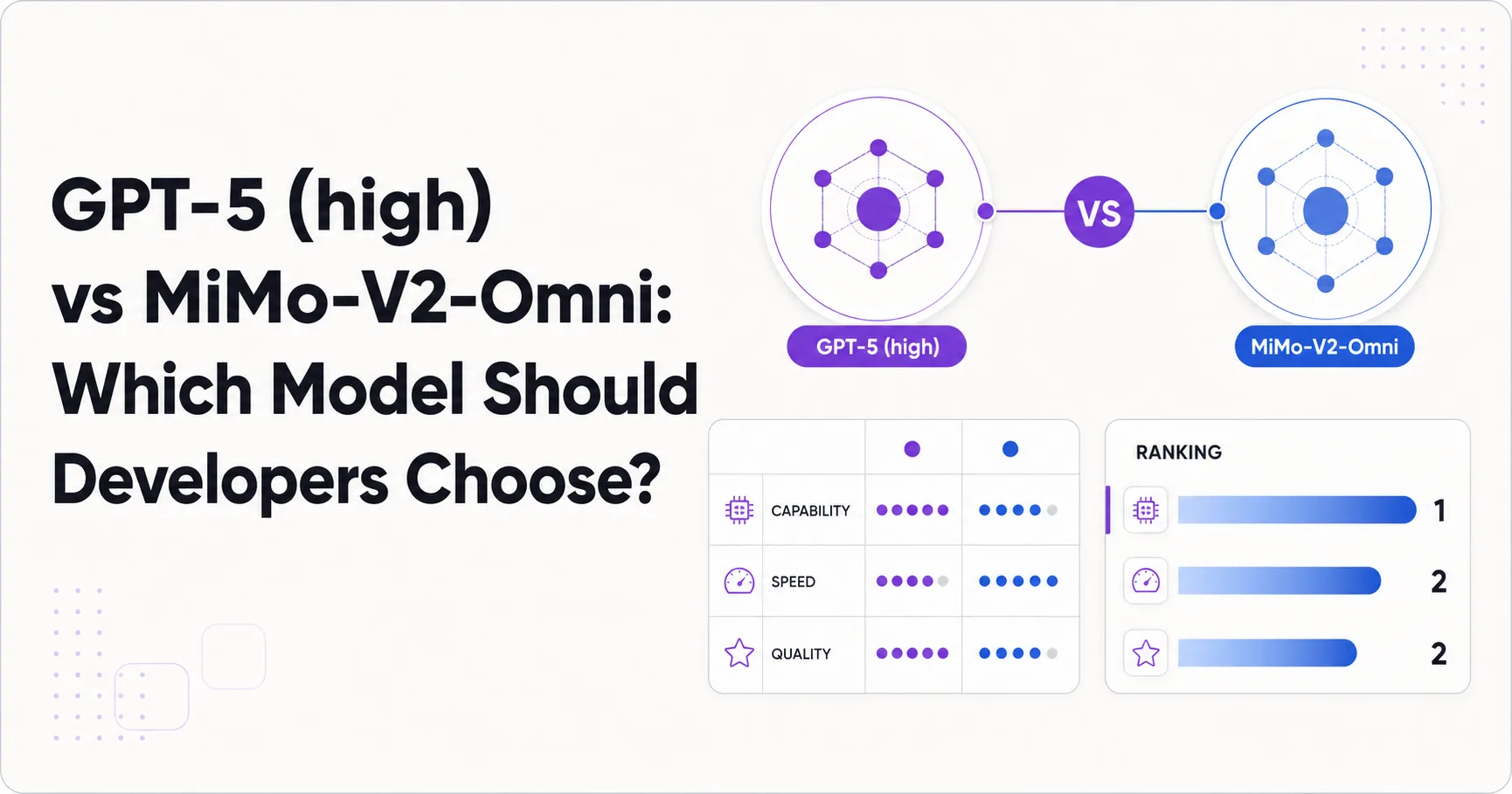
GPT-5 (high) is the safer developer choice because its API behavior, tool support, pricing, and coding evidence are documented, while MiMo-V2-Omni has only one supplied comparison score.
The available data does not establish a broad capability winner. MiMo-V2-Omni reaches 35 on the Artificial Analysis Intelligence Index, while GPT-5 reaches 34.7. That narrow result favors MiMo-V2-Omni on one index, but it does not show whether the difference matters in production coding, reasoning, agent workflows, or multimodal applications.
GPT-5 has a clearer implementation path. OpenAI positions it for coding, reasoning, and agentic tasks, with documented reasoning controls, verbosity controls, function calling, structured outputs, streaming, and custom tools (GPT-5 for developers). Its model documentation also lists its API alias, endpoint availability, input modalities, output limits, and pricing (GPT-5 model documentation).
MiMo-V2-Omni may be attractive for teams optimizing specifically for the supplied intelligence-index result. However, the research brief contains no verified official documentation, pricing page, API alias, community testing, or failure analysis for that model. Selection therefore depends less on a claimed overall ranking and more on whether documentation and operational certainty are requirements.
GPT-5 (high) offers the stronger evidence base, while MiMo-V2-Omni offers a small measured advantage on the only shared intelligence metric.
GPT-5 records 37.8 on the Artificial Analysis Coding Index and 94.3 on the Artificial Analysis Math Index. MiMo-V2-Omni has no supplied coding or math score. This missing evidence matters for developers because an intelligence aggregate cannot substitute for task-specific coding validation.
The pricing difference is decisive for many production workloads. GPT-5 costs $3.4375 per 1M blended tokens, compared with $15 for MiMo-V2-Omni. GPT-5 input tokens cost $1.25 per 1M, and output tokens cost $10 per 1M. MiMo-V2-Omni costs $10 per 1M input tokens and $30 per 1M output tokens. The supplied data therefore shows GPT-5 as the lower-cost option across every listed pricing measure.
Latency does not separate the models in the supplied snapshot. Each model is listed at 0.3 seconds. Output speed is unavailable for both, so the evidence cannot support a throughput winner.
GPT-5 also has a version-management issue. OpenAI’s documentation lists the stable alias gpt-5, but the fixed snapshot gpt-5-2025-08-07 is marked Deprecated and the page recommends GPT-5.6 (GPT-5 model documentation). Teams choosing GPT-5 should therefore design for migration, rather than treating the fixed snapshot as permanent.
GPT-5 has the more useful performance evidence for developers, although MiMo-V2-Omni narrowly leads the shared intelligence index.
MiMo-V2-Omni scores 35 on the Artificial Analysis Intelligence Index, compared with 34.7 for GPT-5. That result is close enough that it should not be treated as a practical capability gap without task-level validation. The supplied brief provides no methodology detail beyond the metric values, so it cannot explain whether the difference reflects reasoning, knowledge, instruction following, or another component.
GPT-5 has direct evidence for coding and mathematics that MiMo-V2-Omni lacks. GPT-5 scores 37.8 on the Artificial Analysis Coding Index and 94.3 on the Artificial Analysis Math Index. Those figures do not prove that GPT-5 will solve a specific repository task or mathematical workload, but they give a developer more evidence to test against real requirements.
OpenAI reports GPT-5 at 74.9% on SWE-bench Verified, 88% on Aider polyglot, 96.7% on τ²-bench telecom, and 69.6% on Scale MultiChallenge (GPT-5 for developers). The SWE-bench result excluded 23 of 500 problems that could not be stably passed on OpenAI’s infrastructure, and the Aider result used high reasoning effort. These qualifications make the results informative, but they also limit direct transfer to every application.
The key unknown is MiMo-V2-Omni’s behavior outside the shared index. The research could not verify its official capabilities, API contract, multimodal support, or failure modes. Developers should not infer coding superiority, lower hallucination rates, or better agent reliability from its 35 score alone.
GPT-5 is the clear price leader in the supplied data, but workload shape and migration risk still determine the real operating decision.
GPT-5 costs $3.4375 per 1M blended tokens, while MiMo-V2-Omni costs $15. GPT-5 is also cheaper for input tokens at $1.25 versus $10, and for output tokens at $10 versus $30. The gap is especially relevant for agentic systems that repeatedly send repository context, tool results, and instructions. Input-heavy workloads benefit from GPT-5’s lower input rate, while response-heavy workloads benefit from its lower output rate.
A cheaper token price does not automatically mean a cheaper completed task. If one model requires more retries, longer prompts, additional verification calls, or more human correction, its effective cost can rise. The supplied research does not provide completion rates, retry rates, output token counts, or production-quality measurements for either model. That means the article cannot calculate task-level total cost or claim that either model is cheaper after failure recovery.
The same limitation applies to latency economics. Both models are listed at 0.3 seconds latency, but output speed is unavailable for both. A streaming application may therefore experience different time-to-completion behavior even though the listed latency ties. Developers should measure time to useful output, not rely on the missing throughput field.
GPT-5’s fixed snapshot also carries migration cost because gpt-5-2025-08-07 is marked Deprecated (GPT-5 model documentation). MiMo-V2-Omni’s lifecycle status is unknown from the supplied research, so its operational risk cannot be ranked confidently.
MiMo-V2-Omni leads on 3 of 3 metrics
GPT-5 is the recommended default for production developers who need verified APIs, documented tools, and lower token prices.
Choose GPT-5 for coding assistants, repository debugging, structured tool workflows, and applications that need an auditable integration path. OpenAI documents function calling, structured outputs, streaming, custom tools, reasoning effort, and verbosity controls (GPT-5 for developers). The supplied benchmark evidence also includes coding and math measurements that are absent for MiMo-V2-Omni.
Choose MiMo-V2-Omni only when your own evaluation shows a meaningful advantage for the exact workload, and when its API, support, pricing, and lifecycle can be verified independently. The supplied research does not confirm that it is callable, does not identify a stable alias, and does not document its modalities or failure behavior. Its 35 intelligence-index score is a reason to test it, not enough evidence to make it the default.
A practical evaluation should compare successful task completion, correction effort, tool-call accuracy, output quality, and time to useful result. The supplied data does not contain those task-level measurements, so no definitive claim can be made about production reliability. Test both models with the same prompts, context, tools, and acceptance criteria.
GPT-5 still needs a version strategy. The alias gpt-5 remains listed as callable, but the fixed snapshot is Deprecated and the documentation recommends GPT-5.6 (GPT-5 model documentation). Pinning a snapshot may improve reproducibility, while using the alias may reduce maintenance. Either choice requires monitoring and migration tests.
GPT-5 is the better starting point for most developers because its documented integration surface is materially clearer than MiMo-V2-Omni’s supplied evidence.
The comparison is not a claim that GPT-5 is universally more capable. MiMo-V2-Omni scores 35 on the shared intelligence index, compared with 34.7 for GPT-5, but the research does not provide matching coding, math, API, or reliability evidence. Developers should treat the result as a prompt for targeted testing.
GPT-5 is also not free of selection risk. Its fixed snapshot is marked Deprecated, and the supplied community evidence reports mixed experiences in complex existing codebases and full application generation (Tried GPT-5 Here Are My First Impressions). Those reports are subjective and non-controlled, so they should inform test design rather than replace it.
GPT-5 should be the default starting point because its API, tools, pricing, coding evidence, and model lifecycle are documented, while MiMo-V2-Omni lacks verified documentation in the supplied research. Validate the final choice on your own workload.
MiMo-V2-Omni leads the supplied shared intelligence index with 35 versus GPT-5 at 34.7, but that single result does not establish broader superiority. The research provides no matching coding, math, reliability, or production-task evidence for MiMo-V2-Omni.
GPT-5 is cheaper across every supplied pricing measure: $3.4375 versus $15 per 1M blended tokens, $1.25 versus $10 per 1M input tokens, and $10 versus $30 per 1M output tokens. Actual task cost still depends on retries and correction effort.
Neither model wins on the supplied latency measure because GPT-5 and MiMo-V2-Omni are both listed at 0.3 seconds. Output speed is unavailable for both, so the evidence cannot establish which model produces useful completed responses sooner.
GPT-5 supports text and image input with text output, but the supplied official documentation says it does not support audio or video input or output. Developers building audio or video workflows therefore need another model or an additional processing system.
Developers should pin the GPT-5 snapshot only when reproducibility justifies migration work, because gpt-5-2025-08-07 is marked Deprecated. The documented gpt-5 alias remains callable, but teams should maintain regression tests and a migration plan.