
Time to First Token · GPT-5 (high)
0ms
Time to First Token · Motif 3 (Beta)
0ms
Deep dive into reasoning, benchmarks, and latency insights.
The current catalog does not contain complete performance evidence for both models, so this page does not declare an overall winner. Use the available fields as comparison signals and validate the models on your own workload.
Key decision metrics at a glance.
| Model | Metric | Value | Unit | Source / snapshot |
|---|---|---|---|---|
| GPT-5 (high) | Reasoning | 9.0 | benchmark or capability score | Artificial Analysis · current catalog |
| Motif 3 (Beta) | Reasoning | 6.0 | benchmark or capability score | Artificial Analysis · current catalog |
| GPT-5 (high) | Coding | 4.0 | benchmark or capability score | Artificial Analysis · current catalog |
| Motif 3 (Beta) | Coding | 6.0 | benchmark or capability score | Artificial Analysis · current catalog |
| GPT-5 (high) | Multimodal | 3.0 | benchmark or capability score | Artificial Analysis · current catalog |
| Motif 3 (Beta) | Multimodal | 4.0 | benchmark or capability score | Artificial Analysis · current catalog |
| GPT-5 (high) | Long Context | 4.0 | benchmark or capability score | Artificial Analysis · current catalog |
| Motif 3 (Beta) | Long Context | 6.0 | benchmark or capability score | Artificial Analysis · current catalog |
| GPT-5 (high) | Blended Price / 1M tokens | $3.438 | USD per 1M tokens | Artificial Analysis · current catalog |
| Motif 3 (Beta) | Blended Price / 1M tokens | $0 | USD per 1M tokens | Artificial Analysis · current catalog |
| GPT-5 (high) | P95 Latency | — | milliseconds | Artificial Analysis · current catalog |
| Motif 3 (Beta) | P95 Latency | — | milliseconds | Artificial Analysis · current catalog |
| GPT-5 (high) | Tokens per second | 0 | tokens per second | Artificial Analysis · current catalog |
| Motif 3 (Beta) | Tokens per second | 0 | tokens per second | Artificial Analysis · current catalog |
Data provided by Artificial Analysis; live values use the current catalog.
This radar chart visually maps the core capabilities (reasoning, coding, math proxy, multimodal, long context) of `GPT-5 (high)` vs `Motif 3 (Beta)`.
This grouped bar chart provides a side-by-side comparison for each benchmark metric.
Lower time to first token is better; higher tokens per second is better.
Compare input and output pricing in USD per 1M tokens.
GPT-5 (high)$3.75
Motif 3 (Beta)$0
Motif 3 (Beta) costs $3.75 less per run
This article is a dated snapshot published on 2026-08-07. Live cards above use the current catalog; missing live fields are not inferred.
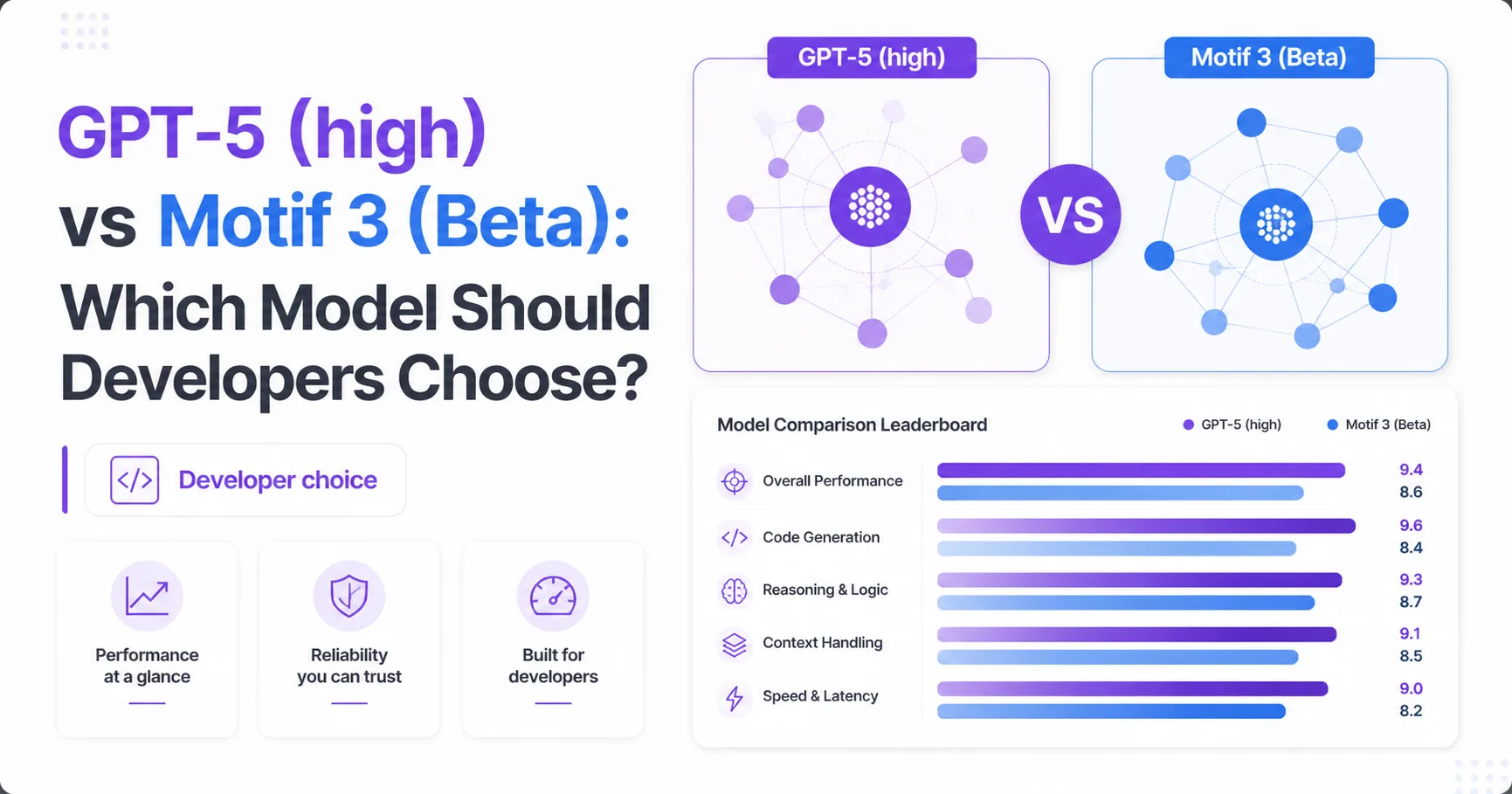
GPT-5 (high) is the safer production choice, while Motif 3 (Beta) has the stronger measured coding and intelligence scores. The decision is therefore not a simple capability ranking. It is a tradeoff between documented integration behavior and an apparently stronger evaluation profile.
The supplied data places Motif 3 (Beta) at 62 on the Artificial Analysis coding index and 44.1 on the Artificial Analysis intelligence index. GPT-5 (high) records 37.8 and 34.7 on those same measures. GPT-5 (high) also records 94.3 on the Artificial Analysis math index, while Motif 3 (Beta) has no corresponding value. These figures come from the supplied comparison dataset, attributed to Artificial Analysis.
The evidence quality differs sharply. OpenAI documents GPT-5's API identity, context limits, modalities, reasoning controls, tools, pricing, and version status in its developer announcement and model documentation. The research supplied for Motif 3 (Beta) contains no verifiable vendor website, developer documentation, pricing page, official benchmark, or community discussion.
For a developer choosing an API, that evidence gap matters as much as the benchmark gap. Motif 3 (Beta) may be the better candidate for a controlled experiment. GPT-5 (high) is easier to evaluate operationally because its interface and constraints are documented.
GPT-5 (high) offers the stronger documented contract, while Motif 3 (Beta) offers the stronger supplied benchmark profile. GPT-5 (high) is available through a stable gpt-5 alias, with the fixed snapshot gpt-5-2025-08-07 documented by OpenAI. The fixed snapshot is marked Deprecated, and the documentation describes GPT-5 as a previous-generation model while recommending GPT-5.6. That creates migration risk for teams that require a fixed model version.
Motif 3 (Beta) has a later release date in the supplied dataset, 2026-07-14, but the research does not establish who operates it, how developers access it, whether its beta status affects availability, or whether its scores are reproducible. The later date is therefore a dataset fact, not evidence of operational maturity.
GPT-5 (high) supports text and image inputs with text output, function calling, structured outputs, streaming, and custom tools constrained by developer-provided context-free grammar. The OpenAI developer material describes reasoning effort controls including minimal, low, medium, and high, while the model page documents the model's API surface and limitations.
The practical ranking depends on the selection criterion. Choose Motif 3 (Beta) if coding evaluation is the primary gate and you can first verify access, behavior, safety, and support. Choose GPT-5 (high) if integration certainty, tool use, and cost control are primary requirements. The supplied evidence does not answer whether Motif 3 (Beta) is more reliable in production.
Motif 3 (Beta) leads the supplied coding and intelligence evaluations, but the evidence does not show whether that lead transfers to your codebase. The coding index is 62 for Motif 3 (Beta) and 37.8 for GPT-5 (high), while the intelligence index is 44.1 and 34.7. The comparison data is provided by Artificial Analysis.
A coding-index lead can matter for repository changes, code generation, and debugging. It does not identify which tasks produced the difference, how much reasoning was required, or how the models behave under your prompts, tools, tests, and repository conventions. Developers should treat the scores as a screening signal, then run representative tasks before committing to an architecture.
GPT-5 (high) has a separate official coding evidence trail. OpenAI reports 74.9% on SWE-bench Verified and 88% on Aider polyglot in its developer announcement. The announcement states that the SWE-bench result excluded 23 of 500 problems that could not be passed reliably on OpenAI's infrastructure, and that Aider used high reasoning effort. Those evaluation conditions limit direct comparison with the supplied Artificial Analysis indices.
The data shows a tie at 0.3 seconds for latency. It provides no median output-tokens-per-second value for either model, so it cannot establish which model streams faster. GPT-5 (high) may be preferable for tool-rich workflows because its documented function calling and structured output support reduce integration uncertainty. Motif 3 (Beta) could still win on task completion, but the supplied research contains no reproducible community or vendor evidence to confirm that conclusion.
GPT-5 (high) is substantially cheaper in the supplied pricing data, but Motif 3 (Beta) could justify its premium if it reduces retries, review work, or failed changes. The blended price is $3.4375 per 1M tokens for GPT-5 (high) and $15 for Motif 3 (Beta). Input pricing is $1.25 and $10, while output pricing is $10 and $30. These figures are provided by Artificial Analysis.
The price gap changes the economics of experimentation. GPT-5 (high) permits more iterations at the same token budget, which can matter for agents that inspect files, call tools, and request revisions. Motif 3 (Beta) needs to produce enough additional task value to offset its higher token rates. The available data does not provide task success rates, retry counts, cache behavior, or total cost per completed software change, so it cannot determine that break-even point.
GPT-5 (high) also has documented cached-input pricing of $0.125 per 1M tokens on the OpenAI model page. That pricing detail is useful for repeated-context workflows, but the supplied Motif research has no comparable information. A developer should not assume that Motif 3 (Beta) offers equivalent caching or billing semantics.
The cheaper option becomes more expensive in practice when it needs more attempts, produces more review work, or lacks the tooling required to finish a task. The premium option becomes wasteful when its higher score does not improve outcomes on the target workload. Until Motif 3 (Beta) exposes verifiable usage and billing details, GPT-5 (high) has the clearer cost case.
Motif 3 (Beta) leads on 3 of 3 metrics
GPT-5 (high) is the default recommendation for production teams that need documented APIs, predictable tool integration, and lower token costs. OpenAI documents Chat Completions, Responses, and Batch availability for GPT-5 in the model documentation. The same documentation identifies the fixed snapshot as Deprecated, so teams should use the stable alias only with an explicit migration and regression-testing plan.
Motif 3 (Beta) is worth a bounded evaluation when coding performance is the dominant selection criterion. Its supplied coding index of 62 exceeds GPT-5 (high)'s 37.8, and its intelligence index of 44.1 exceeds 34.7. Those values make Motif 3 (Beta) a credible experiment candidate. They do not establish API availability, data handling, support quality, uptime, safety behavior, or compatibility with common agent frameworks.
For repository maintenance, GPT-5 (high) is attractive when the work depends on structured tool calls, controlled outputs, and documented reasoning effort. A Reddit user reported that GPT-5 was useful for locating and fixing small bugs, but described less complete results for full applications and UI generation. The report was a subjective, uncontrolled test, and its comments also mention possible hallucinations or incorrect changes in complex existing codebases. See the Reddit discussion.
The recommended process is to benchmark both models on the same repository tasks, with identical acceptance tests and human review criteria. Select Motif 3 (Beta) only if its access and operational claims can be verified. Select GPT-5 (high) when uncertainty itself is an unacceptable production cost. The supplied research cannot identify a universal winner for every developer workload.
GPT-5 (high) has enough public documentation for an initial integration review, while Motif 3 (Beta) requires basic vendor and access verification first. The supplied research does not provide a public Motif URL, so developers cannot independently confirm its interface, limits, or commercial terms from the available material.
A fair comparison also needs workload-specific testing. The supplied benchmark values describe relative evaluation outcomes, but they do not reveal whether either model completes your repository tasks with fewer edits, fewer retries, or less review. The absence of Motif 3 (Beta) community evidence makes this validation especially important.
Teams should record model identifier, reasoning configuration, prompts, tool schemas, latency, output quality, test results, and total token usage. GPT-5 (high) exposes documented reasoning-effort settings, while no equivalent Motif control is established in the research. This difference can affect both quality and cost, but the evidence does not show how Motif 3 (Beta) handles comparable settings.
Version policy deserves separate attention. GPT-5's stable alias remains documented, but the fixed snapshot is Deprecated. Motif 3 (Beta) is labeled beta in the supplied dataset. Neither status supports unattended assumptions about long-term stability. A production decision should therefore include rollback, evaluation refresh, and migration ownership.
GPT-5 (high) is the safer production default because OpenAI documents its API identity, tools, limits, pricing, and endpoints, while the supplied research provides no verifiable Motif 3 (Beta) documentation or operational evidence.
Motif 3 (Beta) scores higher on the supplied coding index, at 62 versus 37.8 for GPT-5 (high), but the evidence does not prove better results on a specific repository, workflow, or production task.
GPT-5 (high) combines lower supplied token prices with documented function calling, structured outputs, streaming, custom tools, and reasoning controls, reducing integration uncertainty that Motif 3 (Beta) cannot currently address with published evidence.
GPT-5 (high) and Motif 3 (Beta) tie on the supplied latency value of 0.3 seconds, while the dataset provides no median output-tokens-per-second value, so it cannot establish a streaming-speed winner.
GPT-5 (high) supports text and image inputs with text output, but the supplied OpenAI documentation states that it does not support audio or video input and output, so those workflows need another model or service.
A team should verify Motif 3 (Beta)'s vendor identity, API access, model identifier, data policies, context and output limits, pricing, reliability, tool support, and benchmark methodology because the supplied research confirms none of those details.