
Time to First Token · GPT-5 (high)
0ms
Time to First Token · Nex-N2-Pro
937ms
Deep dive into reasoning, benchmarks, and latency insights.
The current catalog does not contain complete performance evidence for both models, so this page does not declare an overall winner. Use the available fields as comparison signals and validate the models on your own workload.
Key decision metrics at a glance.
| Model | Metric | Value | Unit | Source / snapshot |
|---|---|---|---|---|
| GPT-5 (high) | Reasoning | 9.0 | benchmark or capability score | Artificial Analysis · current catalog |
| Nex-N2-Pro | Reasoning | 6.0 | benchmark or capability score | Artificial Analysis · current catalog |
| GPT-5 (high) | Coding | 4.0 | benchmark or capability score | Artificial Analysis · current catalog |
| Nex-N2-Pro | Coding | 6.0 | benchmark or capability score | Artificial Analysis · current catalog |
| GPT-5 (high) | Multimodal | 3.0 | benchmark or capability score | Artificial Analysis · current catalog |
| Nex-N2-Pro | Multimodal | 3.0 | benchmark or capability score | Artificial Analysis · current catalog |
| GPT-5 (high) | Long Context | 4.0 | benchmark or capability score | Artificial Analysis · current catalog |
| Nex-N2-Pro | Long Context | 5.0 | benchmark or capability score | Artificial Analysis · current catalog |
| GPT-5 (high) | Blended Price / 1M tokens | $3.438 | USD per 1M tokens | Artificial Analysis · current catalog |
| Nex-N2-Pro | Blended Price / 1M tokens | $1 | USD per 1M tokens | Artificial Analysis · current catalog |
| GPT-5 (high) | P95 Latency | — | milliseconds | Artificial Analysis · current catalog |
| Nex-N2-Pro | P95 Latency | — | milliseconds | Artificial Analysis · current catalog |
| GPT-5 (high) | Tokens per second | 0 | tokens per second | Artificial Analysis · current catalog |
| Nex-N2-Pro | Tokens per second | 139.694 | tokens per second | Artificial Analysis · current catalog |
Data provided by Artificial Analysis; live values use the current catalog.
This radar chart visually maps the core capabilities (reasoning, coding, math proxy, multimodal, long context) of `GPT-5 (high)` vs `Nex-N2-Pro`.
This grouped bar chart provides a side-by-side comparison for each benchmark metric.
Lower time to first token is better; higher tokens per second is better.
Compare input and output pricing in USD per 1M tokens.
GPT-5 (high)$3.75
Nex-N2-Pro$1.125
Nex-N2-Pro costs $2.625 less per run
This article is a dated snapshot published on 2026-08-07. Live cards above use the current catalog; missing live fields are not inferred.
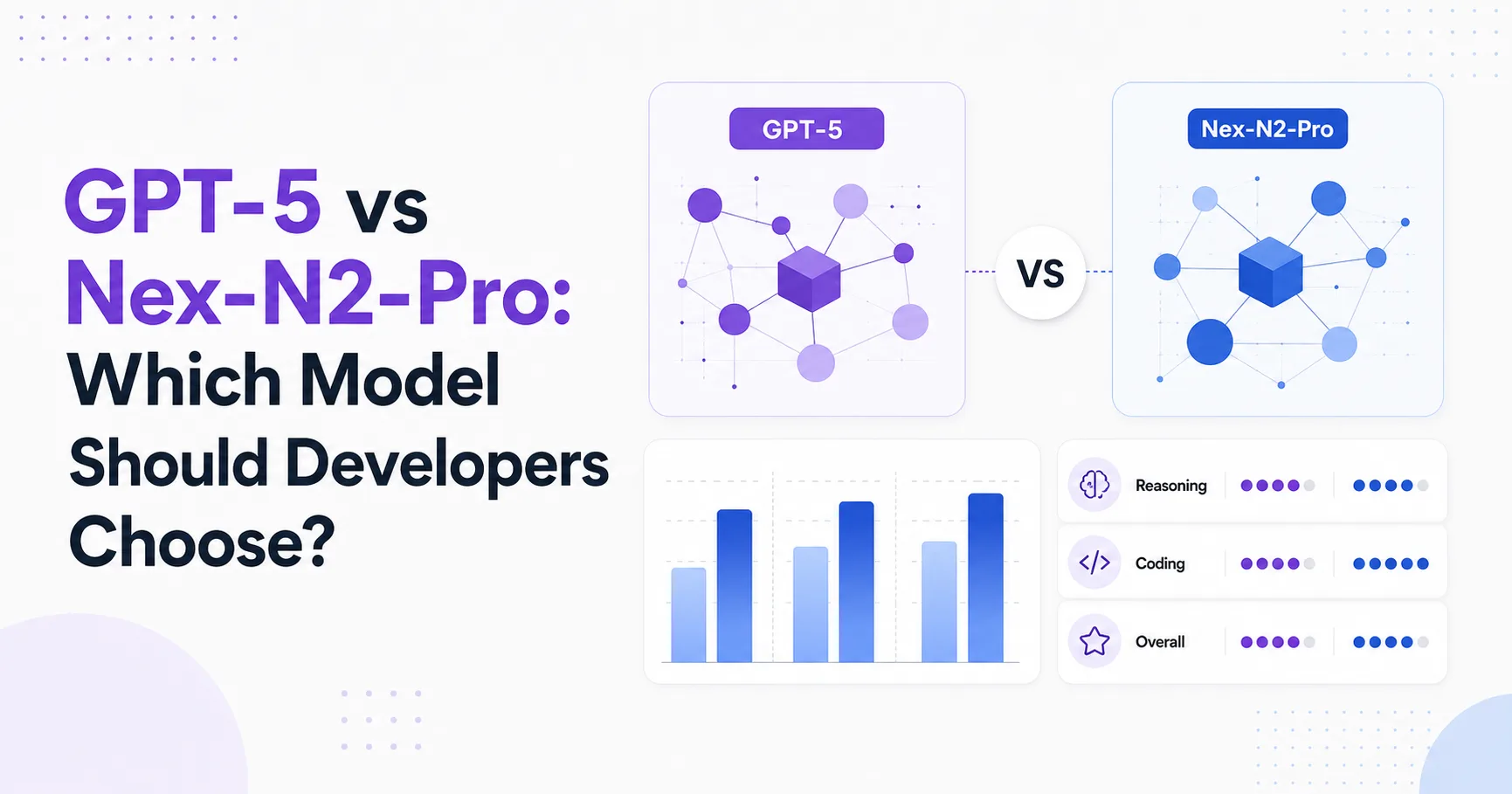
Nex-N2-Pro leads the available Artificial Analysis scores, but GPT-5 is the only model in this comparison with verifiable developer documentation and an accessible API position. The comparison data is provided by Artificial Analysis. Nex-N2-Pro records a 59.1 coding index and a 41 intelligence index, while GPT-5 records 37.8 and 34.7 respectively. Those figures make Nex-N2-Pro the apparent benchmark winner. They do not establish a production winner because the research brief found no verifiable Nex-N2-Pro vendor site, API documentation, pricing page, or official evaluation source. GPT-5 has documented text and image input, structured outputs, function calling, streaming, and configurable reasoning effort. Developers therefore face a clear tradeoff: Nex-N2-Pro offers stronger reported results and lower listed prices, while GPT-5 offers substantially stronger evidence for implementation and operational review.
GPT-5 is the safer production choice when a documented API contract matters, while Nex-N2-Pro is the more attractive experiment when reported quality and price dominate the decision. OpenAI describes GPT-5 as a reasoning model for coding, reasoning, and agentic tasks. Its documentation identifies the callable alias as gpt-5, lists a 400,000-token context window, and permits up to 128,000 output tokens. The same documentation marks the fixed snapshot gpt-5-2025-08-07 as Deprecated and recommends GPT-5.6, which creates version-management work for teams that require reproducibility. Nex-N2-Pro appears newer in the data snapshot, with a release date of 2026-06-02, but the research found no reliable public material that explains what the name represents or how developers can access it. The central selection question is therefore not simply which score is higher. It is whether the team can validate Nex-N2-Pro's identity, interface, data handling, and repeatability before assigning it production responsibility.
Nex-N2-Pro cannot currently support a normal production evaluation because the research brief contains no verifiable primary source for its capabilities, limits, or access model. That absence is more consequential than a missing marketing page. Developers cannot confirm whether the reported model is available through an API, whether its behavior is stable, whether its benchmark numbers use a comparable protocol, or whether its listed prices are actionable. GPT-5 has the opposite problem: its evidence is extensive, but its lifecycle is already moving forward. The GPT-5 model documentation still lists gpt-5 as a callable alias and identifies API endpoints including Chat Completions, Responses, and Batch. The same page marks the fixed snapshot as Deprecated. This produces a practical asymmetry. Nex-N2-Pro needs identity and access validation before a fair test. GPT-5 needs migration planning and regression testing before long-term commitment. The available material does not answer whether Nex-N2-Pro's benchmark advantage survives an independently controlled evaluation, so that question should remain explicitly open.
Nex-N2-Pro looks stronger for coding and general intelligence in the available snapshot, but the score advantage is not enough to prove better results on a developer's workload. Nex-N2-Pro records a coding index of 59.1 versus GPT-5 at 37.8, and an intelligence index of 41 versus 34.7. GPT-5 also has a reported math index of 94.3, while Nex-N2-Pro has no corresponding value in the snapshot. The missing math comparison prevents a complete reasoning verdict. The coding gap could matter for repository edits, code generation, and agent loops, but the research brief provides no task protocol, confidence interval, or reproducible Nex-N2-Pro source. GPT-5's official results include 74.9% on SWE-bench Verified, 88% on Aider polyglot, 96.7% on τ²-bench telecom, and 69.6% on Scale MultiChallenge. OpenAI notes that the SWE-bench result excluded 23 problems from 500 because they could not pass reliably on its infrastructure, and that Aider used high reasoning effort. In practice, Nex-N2-Pro deserves a controlled trial for coding-heavy workflows. GPT-5 remains easier to interpret because its evaluation conditions and control parameters are documented.
Nex-N2-Pro has the only reported output-speed measurement, while GPT-5 offers more documented controls for managing response behavior. Nex-N2-Pro reports 133.401 median output tokens per second, and both models report 0.3 seconds of latency in the data snapshot. GPT-5 has no output-speed value in that snapshot, so developers should not claim a speed winner from the available evidence. The equal latency figure also does not explain throughput under long prompts, tool calls, retries, or streaming. GPT-5 supports reasoning_effort values of minimal, low, medium, and high, plus verbosity values of low, medium, and high. Those settings let teams trade answer depth, response length, and likely operational cost within a documented interface. GPT-5 supports function calling, structured outputs, streaming, and custom tools constrained by a developer-provided context-free grammar, according to OpenAI's developer announcement. Nex-N2-Pro may be faster in real workloads, but the brief does not provide enough evidence to establish that outcome or explain how its output behavior can be controlled.
Nex-N2-Pro is the clear price leader in the supplied snapshot, but its low price becomes useful only after access and quality are verified. Nex-N2-Pro costs $1 per 1M blended tokens, compared with GPT-5 at $3.4375. Its input price is $0.5 per 1M tokens, versus GPT-5 at $1.25, while its output price is $2.5, versus GPT-5 at $10. The output difference is especially relevant for coding agents that generate long patches, explanations, or tool plans. A cheaper token can still become the more expensive system if weak outputs trigger retries, human review, rollback, or additional orchestration. The brief contains no Nex-N2-Pro documentation that explains rate limits, billing behavior, cache treatment, or availability. GPT-5's documentation lists cached input at $0.125 per 1M tokens, alongside its input and output prices, giving teams a documented cost surface for prompt caching decisions. That does not make GPT-5 cheaper. It makes its cost easier to model before deployment. Treat Nex-N2-Pro's price as a strong hypothesis for a pilot, not as a budget commitment, until a verifiable vendor source confirms it.
GPT-5 can be economically preferable when reliability, review effort, and migration risk outweigh the token-price difference. Nex-N2-Pro's $1 blended-token price is compelling for high-volume workloads, especially if its reported coding index of 59.1 holds under the team's own tests. However, the evidence gap makes hidden costs impossible to estimate from the brief. Developers do not know whether Nex-N2-Pro requires a different integration layer, offers stable structured output, supports tool calling, or preserves behavior across deployments. Those unknowns affect engineering time and failure handling, even before token spend. GPT-5 also has cost risks. Its output price is $10 per 1M tokens, and high reasoning effort was used for the Aider result reported by OpenAI. Teams that select GPT-5 should measure how reasoning effort and verbosity affect actual request budgets rather than assuming benchmark settings match production settings. The correct cost decision depends on the complete workflow: successful task rate, retry rate, review time, and migration effort. The supplied materials do not provide those measurements for either model, so a final total-cost ranking would be unsupported.
Nex-N2-Pro leads on 3 of 3 metrics
GPT-5 is the recommended default for production systems that need documented capabilities, while Nex-N2-Pro is the recommended candidate for a gated benchmark experiment. Choose GPT-5 for code agents that need function calling, structured outputs, streaming, configurable reasoning effort, or image input. The model documentation also states that GPT-5 does not support audio or video input or output, and it marks fine-tuning and predicted outputs as unsupported. Choose Nex-N2-Pro for an isolated coding evaluation if the team can first verify the endpoint, authentication, data policy, output contract, and price. Its reported coding index of 59.1 and median output speed of 133.401 make that experiment worthwhile. Do not make Nex-N2-Pro the default production dependency based only on the supplied scores. Do not make GPT-5 a long-lived fixed-snapshot dependency without addressing the Deprecated status of gpt-5-2025-08-07. A sensible decision gate is simple: validate Nex-N2-Pro's operational identity, run matched tasks, measure retries and review effort, then compare the resulting workflow cost against GPT-5. The research brief does not establish whether Nex-N2-Pro can pass that gate.
Nex-N2-Pro should enter the stack through a reversible evaluation path, while GPT-5 should enter through version-aware production controls. Start by testing Nex-N2-Pro against the team's real coding tasks, including repository navigation, patch correctness, test repair, and structured tool calls. Record whether the model can be reached consistently and whether its outputs remain valid under retries. Then run GPT-5 with the reasoning and verbosity settings that match the intended workflow. Compare successful task completion, review burden, latency, and token usage rather than comparing benchmark labels alone. If Nex-N2-Pro wins the controlled trial and its provider evidence becomes verifiable, it can become the lower-cost candidate. If the trial cannot be reproduced, GPT-5's documented interface provides the stronger operational foundation. Teams should also separate the GPT-5 alias from the Deprecated fixed snapshot in configuration and regression tests. The materials do not state how Nex-N2-Pro handles snapshots or model replacement, so its release-management risk remains unknown.
GPT-5 is easier to approve today because its API, model behavior controls, limitations, and lifecycle status are documented in public sources. Nex-N2-Pro requires additional vendor verification before a procurement or production decision. The questions below focus on uncertainties that the supplied materials do not resolve.
Nex-N2-Pro leads the supplied coding index at 59.1 versus GPT-5 at 37.8, but the comparison does not prove production superiority because no verifiable Nex-N2-Pro benchmark methodology or official documentation was found.
Nex-N2-Pro is cheaper in the supplied pricing snapshot at $1 per 1M blended tokens versus GPT-5 at $3.4375, although its access model and price provenance remain unverified.
GPT-5 should be the first production candidate when documented API behavior, tool support, and operational governance matter, while Nex-N2-Pro should begin as a controlled experiment until its provider evidence is verified.
GPT-5-high is not identified as a separate API model in the supplied research; high refers to GPT-5's reasoning_effort=high setting, while the documented callable alias is gpt-5.
GPT-5 cannot directly accept or produce audio or video because its documented modality support covers text and image input with text output; the supplied materials provide no equivalent Nex-N2-Pro evidence.
GPT-5 has a stable gpt-5 alias and a fixed snapshot named gpt-5-2025-08-07, but the fixed snapshot is marked Deprecated, so teams must plan for migration and regression testing.