
Time to First Token · GPT-5 (high)
0ms
Time to First Token · Qwen3.5 27B (Non-reasoning)
0ms
Deep dive into reasoning, benchmarks, and latency insights.
The current catalog does not contain complete performance evidence for both models, so this page does not declare an overall winner. Use the available fields as comparison signals and validate the models on your own workload.
Key decision metrics at a glance.
| Model | Metric | Value | Unit | Source / snapshot |
|---|---|---|---|---|
| GPT-5 (high) | Reasoning | 9.0 | benchmark or capability score | Artificial Analysis · current catalog |
| Qwen3.5 27B (Non-reasoning) | Reasoning | 6.0 | benchmark or capability score | Artificial Analysis · current catalog |
| GPT-5 (high) | Coding | 4.0 | benchmark or capability score | Artificial Analysis · current catalog |
| Qwen3.5 27B (Non-reasoning) | Coding | 6.0 | benchmark or capability score | Artificial Analysis · current catalog |
| GPT-5 (high) | Multimodal | 3.0 | benchmark or capability score | Artificial Analysis · current catalog |
| Qwen3.5 27B (Non-reasoning) | Multimodal | 3.0 | benchmark or capability score | Artificial Analysis · current catalog |
| GPT-5 (high) | Long Context | 4.0 | benchmark or capability score | Artificial Analysis · current catalog |
| Qwen3.5 27B (Non-reasoning) | Long Context | 4.0 | benchmark or capability score | Artificial Analysis · current catalog |
| GPT-5 (high) | Blended Price / 1M tokens | $3.438 | USD per 1M tokens | Artificial Analysis · current catalog |
| Qwen3.5 27B (Non-reasoning) | Blended Price / 1M tokens | $0.825 | USD per 1M tokens | Artificial Analysis · current catalog |
| GPT-5 (high) | P95 Latency | — | milliseconds | Artificial Analysis · current catalog |
| Qwen3.5 27B (Non-reasoning) | P95 Latency | — | milliseconds | Artificial Analysis · current catalog |
| GPT-5 (high) | Tokens per second | 0 | tokens per second | Artificial Analysis · current catalog |
| Qwen3.5 27B (Non-reasoning) | Tokens per second | 0 | tokens per second | Artificial Analysis · current catalog |
Data provided by Artificial Analysis; live values use the current catalog.
This radar chart visually maps the core capabilities (reasoning, coding, math proxy, multimodal, long context) of `GPT-5 (high)` vs `Qwen3.5 27B (Non-reasoning)`.
This grouped bar chart provides a side-by-side comparison for each benchmark metric.
Lower time to first token is better; higher tokens per second is better.
Compare input and output pricing in USD per 1M tokens.
GPT-5 (high)$3.75
Qwen3.5 27B (Non-reasoning)$0.9
Qwen3.5 27B (Non-reasoning) costs $2.85 less per run
This article is a dated snapshot published on 2026-08-07. Live cards above use the current catalog; missing live fields are not inferred.
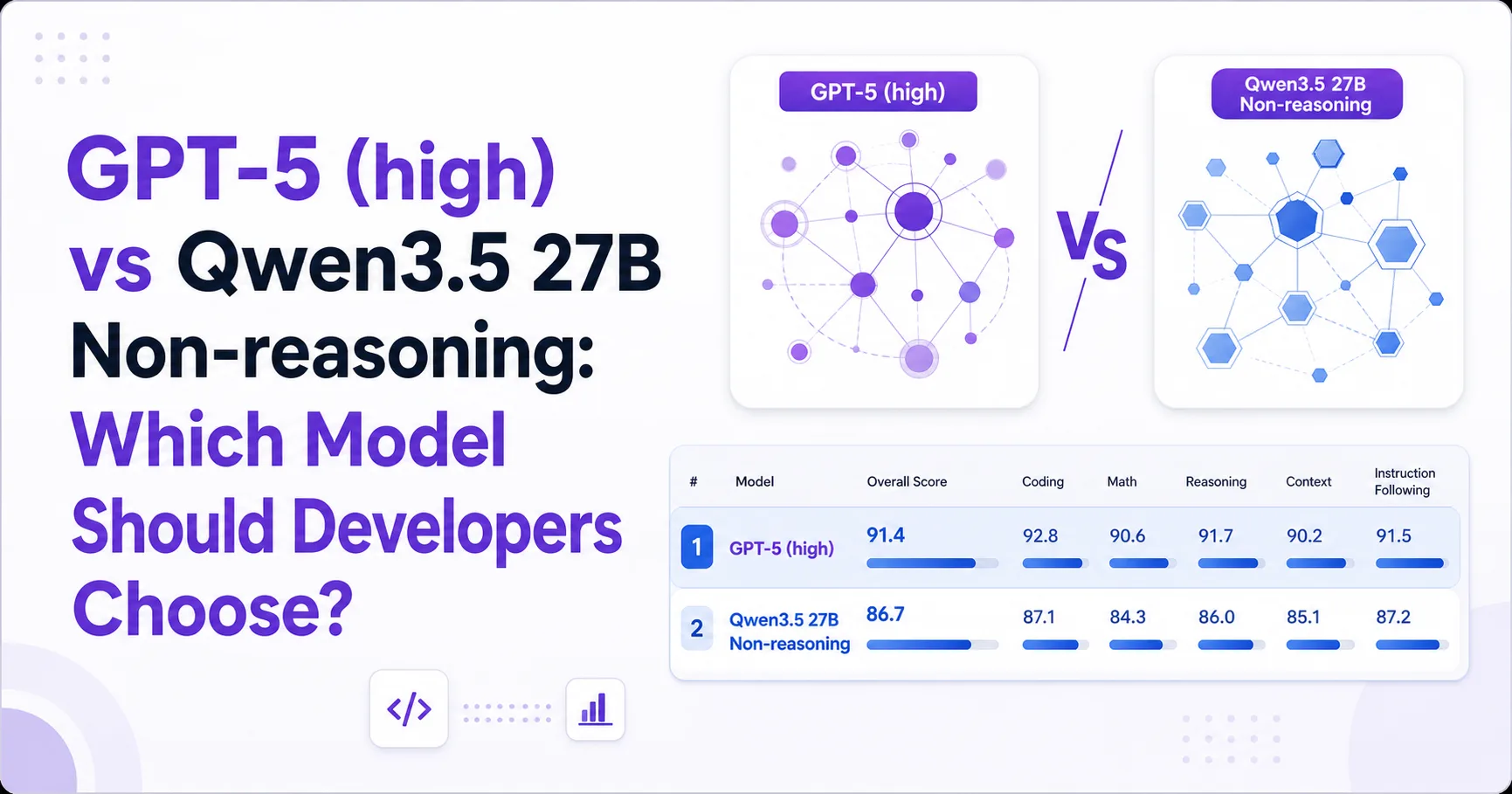
GPT-5 (high) is the safer developer choice today because it has documented API behavior and measured capability evidence, while Qwen3.5 27B Non-reasoning is cheaper but largely unverified in the supplied research. The comparison data comes from Artificial Analysis, while qualitative claims about GPT-5 come from OpenAI documentation and one community report.\n\nThe naming requires care. The supplied research found no independent API model called gpt-5-high; “high” describes GPT-5’s reasoning_effort=high setting, according to GPT-5 for developers and the GPT-5 model documentation. Qwen3.5 27B Non-reasoning appears in the data snapshot with a release date of 2026-02-24, but the research found no verifiable official announcement, model card, pricing page, or developer documentation for that exact model.\n\nThat difference changes the selection question. GPT-5 can be evaluated as a documented service with known constraints. Qwen3.5 27B Non-reasoning can be evaluated on price and the available intelligence score, but not confidently on context limits, output limits, API stability, modalities, tool calling, or failure behavior.
GPT-5 (high) leads the evidence-backed comparison, while Qwen3.5 27B Non-reasoning leads on listed price. GPT-5 records 34.7 on the Artificial Analysis Intelligence Index, compared with 29.3 for Qwen3.5 27B Non-reasoning. The same snapshot gives GPT-5 a 37.8 Coding Index and a 94.3 Math Index, but it does not provide corresponding Qwen scores. Therefore, the available data supports a GPT-5 capability lead on the common intelligence measure, not a complete coding or mathematics ranking.\n\nQwen3.5 27B Non-reasoning costs $0.825 per 1M blended tokens, compared with $3.4375 for GPT-5. Its listed input price is $0.3 per 1M tokens and its output price is $2.4. GPT-5 lists $1.25 for input and $10 for output. Both models show 0.3 seconds latency in the data snapshot, and neither has a reported median output-tokens-per-second value.\n\nGPT-5 also has a clearer production contract. OpenAI’s developer announcement describes it as a reasoning model for coding, reasoning, and agentic tasks. The model documentation documents a stable gpt-5 alias, a fixed snapshot, endpoint availability, supported modalities, and model limitations. The research found no equivalent verified material for Qwen3.5 27B Non-reasoning.\n\nThe practical result is conditional. Choose GPT-5 when correctness, documented controls, and integration confidence dominate. Choose Qwen3.5 27B Non-reasoning only when the lower listed cost is decisive and you can independently validate the provider, endpoint, model behavior, and failure modes.
GPT-5 has the stronger documented performance case, but the available benchmark evidence cannot establish a complete head-to-head win over Qwen3.5 27B Non-reasoning. The common Artificial Analysis measure favors GPT-5 at 34.7 versus 29.3 for Qwen3.5 27B Non-reasoning. That result supports a higher measured general capability signal for GPT-5 in this snapshot. It does not prove that GPT-5 will win every coding workflow, because the snapshot contains no Qwen coding score.\n\nThe missing comparison matters for developers. GPT-5 has an Artificial Analysis Coding Index of 37.8 and Math Index of 94.3, but Qwen3.5 27B Non-reasoning has no corresponding values in the supplied data. A buyer should therefore treat the coding and mathematics advantage as unconfirmed, rather than turning GPT-5’s standalone scores into a direct model-to-model margin.\n\nOpenAI reports GPT-5 results of 74.9% on SWE-bench Verified, 88% on Aider polyglot, 96.7% on τ²-bench telecom, and 69.6% on Scale MultiChallenge in GPT-5 for developers. The announcement states that the SWE-bench result excluded 23 problems from a 500-problem set because they could not be passed reliably in OpenAI’s infrastructure. That qualification makes the result useful evidence, but not a universal forecast for a private repository.\n\nGPT-5 supports reasoning_effort values of minimal, low, medium, and high, plus configurable verbosity. It also supports function calling, structured outputs, streaming, and grammar-constrained custom tools, according to OpenAI’s documentation. The supplied research gives Qwen no verified information on equivalent controls.\n\nLatency does not separate the models in the snapshot: each is listed at 0.3 seconds. Output throughput is unavailable for both. Developers needing streaming feel, sustained generation speed, or time-to-first-useful-token must run a task-specific test. The research does not provide enough evidence to say which model feels faster in production.
Qwen3.5 27B Non-reasoning is the clear price winner in the supplied snapshot, although the commercial conclusion depends on whether its unverified operational assumptions hold. Its blended price is $0.825 per 1M tokens, versus $3.4375 for GPT-5. Its input price is $0.3, versus $1.25 for GPT-5, and its output price is $2.4, versus $10.\n\nThe chart makes the headline difference visible. The harder selection issue is output behavior. GPT-5’s documented reasoning controls may produce more deliberate work for coding, agentic tasks, and difficult analysis, but the supplied research does not quantify how those settings change token usage or application cost. A cheaper model can become more expensive at the system level if it needs additional retries, validation passes, routing logic, or human review. The research provides no measured retry rate or quality-adjusted cost for either model.\n\nQwen3.5 27B Non-reasoning is attractive for high-volume, latency-sensitive, or cost-constrained workloads if its endpoint and behavior are reliable. Yet the supplied research could not verify whether this exact model remains directly callable, who operates the service, which API contract applies, or whether later model changes affect results. Those unknowns can create migration and monitoring costs that the price chart cannot show.\n\nGPT-5’s cache input price is $0.125 per 1M tokens, according to the GPT-5 model documentation. Qwen’s supplied data does not include a cache price, so cache-heavy workloads cannot be compared completely. Developers should benchmark their own ratio of input, cached input, output, retries, and review effort before treating the blended price as a total-cost decision.
Qwen3.5 27B (Non-reasoning) leads on 3 of 3 metrics
GPT-5 (high) is the default recommendation for production systems that need documented controls, coding evidence, and predictable integration behavior. OpenAI positions GPT-5 for coding, reasoning, and agentic tasks in its developer announcement. The model documentation also lists support for text and image input with text output, while excluding audio and video input and output. That makes GPT-5 a strong fit for text-centric software engineering, repository analysis, structured automation, and tool-driven workflows.\n\nQwen3.5 27B Non-reasoning is the candidate to test for workloads where listed token cost is the dominant constraint. The available data gives it the lower blended price and the lower input and output prices. It may be suitable for inexpensive classification, drafting, extraction, or high-volume assistance, but the research does not verify these use cases for the exact model. A pilot should measure task accuracy, malformed outputs, retries, context handling, and provider availability before production adoption.\n\nGPT-5 should not be selected blindly. The fixed snapshot gpt-5-2025-08-07 is marked Deprecated, and the model documentation describes GPT-5 as a previous-generation model while recommending GPT-5.6. Teams that require a long-lived pinned version should review migration policy before committing to that snapshot. The stable gpt-5 alias may also have different lifecycle implications from the fixed snapshot, so deployment policy should state which identifier is used.\n\nNeither model is the proven answer for audio or video workflows. GPT-5’s documentation explicitly excludes those modalities. Qwen’s modality support is unknown in the supplied research. Neither model has a reported output-speed metric here, so interactive product teams should not infer a speed winner from the equal 0.3-second latency figure.\n\nThe final choice is therefore risk-adjusted. Select GPT-5 for capability-sensitive or integration-sensitive systems. Select Qwen3.5 27B Non-reasoning for a controlled cost experiment, not as an evidence-backed drop-in replacement. The most important unresolved question is Qwen’s missing documentation and benchmark coverage, and the supplied research is insufficient to answer it.
GPT-5 (high) is easier to approve because its documented capabilities and limitations are visible, while Qwen3.5 27B Non-reasoning requires independent validation before a production decision. The available research does not provide a verified Qwen source, so the comparison should be treated as asymmetric evidence rather than a complete vendor evaluation.\n\nA useful approval process should separate three decisions: capability fit, commercial fit, and operational fit. Capability fit asks whether the model handles the repository, reasoning depth, tools, and output format required by the product. Commercial fit asks whether the listed token prices match the real input and output mix. Operational fit asks whether the endpoint, model identifier, lifecycle, monitoring, and rollback process are dependable. GPT-5 has documented answers for many of these questions. Qwen3.5 27B Non-reasoning does not in the supplied research.\n\nThe community evidence also needs restraint. A Reddit author reported that GPT-5 helped with small bug fixes but appeared less complete for full applications and UI generation. Comments described possible hallucinations or incorrect changes in complex existing codebases. The report is based on one user’s uncontrolled testing, as described in the Reddit discussion. The supplied research found no reliable community evidence for Qwen, so silence should not be interpreted as superior stability.\n\nDevelopers should run the same prompts, repository tasks, tool schemas, acceptance tests, and review process against both models where access is available. The supplied evidence can identify the leading default and the lower-cost experiment, but it cannot replace a workload-specific evaluation.
GPT-5 (high) is not identified as a separate API model in the supplied research; “high” refers to GPT-5’s reasoning_effort=high parameter, while the callable model alias is gpt-5. OpenAI documents this behavior in GPT-5 for developers and the GPT-5 model documentation.
Qwen3.5 27B Non-reasoning is cheaper in the supplied data, at $0.825 per 1M blended tokens compared with GPT-5 at $3.4375. Its listed input and output prices are also lower, but the research does not verify its endpoint, reliability, or quality-adjusted cost.
Neither model is faster in the supplied snapshot because both have a listed latency of 0.3 seconds, and neither has a reported median output-tokens-per-second value. Developers should run a controlled test for streaming behavior and sustained generation speed.
GPT-5 has stronger available coding evidence because the snapshot reports a 37.8 Coding Index and OpenAI reports coding benchmarks, but Qwen3.5 27B Non-reasoning has no corresponding coding score. The supplied research therefore cannot prove a complete direct coding win.
A production team should review migration risk before pinning gpt-5-2025-08-07, because OpenAI marks that fixed snapshot Deprecated and recommends GPT-5.6. The stable gpt-5 alias and snapshot should be evaluated separately in the team’s lifecycle policy.
The biggest unknown is Qwen3.5 27B Non-reasoning’s operational and capability profile. The supplied research lacks a verified official source for its API, context, modalities, benchmarks, pricing status, lifecycle, and failure modes, so its lower price cannot be treated as a complete production advantage.