
Time to First Token · GPT-5 (high)
0ms
Time to First Token · Qwen3.6 27B (Non-reasoning)
1545ms
Deep dive into reasoning, benchmarks, and latency insights.
The current catalog does not contain complete performance evidence for both models, so this page does not declare an overall winner. Use the available fields as comparison signals and validate the models on your own workload.
Key decision metrics at a glance.
| Model | Metric | Value | Unit | Source / snapshot |
|---|---|---|---|---|
| GPT-5 (high) | Reasoning | 9.0 | benchmark or capability score | Artificial Analysis · current catalog |
| Qwen3.6 27B (Non-reasoning) | Reasoning | 6.0 | benchmark or capability score | Artificial Analysis · current catalog |
| GPT-5 (high) | Coding | 4.0 | benchmark or capability score | Artificial Analysis · current catalog |
| Qwen3.6 27B (Non-reasoning) | Coding | 5.0 | benchmark or capability score | Artificial Analysis · current catalog |
| GPT-5 (high) | Multimodal | 3.0 | benchmark or capability score | Artificial Analysis · current catalog |
| Qwen3.6 27B (Non-reasoning) | Multimodal | 3.0 | benchmark or capability score | Artificial Analysis · current catalog |
| GPT-5 (high) | Long Context | 4.0 | benchmark or capability score | Artificial Analysis · current catalog |
| Qwen3.6 27B (Non-reasoning) | Long Context | 4.0 | benchmark or capability score | Artificial Analysis · current catalog |
| GPT-5 (high) | Blended Price / 1M tokens | $3.438 | USD per 1M tokens | Artificial Analysis · current catalog |
| Qwen3.6 27B (Non-reasoning) | Blended Price / 1M tokens | $1.35 | USD per 1M tokens | Artificial Analysis · current catalog |
| GPT-5 (high) | P95 Latency | — | milliseconds | Artificial Analysis · current catalog |
| Qwen3.6 27B (Non-reasoning) | P95 Latency | — | milliseconds | Artificial Analysis · current catalog |
| GPT-5 (high) | Tokens per second | 0 | tokens per second | Artificial Analysis · current catalog |
| Qwen3.6 27B (Non-reasoning) | Tokens per second | 58.247 | tokens per second | Artificial Analysis · current catalog |
Data provided by Artificial Analysis; live values use the current catalog.
This radar chart visually maps the core capabilities (reasoning, coding, math proxy, multimodal, long context) of `GPT-5 (high)` vs `Qwen3.6 27B (Non-reasoning)`.
This grouped bar chart provides a side-by-side comparison for each benchmark metric.
Lower time to first token is better; higher tokens per second is better.
Compare input and output pricing in USD per 1M tokens.
GPT-5 (high)$3.75
Qwen3.6 27B (Non-reasoning)$1.5
Qwen3.6 27B (Non-reasoning) costs $2.25 less per run
This article is a dated snapshot published on 2026-08-07. Live cards above use the current catalog; missing live fields are not inferred.
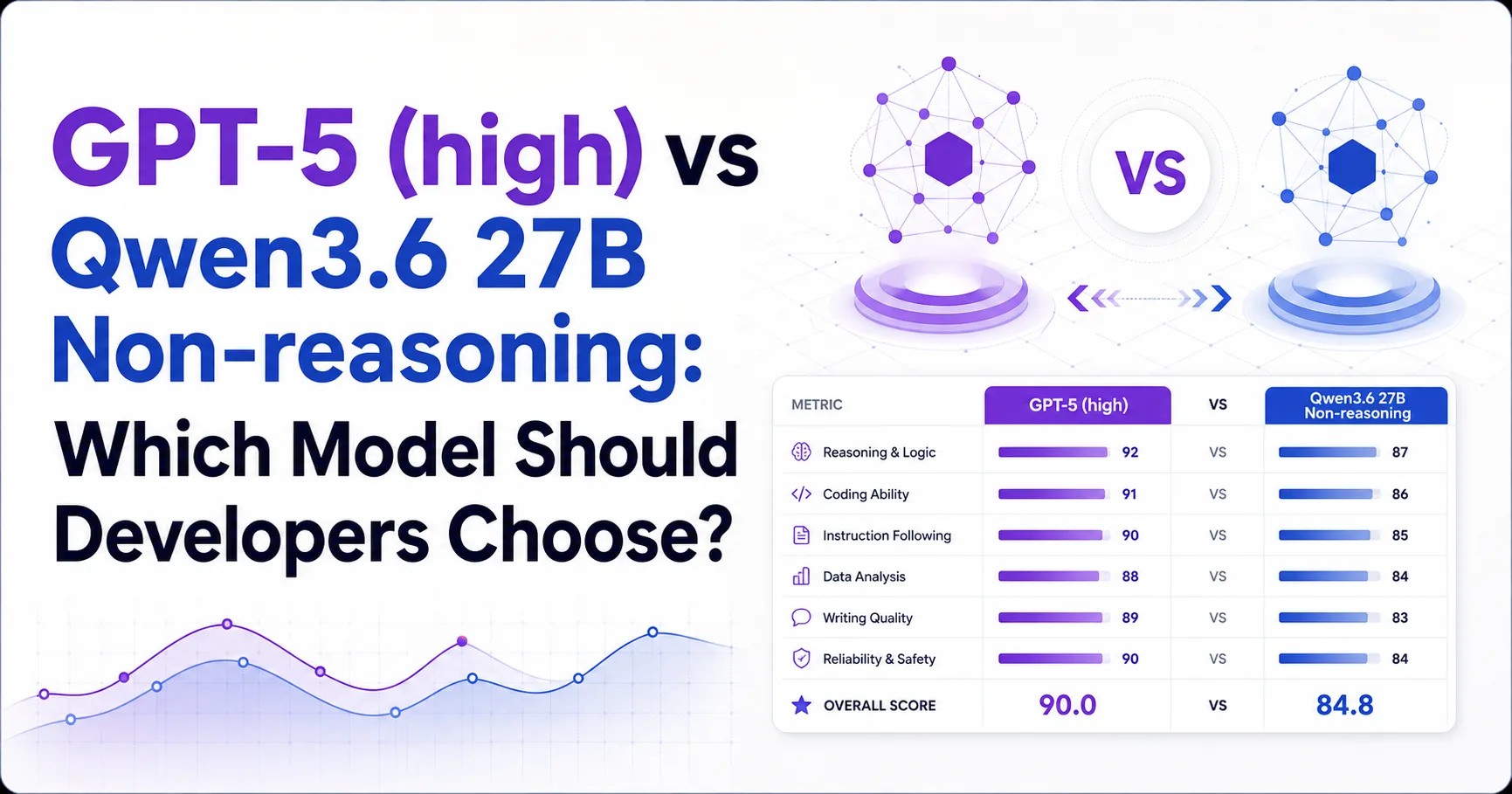
GPT-5 (high) is the safer production choice, while Qwen3.6 27B (Non-reasoning) is the stronger low-cost coding bet when undocumented operational details are acceptable. The comparison is uneven because GPT-5 has public developer documentation, benchmark disclosures, pricing, and community discussion, while the research brief found no verifiable vendor or community material for Qwen3.6 27B (Non-reasoning).
The data snapshot lists GPT-5 (high) with an Intelligence Index of 34.7, a Coding Index of 37.8, and a Math Index of 94.3. Qwen3.6 27B (Non-reasoning) records an Intelligence Index of 30.5 and a Coding Index of 46.6. Qwen3.6 27B (Non-reasoning) also has the lower blended price and the only reported output-speed figure.
This article separates measured differences from evidence gaps. The benchmark values come from Data provided by https://artificialanalysis.ai/. GPT-5’s API positioning, reasoning controls, tool support, and published benchmarks come from GPT-5 for developers and the GPT-5 model documentation.
GPT-5 (high) offers the more defensible engineering decision because its behavior and integration surface are documented, even though Qwen3.6 27B (Non-reasoning) leads the available coding score. OpenAI describes GPT-5 as a reasoning model for coding, reasoning, and agentic tasks, and its model documentation identifies a stable gpt-5 alias, Responses support, Chat Completions support, Batch support, function calling, structured outputs, and streaming.
| Decision factor | GPT-5 (high) | Qwen3.6 27B (Non-reasoning) |
|---|---|---|
| Intelligence Index | 34.7 | 30.5 |
| Coding Index | 37.8 | 46.6 |
| Math Index | 94.3 | Not reported |
| Blended price per 1M tokens | $3.4375 | $1.35 |
| Input price per 1M tokens | $1.25 | $0.6 |
| Output price per 1M tokens | $10 | $3.6 |
| Reported median output speed | Not reported | 59.85 tokens per second |
| Reported latency | 0.3 seconds | 0.3 seconds |
The table supports two different conclusions. Qwen3.6 27B (Non-reasoning) looks attractive for coding-heavy workloads and cost-sensitive batch processing. GPT-5 looks stronger for teams that need documented reasoning behavior, mathematical evidence, multimodal input, tool interfaces, and a clearer operational contract.
The central unresolved question is whether Qwen3.6 27B (Non-reasoning) can deliver its coding advantage consistently through a stable, supported API. The available research does not answer that question.
Qwen3.6 27B (Non-reasoning) leads the available coding evaluation, while GPT-5 (high) has the broader and more credible evidence base for reasoning-oriented development workflows. The Artificial Analysis snapshot reports a Coding Index of 46.6 for Qwen3.6 27B (Non-reasoning), compared with 37.8 for GPT-5 (high). That gap is large enough to justify a focused coding trial before selecting GPT-5 by reputation alone.
The coding result does not establish that Qwen3.6 27B (Non-reasoning) is better for every software task. The brief provides no details about its benchmark methodology, prompt format, tool access, repository size, or execution environment. It also provides no measured failure analysis. A coding index can therefore identify a promising candidate, but it cannot settle questions about patch safety, test discipline, instruction following, or performance in a complex existing codebase.
GPT-5 has a different evidence profile. OpenAI reports 74.9% on SWE-bench Verified, 88% on Aider polyglot, 96.7% on τ²-bench telecom, and 69.6% on Scale MultiChallenge in its developer announcement. OpenAI states that the SWE-bench result excluded 23 problems that could not be passed reliably on its infrastructure, and that the Aider evaluation used high reasoning effort. Those qualifications matter because they limit direct comparison with the Artificial Analysis Coding Index.
GPT-5 is better supported for agentic workflows because the documentation covers function calling, structured outputs, streaming, and custom tools. Qwen3.6 27B (Non-reasoning) may still be the better choice for code generation or transformation if a local evaluation confirms its advantage. The research brief does not provide enough evidence to predict its tool-use reliability, repository-edit behavior, or reasoning quality.
Qwen3.6 27B (Non-reasoning) is the clear price leader, but GPT-5 (high) can still be cheaper at the system level when quality reduces retries, reviews, and failed tool actions. The snapshot lists Qwen3.6 27B (Non-reasoning) at $1.35 per 1M blended tokens, versus $3.4375 for GPT-5 (high). Its input price is $0.6, versus $1.25, and its output price is $3.6, versus $10.
Those prices favor Qwen3.6 27B (Non-reasoning) for workloads with high request volume, short-lived experiments, large-scale classification, or predictable code transformations. The advantage is especially relevant when outputs are cheap to validate and failures do not trigger expensive downstream work.
The cost conclusion can reverse in agentic applications. A lower-priced model becomes more expensive when it needs more retries, produces unsafe patches, calls tools incorrectly, or requires manual review. The research brief contains no reliable Qwen3.6 27B (Non-reasoning) documentation for tool calling, structured outputs, context limits, or failure modes. That missing information prevents a trustworthy total-cost estimate.
GPT-5’s output price is materially higher, so it should not be the default for every request. A practical architecture could reserve GPT-5 for high-risk planning, mathematical reasoning, migration design, and final review, while testing Qwen3.6 27B (Non-reasoning) for lower-risk coding work. That routing idea remains a design hypothesis, not a measured result from the supplied data.
The reported latency is 0.3 seconds for both models. Qwen3.6 27B (Non-reasoning) additionally has a reported median output speed of 59.85 tokens per second, while GPT-5 has no corresponding value in the snapshot. The missing GPT-5 speed figure prevents a fair throughput comparison.
Qwen3.6 27B (Non-reasoning) leads on 3 of 3 metrics
GPT-5 (high) is the default recommendation for documented production integration, while Qwen3.6 27B (Non-reasoning) deserves a controlled pilot for coding-heavy and cost-sensitive workloads. Choose GPT-5 when the application needs a known API surface, explicit reasoning effort controls, structured outputs, custom tool constraints, or multimodal input. OpenAI documents text and image input with text output, but no audio or video input or output.
Choose Qwen3.6 27B (Non-reasoning) when the primary success metric is coding throughput or unit cost, and the team can independently verify availability, context behavior, output quality, and operational support. Its Coding Index of 46.6 is the strongest available signal in this comparison. That signal should lead to testing, not automatic adoption, because the research brief found no verifiable official Qwen3.6 27B (Non-reasoning) documentation or reliable community evaluation.
GPT-5 also carries a version-management concern. The model documentation marks the fixed snapshot gpt-5-2025-08-07 as Deprecated and describes GPT-5 as a previous-generation model. The same page still lists gpt-5 as a callable alias and recommends GPT-5.6. Teams choosing GPT-5 should therefore isolate the model identifier, monitor deprecation notices, and maintain a migration test set.
The evidence does not establish a universal winner. GPT-5 has stronger documentation and a reported Math Index of 94.3. Qwen3.6 27B (Non-reasoning) has the higher reported Coding Index and lower prices. Developers should select GPT-5 for integration certainty, and select Qwen3.6 27B (Non-reasoning) only after a workload-specific pilot closes the evidence gaps.
GPT-5 (high) requires a migration-aware decision because documented capability, benchmark leadership, and current availability point in different directions. The following questions address the gaps that a scorecard alone cannot resolve.
A pilot should measure accepted patches, test-pass rate, retry count, tool-call validity, review time, and cost per completed task. The supplied materials do not provide those task-level measurements for either model, so developers must collect them against their own repositories and prompts.
The coding score should determine which model enters testing, not which model ships. Qwen3.6 27B (Non-reasoning) leads the available Coding Index at 46.6, but the brief does not identify its test conditions or operational guarantees. GPT-5’s published developer benchmarks are broader, yet they are not directly interchangeable with the Artificial Analysis score.
GPT-5 (high) is not documented as a separate API model ID; “high” refers to the reasoning_effort=high parameter on gpt-5. OpenAI’s developer documentation describes the reasoning-effort parameter, while the model page lists gpt-5 and the fixed snapshot identifier.
The largest documented GPT-5 risk is lifecycle management because the fixed snapshot gpt-5-2025-08-07 is marked Deprecated. Teams also need to account for its lack of audio and video support, plus the absence of fine-tuning and predicted outputs in the model documentation.
The largest known Qwen3.6 27B (Non-reasoning) risk is insufficient evidence rather than a confirmed technical limitation. The research brief found no reliable official documentation, pricing page, API status, community discussion, or failure analysis for this model.
GPT-5 (high) is the safer production starting point because its API behavior, tool support, reasoning controls, and lifecycle information are publicly documented, while Qwen3.6 27B (Non-reasoning) lacks comparable evidence.
Qwen3.6 27B (Non-reasoning) leads the supplied Coding Index at 46.6 versus GPT-5 (high) at 37.8, but developers should validate repository editing, testing, tool use, and reliability before treating that result as decisive.
Qwen3.6 27B (Non-reasoning) is cheaper at $1.35 per 1M blended tokens, compared with $3.4375 for GPT-5 (high), although retries, reviews, and failed actions can change total operating cost.
GPT-5 (high) has stronger documented reasoning evidence because OpenAI reports a Math Index of 94.3 and publishes developer benchmarks, while the supplied materials report no Qwen3.6 27B (Non-reasoning) math score.
Teams should verify API availability, context limits, output behavior, tool calling, structured outputs, pricing stability, failure modes, and support because the supplied research found no reliable public documentation for those areas.