
Time to First Token · GPT-5 (high)
0ms
Time to First Token · Qwen3.6 35B A3B (Reasoning)
1079ms
Deep dive into reasoning, benchmarks, and latency insights.
The current catalog does not contain complete performance evidence for both models, so this page does not declare an overall winner. Use the available fields as comparison signals and validate the models on your own workload.
Key decision metrics at a glance.
| Model | Metric | Value | Unit | Source / snapshot |
|---|---|---|---|---|
| GPT-5 (high) | Reasoning | 9.0 | benchmark or capability score | Artificial Analysis · current catalog |
| Qwen3.6 35B A3B (Reasoning) | Reasoning | 6.0 | benchmark or capability score | Artificial Analysis · current catalog |
| GPT-5 (high) | Coding | 4.0 | benchmark or capability score | Artificial Analysis · current catalog |
| Qwen3.6 35B A3B (Reasoning) | Coding | 4.0 | benchmark or capability score | Artificial Analysis · current catalog |
| GPT-5 (high) | Multimodal | 3.0 | benchmark or capability score | Artificial Analysis · current catalog |
| Qwen3.6 35B A3B (Reasoning) | Multimodal | 3.0 | benchmark or capability score | Artificial Analysis · current catalog |
| GPT-5 (high) | Long Context | 4.0 | benchmark or capability score | Artificial Analysis · current catalog |
| Qwen3.6 35B A3B (Reasoning) | Long Context | 4.0 | benchmark or capability score | Artificial Analysis · current catalog |
| GPT-5 (high) | Blended Price / 1M tokens | $3.438 | USD per 1M tokens | Artificial Analysis · current catalog |
| Qwen3.6 35B A3B (Reasoning) | Blended Price / 1M tokens | $0.844 | USD per 1M tokens | Artificial Analysis · current catalog |
| GPT-5 (high) | P95 Latency | — | milliseconds | Artificial Analysis · current catalog |
| Qwen3.6 35B A3B (Reasoning) | P95 Latency | — | milliseconds | Artificial Analysis · current catalog |
| GPT-5 (high) | Tokens per second | 0 | tokens per second | Artificial Analysis · current catalog |
| Qwen3.6 35B A3B (Reasoning) | Tokens per second | 138.895 | tokens per second | Artificial Analysis · current catalog |
Data provided by Artificial Analysis; live values use the current catalog.
This radar chart visually maps the core capabilities (reasoning, coding, math proxy, multimodal, long context) of `GPT-5 (high)` vs `Qwen3.6 35B A3B (Reasoning)`.
This grouped bar chart provides a side-by-side comparison for each benchmark metric.
Lower time to first token is better; higher tokens per second is better.
Compare input and output pricing in USD per 1M tokens.
GPT-5 (high)$3.75
Qwen3.6 35B A3B (Reasoning)$0.938
Qwen3.6 35B A3B (Reasoning) costs $2.813 less per run
This article is a dated snapshot published on 2026-08-07. Live cards above use the current catalog; missing live fields are not inferred.
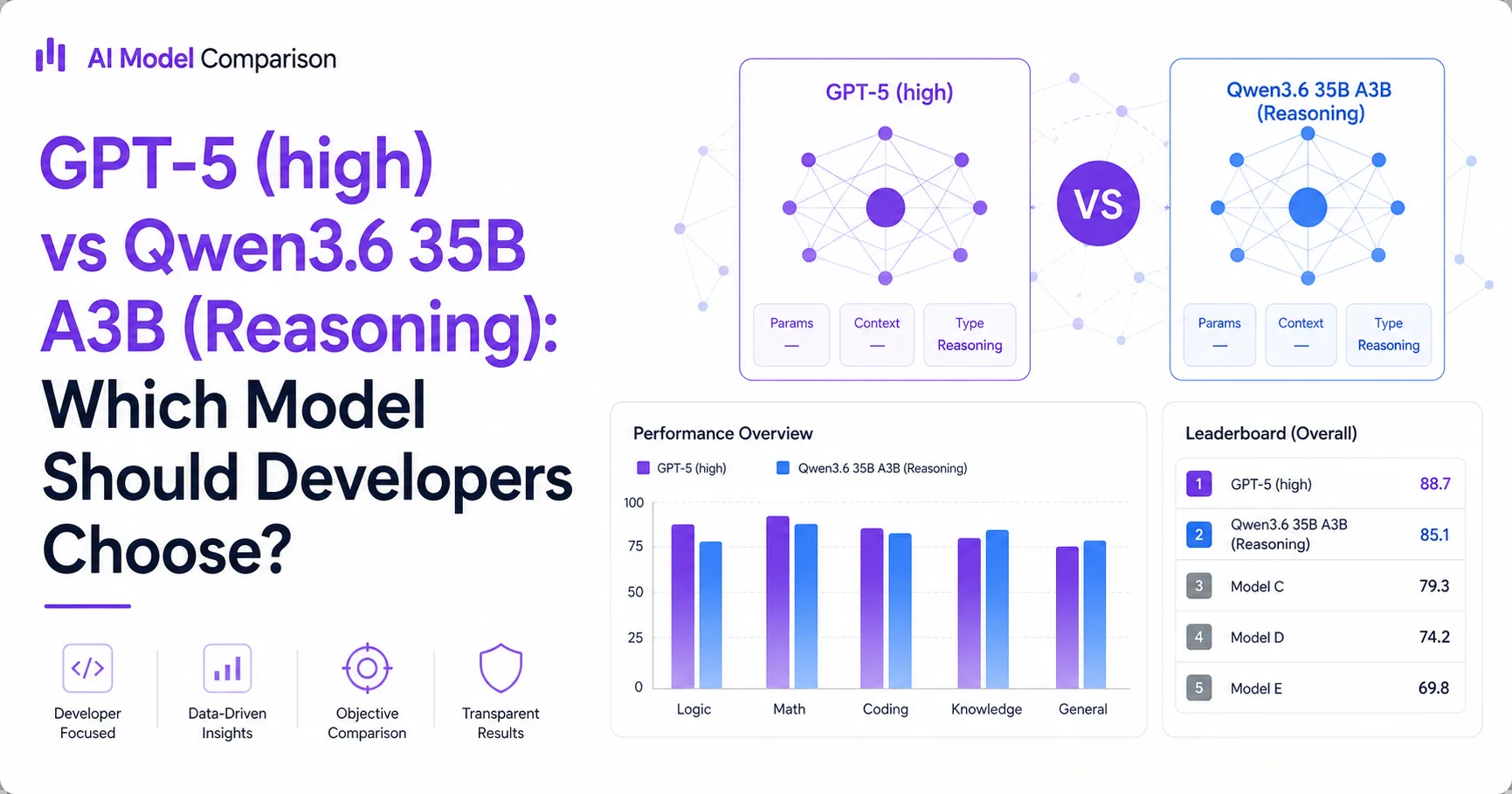
GPT-5 (high) is the safer production choice when developers need documented behavior, while Qwen3.6 35B A3B (Reasoning) is the stronger low-cost coding candidate.
The comparison is asymmetric. OpenAI publishes developer documentation, API positioning, capability details, and benchmark results for GPT-5. The available material provides no verified official announcement, developer documentation, pricing page, or benchmark source for Qwen3.6 35B A3B (Reasoning). That difference matters because model selection depends on more than a score. Developers also need to know whether a model can be called consistently, how its controls work, what its supported modalities are, and whether its version will remain available.
The data brief gives Qwen3.6 35B A3B (Reasoning) a coding index of 41.9, compared with 37.8 for GPT-5 (high). Qwen therefore has the stronger measured coding result in this dataset. GPT-5 leads the intelligence index at 34.7 versus 31.6 and is the only model with a reported math index, at 94.3. The pricing gap is substantial, with Qwen listed at $0.55725 per 1M blended tokens and GPT-5 at $3.4375.
The practical conclusion is conditional. Qwen is attractive for coding-heavy workloads that can tolerate uncertainty around product documentation and operational support. GPT-5 is easier to evaluate for agents, tool-driven workflows, and reasoning systems because OpenAI documents those integration features directly. OpenAI describes GPT-5 as a reasoning model for coding, reasoning, and agentic tasks in GPT-5 for developers.
GPT-5 (high) offers the stronger documented reasoning package, while Qwen3.6 35B A3B (Reasoning) offers the stronger measured coding score and lower operating cost.
| Decision factor | GPT-5 (high) | Qwen3.6 35B A3B (Reasoning) | What it means |
|---|---|---|---|
| Intelligence index | 34.7 | 31.6 | GPT-5 leads the broad index in the supplied data. |
| Coding index | 37.8 | 41.9 | Qwen leads the measured coding comparison. |
| Math index | 94.3 | Not reported | GPT-5 has the only available result, so the models cannot be ranked on this dimension. |
| Blended price per 1M tokens | $3.4375 | $0.55725 | Qwen is the lower-cost option in the supplied pricing snapshot. |
| Output speed | Not reported | 129.58 tokens per second | Qwen has the only reported output-speed value. |
| Latency | 0.3 seconds | 0.3 seconds | The supplied data shows a tie on latency. |
The scores do not produce a universal winner. Qwen's coding lead suggests that developers should test it seriously for code generation, code transformation, and repository tasks. The result does not establish that Qwen is safer for production, because the research brief contains no verified documentation or reproducible community evidence for the model.
GPT-5's advantage is evidence quality and integration clarity. OpenAI documents function calling, structured outputs, streaming, and custom tools with developer-provided context-free grammar constraints in GPT-5 for developers and the GPT-5 model documentation. Those details reduce the amount of discovery work required before building an agent.
The most important unanswered question concerns Qwen's deployment reality. The available material does not verify a stable alias, callable endpoint, support policy, or replacement relationship. Developers should treat Qwen's favorable price and coding score as promising evaluation inputs, not as proof of production readiness.
Qwen3.6 35B A3B (Reasoning) leads the supplied coding index, but GPT-5 (high) has the clearer evidence for broader reasoning and agent workflows.
A coding-index lead can matter greatly for developers whose requests are narrowly technical. Code completion, refactoring, test generation, and bug localization may benefit from Qwen's 41.9 result. The gap over GPT-5's 37.8 is large enough to justify a direct task-based evaluation. Developers should compare patch correctness, test preservation, dependency awareness, and rollback frequency rather than treating the index as a complete description of software quality.
GPT-5's broader profile points in a different direction. The model has a reported intelligence index of 34.7 and a math index of 94.3, while Qwen has no supplied math result. That missing Qwen value prevents a fair mathematical comparison. GPT-5 also has official evidence for coding, reasoning, and agentic tasks. OpenAI reports results on SWE-bench Verified, Aider polyglot, τ²-bench telecom, and Scale MultiChallenge in GPT-5 for developers. The benchmark evidence still needs careful interpretation because the SWE-bench result excluded 23 problems that could not run reliably in OpenAI's infrastructure, and the Aider result used high reasoning effort.
The latency data does not separate the models. Both models are listed at 0.3 seconds, so the decision should not assume that the lower-cost model automatically feels faster to users. Qwen does have a reported median output speed of 129.58 tokens per second, while GPT-5 has no corresponding value. That makes Qwen the only model with evidence for sustained output speed, but it does not establish end-to-end responsiveness for a tool-using workflow.
Community evidence adds caution rather than a firm verdict. A Reddit author reported that GPT-5 was useful for locating and fixing small bugs, but described less complete output for full applications and UI generation. The post was a subjective, uncontrolled test, and comments raised possible hallucination or incorrect-edit risks in complex existing codebases. See Tried GPT-5 Here Are My First Impressions. No comparable reliable community evidence was found for Qwen.
Qwen3.6 35B A3B (Reasoning) is the clear price winner, but lower token prices do not guarantee lower total engineering cost.
The supplied blended price is $0.55725 per 1M tokens for Qwen and $3.4375 for GPT-5. Qwen also has lower listed input pricing at $0.248 per 1M tokens and lower output pricing at $1.485 per 1M tokens. GPT-5 is listed at $1.25 per 1M input tokens and $10 per 1M output tokens. Those values make Qwen especially attractive for high-volume generation, classification, code transformation, and exploratory workloads where token consumption dominates the budget.
The cost conclusion can reverse if the model needs more supervision. A cheaper model becomes more expensive when developers must add repeated validation calls, manual review, retries, corrective prompts, or custom routing to compensate for uncertain behavior. The research brief does not provide failure rates, retry rates, quality-adjusted cost, or operational support costs for either model. Those gaps prevent a complete total-cost comparison.
GPT-5 may justify its higher token price when a single successful response replaces several corrective cycles. OpenAI documents reasoning controls, structured output, function calling, streaming, and custom tools in GPT-5 model documentation. Those features can reduce integration work for systems that need reliable machine-readable actions. The available evidence does not prove that GPT-5 will require fewer retries than Qwen, so that benefit remains a production hypothesis.
The right cost test is therefore workload-specific. Measure successful task completion, reviewer intervention, retry frequency, latency under real tool usage, and token consumption. Use the blended prices as the budget baseline, then add the engineering and reliability costs that the data brief does not quantify. Qwen is the rational first candidate for cost-sensitive experiments. GPT-5 is the rational candidate when documented controls and integration confidence carry high value.
Qwen3.6 35B A3B (Reasoning) leads on 3 of 3 metrics
GPT-5 (high) is the recommended default for documented agent integrations, while Qwen3.6 35B A3B (Reasoning) is the recommended challenger for cost-sensitive coding workloads.
Choose GPT-5 (high) when the application needs explicit reasoning controls, structured outputs, function calling, streaming, or custom tools. OpenAI documents these capabilities and positions GPT-5 for coding, reasoning, and agentic tasks in GPT-5 for developers. GPT-5 is also the better-supported choice for math-heavy workflows because it has a reported math index of 94.3, while the supplied data contains no Qwen math result.
Choose Qwen3.6 35B A3B (Reasoning) when coding throughput and token cost dominate the decision. Qwen leads the coding index at 41.9 and is listed at $0.55725 per 1M blended tokens. Those advantages make it worth testing for code generation, repository edits, migration scripts, and high-volume developer assistance. The recommendation depends on verifying the model's actual endpoint, version stability, access terms, and error behavior because the research brief supplies no reliable official source for those details.
Avoid making a final choice from benchmark scores alone. GPT-5's fixed snapshot, gpt-5-2025-08-07, is marked Deprecated in the GPT-5 model documentation, even though the gpt-5 alias remains listed. That creates migration risk for applications that require an immutable version. Qwen has a different risk: the available research does not verify a stable API identity or lifecycle.
A sensible evaluation order is straightforward. Start with Qwen for coding-focused cost trials. Run GPT-5 against the same tasks with the intended reasoning setting. Compare accepted patches, tool-call validity, reviewer effort, retries, and user-visible latency. Promote Qwen only after its operational status and quality hold under the application's own tests. Keep GPT-5 as the safer baseline for agentic workflows with documented integration requirements.
Qwen3.6 35B A3B (Reasoning) deserves a production trial only after developers verify the operational facts missing from the available evidence.
The research brief provides a strong technical profile for GPT-5 and a strong comparative data point for Qwen's coding performance. It does not provide enough information to settle Qwen's availability, lifecycle, supported interfaces, or failure behavior. Those unknowns are material because a model can score well and remain difficult to operate.
GPT-5 also requires explicit risk review. Its documented capabilities are broad, but the fixed snapshot is marked Deprecated. Its API supports text and image input with text output, but the documentation states that audio and video input and output are unsupported. The community evidence about full application generation and complex codebases is useful as a warning, yet it comes from an uncontrolled Reddit post rather than a reproducible evaluation.
The FAQ below separates evidence-backed conclusions from questions that remain unresolved. Developers should use the supplied benchmark and price values to prioritize tests, then make the final decision with application-level measurements.
Qwen3.6 35B A3B (Reasoning) has the higher supplied coding index at 41.9 versus 37.8 for GPT-5 (high), so Qwen is the stronger measured coding candidate. GPT-5 remains easier to validate for production because OpenAI documents its coding, reasoning, agentic-task positioning, and tool integration. The evidence does not show that either model wins every repository or software-engineering task.
Qwen3.6 35B A3B (Reasoning) is cheaper in the supplied pricing snapshot, at $0.55725 per 1M blended tokens versus $3.4375 for GPT-5 (high). Qwen also has lower listed input and output prices. Total cost can still change if Qwen requires more retries, review, routing, or validation, because the available data does not quantify those operational factors.
Qwen3.6 35B A3B (Reasoning) is the only model with a reported median output speed, at 129.58 tokens per second, while GPT-5 (high) has no supplied output-speed value. The latency comparison is tied at 0.3 seconds for both models. Developers should therefore test complete request-to-result time, especially when tools, reasoning, and multiple model turns are involved.
Developers should treat the GPT-5 fixed snapshot as a migration risk because gpt-5-2025-08-07 is marked Deprecated in OpenAI's model documentation. The gpt-5 alias remains listed, but applications requiring a stable version should monitor replacement guidance, test migrations, and avoid assuming that the deprecated snapshot will remain available indefinitely.
The biggest evidence gap concerns Qwen3.6 35B A3B (Reasoning), because the research brief contains no verified official release announcement, developer documentation, pricing page, stable alias, endpoint status, benchmark source, or reliable community evaluation. Qwen's coding and price figures are useful for prioritizing tests, but they do not establish production readiness or long-term availability.