
Time to First Token · GPT-5 (high)
0ms
Time to First Token · Step 3.7 Flash
1828ms
Deep dive into reasoning, benchmarks, and latency insights.
The current catalog does not contain complete performance evidence for both models, so this page does not declare an overall winner. Use the available fields as comparison signals and validate the models on your own workload.
Key decision metrics at a glance.
| Model | Metric | Value | Unit | Source / snapshot |
|---|---|---|---|---|
| GPT-5 (high) | Reasoning | 9.0 | benchmark or capability score | Artificial Analysis · current catalog |
| Step 3.7 Flash | Reasoning | 6.0 | benchmark or capability score | Artificial Analysis · current catalog |
| GPT-5 (high) | Coding | 4.0 | benchmark or capability score | Artificial Analysis · current catalog |
| Step 3.7 Flash | Coding | 4.0 | benchmark or capability score | Artificial Analysis · current catalog |
| GPT-5 (high) | Multimodal | 3.0 | benchmark or capability score | Artificial Analysis · current catalog |
| Step 3.7 Flash | Multimodal | 3.0 | benchmark or capability score | Artificial Analysis · current catalog |
| GPT-5 (high) | Long Context | 4.0 | benchmark or capability score | Artificial Analysis · current catalog |
| Step 3.7 Flash | Long Context | 4.0 | benchmark or capability score | Artificial Analysis · current catalog |
| GPT-5 (high) | Blended Price / 1M tokens | $3.438 | USD per 1M tokens | Artificial Analysis · current catalog |
| Step 3.7 Flash | Blended Price / 1M tokens | $0.438 | USD per 1M tokens | Artificial Analysis · current catalog |
| GPT-5 (high) | P95 Latency | — | milliseconds | Artificial Analysis · current catalog |
| Step 3.7 Flash | P95 Latency | — | milliseconds | Artificial Analysis · current catalog |
| GPT-5 (high) | Tokens per second | 0 | tokens per second | Artificial Analysis · current catalog |
| Step 3.7 Flash | Tokens per second | 120.093 | tokens per second | Artificial Analysis · current catalog |
Data provided by Artificial Analysis; live values use the current catalog.
This radar chart visually maps the core capabilities (reasoning, coding, math proxy, multimodal, long context) of `GPT-5 (high)` vs `Step 3.7 Flash`.
This grouped bar chart provides a side-by-side comparison for each benchmark metric.
Lower time to first token is better; higher tokens per second is better.
Compare input and output pricing in USD per 1M tokens.
GPT-5 (high)$3.75
Step 3.7 Flash$0.487
Step 3.7 Flash costs $3.263 less per run
This article is a dated snapshot published on 2026-08-07. Live cards above use the current catalog; missing live fields are not inferred.
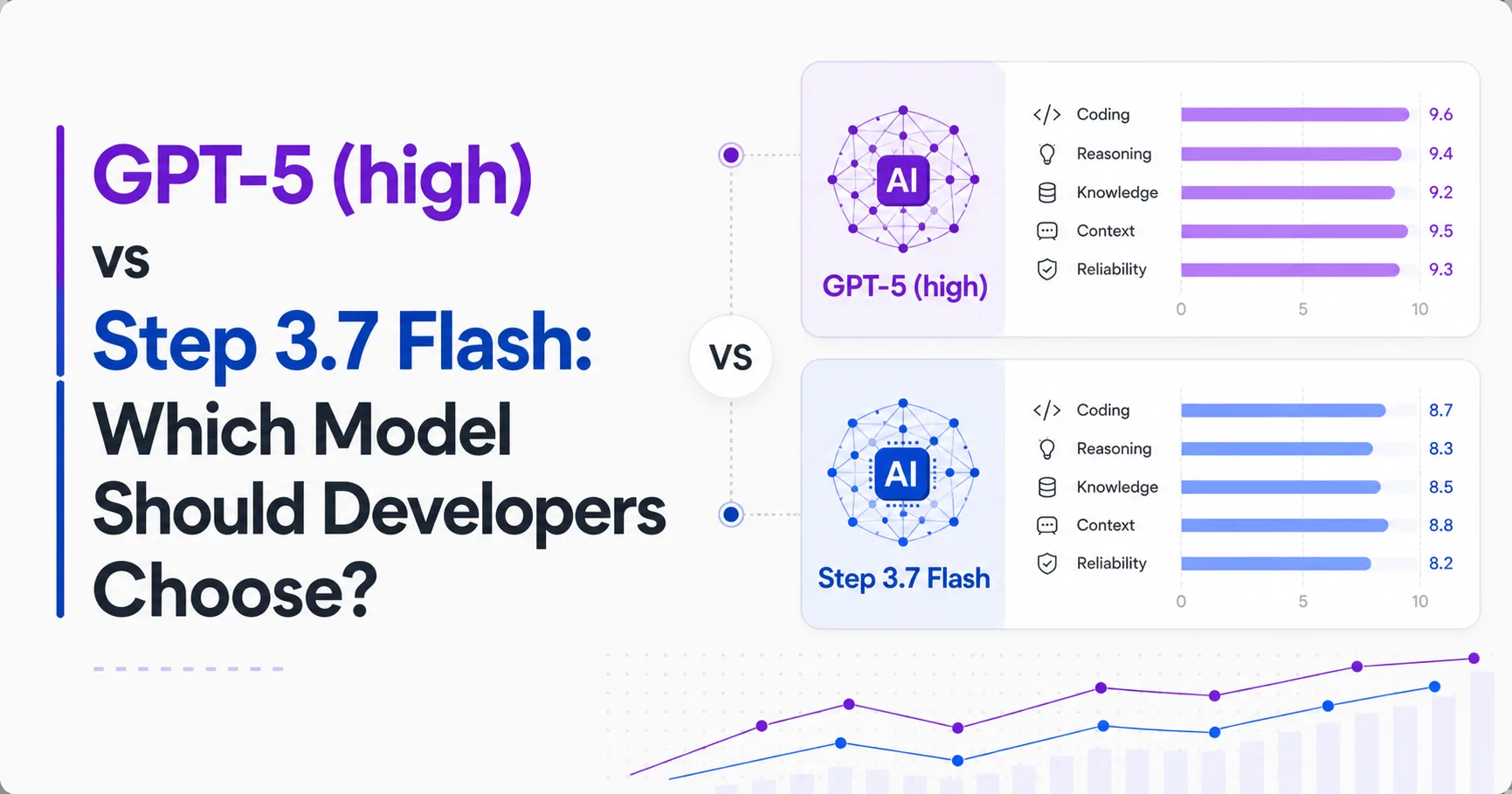
GPT-5 (high) is the safer documented choice, while Step 3.7 Flash is the stronger low-cost experiment for throughput-sensitive coding workloads.
The Artificial Analysis data shows a split decision rather than a universal winner. GPT-5 (high) leads the Artificial Analysis Intelligence Index at 34.7, compared with 30.3 for Step 3.7 Flash. Step 3.7 Flash leads the Artificial Analysis Coding Index at 39.6, compared with 37.8 for GPT-5 (high). The data also reports a GPT-5 (high) Artificial Analysis Math Index of 94.3, while no Step 3.7 Flash value is provided for that evaluation.
Cost creates the largest visible difference. Step 3.7 Flash costs $0.4375 per 1M blended tokens, while GPT-5 (high) costs $3.4375. Step 3.7 Flash also reports a median output speed of 392.472 tokens per second. GPT-5 (high) has no supplied median output speed value, so the data cannot establish a direct speed ranking.
The evidence quality is asymmetric. OpenAI provides public documentation for GPT-5, including its API positioning, tools, modalities, and lifecycle status. The supplied research found no verifiable vendor documentation, pricing page, stable API alias, or reliable community discussion for Step 3.7 Flash. That gap matters when a production team must evaluate support, compatibility, migration paths, and failure handling.
GPT-5 (high) offers broader documented capability evidence, while Step 3.7 Flash offers the better measured coding score and much lower token cost.
Step 3.7 Flash's coding lead is small in index terms, with 39.6 versus 37.8. That result makes it a credible candidate for code generation, code transformation, and rapid iteration, but it does not prove better performance on every repository or workflow. The research contains no independent testing method for Step 3.7 Flash, so developers should treat the coding result as a selection signal rather than a complete engineering verdict.
GPT-5 (high) leads the general intelligence index by 4.4 points. Its supplied math score of 94.3 adds evidence for demanding analytical tasks, although the missing Step 3.7 Flash math value prevents a direct comparison. The conclusion is therefore directional, not absolute. GPT-5 (high) has stronger evidence for broad reasoning, but the supplied data cannot quantify its advantage over Step 3.7 Flash on the same math evaluation.
OpenAI positions GPT-5 as a reasoning model for coding, reasoning, and agentic tasks in GPT-5 for developers. Its documentation also describes function calling, structured outputs, streaming, and custom tools in GPT-5 model documentation. Those documented interfaces reduce integration uncertainty for teams building tool-using systems.
Step 3.7 Flash has no corresponding verified source in the supplied research. That absence does not prove that the model lacks these capabilities. It does mean developers cannot responsibly assume equivalent API behavior, modality support, version stability, or operational guarantees.
Step 3.7 Flash is the measured coding leader, but GPT-5 (high) has the stronger case for broad reasoning and mathematically demanding work.
The coding index favors Step 3.7 Flash at 39.6 over GPT-5 (high) at 37.8. In practical terms, that makes Step 3.7 Flash worth testing for tasks where the main output is code and where high request volume makes iteration speed important. The score alone does not reveal whether the advantage comes from patch accuracy, code completion, test generation, repository navigation, or another mixture of tasks. Developers should map the result to their own workload before treating it as a production decision.
GPT-5 (high) leads the Artificial Analysis Intelligence Index at 34.7 versus 30.3. That broader lead may matter more for systems that combine planning, explanation, tool selection, code changes, and ambiguous user requirements. GPT-5's official materials specifically frame the model around coding, reasoning, and agentic tasks in GPT-5 for developers. The same materials document configurable reasoning effort and verbosity, which gives developers explicit control over response behavior.
The speed evidence is incomplete. Step 3.7 Flash reports 392.472 median output tokens per second, while GPT-5 (high) has no supplied median output speed value. Both models report 0.3 seconds of latency in the data brief, so the available latency measure does not separate them. A fast output rate can improve streaming experience, but it does not guarantee faster time to a correct answer. A model that requires fewer retries or less post-processing may still finish a user task sooner.
Community evidence does not resolve the gap. A Reddit user reported that GPT-5 handled small bug fixes quickly, but found its complete application and UI generation more abbreviated, with weaker design detail. The post was an uncontrolled personal test, as described in Tried GPT-5 Here Are My First Impressions. The supplied research found no reliable comparable discussion for Step 3.7 Flash.
Step 3.7 Flash is the clear price winner for the supplied blended-token scenario, especially when output volume is high.
The blended price is $0.4375 per 1M tokens for Step 3.7 Flash and $3.4375 for GPT-5 (high). The input price is $0.2 for Step 3.7 Flash versus $1.25 for GPT-5 (high). The output price is $1.15 for Step 3.7 Flash versus $10 for GPT-5 (high). These differences make Step 3.7 Flash the natural first candidate for high-volume generation, classification, transformation, and interactive coding workloads where quality remains acceptable.
The output price deserves special attention. Developer tools often generate long responses, patches, tests, explanations, and tool arguments. A model with a $10 output price can become expensive when prompts trigger verbose reasoning or repeated repairs. GPT-5 supports configurable reasoning effort and verbosity according to GPT-5 for developers, so request policy can influence spend. The supplied data does not show how those settings change token usage or task success, so no stronger cost conclusion is justified.
The cheaper model can still become more expensive operationally if it needs more retries, human review, validation, or fallback calls. The research supplies no retry rate, error rate, review burden, or production reliability data for Step 3.7 Flash. It also provides no equivalent operational evidence for GPT-5 (high). Therefore, the chart supports a token-price decision, not a total-cost-of-ownership decision.
Teams should compare cost per accepted result, not only cost per generated token. A cheaper model is attractive when its coding lead survives local evaluation and its outputs pass existing tests. GPT-5 (high) may justify its higher price when broad reasoning, structured tool use, or lower integration uncertainty prevents expensive downstream work.
Step 3.7 Flash leads on 3 of 3 metrics
GPT-5 (high) is the better default for documented agentic systems, while Step 3.7 Flash is the better first trial for cost-sensitive coding throughput.
Choose GPT-5 (high) when the application must coordinate several tools, interpret ambiguous instructions, produce structured outputs, or handle reasoning-heavy workflows. OpenAI documents function calling, structured outputs, streaming, and custom tools in GPT-5 model documentation. The documentation also identifies text and image input with text output, while excluding audio and video input and output. That makes GPT-5 a strong fit for text-and-image developer products, but not a direct solution for audio or video pipelines.
Choose Step 3.7 Flash when the primary constraint is token cost, output throughput, or rapid code iteration. Its coding index is 39.6, its median output speed is 392.472 tokens per second, and its blended price is $0.4375 per 1M tokens. Those values justify a focused pilot for coding assistants, bulk refactoring, test scaffolding, and other workloads with clear automated acceptance checks.
Use a dual-model routing strategy only if the added system complexity is justified. A simple first design can send routine coding tasks to Step 3.7 Flash and reserve GPT-5 (high) for planning, difficult debugging, mathematical reasoning, or tool-heavy workflows. The research does not provide routing accuracy, failure rates, or measured escalation benefits, so this pattern should remain a hypothesis until tested against real traffic.
Treat GPT-5's lifecycle as a deployment concern. OpenAI's documentation currently lists the stable alias, but marks the fixed snapshot as Deprecated and presents GPT-5 as a previous-generation model. The supplied research found no corresponding lifecycle or migration information for Step 3.7 Flash. That creates a documented migration risk for fixed GPT-5 snapshots and an undocumented platform risk for Step 3.7 Flash.
The final choice should depend on the cost of being wrong. If an incorrect patch can ship without strong tests, GPT-5 (high)'s broader evidence and documented controls are more valuable. If every result is automatically validated and the workload is large, Step 3.7 Flash deserves priority because the cost and coding signals are stronger.
GPT-5 (high) is easier to evaluate responsibly because the supplied research includes direct official documentation, while Step 3.7 Flash remains largely unevidenced outside the data brief.
A production evaluation should separate capability from platform risk. The supplied comparison can establish that Step 3.7 Flash leads the coding index and token-price measures, while GPT-5 (high) leads the broader intelligence index and has a documented tool interface. It cannot establish equivalent reliability, support, context behavior, migration policy, or failure rates for the two models.
The most important missing evidence concerns Step 3.7 Flash. No verified public product page, API documentation, pricing page, stable alias, or reliable community test was found in the research. That absence should change the rollout plan. Developers can run a contained pilot with strict validation, but they should avoid assuming that a high coding score translates directly into a supported production integration.
GPT-5 (high) also has meaningful limitations. Its fixed snapshot is marked Deprecated in the supplied documentation, and its documented modality range excludes direct audio and video processing. A team selecting GPT-5 should therefore pin its integration assumptions to the current documentation and maintain a migration path.
GPT-5 (high) is the safer overall choice because it leads the broader intelligence index at 34.7, has a supplied math score of 94.3, and offers verified official documentation for tools and API behavior. Step 3.7 Flash remains attractive for coding-focused workloads because its coding index is 39.6, but its public product evidence is missing from the supplied research.
Step 3.7 Flash is cheaper across every supplied token-price measure, including $0.4375 per 1M blended tokens, $0.2 per 1M input tokens, and $1.15 per 1M output tokens. GPT-5 (high) costs $3.4375 blended, $1.25 for input, and $10 for output, so it needs a quality or reliability benefit to justify the difference.
Step 3.7 Flash is the only model with a supplied median output speed, at 392.472 tokens per second, so it has the stronger available throughput signal. Both models show 0.3 seconds of latency in the data brief, while GPT-5 (high) has no comparable output-speed value. The evidence therefore cannot prove a complete end-to-end speed winner.
Step 3.7 Flash is worth piloting for a coding assistant when automated tests, patch validation, and clear rollback controls are available. Its coding index is 39.6, its output speed is 392.472 tokens per second, and its blended price is $0.4375 per 1M tokens. The missing documentation means the pilot should verify API stability, repository behavior, and failure handling before production use.
Choose GPT-5 (high) when your system needs broad reasoning, mathematical analysis, structured tool calls, or documented agentic interfaces. GPT-5 (high) leads the intelligence index at 34.7 and has a supplied math score of 94.3. Its higher price and deprecated fixed snapshot require budget controls and lifecycle planning, but its official documentation reduces uncertainty that Step 3.7 Flash does not currently resolve.