
Time to First Token · Grok 4.20 0309 v2 (Reasoning)
0ms
Time to First Token · o3
7185ms
Deep dive into reasoning, benchmarks, and latency insights.
The current catalog does not contain complete performance evidence for both models, so this page does not declare an overall winner. Use the available fields as comparison signals and validate the models on your own workload.
Key decision metrics at a glance.
| Model | Metric | Value | Unit | Source / snapshot |
|---|---|---|---|---|
| Grok 4.20 0309 v2 (Reasoning) | Reasoning | 6.0 | benchmark or capability score | Artificial Analysis · current catalog |
| o3 | Reasoning | 9.0 | benchmark or capability score | Artificial Analysis · current catalog |
| Grok 4.20 0309 v2 (Reasoning) | Coding | 6.0 | benchmark or capability score | Artificial Analysis · current catalog |
| o3 | Coding | 6.0 | benchmark or capability score | Artificial Analysis · current catalog |
| Grok 4.20 0309 v2 (Reasoning) | Multimodal | 3.0 | benchmark or capability score | Artificial Analysis · current catalog |
| o3 | Multimodal | 3.0 | benchmark or capability score | Artificial Analysis · current catalog |
| Grok 4.20 0309 v2 (Reasoning) | Long Context | 5.0 | benchmark or capability score | Artificial Analysis · current catalog |
| o3 | Long Context | 4.0 | benchmark or capability score | Artificial Analysis · current catalog |
| Grok 4.20 0309 v2 (Reasoning) | Blended Price / 1M tokens | $1.563 | USD per 1M tokens | Artificial Analysis · current catalog |
| o3 | Blended Price / 1M tokens | $3.5 | USD per 1M tokens | Artificial Analysis · current catalog |
| Grok 4.20 0309 v2 (Reasoning) | P95 Latency | — | milliseconds | Artificial Analysis · current catalog |
| o3 | P95 Latency | — | milliseconds | Artificial Analysis · current catalog |
| Grok 4.20 0309 v2 (Reasoning) | Tokens per second | 0 | tokens per second | Artificial Analysis · current catalog |
| o3 | Tokens per second | 119.185 | tokens per second | Artificial Analysis · current catalog |
Data provided by Artificial Analysis; live values use the current catalog.
This radar chart visually maps the core capabilities (reasoning, coding, math proxy, multimodal, long context) of `Grok 4.20 0309 v2 (Reasoning)` vs `o3`.
This grouped bar chart provides a side-by-side comparison for each benchmark metric.
Lower time to first token is better; higher tokens per second is better.
Compare input and output pricing in USD per 1M tokens.
Grok 4.20 0309 v2 (Reasoning)$1.875
o3$4
Grok 4.20 0309 v2 (Reasoning) costs $2.125 less per run
This article is a dated snapshot published on 2026-08-07. Live cards above use the current catalog; missing live fields are not inferred.
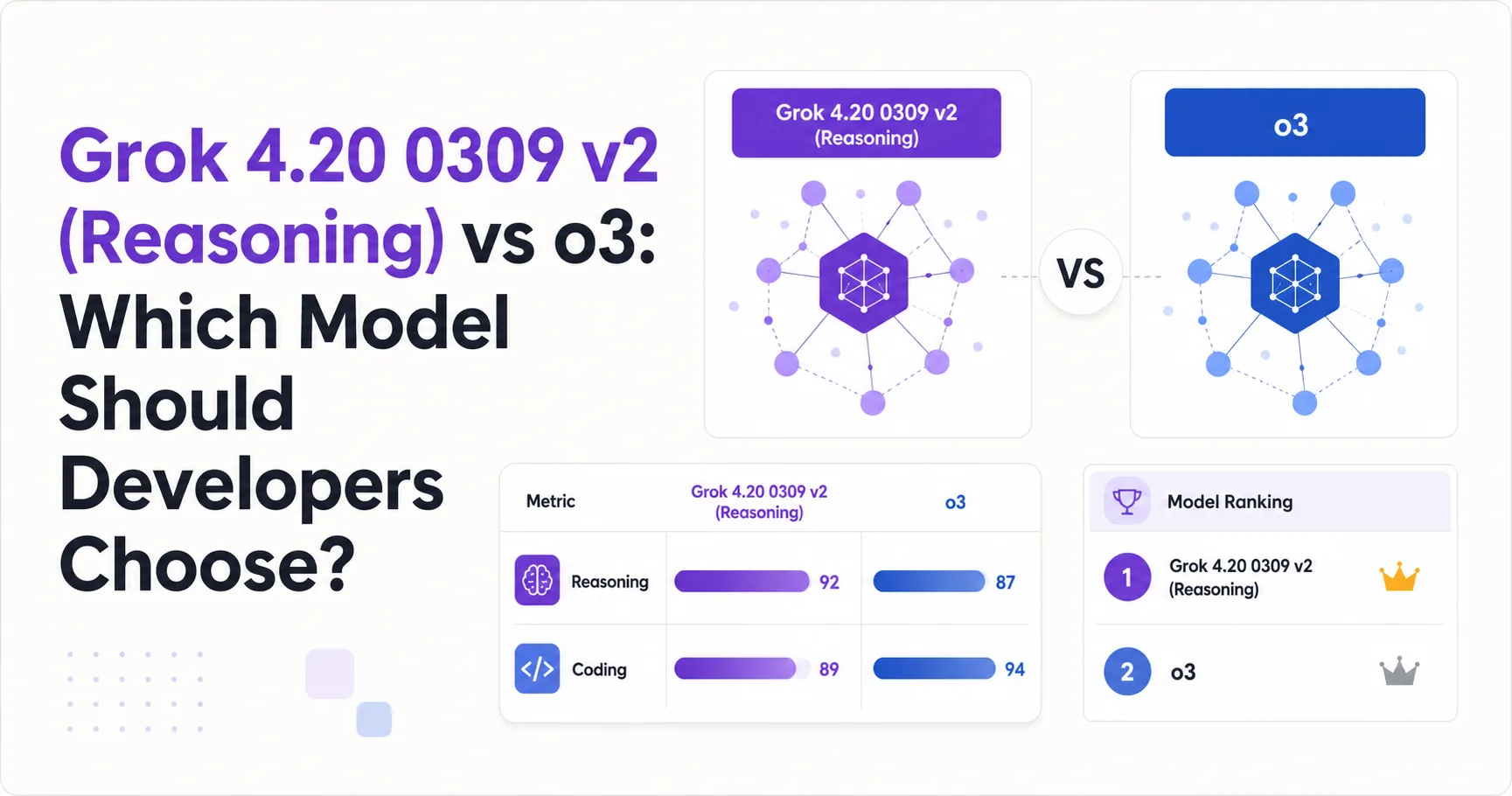
Grok 4.20 0309 v2 (Reasoning) is the stronger measured general-capability option, but o3 is the safer choice when documented math performance and output speed matter more than price.
The supplied Artificial Analysis data gives Grok an Intelligence Index of 37 and o3 an Intelligence Index of 30.4. That result supports a capability advantage for Grok on the reported aggregate measure, but it does not establish superiority on coding, tool use, long-context work, or production reliability. The same dataset reports a Math Index of 88.3 for o3 and no corresponding Grok value, so the math comparison is incomplete rather than decisive.
The commercial picture favors Grok on blended usage and output tokens. Grok is listed at $3 per 1M blended tokens, while o3 is listed at $3.5. Input pricing is $2 for each model, and output pricing is $6 for Grok versus $8 for o3. Those numbers matter most for workloads that generate substantial responses. They matter less for input-heavy applications.
The operational evidence is uneven. The dataset reports 0.3 seconds of latency for each model and 128.056 median output tokens per second for o3, but it reports no output-speed value for Grok. The research brief found no verifiable official documentation for Grok’s availability, context window, API parameters, or current price. It also found that OpenAI’s current model directory does not list o3, and its current pricing page does not list an o3 price. OpenAI model directory and OpenAI API pricing therefore provide useful evidence about current documentation visibility, not a complete deployment guarantee.
Data provided by https://artificialanalysis.ai/
Grok 4.20 0309 v2 (Reasoning) wins the supplied general index, while o3 offers the clearer task-specific evidence for mathematics and generation speed.
| Decision factor | Grok 4.20 0309 v2 (Reasoning) | o3 |
|---|---|---|
| Reported general capability | Intelligence Index: 37 | Intelligence Index: 30.4 |
| Reported mathematics signal | No value supplied | Math Index: 88.3 |
| Reported output speed | No value supplied | 128.056 median output tokens per second |
| Reported latency | 0.3 seconds | 0.3 seconds |
| Blended price | $3 per 1M tokens | $3.5 per 1M tokens |
| Input price | $2 per 1M tokens | $2 per 1M tokens |
| Output price | $6 per 1M tokens | $8 per 1M tokens |
| Context window | Not supplied | Not supplied |
The key selection problem is that the evidence does not answer the same questions for each model. Grok has a higher reported general index, but its missing speed and math values prevent a balanced task-level comparison. o3 has a measured speed value and a math value, yet the research brief could not verify its current presence in OpenAI’s model directory or pricing page. OpenAI’s current model directory lists newer frontier model families and does not list o3 in the supplied review. OpenAI’s pricing page also does not provide a current o3 price in that review.
For a developer, this means the headline winner depends on what must be proven before launch. If aggregate capability and listed token economics are the main inputs, Grok leads. If a math-oriented workload requires an available benchmark signal and observed generation speed, o3 has the more useful evidence. If API availability, aliases, limits, and support commitments are mandatory, the supplied research is insufficient for either a confident production decision.
o3 has the more actionable performance evidence, while Grok 4.20 0309 v2 (Reasoning) has the higher reported aggregate capability score.
The Artificial Analysis Intelligence Index favors Grok by the supplied comparison, 37 to 30.4. In a real application, that gap may matter when the workload mixes planning, reasoning, instruction following, and general problem solving. It should not be treated as a forecast of success for a particular codebase. The brief provides no coding benchmark, no tool-use test, no failure analysis, and no verified community testing for Grok.
The math evidence points in a different direction because only o3 has a reported Math Index, 88.3. That value makes o3 easier to evaluate for mathematical reasoning, quantitative analysis, and tasks where a math-specific signal is relevant. It does not prove that o3 is better across all developer workflows. Grok has no supplied Math Index, so the data cannot establish a winner for direct mathematical comparison.
Latency is reported as 0.3 seconds for each model. That tie suggests similar responsiveness under the measurement represented by the dataset, but it does not describe complete user-perceived time to answer. A production test would still need to measure queueing, time to first token, streaming behavior, retries, and end-to-end tool calls. The brief does not provide those measurements.
o3 has a reported median output rate of 128.056 tokens per second. Grok has no reported output-rate value. This creates an asymmetric conclusion: o3 is the only model with a supplied throughput signal, not necessarily the only model that can produce quickly. Developers building interactive coding tools should treat Grok’s speed as unknown until measured in the intended endpoint and region.
Neither model has a supplied context-window value. The research brief also found no verifiable official documentation for Grok’s API parameters or multimodal support. OpenAI’s current model documentation does not provide those o3 details in the supplied material. OpenAI model documentation therefore cannot close the evidence gap for context limits, supported inputs, or stable endpoint behavior.
Grok 4.20 0309 v2 (Reasoning) is the lower-cost option in the supplied pricing snapshot, especially for applications that generate many output tokens.
The blended figure is $3 per 1M tokens for Grok and $3.5 for o3. Input pricing is equal at $2 per 1M tokens, so the listed blended advantage comes from the output side rather than cheaper prompts. Output pricing is $6 for Grok and $8 for o3. That difference can become important in agent loops, code generation, long explanations, and workflows that ask the model to produce substantial artifacts.
The chart below the cost section already shows the individual prices. The practical question is how the application distributes tokens. An input-heavy retrieval workflow may see little economic separation because both models have the same listed input price. An output-heavy workflow makes o3 more expensive per generated token. A workload that needs fewer repair attempts, shorter answers, or more reliable task completion could still make the nominally cheaper model more expensive in practice, but the supplied research contains no failure-rate or retry-cost measurements.
The cost conclusion also depends on whether the listed model can actually be called. The research brief found no verifiable current price, stable alias, or direct-call status for Grok. It also found no current o3 listing on the reviewed OpenAI model directory and no o3 entry on the reviewed pricing page. OpenAI API pricing is therefore evidence that a current official price was not found in the supplied review, not evidence that every third-party price is invalid.
Developers should separate benchmark economics from procurement economics. The dataset supplies comparable token prices, but it does not supply quotas, rate limits, batching terms, regional availability, contract discounts, or support costs. Those missing variables can outweigh a difference of $3 versus $3.5 per 1M blended tokens for a production system.
Grok 4.20 0309 v2 (Reasoning) leads on 3 of 3 metrics
o3 is the better default for a math-sensitive workflow with a validated endpoint, while Grok 4.20 0309 v2 (Reasoning) is the better candidate for a cost-conscious general reasoning trial.
Choose Grok first when the application values the supplied general-capability result and expects meaningful output volume. Its Intelligence Index is 37, compared with 30.4 for o3, and its blended price is $3 per 1M tokens. The price advantage is stronger on output tokens, where Grok is listed at $6 and o3 at $8. This combination makes Grok worth testing for broad assistants, drafting systems, planning tasks, and developer tools that can tolerate an unverified availability story.
Choose o3 first when mathematics is central and the endpoint is already confirmed through your own access path. o3 is the only model with a supplied Math Index, 88.3, and it is the only model with a supplied median output rate, 128.056 tokens per second. Those measurements give a math-heavy or interactive application a more concrete starting point. They do not remove the need to verify current model access, because the reviewed official model directory does not list o3. OpenAI’s model directory should be checked again during implementation.
Do not make a final production commitment based on this brief alone. The evidence does not establish either model’s context window, output limit, API parameters, multimodal support, stable alias, rate limits, or failure modes. The Grok research found no reliable official or community sources for those questions. The o3 research found no official source in the supplied material that resolves its current availability or replacement status.
A sensible selection gate is a small task suite built from the intended codebase. Test correctness, repair behavior, tool-call completion, output length, and total response time. Record successful completion and retries separately. The supplied data can set an initial hypothesis, with Grok favored for aggregate capability and listed cost, and o3 favored for documented math and output-speed signals. Evidence from the application should decide the final deployment.
Grok 4.20 0309 v2 (Reasoning) should be treated as an evaluation candidate until its access path and operating limits are verified.
The supplied research does not confirm a stable public endpoint, a documented context window, or official API behavior for Grok. The same research does not fully confirm current o3 availability either. Developers should therefore validate access before designing around model-specific features. The following questions identify the practical gaps that the supplied benchmark and pricing snapshot cannot answer.
Grok 4.20 0309 v2 (Reasoning) is the overall winner on the supplied general-capability and blended-cost signals, but o3 remains the safer choice for math-focused work with a verified endpoint.
o3 is the stronger evidence-based choice for mathematical reasoning because it is the only model with a supplied Math Index of 88.3; Grok cannot be ranked on that measure.
Grok 4.20 0309 v2 (Reasoning) is cheaper on the supplied blended price at $3 versus $3.5 per 1M tokens, with a larger listed advantage for output tokens.
o3 is the only model with a supplied output-speed measurement at 128.056 median output tokens per second, while both models have a reported latency of 0.3 seconds.
No, the supplied research does not fully verify current direct access, stable aliases, context limits, or endpoint guarantees for either model, so availability must be tested before integration.