
Time to First Token · Grok 4.3 (medium)
20752ms
Time to First Token · o3
7185ms
Deep dive into reasoning, benchmarks, and latency insights.
The current catalog does not contain complete performance evidence for both models, so this page does not declare an overall winner. Use the available fields as comparison signals and validate the models on your own workload.
Key decision metrics at a glance.
| Model | Metric | Value | Unit | Source / snapshot |
|---|---|---|---|---|
| Grok 4.3 (medium) | Reasoning | 6.0 | benchmark or capability score | Artificial Analysis · current catalog |
| o3 | Reasoning | 9.0 | benchmark or capability score | Artificial Analysis · current catalog |
| Grok 4.3 (medium) | Coding | 6.0 | benchmark or capability score | Artificial Analysis · current catalog |
| o3 | Coding | 6.0 | benchmark or capability score | Artificial Analysis · current catalog |
| Grok 4.3 (medium) | Multimodal | 3.0 | benchmark or capability score | Artificial Analysis · current catalog |
| o3 | Multimodal | 3.0 | benchmark or capability score | Artificial Analysis · current catalog |
| Grok 4.3 (medium) | Long Context | 5.0 | benchmark or capability score | Artificial Analysis · current catalog |
| o3 | Long Context | 4.0 | benchmark or capability score | Artificial Analysis · current catalog |
| Grok 4.3 (medium) | Blended Price / 1M tokens | $1.563 | USD per 1M tokens | Artificial Analysis · current catalog |
| o3 | Blended Price / 1M tokens | $3.5 | USD per 1M tokens | Artificial Analysis · current catalog |
| Grok 4.3 (medium) | P95 Latency | — | milliseconds | Artificial Analysis · current catalog |
| o3 | P95 Latency | — | milliseconds | Artificial Analysis · current catalog |
| Grok 4.3 (medium) | Tokens per second | 114.991 | tokens per second | Artificial Analysis · current catalog |
| o3 | Tokens per second | 119.185 | tokens per second | Artificial Analysis · current catalog |
Data provided by Artificial Analysis; live values use the current catalog.
This radar chart visually maps the core capabilities (reasoning, coding, math proxy, multimodal, long context) of `Grok 4.3 (medium)` vs `o3`.
This grouped bar chart provides a side-by-side comparison for each benchmark metric.
Lower time to first token is better; higher tokens per second is better.
Compare input and output pricing in USD per 1M tokens.
Grok 4.3 (medium)$1.875
o3$4
Grok 4.3 (medium) costs $2.125 less per run
This article is a dated snapshot published on 2026-08-07. Live cards above use the current catalog; missing live fields are not inferred.
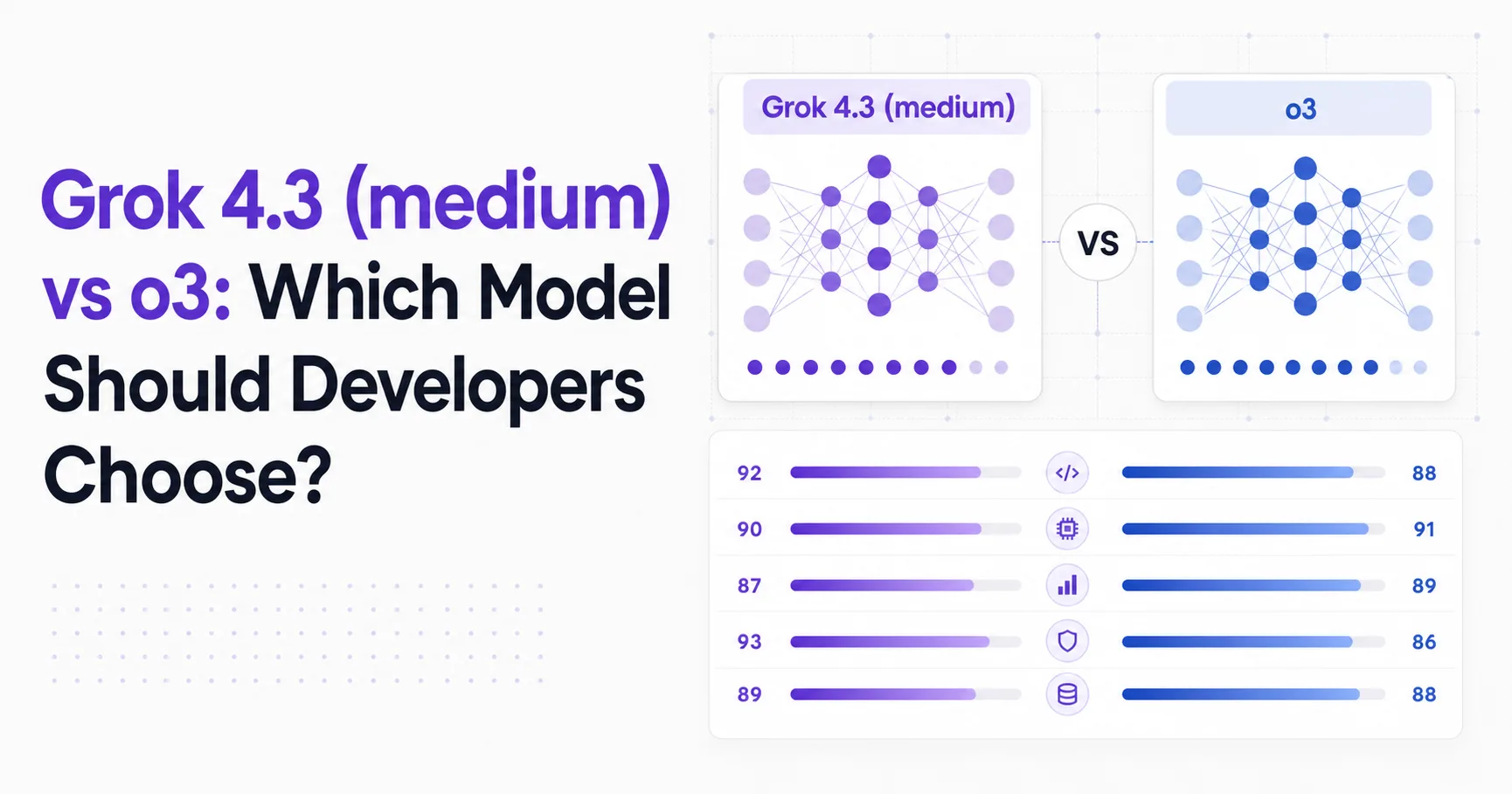
Grok 4.3 (medium) is the stronger default for cost-sensitive developer workloads, while o3 remains the more defensible choice when math capability is the deciding factor.
The supplied benchmark snapshot gives Grok 4.3 (medium) an Artificial Analysis Intelligence Index score of 36, compared with 30.4 for o3. Grok 4.3 (medium) also has the lower blended price at $1.5625 per 1M tokens and the higher median output speed at 158.429 tokens per second. Both models show latency of 0.3 seconds in the supplied data.
That apparent advantage has an important qualification. The research brief contains no reliable official or community source for Grok 4.3 (medium), and the provided OpenAI model directory does not list o3. The comparison therefore supports a measured benchmark and cost decision, but not a confident production-availability decision. Data provided by https://artificialanalysis.ai/.
Grok 4.3 (medium) leads the supplied general intelligence comparison, but o3 has the only reported math result and a clearer vendor identity.
The benchmark evidence points toward Grok 4.3 (medium) for broad task selection. Its Intelligence Index score is 36, whereas o3 scores 30.4. That difference matters for developers building mixed workloads that combine reasoning, writing, extraction, planning, and code-related tasks. It does not prove that Grok 4.3 (medium) wins every coding or reasoning task, because the brief provides no task-level breakdown.
o3 has a different evidence profile. The supplied data reports an Artificial Analysis Math Index score of 88.3 for o3, while no comparable Grok value is available. Developers who care about mathematical reasoning should not treat the missing Grok score as a zero. The evidence is simply incomplete.
Availability is the largest unresolved risk. The OpenAI model directory currently highlights GPT-5.6 Sol, GPT-5.6 Terra, and GPT-5.6 Luna as the latest frontier models, but does not list o3. The research brief also found no verifiable official page for Grok 4.3 (medium). Neither model can therefore receive a strong recommendation based on benchmark evidence alone. Data provided by https://artificialanalysis.ai/.
Grok 4.3 (medium) is the faster model in the supplied output-speed data, while o3 has the stronger documented case for math-focused evaluation.
Grok 4.3 (medium) produces a median of 158.429 output tokens per second, compared with 128.056 for o3. In an interactive developer tool, that difference can make streamed answers feel more responsive, especially when the model generates explanations, code suggestions, or multi-step plans. The latency value is 0.3 seconds for each model, so the speed advantage appears after response generation begins rather than at initial request handling.
The practical meaning depends on output shape. Faster token generation helps long responses and visible streaming. It does less for short answers, tool calls, or workflows dominated by external services. The equal latency value also means the supplied data does not establish a clear winner for time to first response.
Capability evidence is uneven. Grok 4.3 (medium) leads the reported Intelligence Index comparison at 36 versus o3 at 30.4. o3 alone has a Math Index result of 88.3. Developers should run representative coding and reasoning tasks before making a broad quality claim, because the research brief contains no verified community tests, failure cases, or official benchmark results for either model. Data provided by https://artificialanalysis.ai/.
Grok 4.3 (medium) is cheaper across every supplied token-price measure, yet an unverified endpoint can make the cheaper model unusable.
The blended price is $1.5625 per 1M tokens for Grok 4.3 (medium), compared with $3.5 for o3. Grok 4.3 (medium) is also listed at $1.25 per 1M input tokens and $2.5 per 1M output tokens, while o3 is listed at $2 for input and $8 for output. The largest practical difference is on generated output, so applications that produce long answers may see the clearest cost advantage with Grok 4.3 (medium).
The charted price gap does not settle total operating cost. A model with lower token rates can still cost more if it requires retries, lower-quality outputs that need human review, or integration work around unstable access. The research brief found no reliable current listing for Grok 4.3 (medium). It also found no current o3 price listing on the official OpenAI API pricing page.
OpenAI’s pricing page does not list Standard, Batch, Flex, or Fast mode pricing for o3 in the supplied research. That absence prevents a current procurement conclusion. Treat the data snapshot as a comparison of reported prices, not as confirmation that either price is currently purchasable. Data provided by https://artificialanalysis.ai/.
Grok 4.3 (medium) leads on 3 of 3 metrics
Grok 4.3 (medium) is the better first candidate for broad, high-volume applications, while o3 deserves targeted testing for math-heavy work.
Choose Grok 4.3 (medium) when the workload needs a broad capability profile, high generated-token throughput, and lower reported token cost. The supplied Intelligence Index score of 36 gives it the stronger general comparison result. Its median output speed of 158.429 tokens per second also favors interactive experiences that stream substantial answers to developers or end users.
Choose o3 when mathematical reasoning is central to the product and the reported Math Index score of 88.3 matches the task you need to solve. That score is not directly comparable with Grok 4.3 (medium), because the corresponding Grok value is missing. It is evidence for a focused o3 evaluation, not proof that o3 is superior across all workloads.
Do not commit either model to production until access is verified. The OpenAI model directory does not list o3 in the supplied research, and no reliable official or community source confirms Grok 4.3 (medium) availability, aliases, parameters, context window, or failure modes. The evidence is insufficient to recommend either model as a stable platform dependency.
A sensible selection process is to validate endpoint access first, then test representative prompts, output length, retries, and human review cost. The benchmark snapshot should narrow the shortlist, not replace application-specific evaluation. Data provided by https://artificialanalysis.ai/.
o3 has more identifiable vendor documentation, but the supplied evidence still cannot establish a complete production-readiness profile.
The research brief found no verified official release announcement, developer documentation, pricing page, or reliable community testing for Grok 4.3 (medium). It also found no reliable Reddit, Hacker News, or X posts that could confirm coding experience, speed perception, behavioral preferences, or failure patterns.
For o3, the available official pages provide useful context about current model visibility and pricing, but they do not provide the missing operational details for this comparison. The model directory does not list o3, and the supplied official pages do not confirm its current endpoint, stable alias, context window, output limit, API parameters, multimodal support, or known limitations.
That gap changes how the results should be interpreted. Grok 4.3 (medium) has the better reported general score, speed, and price. o3 has the only reported math score and a more identifiable vendor ecosystem. Neither model has enough verified operational evidence in the brief to support an unconditional production recommendation. Data provided by https://artificialanalysis.ai/.
Grok 4.3 (medium) is the stronger initial candidate for broad coding workloads because it scores 36 versus 30.4 on the supplied Intelligence Index and generates 158.429 output tokens per second. The brief does not include verified coding tests, so application-specific evaluation remains necessary.
Grok 4.3 (medium) is cheaper in the supplied data, at $1.5625 per 1M blended tokens versus $3.5 for o3. Its input price is $1.25 and output price is $2.5, compared with $2 and $8 for o3.
o3 is the safer model to test for mathematical reasoning because the supplied data reports an Artificial Analysis Math Index score of 88.3 for o3 and no comparable score for Grok 4.3 (medium). The missing Grok result is not evidence of poor performance.
Developers should verify availability before committing, because the supplied research does not confirm a current callable endpoint for Grok 4.3 (medium), and the official OpenAI model directory does not list o3. Stable aliases and replacement relationships are also unconfirmed.
A cost-sensitive product should test Grok 4.3 (medium) first because its reported blended price is $1.5625 per 1M tokens and its output speed is 158.429 tokens per second. The product should still measure retries, review effort, and access stability.