
Time to First Token · Grok 4.5 (high)
13271ms
Time to First Token · o3
7185ms
Deep dive into reasoning, benchmarks, and latency insights.
The current catalog does not contain complete performance evidence for both models, so this page does not declare an overall winner. Use the available fields as comparison signals and validate the models on your own workload.
Key decision metrics at a glance.
| Model | Metric | Value | Unit | Source / snapshot |
|---|---|---|---|---|
| Grok 4.5 (high) | Reasoning | 6.0 | benchmark or capability score | Artificial Analysis · current catalog |
| o3 | Reasoning | 9.0 | benchmark or capability score | Artificial Analysis · current catalog |
| Grok 4.5 (high) | Coding | 7.0 | benchmark or capability score | Artificial Analysis · current catalog |
| o3 | Coding | 6.0 | benchmark or capability score | Artificial Analysis · current catalog |
| Grok 4.5 (high) | Multimodal | 5.0 | benchmark or capability score | Artificial Analysis · current catalog |
| o3 | Multimodal | 3.0 | benchmark or capability score | Artificial Analysis · current catalog |
| Grok 4.5 (high) | Long Context | 7.0 | benchmark or capability score | Artificial Analysis · current catalog |
| o3 | Long Context | 4.0 | benchmark or capability score | Artificial Analysis · current catalog |
| Grok 4.5 (high) | Blended Price / 1M tokens | $3 | USD per 1M tokens | Artificial Analysis · current catalog |
| o3 | Blended Price / 1M tokens | $3.5 | USD per 1M tokens | Artificial Analysis · current catalog |
| Grok 4.5 (high) | P95 Latency | — | milliseconds | Artificial Analysis · current catalog |
| o3 | P95 Latency | — | milliseconds | Artificial Analysis · current catalog |
| Grok 4.5 (high) | Tokens per second | 50.981 | tokens per second | Artificial Analysis · current catalog |
| o3 | Tokens per second | 119.185 | tokens per second | Artificial Analysis · current catalog |
Data provided by Artificial Analysis; live values use the current catalog.
This radar chart visually maps the core capabilities (reasoning, coding, math proxy, multimodal, long context) of `Grok 4.5 (high)` vs `o3`.
This grouped bar chart provides a side-by-side comparison for each benchmark metric.
Lower time to first token is better; higher tokens per second is better.
Compare input and output pricing in USD per 1M tokens.
Grok 4.5 (high)$3.5
o3$4
Grok 4.5 (high) costs $0.5 less per run
This article is a dated snapshot published on 2026-08-07. Live cards above use the current catalog; missing live fields are not inferred.
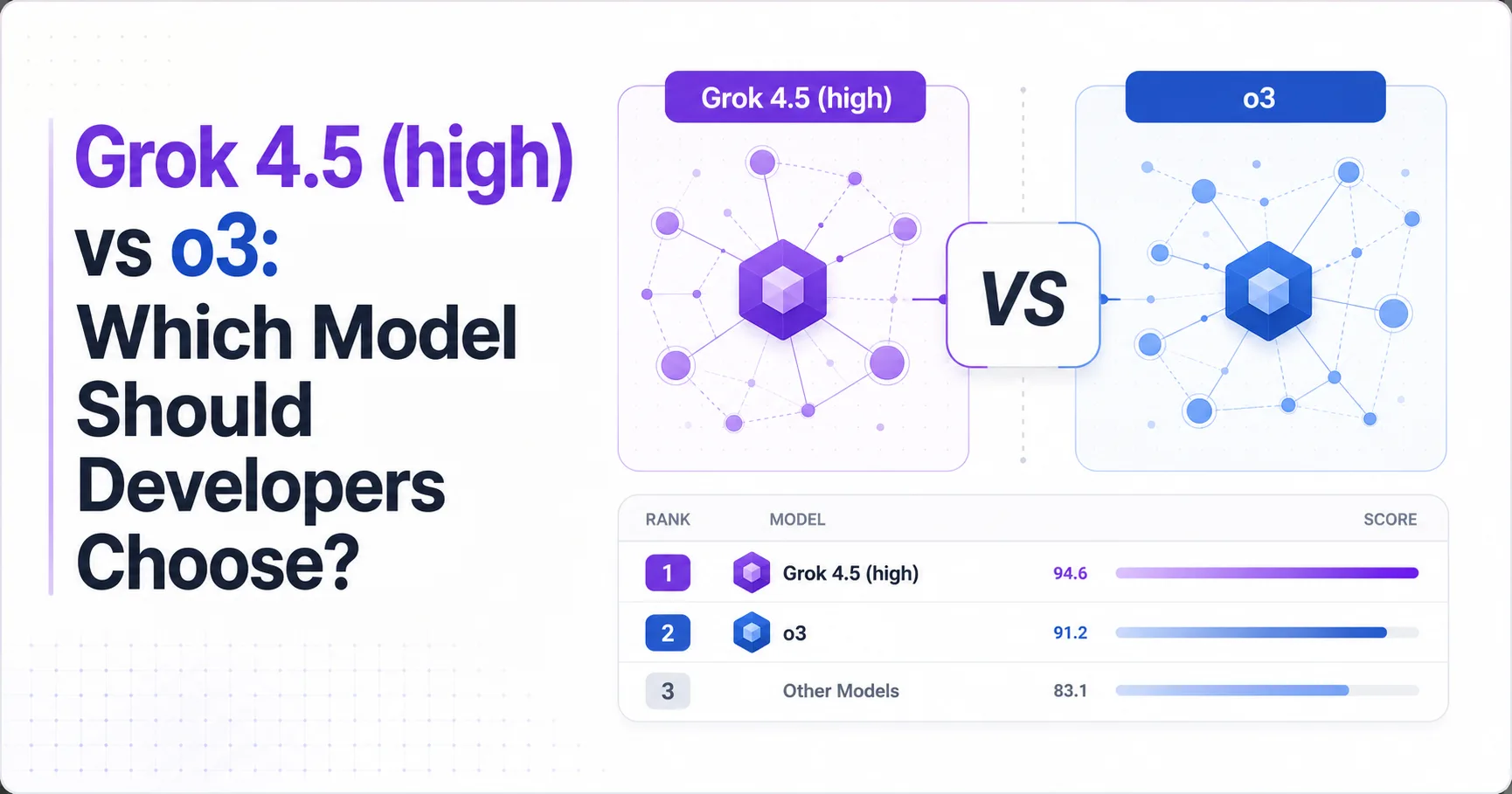
Grok 4.5 (high) is the stronger default for broad developer work, while o3 is the safer specialist choice when mathematical reasoning dominates. The Artificial Analysis snapshot gives Grok 4.5 (high) an Intelligence Index of 53.8, compared with 30.4 for o3. The same snapshot gives o3 a Math Index of 88.3, while no comparable Grok math value appears. Grok also has the available coding measurement, with a Coding Index of 72.4, but the dataset does not provide an equivalent o3 coding score. These gaps matter because the comparison is not a complete head-to-head benchmark. The available evidence favors Grok for general engineering and mixed reasoning tasks, yet it does not prove that Grok is better at every coding or reasoning workload. Developers should treat the result as a decision under uneven evidence, not as a universal ranking. Data provided by Artificial Analysis.
Grok 4.5 (high) offers the more coherent production case because its documented API surface, current availability, and measured general intelligence align with developer workflows. xAI identifies the official model as grok-4.5, with high representing the reasoning_effort setting rather than a separate model, according to the official developer documentation. The model supports text and image input, text output, Responses API, Chat Completions, function calling, structured outputs, web search, X Search, and code execution, according to the model details page and developer documentation. OpenAI's current model directory does not list o3 among its current models, and the supplied official material does not verify a current o3 endpoint, alias, context window, or multimodal specification.
| Decision area | Better-supported choice | Why |
|---|---|---|
| Broad intelligence | Grok 4.5 (high) | Intelligence Index of 53.8 vs 30.4 |
| Mathematical reasoning | o3 | Math Index of 88.3, with no comparable Grok value |
| Coding evidence | Grok 4.5 (high) | Coding Index of 72.4, with no comparable o3 value |
| Output speed | o3 | 128.056 vs 61.802 median output tokens per second |
| Blended cost | Grok 4.5 (high) | $3 vs $3.5 per 1M blended tokens |
| Current documentation confidence | Grok 4.5 (high) | Current xAI documentation identifies an available model |
The central uncertainty is o3's present operational status. The supplied evidence does not establish whether o3 remains directly callable or has been formally replaced.
Grok 4.5 (high) is the better-supported choice for mixed coding and knowledge work, while o3 is materially better suited to math-heavy reasoning when its availability is confirmed. Grok's Intelligence Index is 53.8, versus 30.4 for o3, a gap large enough to influence tasks that combine planning, interpretation, and implementation. Grok's available Coding Index of 72.4 also supports its fit for engineering workflows, although the absence of an o3 coding score prevents a direct coding verdict. The xAI announcement positions Grok 4.5 around coding, agents, engineering, and knowledge work, which matches the measured general profile. That positioning is vendor-authored, so it should support workflow selection rather than replace task-specific testing.
The speed result points in the other direction. o3 produces a median 128.056 output tokens per second, compared with 61.802 for Grok 4.5 (high), while both show latency of 0.3 seconds in the supplied snapshot. For interactive tools, the higher generation rate can make long answers feel substantially shorter after the initial response begins. It does not guarantee better time to a correct patch, because correctness, tool calls, retries, and output length also shape total task duration. The evidence does not reveal how either model behaves across sustained agent loops, failure recovery, or production coding sessions. Developers should benchmark representative repositories and prompts before treating the speed advantage as a throughput advantage.
Grok 4.5 (high) has the lower measured blended price, but o3's faster output may reduce user waiting and operational exposure in long generations. The supplied price is $3 per 1M blended tokens for Grok 4.5 (high), compared with $3.5 for o3. Input pricing is $2 per 1M tokens for each model, while output pricing is $6 for Grok and $8 for o3. That makes Grok the clearer choice for workloads dominated by output volume, especially agents that generate substantial plans, patches, or explanations.
The practical cost ranking can change if the workload uses different token proportions. An application that mostly sends repeated context will see the input tie matter more than the blended difference. An application that emits long reasoning traces will expose o3's higher output rate, and a slow review process can create indirect engineering cost even when the API bill is lower. The supplied data does not include cache-hit rates, retry rates, tool-call counts, or task-completion cost, so it cannot establish total cost per successful task.
Grok's developer documentation specifically recommends setting prompt_cache_key, because cache misses can cause full-price input billing. The Grok model page also states that larger context requests use a higher pricing tier, but the supplied source does not provide that tier's amount. Therefore, the $3 blended comparison is useful for baseline budgeting, not a complete production cost forecast.
Grok 4.5 (high) leads on 2 of 3 metrics
Grok 4.5 (high) should be the first candidate for general software agents, repository analysis, and mixed engineering tasks, while o3 deserves a controlled trial for mathematics-heavy workflows. Choose Grok when the application needs documented tools, structured outputs, web access, or code execution in one API-oriented workflow. The xAI model documentation confirms the relevant input modalities and tool capabilities. Its Intelligence Index of 53.8 and available Coding Index of 72.4 make the choice defensible for broad developer use, even though the coding comparison remains incomplete.
Choose o3 when mathematical reasoning is the primary acceptance criterion and the deployment team can verify that the model remains callable. The available Math Index of 88.3 is the strongest model-specific evidence in the supplied data, but the current OpenAI model directory does not list o3. The current OpenAI pricing page also does not list an o3 price. That documentation gap is a release-management risk, not proof that the model cannot be used.
A sensible selection process is to test both models on the same private task set, separating answer quality from generation speed and API availability. Measure successful task completion, correction cycles, tool-call reliability, and cost per accepted result. The supplied research does not provide reliable independent community testing for o3, and the only Grok community report is a single unreplicated routing and billing account. The Reddit report should therefore be treated as a monitoring signal, not a model-quality conclusion.
Grok 4.5 (high) is easier to evaluate from the supplied evidence, but important production questions remain unanswered for both models. The strongest evidence covers pricing, selected benchmark indices, latency, output speed, and documented capabilities. It does not cover every failure mode, maximum output limit, long-running agent behavior, or cost per successful task. Those missing measurements should shape the evaluation plan before a production commitment.
Grok 4.5 (high) is the better default when software development includes repository analysis, planning, tool use, and broad reasoning, because its available Coding Index is 72.4 and its documented API supports several developer tools. The comparison does not include an equivalent o3 coding score, so teams should validate the choice on representative repositories.
Yes, o3 is faster during token generation in the supplied snapshot, with a median output rate of 128.056 tokens per second versus 61.802 for Grok 4.5 (high). Both models show latency of 0.3 seconds, so the speed advantage mainly concerns response streaming after generation begins.
Grok 4.5 (high) is cheaper on the supplied blended measure at $3 per 1M tokens versus $3.5 for o3. Input pricing is equal at $2 per 1M tokens, while Grok has the lower output price at $6 versus $8. Actual task cost can differ with retries, caching, context size, and output volume.
o3 is the stronger evidence-based choice for mathematics because its available Math Index is 88.3, while the supplied snapshot does not include a comparable Grok math value. Developers must first confirm current API availability because the supplied OpenAI model directory does not list o3.
No, Grok 4.5 (high) refers to the grok-4.5 model evaluated with the high reasoning effort setting. The xAI documentation describes high as a parameter value, not an independent model identifier, so API requests should use grok-4.5.