
Time to First Token · Grok Build 0.1 0616
0ms
Time to First Token · o3
7185ms
Deep dive into reasoning, benchmarks, and latency insights.
The current catalog does not contain complete performance evidence for both models, so this page does not declare an overall winner. Use the available fields as comparison signals and validate the models on your own workload.
Key decision metrics at a glance.
| Model | Metric | Value | Unit | Source / snapshot |
|---|---|---|---|---|
| Grok Build 0.1 0616 | Reasoning | 6.0 | benchmark or capability score | Artificial Analysis · current catalog |
| o3 | Reasoning | 9.0 | benchmark or capability score | Artificial Analysis · current catalog |
| Grok Build 0.1 0616 | Coding | 5.0 | benchmark or capability score | Artificial Analysis · current catalog |
| o3 | Coding | 6.0 | benchmark or capability score | Artificial Analysis · current catalog |
| Grok Build 0.1 0616 | Multimodal | 3.0 | benchmark or capability score | Artificial Analysis · current catalog |
| o3 | Multimodal | 3.0 | benchmark or capability score | Artificial Analysis · current catalog |
| Grok Build 0.1 0616 | Long Context | 5.0 | benchmark or capability score | Artificial Analysis · current catalog |
| o3 | Long Context | 4.0 | benchmark or capability score | Artificial Analysis · current catalog |
| Grok Build 0.1 0616 | Blended Price / 1M tokens | $1.25 | USD per 1M tokens | Artificial Analysis · current catalog |
| o3 | Blended Price / 1M tokens | $3.5 | USD per 1M tokens | Artificial Analysis · current catalog |
| Grok Build 0.1 0616 | P95 Latency | — | milliseconds | Artificial Analysis · current catalog |
| o3 | P95 Latency | — | milliseconds | Artificial Analysis · current catalog |
| Grok Build 0.1 0616 | Tokens per second | 0 | tokens per second | Artificial Analysis · current catalog |
| o3 | Tokens per second | 119.185 | tokens per second | Artificial Analysis · current catalog |
Data provided by Artificial Analysis; live values use the current catalog.
This radar chart visually maps the core capabilities (reasoning, coding, math proxy, multimodal, long context) of `Grok Build 0.1 0616` vs `o3`.
This grouped bar chart provides a side-by-side comparison for each benchmark metric.
Lower time to first token is better; higher tokens per second is better.
Compare input and output pricing in USD per 1M tokens.
Grok Build 0.1 0616$1.5
o3$4
Grok Build 0.1 0616 costs $2.5 less per run
This article is a dated snapshot published on 2026-08-07. Live cards above use the current catalog; missing live fields are not inferred.
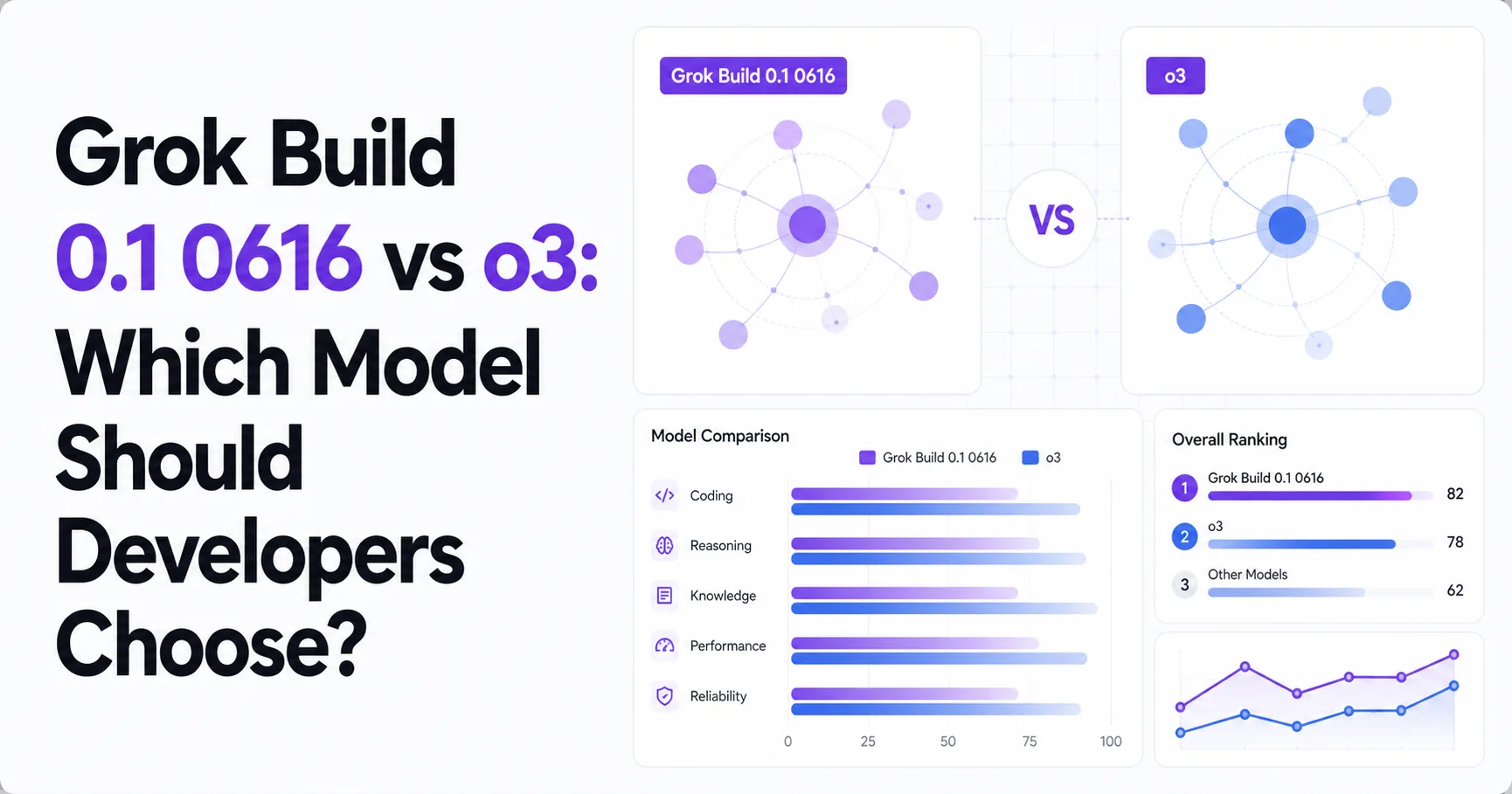
Grok Build 0.1 0616 is the stronger default for cost-sensitive experimentation, but o3 remains the better-supported choice for math-heavy work. The available data gives Grok Build 0.1 0616 an Artificial Analysis Intelligence Index of 39.8, compared with 30.4 for o3. The same snapshot gives o3 a Math Index of 88.3, while no corresponding math value is available for Grok Build 0.1 0616. The pricing gap is also substantial: the blended price is $1.25 per 1M tokens for Grok Build 0.1 0616 and $3.5 for o3. However, the comparison has an important asymmetry. The research brief contains no verified source for Grok Build 0.1 0616, while OpenAI's current documentation does not list o3 in the current model directory. Developers should therefore separate measured snapshot results from production-readiness evidence. Data provided by https://artificialanalysis.ai/
Grok Build 0.1 0616 leads the available general intelligence and blended-cost signals, while o3 leads the available math and output-speed signals. That does not create a clean universal winner. It creates a decision boundary between inexpensive general experimentation and a narrower, better-evidenced technical requirement.
The measured quality signals are incomplete rather than symmetrical. Grok Build 0.1 0616 has an Intelligence Index of 39.8 and a Coding Index of 51.5. o3 has an Intelligence Index of 30.4 and a Math Index of 88.3. No coding value is available for o3, and no math value is available for Grok Build 0.1 0616. A developer cannot honestly infer that Grok Build 0.1 0616 is better at coding than o3, or that o3 is better at general reasoning, from these fields alone.
The operational evidence is also uneven. The research brief found no verifiable official announcement, developer documentation, pricing page, model directory entry, or community discussion for Grok Build 0.1 0616. For o3, the OpenAI model directory does not provide the requested current details in the supplied material, and the OpenAI pricing page does not list a current o3 price. The data snapshot still contains price and speed values, but the research does not establish whether those values describe a currently callable public endpoint.
For a prototype with controlled access to Grok Build 0.1 0616, its lower price and higher available intelligence score make it attractive. For a math-centered workflow, o3's 88.3 Math Index is the most decision-relevant signal. For a production integration, neither model has a complete evidence-backed operational case in the supplied material.
Grok Build 0.1 0616 appears stronger on the available general intelligence signal, while o3 has the clearest advantage for math and the only reported generation-speed measurement. The Artificial Analysis snapshot reports 39.8 for Grok Build 0.1 0616 and 30.4 for o3 on its Intelligence Index. That result supports choosing Grok Build 0.1 0616 for broad evaluation tasks, provided the model is actually accessible in the target environment.
The coding evidence is not a head-to-head result. Grok Build 0.1 0616 has a Coding Index of 51.5, but o3 has no coding value in the snapshot. A developer evaluating code generation, debugging, or repository changes should treat the Grok result as a standalone signal, not as proof of superiority. The missing o3 coding score is a direct evidence gap.
The math evidence points in the other direction. o3 has a Math Index of 88.3, while Grok Build 0.1 0616 has no reported math value. That makes o3 the safer candidate for symbolic reasoning, quantitative verification, and workloads where arithmetic correctness dominates conversational breadth. It does not prove that Grok Build 0.1 0616 fails those tasks, because the supplied research found no verified failure cases.
The latency value is 0.3 seconds for each model, so the snapshot does not distinguish them on that measure. o3 has a reported median output rate of 128.056 tokens per second. Grok Build 0.1 0616 has no reported output-rate value. This means o3 has the stronger evidence for sustained response streaming, but not necessarily a proven end-to-end advantage in every application. The equal latency figure and missing Grok throughput measurement leave interactive performance only partly resolved.
The practical conclusion is to map the model to the dominant task. Broad quality favors Grok Build 0.1 0616 in the available index. Math favors o3. Coding remains unresolved because the comparison lacks an o3 coding score. Speed evidence favors o3 only because Grok's corresponding value is absent, not because the snapshot establishes a measured gap.
Grok Build 0.1 0616 is the cheaper measured option, but its cost advantage matters only if its access and task quality are reliable enough for the workload. The blended price is $1.25 per 1M tokens for Grok Build 0.1 0616 versus $3.5 for o3. Input pricing is $1 for Grok Build 0.1 0616 and $2 for o3. Output pricing is $2 for Grok Build 0.1 0616 and $8 for o3. The output difference is especially important for agents, code generation, and long-form responses, where generated tokens can dominate spend.
A lower token price can become the more expensive engineering choice if the model requires more retries, stronger validation, manual correction, or a fallback provider. The supplied research does not include reliable community testing or verified failure scenarios for either model, so it cannot establish retry rates, correction effort, or task completion cost. Those missing variables are more important than the unit price for workflows with strict correctness requirements.
The pricing evidence also needs careful interpretation. The data snapshot supplies values for both models, but the research brief says the current official pricing page does not list o3, and no verifiable pricing source exists for Grok Build 0.1 0616. The official OpenAI pricing page therefore cannot confirm the supplied o3 figure as a current public listing. The comparison should use the snapshot for relative analysis, while treating live billing and access as items that require manual verification.
For high-volume general requests, Grok Build 0.1 0616 offers the clearer economic case in the supplied data. For math-heavy tasks, paying more for o3 may be rational if its 88.3 Math Index reduces downstream review. That conclusion is conditional. The brief does not provide task-level accuracy, retry behavior, or production availability evidence.
Grok Build 0.1 0616 leads on 3 of 3 metrics
Grok Build 0.1 0616 is the recommended first candidate for low-cost general evaluation, while o3 is the recommended candidate for math-critical workflows. The recommendation changes if production availability, documentation, or reproducibility is a hard requirement.
Choose Grok Build 0.1 0616 when the team can already call it through a controlled endpoint and wants broad quality at a blended price of $1.25 per 1M tokens. Its Intelligence Index of 39.8 is higher than o3's 30.4 in the supplied snapshot. Its Coding Index of 51.5 also makes it worth testing for developer workflows, although the absence of an o3 coding score prevents a direct ranking. The team should validate repository-scale coding, structured output, refusal behavior, and long-context handling directly because the research brief provides no official specification or community test evidence.
Choose o3 when mathematical reliability is the primary acceptance criterion. Its Math Index of 88.3 is the strongest task-specific result in the comparison. The reported output rate of 128.056 tokens per second also gives o3 the more concrete throughput case. Developers should still verify whether the endpoint is available and whether the supplied price remains applicable, because the current OpenAI model directory does not list o3 in the supplied research.
Do not select either model solely from the release dates or nominal model identity. Grok Build 0.1 0616 has a release date of 2026-06-16 in the data snapshot, while o3 has a release date of 2025-04-16, but those dates do not establish current support, stability, or replacement status. The research found no verified stable alias, endpoint, or successor relationship for o3, and no verifiable operational material for Grok Build 0.1 0616.
The best current decision is therefore conditional: use Grok Build 0.1 0616 for an accessible, cost-sensitive general trial; use o3 for math-first evaluation; and withhold a production commitment until access, documentation, and task-level validation are confirmed.
Grok Build 0.1 0616 requires the strictest pre-adoption verification because the supplied research contains no verifiable official or community source for its availability, limits, or operating behavior. o3 has stronger task-specific math evidence, but its current product status is also unresolved because the supplied official model directory does not list it. Developers should confirm endpoint access, context behavior, output limits, billing, and failure handling in the exact environment where the application will run. The following answers distinguish what the snapshot measures from what the research does not establish. Data provided by https://artificialanalysis.ai/
Grok Build 0.1 0616 is the better measured default for cost-sensitive general experiments because its Intelligence Index is 39.8 and its blended price is $1.25 per 1M tokens. That recommendation assumes the team can verify access and acceptable task behavior, since the research brief provides no official documentation or community evidence for the model.
Developers should not choose o3 for coding solely from this comparison because no o3 Coding Index is available. Grok Build 0.1 0616 has a Coding Index of 51.5, but that is a standalone result rather than a head-to-head win. Repository-level testing is required before making a coding decision.
o3 is the stronger candidate for mathematical reasoning because its Artificial Analysis Math Index is 88.3, while no corresponding math value is available for Grok Build 0.1 0616. The result supports prioritizing o3 for math-critical workflows, but it does not establish every production behavior or current endpoint status.
Grok Build 0.1 0616 is cheaper in the supplied pricing snapshot, at $1.25 per 1M blended tokens versus $3.5 for o3. Its input price is $1 and its output price is $2, compared with o3 at $2 input and $8 output. Actual savings still depend on access, retries, validation, and current billing terms.
o3 has the stronger reported throughput evidence because its median output rate is 128.056 tokens per second, while Grok Build 0.1 0616 has no reported value. Both models have a latency value of 0.3 seconds in the snapshot, so the available data does not prove a complete interactive-speed advantage for o3.