
Time to First Token · Inkling Small
1862ms
Time to First Token · o3
7185ms
Deep dive into reasoning, benchmarks, and latency insights.
The current catalog does not contain complete performance evidence for both models, so this page does not declare an overall winner. Use the available fields as comparison signals and validate the models on your own workload.
Key decision metrics at a glance.
| Model | Metric | Value | Unit | Source / snapshot |
|---|---|---|---|---|
| Inkling Small | Reasoning | 6.0 | benchmark or capability score | Artificial Analysis · current catalog |
| o3 | Reasoning | 9.0 | benchmark or capability score | Artificial Analysis · current catalog |
| Inkling Small | Coding | 5.0 | benchmark or capability score | Artificial Analysis · current catalog |
| o3 | Coding | 6.0 | benchmark or capability score | Artificial Analysis · current catalog |
| Inkling Small | Multimodal | 3.0 | benchmark or capability score | Artificial Analysis · current catalog |
| o3 | Multimodal | 3.0 | benchmark or capability score | Artificial Analysis · current catalog |
| Inkling Small | Long Context | 5.0 | benchmark or capability score | Artificial Analysis · current catalog |
| o3 | Long Context | 4.0 | benchmark or capability score | Artificial Analysis · current catalog |
| Inkling Small | Blended Price / 1M tokens | $0.525 | USD per 1M tokens | Artificial Analysis · current catalog |
| o3 | Blended Price / 1M tokens | $3.5 | USD per 1M tokens | Artificial Analysis · current catalog |
| Inkling Small | P95 Latency | — | milliseconds | Artificial Analysis · current catalog |
| o3 | P95 Latency | — | milliseconds | Artificial Analysis · current catalog |
| Inkling Small | Tokens per second | 61.345 | tokens per second | Artificial Analysis · current catalog |
| o3 | Tokens per second | 119.185 | tokens per second | Artificial Analysis · current catalog |
Data provided by Artificial Analysis; live values use the current catalog.
This radar chart visually maps the core capabilities (reasoning, coding, math proxy, multimodal, long context) of `Inkling Small` vs `o3`.
This grouped bar chart provides a side-by-side comparison for each benchmark metric.
Lower time to first token is better; higher tokens per second is better.
Compare input and output pricing in USD per 1M tokens.
Inkling Small$0.6
o3$4
Inkling Small costs $3.4 less per run
This article is a dated snapshot published on 2026-08-07. Live cards above use the current catalog; missing live fields are not inferred.
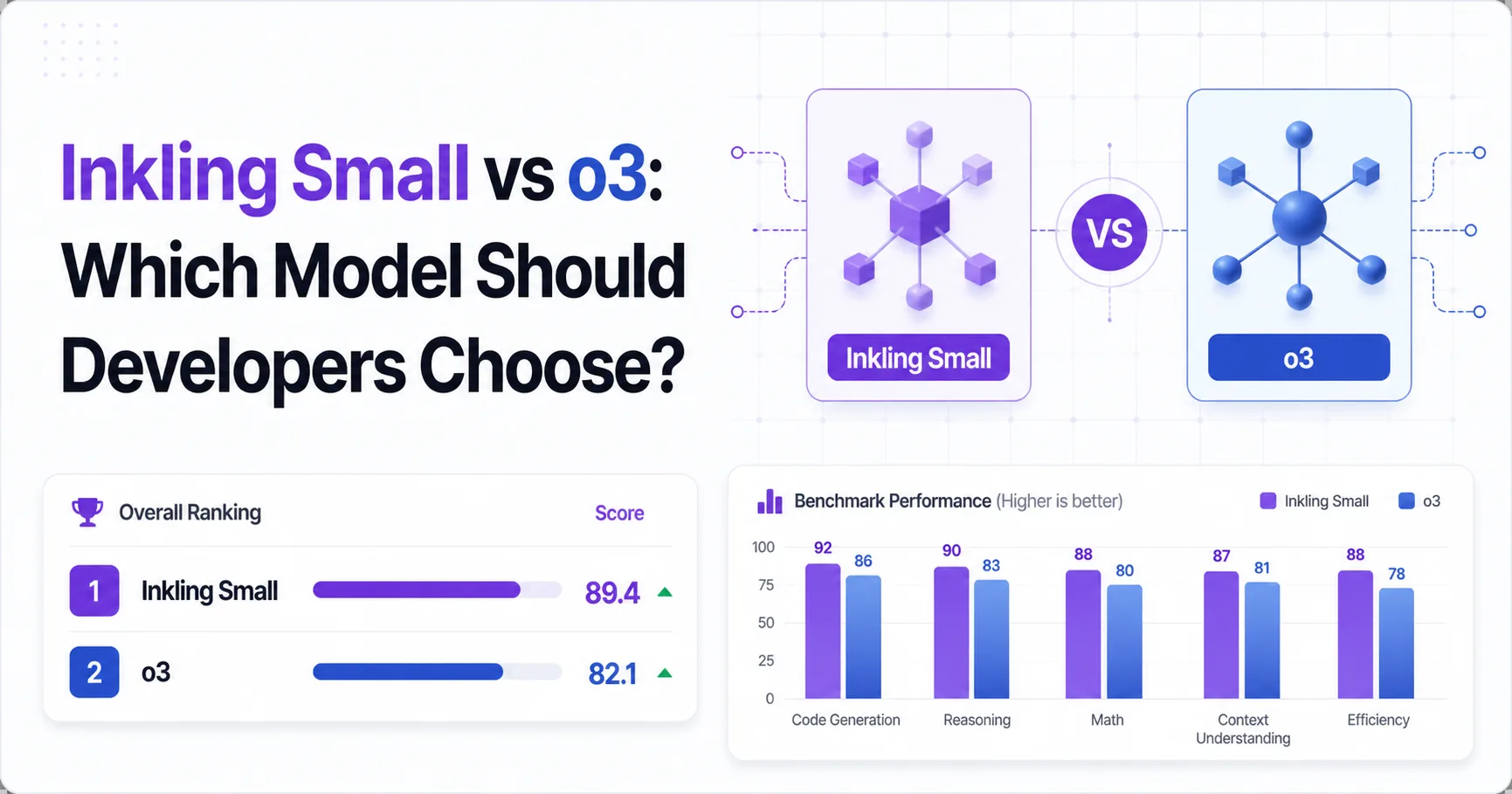
Inkling Small is the stronger measured value, while o3 remains the more defensible choice only for workloads that specifically need its available math result or a known OpenAI product lineage.
The supplied benchmark data gives Inkling Small an Artificial Analysis Intelligence Index of 40.2, compared with 30.4 for o3. The same snapshot gives o3 a Math Index of 88.3, while Inkling Small has no reported math score. Inkling Small also costs $0.525 per 1M blended tokens, compared with $3.5 for o3.
That evidence does not establish a universal quality winner. Inkling Small has a reported Coding Index of 52.9, but o3 has no corresponding coding value in the snapshot. Neither model has a confirmed context window in the supplied data. Product availability is also uncertain for both models, and the current OpenAI model directory does not list o3: OpenAI Models.
Inkling Small offers the better evidence-backed default for cost-sensitive general workloads, but the comparison is incomplete where developers usually need the most confidence.
The measured quality results point in different directions. Inkling Small leads the reported general intelligence measure at 40.2, while o3 records 88.3 on the reported math measure. These are not interchangeable tests, so neither result proves that one model is better across coding, reasoning, instruction following, or production reliability. Inkling Small has a reported coding value of 52.9, but the snapshot contains no o3 coding value. The absence of a value is not evidence that o3 performs poorly.
The operational data is clearer. Inkling Small is much cheaper under the blended pricing measure, at $0.525 per 1M tokens. Its input price is $0.3 per 1M tokens and its output price is $1.2 per 1M tokens. o3 is priced at $3.5 blended, $2 for input, and $8 for output. A workload with substantial generated output therefore exposes a larger cost difference than an input-heavy workload.
Speed is nearly tied in practical terms. Inkling Small reports 123.278 median output tokens per second, while o3 reports 128.056. Both report latency of 0.3 seconds. The small output-rate advantage for o3 should not decide a model migration by itself.
The largest non-benchmark risk is product certainty. The current OpenAI directory lists newer GPT-5.6 models but does not list o3, and the supplied research does not confirm an o3 endpoint, stable alias, or replacement relationship: OpenAI Models. No verifiable official product page, API catalog, pricing page, or community evidence was found for Inkling Small.
Inkling Small is the measured general-intelligence leader, while o3 has the only reported mathematical result and a marginally higher generation rate.
The Artificial Analysis Intelligence Index favors Inkling Small by 40.2 to 30.4. That result supports using Inkling Small as the first candidate for broad assistant tasks, classification, extraction, and mixed developer workflows. It does not prove better code generation, because the snapshot reports Inkling Small at 52.9 on the Coding Index but provides no o3 coding score.
The math evidence changes the decision for numerical or formal reasoning tasks. o3 has a Math Index of 88.3, while Inkling Small has no reported value. A developer choosing a model for symbolic manipulation, quantitative verification, or math-heavy evaluation should treat o3 as the only model with positive evidence in this comparison. The evidence still does not show whether that result transfers to the developer's own prompts, tools, latency targets, or failure tolerance.
The speed difference is unlikely to dominate user experience. o3 reports 128.056 median output tokens per second and Inkling Small reports 123.278. Both report latency of 0.3 seconds. Streaming-heavy applications may notice a small difference in long responses, but the supplied data does not establish a meaningful end-to-end advantage. Network time, retries, tool calls, and output length remain unmeasured here.
Developers should therefore test task-specific quality before interpreting the headline scores. The supplied research found no verified community discussions that establish coding experience, speed perception, behavioral preferences, limitations, or recurring failure scenarios for either model.
Inkling Small is the clear price leader, but its lower unit price only creates savings when its quality and availability are sufficient for the workload.
Inkling Small costs $0.525 per 1M blended tokens, compared with $3.5 for o3. Its input price is $0.3 per 1M tokens versus $2 for o3, and its output price is $1.2 versus $8. The gap is especially important for agents that generate long plans, code patches, explanations, or repeated intermediate responses.
The headline price can reverse at the application level if Inkling Small requires more retries, human review, routing, or fallback calls. The supplied research contains no verified failure-rate, reliability, or production-quality evidence for Inkling Small, so developers cannot turn the unit-price gap into a guaranteed total-cost advantage. The same limitation applies to o3 because no reliable community testing or official failure documentation was found.
A cheaper model may also be more expensive if it cannot handle the required context, output length, tools, or structured format. Neither model has a confirmed context window in the supplied snapshot. That missing fact is material for repository analysis, long conversations, document processing, and agent memory.
Availability adds another cost risk. The current OpenAI pricing page does not list o3 under Standard, Batch, Flex, or Fast mode pricing: OpenAI API Pricing. The supplied materials also do not confirm a current o3 endpoint or stable alias. Inkling Small has an even larger availability gap because no verifiable product page, API catalog, or pricing page was found. Budgeting should therefore treat both listed prices as benchmark snapshot values, not confirmed procurement quotes.
Inkling Small leads on 3 of 3 metrics
Inkling Small is the best first choice for developers optimizing measured general quality and token economics, subject to an availability check and task-level evaluation.
Choose Inkling Small when the application serves broad, cost-sensitive requests and can tolerate uncertainty about product documentation. Its Intelligence Index is 40.2, its reported Coding Index is 52.9, and its blended price is $0.525 per 1M tokens. Those values make it a sensible candidate for support assistants, routine code assistance, extraction, classification, and high-volume experimentation. The recommendation is provisional because the supplied research found no verifiable official or community source describing Inkling Small's API, limits, reliability, or failure modes.
Choose o3 when mathematical reasoning is a central acceptance criterion and the model is actually available through the deployment path you intend to use. Its Math Index is 88.3, which is the strongest task-specific evidence in this comparison. o3 also reports 128.056 median output tokens per second, although the practical speed difference is small because Inkling Small reports 123.278 and both report latency of 0.3 seconds.
Do not choose either model solely from the general intelligence score. Inkling Small leads that measure, but o3 has no reported coding score, and Inkling Small has no reported math score. Do not assume that o3 is currently callable because the official model directory does not list it: OpenAI Models. Do not assume that the displayed o3 price is a current quote because the official pricing page does not list it: OpenAI API Pricing.
The safest selection process is a gated pilot. First verify endpoint access, model identity, context behavior, and billing. Then evaluate representative coding and math tasks separately. Finally measure retries, review effort, and fallback frequency, since the supplied evidence does not cover those production variables.
Inkling Small is the more attractive default only after developers confirm that its undocumented operational boundaries fit the application.
The central evidence gap is not a minor metadata issue. Neither model has a confirmed context window in the supplied data. The research also provides no reliable community evidence for coding behavior, speed perception, preferences, limitations, or recurring failure scenarios. The official OpenAI pages confirm what is currently visible in the directory and pricing catalog, but they do not establish the missing o3 details. Developers should keep those unknowns explicit in procurement and launch decisions.
Inkling Small is the better measured default for general workloads because its Intelligence Index is 40.2 versus 30.4 for o3, but the comparison lacks o3 coding data and verified production evidence.
o3 is the stronger evidence-backed candidate for math-heavy applications because it has a reported Math Index of 88.3, while Inkling Small has no reported math value in the supplied snapshot.
Inkling Small is cheaper at $0.525 per 1M blended tokens, with $0.3 input and $1.2 output pricing, compared with o3 at $3.5 blended, $2 input, and $8 output.
o3 availability is unconfirmed from the supplied evidence because the current official model directory does not list o3, and the research does not identify a stable alias or callable endpoint.
o3 has a small measured output-rate advantage at 128.056 median output tokens per second versus Inkling Small at 123.278, while both models report latency of 0.3 seconds.