
Time to First Token · Kimi K2.6 (Non-reasoning)
0ms
Time to First Token · o3
7185ms
Deep dive into reasoning, benchmarks, and latency insights.
The current catalog does not contain complete performance evidence for both models, so this page does not declare an overall winner. Use the available fields as comparison signals and validate the models on your own workload.
Key decision metrics at a glance.
| Model | Metric | Value | Unit | Source / snapshot |
|---|---|---|---|---|
| Kimi K2.6 (Non-reasoning) | Reasoning | 6.0 | benchmark or capability score | Artificial Analysis · current catalog |
| o3 | Reasoning | 9.0 | benchmark or capability score | Artificial Analysis · current catalog |
| Kimi K2.6 (Non-reasoning) | Coding | 6.0 | benchmark or capability score | Artificial Analysis · current catalog |
| o3 | Coding | 6.0 | benchmark or capability score | Artificial Analysis · current catalog |
| Kimi K2.6 (Non-reasoning) | Multimodal | 3.0 | benchmark or capability score | Artificial Analysis · current catalog |
| o3 | Multimodal | 3.0 | benchmark or capability score | Artificial Analysis · current catalog |
| Kimi K2.6 (Non-reasoning) | Long Context | 4.0 | benchmark or capability score | Artificial Analysis · current catalog |
| o3 | Long Context | 4.0 | benchmark or capability score | Artificial Analysis · current catalog |
| Kimi K2.6 (Non-reasoning) | Blended Price / 1M tokens | $1.712 | USD per 1M tokens | Artificial Analysis · current catalog |
| o3 | Blended Price / 1M tokens | $3.5 | USD per 1M tokens | Artificial Analysis · current catalog |
| Kimi K2.6 (Non-reasoning) | P95 Latency | — | milliseconds | Artificial Analysis · current catalog |
| o3 | P95 Latency | — | milliseconds | Artificial Analysis · current catalog |
| Kimi K2.6 (Non-reasoning) | Tokens per second | 0 | tokens per second | Artificial Analysis · current catalog |
| o3 | Tokens per second | 119.185 | tokens per second | Artificial Analysis · current catalog |
Data provided by Artificial Analysis; live values use the current catalog.
This radar chart visually maps the core capabilities (reasoning, coding, math proxy, multimodal, long context) of `Kimi K2.6 (Non-reasoning)` vs `o3`.
This grouped bar chart provides a side-by-side comparison for each benchmark metric.
Lower time to first token is better; higher tokens per second is better.
Compare input and output pricing in USD per 1M tokens.
Kimi K2.6 (Non-reasoning)$1.95
o3$4
Kimi K2.6 (Non-reasoning) costs $2.05 less per run
This article is a dated snapshot published on 2026-08-07. Live cards above use the current catalog; missing live fields are not inferred.
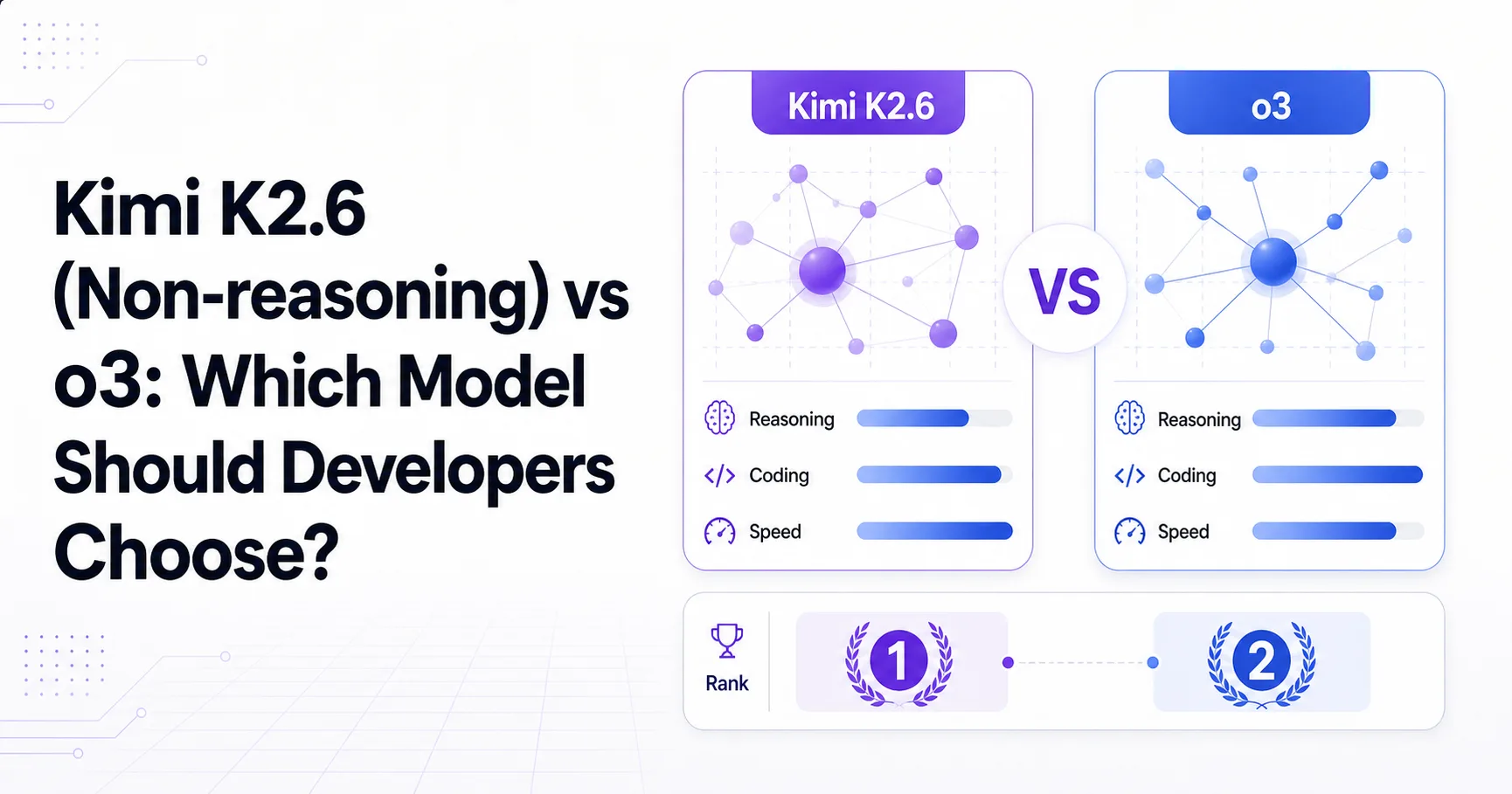
Kimi K2.6 (Non-reasoning) is the stronger default on the available general intelligence and cost data, while o3 is the clear speed and mathematics specialist.\n\nThe measured Artificial Analysis Intelligence Index favors Kimi K2.6 (Non-reasoning) at 34.6, compared with 30.4 for o3. Kimi also costs $1.7125000000000001 per 1M blended tokens, compared with $3.5 for o3. The output-speed result reverses the ranking: o3 reaches 128.056 median output tokens per second, while Kimi reaches 42.312.\n\nThat result does not establish a universal winner. The data snapshot gives o3 a mathematics score of 88.3, while no corresponding Kimi score is provided. The research brief also provides no verified community testing for either model.\n\nDevelopers should therefore treat this as a selection decision under incomplete evidence. Choose Kimi for a lower measured cost and higher available general score. Choose o3 when fast long responses or mathematics-related evidence matter more than price. Data provided by https://artificialanalysis.ai/.
Kimi K2.6 (Non-reasoning) offers the better measured value, while o3 offers stronger evidence for speed and mathematics.\n\nThe two models occupy different decision positions. Kimi leads the available Artificial Analysis Intelligence Index by 4.200000000000003 points, and its blended price is $1.7125000000000001 per 1M tokens. o3 costs $3.5 on the same blended measure. Kimi also has lower listed input and output prices, at $0.95 and $4 per 1M tokens, compared with $2 and $8 for o3.\n\no3 has the strongest operational performance signal in the supplied data. Its median output speed is 128.056 tokens per second, compared with 42.312 for Kimi. Both models have a listed latency of 0.3 seconds, so the speed advantage appears after generation begins rather than in the initial latency metric.\n\nThe evidence is uneven. The data snapshot contains an o3 mathematics index of 88.3, but no Kimi mathematics value. It contains no context-window value for either model. The research brief contains no verified official documentation for Kimi K2.6. For o3, the current OpenAI model directory does not list o3 among the supplied current models, and the OpenAI pricing page does not list a current o3 price.\n\nThe practical conclusion is conditional: Kimi wins the measured value case, and o3 wins the measured throughput case, but deployment availability must be verified before either model enters production.
o3 is the better performance choice when generated-token throughput directly affects interaction time or queue capacity.\n\nThe key difference is output speed. o3 records 128.056 median output tokens per second, while Kimi K2.6 (Non-reasoning) records 42.312. A developer building a streaming coding assistant, interactive analysis tool, or response-heavy workflow would likely experience the difference during generation. The supplied latency metric does not separate them: both models record 0.3 seconds.\n\nThat makes the result more specific than saying o3 is simply faster. The available measurement points to a throughput advantage, not a lower initial response delay. For short outputs, the equal latency may dominate the experience. For longer outputs or concurrent workloads, token generation speed becomes more relevant. The final choice depends on how much text each request produces and whether the interface streams partial output.\n\nThe general intelligence result points in the opposite direction. Kimi scores 34.6 on the Artificial Analysis Intelligence Index, compared with 30.4 for o3. That score favors Kimi on the supplied broad evaluation, but it does not prove that Kimi is better for every developer task.\n\no3 also has a mathematics index of 88.3, while the Kimi value is unavailable. This is a meaningful evidence gap, not a demonstrated Kimi failure. Developers selecting for mathematical reasoning should test representative workloads rather than infer parity from the general index.\n\nNo verified community benchmark, coding test, or failure analysis is available in the research brief for either model. Claims about instruction following, code quality, tool use, or reliability remain unconfirmed here.
Kimi K2.6 (Non-reasoning) is the price leader, but o3 can justify its higher rate when faster generation reduces waiting or infrastructure pressure.\n\nKimi is listed at $1.7125000000000001 per 1M blended tokens, compared with $3.5 for o3. Its input price is $0.95 per 1M tokens, compared with $2 for o3. Its output price is $4 per 1M tokens, compared with $8 for o3. These figures make Kimi the obvious first candidate for high-volume workloads where token spend is the dominant constraint.\n\nThe cost chart cannot show whether a lower token bill produces a lower total system cost. A slower model may keep users waiting, hold workers longer, or require more concurrency capacity. o3's 128.056 median output tokens per second may matter in workloads where latency affects abandonment, support volume, or interactive productivity. The supplied data does not quantify any of those business effects, so no total-cost winner can be established.\n\nThe blended price also depends on the input-to-output mix represented by the data brief. Applications that generate unusually long answers may feel the output-price difference more strongly than applications dominated by short prompts. The relevant comparison is therefore workload-specific, even though Kimi is cheaper on every listed token-price field.\n\nAvailability is an additional cost risk. The research brief does not verify Kimi's current callable status or stable alias. The current OpenAI model directory does not list o3 in the supplied official evidence, and the current OpenAI pricing page does not show an o3 price. Developers should confirm access before treating either listed price as a production purchasing assumption.
Kimi K2.6 (Non-reasoning) leads on 3 of 3 metrics
Kimi K2.6 (Non-reasoning) is the best initial choice for cost-sensitive general workloads, while o3 is safer for speed-sensitive or mathematics-focused evaluation.\n\nPick Kimi when the application processes many tokens, the broad intelligence score is the most relevant available signal, and the team can verify a working endpoint. The model leads the available general index at 34.6 and has a blended price of $1.7125000000000001 per 1M tokens. That combination makes it the stronger value candidate in the supplied comparison.\n\nPick o3 when response throughput is central to the product experience. Its 128.056 median output tokens per second is materially higher than Kimi's 42.312. o3 is also the only model in the snapshot with a reported mathematics index, at 88.3. That does not prove superiority across all reasoning tasks, but it gives mathematics-oriented selection a concrete signal that Kimi lacks.\n\nUse a staged decision for production. First, verify that the intended model name, endpoint, and pricing are currently usable. The research brief does not confirm Kimi's availability, and the supplied OpenAI model directory does not list o3 among its current entries. Second, test representative prompts with the same output limits and concurrency. Third, compare task success, user-visible waiting, and token spend together.\n\nThe evidence does not support a definitive recommendation for coding quality, tool calling, context-heavy work, or failure recovery. Neither the context window nor output limit is supplied for either model. Those unknowns can overturn the initial ranking for applications with large prompts or strict response contracts.
Kimi K2.6 (Non-reasoning) and o3 cannot be fully compared for production readiness because key documentation and task-specific evidence are missing.\n\nThe data snapshot supplies release dates of 2026-04-20 for Kimi and 2025-04-16 for o3, but dates do not establish current availability. It supplies no context-window value for either model. It also does not provide a Kimi mathematics score, while o3 has a mathematics index of 88.3.\n\nThe research brief reports no verified community discussions, coding evaluations, failure reports, or official model documentation for Kimi. For o3, the current OpenAI model directory does not provide the requested o3 specifications in the supplied evidence. The OpenAI pricing page also does not list a current o3 price.\n\nThese gaps should change the procurement process, not be silently filled with assumptions. A small private evaluation should cover the application's actual prompts, response lengths, concurrency, mathematics needs, and error handling. The supplied benchmarks are useful for ranking initial hypotheses, but they are not a substitute for an access and reliability check.
Kimi K2.6 (Non-reasoning) is better on the supplied overall value signals, with an Artificial Analysis Intelligence Index of 34.6 and a blended price of $1.7125000000000001 per 1M tokens. o3 remains stronger on measured output speed at 128.056 median output tokens per second and has the only supplied mathematics score, 88.3. The evidence is insufficient to declare a universal winner for coding, tools, context-heavy prompts, or reliability.
Kimi K2.6 (Non-reasoning) is cheaper on every listed token-price measure in the data brief. Its blended price is $1.7125000000000001 per 1M tokens, input costs $0.95, and output costs $4. o3 is listed at $3.5 blended, $2 input, and $8 output per 1M tokens. Actual production cost still depends on workload mix and verified endpoint availability.
o3 is faster during generation, with 128.056 median output tokens per second compared with 42.312 for Kimi K2.6 (Non-reasoning). Both models show 0.3 seconds latency in the supplied data, so the advantage is measured throughput rather than a lower initial latency. The brief does not provide task-level user-perceived latency or concurrency tests.
Developers should evaluate o3 first for mathematics-oriented workloads because the supplied data reports an Artificial Analysis Math Index of 88.3 for o3 and no corresponding Kimi value. That result is evidence of a measurable signal, not proof that o3 succeeds on every mathematical task. The team should still test its own problem formats, answer-verification needs, and tolerance for the higher listed price.
Neither model can be selected confidently from this evidence alone because the supplied materials do not verify every production requirement. Kimi's current callable status is unconfirmed, while the current OpenAI model directory does not list o3 in the supplied evidence. Neither model has a supplied context-window value, and reliable community tests for coding, tools, and failure modes are absent.