
Time to First Token · Kimi K2 Thinking
0ms
Time to First Token · o3
7185ms
Deep dive into reasoning, benchmarks, and latency insights.
The current catalog does not contain complete performance evidence for both models, so this page does not declare an overall winner. Use the available fields as comparison signals and validate the models on your own workload.
Key decision metrics at a glance.
| Model | Metric | Value | Unit | Source / snapshot |
|---|---|---|---|---|
| Kimi K2 Thinking | Reasoning | 9.0 | benchmark or capability score | Artificial Analysis · current catalog |
| o3 | Reasoning | 9.0 | benchmark or capability score | Artificial Analysis · current catalog |
| Kimi K2 Thinking | Coding | 6.0 | benchmark or capability score | Artificial Analysis · current catalog |
| o3 | Coding | 6.0 | benchmark or capability score | Artificial Analysis · current catalog |
| Kimi K2 Thinking | Multimodal | 3.0 | benchmark or capability score | Artificial Analysis · current catalog |
| o3 | Multimodal | 3.0 | benchmark or capability score | Artificial Analysis · current catalog |
| Kimi K2 Thinking | Long Context | 4.0 | benchmark or capability score | Artificial Analysis · current catalog |
| o3 | Long Context | 4.0 | benchmark or capability score | Artificial Analysis · current catalog |
| Kimi K2 Thinking | Blended Price / 1M tokens | $1.075 | USD per 1M tokens | Artificial Analysis · current catalog |
| o3 | Blended Price / 1M tokens | $3.5 | USD per 1M tokens | Artificial Analysis · current catalog |
| Kimi K2 Thinking | P95 Latency | — | milliseconds | Artificial Analysis · current catalog |
| o3 | P95 Latency | — | milliseconds | Artificial Analysis · current catalog |
| Kimi K2 Thinking | Tokens per second | 0 | tokens per second | Artificial Analysis · current catalog |
| o3 | Tokens per second | 119.185 | tokens per second | Artificial Analysis · current catalog |
Data provided by Artificial Analysis; live values use the current catalog.
This radar chart visually maps the core capabilities (reasoning, coding, math proxy, multimodal, long context) of `Kimi K2 Thinking` vs `o3`.
This grouped bar chart provides a side-by-side comparison for each benchmark metric.
Lower time to first token is better; higher tokens per second is better.
Compare input and output pricing in USD per 1M tokens.
Kimi K2 Thinking$1.225
o3$4
Kimi K2 Thinking costs $2.775 less per run
This article is a dated snapshot published on 2026-08-07. Live cards above use the current catalog; missing live fields are not inferred.
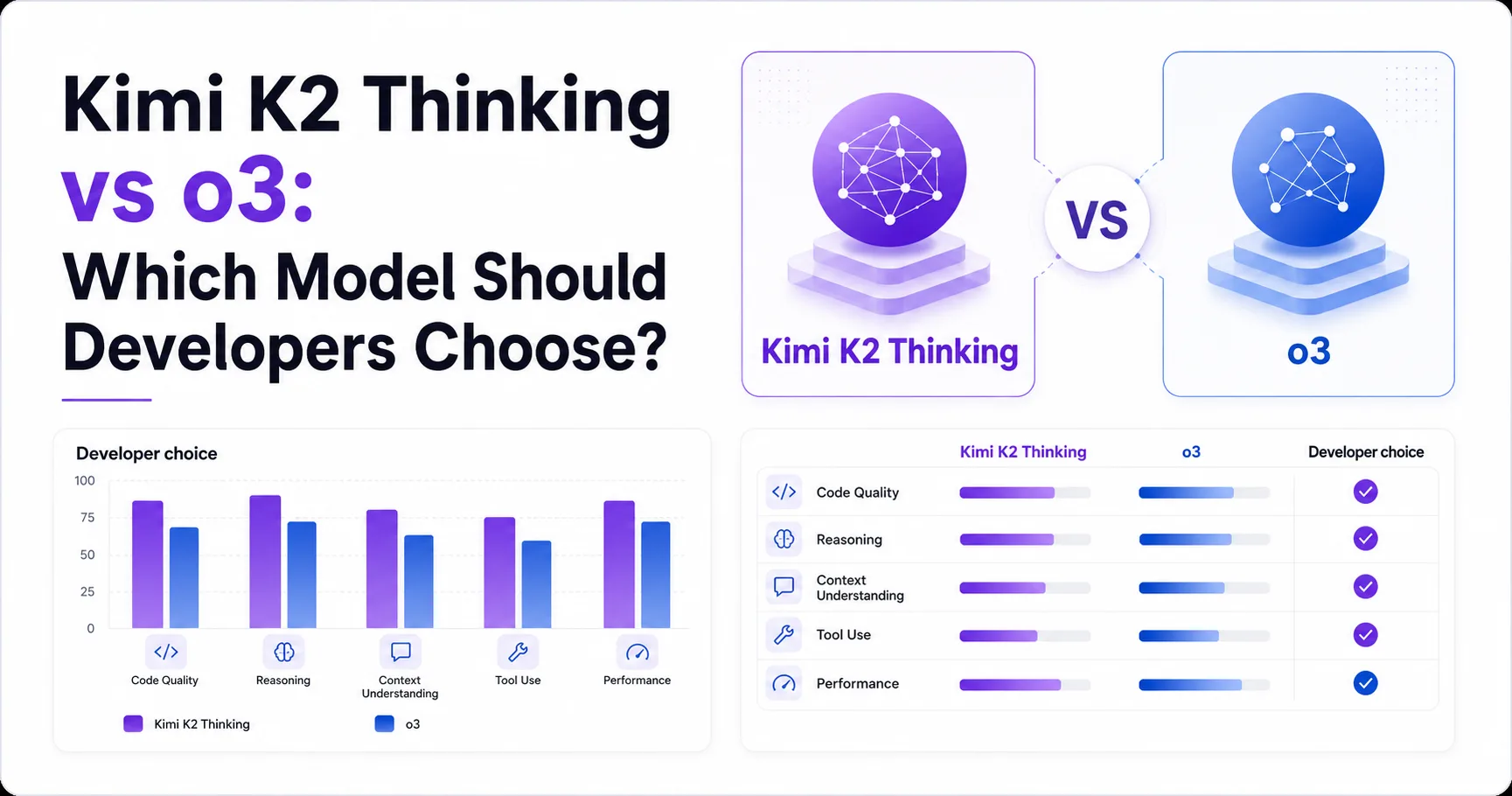
Kimi K2 Thinking is the stronger value choice in the supplied benchmark snapshot, but o3 is the safer candidate only if its operational access is already confirmed in your environment.
The numerical case favors Kimi K2 Thinking. Its Artificial Analysis Intelligence Index is 32.7, compared with 30.4 for o3. Its Artificial Analysis Math Index is 94.7, compared with 88.3 for o3. The blended price is $1.075 per 1M tokens for Kimi K2 Thinking and $3.5 for o3.
The operational case is less decisive. The research material does not provide a verified official release announcement, developer document, pricing page, stable API alias, or community test record for Kimi K2 Thinking. A Google search for Kimi K2 Thinking official release, API, context, and pricing was supplied only as an initial search entry, not as proof of production readiness.
o3 has a clearer vendor reference point, but the current OpenAI model directory does not list o3 in the supplied research. The OpenAI pricing page also does not list a current o3 price. Developers should therefore treat the choice as a trade-off between measured efficiency and verified operational status, not as a simple quality ranking.
Data provided by https://artificialanalysis.ai/
Kimi K2 Thinking leads the available quantitative comparison, while o3 has no confirmed advantage in the supplied qualitative research.
| Decision factor | Kimi K2 Thinking | o3 | Practical reading |
|---|---|---|---|
| Intelligence Index | 32.7 | 30.4 | Kimi K2 Thinking leads the supplied snapshot |
| Math Index | 94.7 | 88.3 | Kimi K2 Thinking has the larger measured edge |
| Blended price per 1M tokens | $1.075 | $3.5 | Kimi K2 Thinking is cheaper in the supplied pricing data |
| Input price per 1M tokens | $0.6 | $2 | Kimi K2 Thinking reduces prompt cost |
| Output price per 1M tokens | $2.5 | $8 | Kimi K2 Thinking reduces generated-token cost |
| Median output speed | Not reported | 128.056 tokens per second | Speed comparison is incomplete |
| Latency | 0.3 seconds | 0.3 seconds | The supplied snapshot reports a tie |
| Context window | Not reported | Not reported | Neither choice has verified context evidence here |
This comparison has an important asymmetry. Kimi K2 Thinking has the better supplied scores and prices, but the research brief cannot verify its current callability or API identity. o3 has an official OpenAI documentation surface, yet the supplied current pages do not establish that o3 remains listed, priced, or directly callable.
The result is a conditional recommendation. Choose Kimi K2 Thinking for an experiment or workload where the endpoint is already available and cost efficiency matters. Choose o3 only when your platform has independently verified access, because the supplied research does not establish a current public price or replacement path. The material also does not establish a reliable difference in coding style, tool use, multimodal support, failure modes, or context limits.
Kimi K2 Thinking leads the supplied intelligence and math measurements, but the evidence does not show whether that lead transfers to your application workload.
The math result is the clearest signal. Kimi K2 Thinking records 94.7 on the Artificial Analysis Math Index, while o3 records 88.3. For developers building systems that depend on symbolic reasoning, quantitative transformations, or structured problem solving, that gap makes Kimi K2 Thinking the better first candidate for evaluation. It does not prove superior production accuracy for code generation, debugging, planning, or tool-calling workflows.
The Intelligence Index points in the same direction, with Kimi K2 Thinking at 32.7 and o3 at 30.4. The agreement between the supplied measures strengthens the case for testing Kimi K2 Thinking first. It still does not identify which model produces fewer retries, follows repository conventions more reliably, or handles long tool sequences better. The research brief contains no verified community tests for either model's coding experience, response behavior, or failure patterns.
The speed evidence is uneven. o3 has a reported median output speed of 128.056 tokens per second. Kimi K2 Thinking has no reported value in the supplied snapshot. That absence prevents a fair throughput conclusion. Both models have a reported latency of 0.3 seconds, but latency alone does not describe time to useful completion. A model that generates quickly can still be less efficient if it needs more corrections or produces unusable code.
Developers should test representative tasks before treating the benchmark lead as a product decision. Include code repair, new feature implementation, structured extraction, multi-step reasoning, and tool-call recovery. The supplied sources do not provide enough evidence to predict the winner for those tasks.
Kimi K2 Thinking leads on 2 of 2 metrics
Kimi K2 Thinking is substantially cheaper in the supplied pricing snapshot, but token price alone cannot establish the lower total cost of ownership.
Kimi K2 Thinking costs $1.075 per 1M blended tokens, compared with $3.5 for o3. Its input price is $0.6, compared with $2, and its output price is $2.5, compared with $8. The advantage is especially relevant for applications that generate long answers, maintain large prompt histories, or run repeated reasoning calls. Output-heavy workloads expose the pricing difference more directly than short prompts.
The cheaper model can become more expensive when its operational uncertainty creates engineering work. If a team cannot confirm a stable endpoint, version alias, documentation set, or support path, integration time and monitoring effort become part of the real bill. The Kimi K2 Thinking research brief does not verify any of those operational details. That is evidence of uncertainty, not evidence that the model is unavailable.
o3 has the opposite cost risk. Its supplied benchmark price is higher, but the current OpenAI pricing material does not list o3, so $3.5 should not be interpreted as a verified current public price. Developers need to confirm the actual account-level route and billing mode before forecasting spend. The research also does not establish whether a later model has formally replaced o3 or whether an existing deployment can continue unchanged.
A sensible cost test should track successful task completion, retries, review time, and output length. The supplied material gives no retry rate, quality-adjusted cost, or failure-rate data. Therefore, Kimi K2 Thinking is the clear token-price winner, while the production-cost winner remains unproven until an application-level trial is available.
Kimi K2 Thinking leads on 3 of 3 metrics
Kimi K2 Thinking is the recommended starting point for cost-sensitive evaluation, while o3 deserves consideration only after its current access path is confirmed.
Pick Kimi K2 Thinking when your team already has a working endpoint, the workload is math-heavy, and generated-token spend is a major constraint. The supplied snapshot gives it the stronger Intelligence Index, the stronger Math Index, and the lower input, output, and blended prices. Those facts justify making it the first model in a controlled bake-off.
Pick o3 when an existing system already depends on an OpenAI-managed integration and migration risk is more important than the supplied price gap. This is a deployment-context recommendation, not a claim that o3 performs better. The research brief does not provide reliable evidence of o3's current community behavior, limitations, or official benchmark results. The current OpenAI model directory also does not list o3 in the supplied evidence.
Do not make either model your default solely because of the benchmark snapshot. The evidence does not resolve context-window capacity, output limits, API parameters, multimodal support, stable aliases, or concrete failure scenarios. Those omissions matter for agentic coding systems, long-context repositories, and regulated workloads.
The practical decision path is simple: verify access, run the same representative task set, measure successful completion and correction work, then compare total spend. If Kimi K2 Thinking is callable and maintains its measured advantage on your tasks, it is the stronger selection. If access cannot be verified, the benchmark advantage is not enough to justify production dependency.
Kimi K2 Thinking and o3 require an access verification step before a production decision, because the supplied research leaves important operational questions unanswered.
The available evidence supports a measured comparison, not a complete deployment guide. The following answers separate what the data shows from what remains unknown.
Kimi K2 Thinking is the better overall candidate in the supplied snapshot because it leads o3 on the Intelligence Index and Math Index while carrying the lower blended token price. The research does not prove superior coding or tool-use behavior.
Kimi K2 Thinking is cheaper at $1.075 per 1M blended tokens, compared with $3.5 for o3. Its input and output prices are also lower, but total application cost remains unknown without retry and completion data.
o3 has the only reported median output speed, at 128.056 tokens per second, so the available evidence cannot establish a complete speed ranking. Both models have a reported latency of 0.3 seconds.
Developers should choose Kimi K2 Thinking for production only after verifying a working endpoint, stable model identity, and operational support. The supplied research does not confirm its current availability, API alias, context window, or failure modes.
The benchmark does not prove that Kimi K2 Thinking writes better code. It reports stronger Intelligence and Math Index values, while the research brief contains no verified coding tests, repository evaluations, or community methodology for either model.