
Time to First Token · MiMo-V2.5-Pro
2847ms
Time to First Token · o3
7185ms
Deep dive into reasoning, benchmarks, and latency insights.
The current catalog does not contain complete performance evidence for both models, so this page does not declare an overall winner. Use the available fields as comparison signals and validate the models on your own workload.
Key decision metrics at a glance.
| Model | Metric | Value | Unit | Source / snapshot |
|---|---|---|---|---|
| MiMo-V2.5-Pro | Reasoning | 6.0 | benchmark or capability score | Artificial Analysis · current catalog |
| o3 | Reasoning | 9.0 | benchmark or capability score | Artificial Analysis · current catalog |
| MiMo-V2.5-Pro | Coding | 6.0 | benchmark or capability score | Artificial Analysis · current catalog |
| o3 | Coding | 6.0 | benchmark or capability score | Artificial Analysis · current catalog |
| MiMo-V2.5-Pro | Multimodal | 4.0 | benchmark or capability score | Artificial Analysis · current catalog |
| o3 | Multimodal | 3.0 | benchmark or capability score | Artificial Analysis · current catalog |
| MiMo-V2.5-Pro | Long Context | 5.0 | benchmark or capability score | Artificial Analysis · current catalog |
| o3 | Long Context | 4.0 | benchmark or capability score | Artificial Analysis · current catalog |
| MiMo-V2.5-Pro | Blended Price / 1M tokens | $0.544 | USD per 1M tokens | Artificial Analysis · current catalog |
| o3 | Blended Price / 1M tokens | $3.5 | USD per 1M tokens | Artificial Analysis · current catalog |
| MiMo-V2.5-Pro | P95 Latency | — | milliseconds | Artificial Analysis · current catalog |
| o3 | P95 Latency | — | milliseconds | Artificial Analysis · current catalog |
| MiMo-V2.5-Pro | Tokens per second | 58.111 | tokens per second | Artificial Analysis · current catalog |
| o3 | Tokens per second | 119.185 | tokens per second | Artificial Analysis · current catalog |
Data provided by Artificial Analysis; live values use the current catalog.
This radar chart visually maps the core capabilities (reasoning, coding, math proxy, multimodal, long context) of `MiMo-V2.5-Pro` vs `o3`.
This grouped bar chart provides a side-by-side comparison for each benchmark metric.
Lower time to first token is better; higher tokens per second is better.
Compare input and output pricing in USD per 1M tokens.
MiMo-V2.5-Pro$0.652
o3$4
MiMo-V2.5-Pro costs $3.348 less per run
This article is a dated snapshot published on 2026-08-07. Live cards above use the current catalog; missing live fields are not inferred.
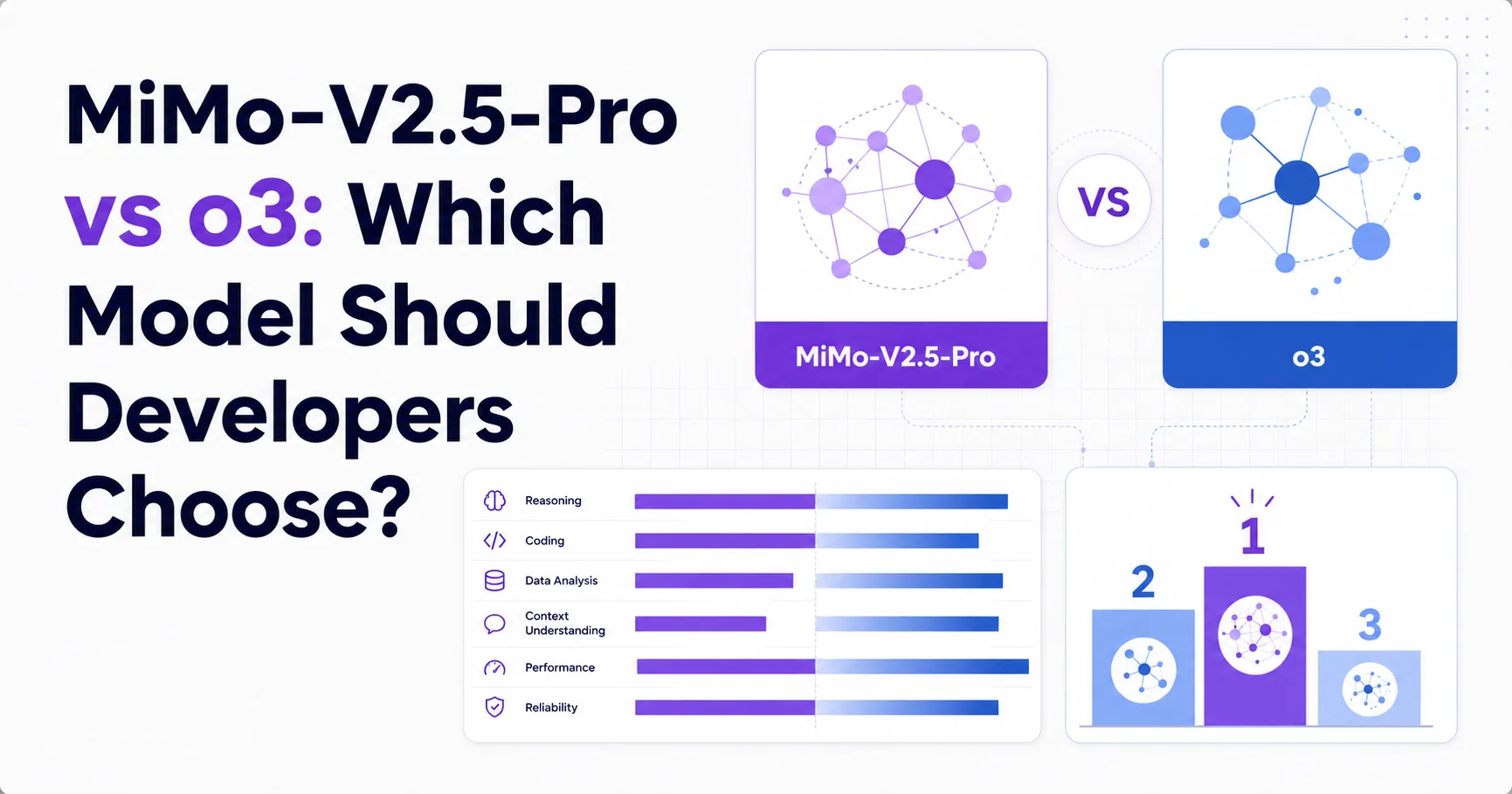
MiMo-V2.5-Pro is the stronger default for cost-sensitive development workloads, while o3 remains the safer mathematical specialist on the available evidence. The dataset gives MiMo-V2.5-Pro an Artificial Analysis Intelligence Index of 42.2, compared with 30.4 for o3. It also reports a MiMo-V2.5-Pro coding index of 60.2, although no comparable o3 coding score is available. o3 leads clearly in output speed at 128.056 median output tokens per second, while both models show 0.3 seconds of latency. The largest practical risk is not a benchmark gap. It is uncertainty about availability, documentation, and operational continuity. The supplied research found no verified official material for MiMo-V2.5-Pro. OpenAI’s current model directory does not list o3 in the provided source material.
MiMo-V2.5-Pro offers the better general selection case because its measured intelligence score is higher and its blended token price is substantially lower. The available data reports 42.2 for MiMo-V2.5-Pro and 30.4 for o3 on the Artificial Analysis Intelligence Index. That result supports MiMo-V2.5-Pro for broad assistant work, coding-oriented exploration, and applications where usage volume matters. It does not prove that MiMo-V2.5-Pro is superior at every task.
| Decision area | Better-supported choice | Why it matters |
|---|---|---|
| General intelligence | MiMo-V2.5-Pro | The reported intelligence score is 42.2 versus 30.4 |
| Mathematical reasoning | o3 | o3 has a reported Math Index of 88.3, while MiMo-V2.5-Pro has no supplied math score |
| Coding evidence | MiMo-V2.5-Pro, with a major evidence gap | MiMo-V2.5-Pro has a coding score of 60.2, but no comparable o3 score was supplied |
| Output speed | o3 | Its median output speed is 128.056 tokens per second versus 40.904 |
| Initial latency | Tie | Each model is reported at 0.3 seconds |
| Blended cost | MiMo-V2.5-Pro | The reported price is $0.54375 versus $3.5 per 1M blended tokens |
The comparison therefore has an asymmetric evidence base. MiMo-V2.5-Pro looks stronger on broad intelligence, coding evidence, and cost. o3 looks stronger for mathematics and interactive generation speed. The supplied research does not verify either model’s current context window, output limit, API parameters, multimodal support, stable alias, or failure modes. Those unknowns can outweigh benchmark differences in production. Developers should treat the dataset as a screening signal, then verify access and behavior in their own environment. Data provided by https://artificialanalysis.ai/.
o3 is the better choice for fast visible generation, while MiMo-V2.5-Pro has the stronger reported general-intelligence signal. o3 produces a median 128.056 output tokens per second, compared with 40.904 for MiMo-V2.5-Pro. That difference should matter in chat interfaces, streaming code assistance, and workflows where users watch responses arrive. It matters less when generation is only one stage in a longer pipeline.
The latency result changes the interpretation. Both models are reported at 0.3 seconds, so o3’s output-speed advantage does not automatically mean faster request completion. A response may begin at the same measured latency while one model continues producing text more quickly. For short answers, the difference may be barely visible. For long explanations, code generation, or multi-step reasoning traces, sustained output speed becomes more important.
MiMo-V2.5-Pro has the higher reported Artificial Analysis Intelligence Index, at 42.2 versus o3 at 30.4. It also has a coding index of 60.2. Those values support MiMo-V2.5-Pro as the broader engineering candidate, but the comparison cannot establish a coding winner because the supplied data contains no o3 coding score. o3’s Math Index of 88.3 gives it the clearest task-specific advantage in this dataset. MiMo-V2.5-Pro has no supplied mathematics result, so its mathematical position is unknown rather than weak.
The evidence is insufficient for claims about debugging reliability, repository-scale code changes, tool use, instruction following, or refusal behavior. Developers should test representative tasks instead of treating the available index values as a complete engineering profile.
MiMo-V2.5-Pro is the clear cost choice when the workload can use its available capability and access is dependable. The reported blended price is $0.54375 per 1M blended tokens, compared with $3.5 for o3. MiMo-V2.5-Pro is also listed at $0.435 per 1M input tokens and $0.87 per 1M output tokens, while o3 is listed at $2 and $8. The output price difference is especially important for applications that generate long answers, code patches, explanations, or structured documents.
A lower token price can still become the more expensive architecture if the model needs repeated retries, additional verification, or a stronger model for difficult cases. The supplied research provides no reliable failure scenarios for MiMo-V2.5-Pro and no verified o3 behavior profile. That prevents a defensible estimate of retry rates, human review, or fallback usage. Cost should therefore be evaluated at the workflow level, not only at the token level.
MiMo-V2.5-Pro is attractive for high-volume classification, drafting, coding assistance, and response generation where the reported intelligence and coding results match the task. o3 may justify its higher price for mathematical reasoning, especially where an incorrect result creates more cost than a slower or cheaper first pass. Its 88.3 Math Index is the strongest task-specific result in the supplied comparison.
The pricing conclusion also has an availability condition. The supplied official OpenAI pricing page does not list o3 under the provided current pricing evidence. MiMo-V2.5-Pro has no verified pricing page in the research brief. The dataset prices are useful for comparison, but developers should confirm that each model can actually be purchased and called before budgeting around them.
MiMo-V2.5-Pro leads on 3 of 3 metrics
MiMo-V2.5-Pro is the recommended first candidate for general developer applications, provided a working endpoint and production terms can be verified. Its reported Intelligence Index of 42.2 exceeds o3’s 30.4, its coding index is 60.2, and its blended price is $0.54375 per 1M blended tokens. Those signals make it the logical starting point for code assistants, internal developer tools, content-generation pipelines, and high-volume applications.
Choose o3 when mathematical reasoning is central, fast streaming output has direct product value, or an existing OpenAI integration already provides the required access path. o3’s Math Index is 88.3, and its median output speed is 128.056 tokens per second. Those advantages can outweigh its $3.5 blended price when the model handles difficult reasoning that would otherwise require retries, manual checks, or another specialist.
Do not select MiMo-V2.5-Pro solely because its benchmark and price profile looks favorable. The research brief found no verified official announcement, developer documentation, pricing page, stable alias, or community testing for that model. The official OpenAI sources supplied in the brief also do not currently establish o3’s active availability, stable alias, or replacement status. The OpenAI model directory lists newer GPT-5.6 models in the provided research, but it does not provide the missing operational details for o3.
A sensible evaluation path is to test each candidate on the application’s real prompts, especially mathematical tasks, repository edits, long outputs, and failure recovery. Measure correctness, retry frequency, user-visible completion time, and total workflow cost. The supplied material is insufficient to predict those production outcomes directly. If access cannot be verified, operational certainty should outrank the apparent benchmark winner.
o3 and MiMo-V2.5-Pro both require access verification before a production commitment because the supplied research leaves key deployment facts unresolved. The research does not verify context windows, output limits, API parameters, multimodal support, stable aliases, endpoint availability, or documented failure modes for either model. The current OpenAI model documentation is relevant to model visibility and product-line status, while the current pricing documentation is relevant to listed billing information. Neither supplied page resolves every question about o3. No equivalent official source was found for MiMo-V2.5-Pro. Developers should confirm endpoint access, model naming, billing behavior, rate limits, and replacement policy before integrating application logic around either name.
MiMo-V2.5-Pro is the better-supported coding candidate because it has a reported coding index of 60.2 and lower pricing, but the evidence cannot prove superiority because no comparable o3 coding score or reliable coding tests were supplied.
o3 is the better-supported mathematics choice because its Artificial Analysis Math Index is 88.3, while the supplied data contains no MiMo-V2.5-Pro mathematics score and therefore cannot establish a direct comparison.
o3 is faster during sustained generation, with 128.056 median output tokens per second versus MiMo-V2.5-Pro at 40.904, although the reported latency is 0.3 seconds for each model.
MiMo-V2.5-Pro costs less on the supplied pricing snapshot, at $0.54375 per 1M blended tokens versus o3 at $3.5, but retries and availability could change total workflow cost.
Developers cannot safely assume continued availability for either model from the supplied evidence, because MiMo-V2.5-Pro lacks verified official documentation and the current OpenAI model directory does not list o3.