
Time to First Token · MiniMax-M2.7
0ms
Time to First Token · o3
7185ms
Deep dive into reasoning, benchmarks, and latency insights.
The current catalog does not contain complete performance evidence for both models, so this page does not declare an overall winner. Use the available fields as comparison signals and validate the models on your own workload.
Key decision metrics at a glance.
| Model | Metric | Value | Unit | Source / snapshot |
|---|---|---|---|---|
| MiniMax-M2.7 | Reasoning | 6.0 | benchmark or capability score | Artificial Analysis · current catalog |
| o3 | Reasoning | 9.0 | benchmark or capability score | Artificial Analysis · current catalog |
| MiniMax-M2.7 | Coding | 5.0 | benchmark or capability score | Artificial Analysis · current catalog |
| o3 | Coding | 6.0 | benchmark or capability score | Artificial Analysis · current catalog |
| MiniMax-M2.7 | Multimodal | 3.0 | benchmark or capability score | Artificial Analysis · current catalog |
| o3 | Multimodal | 3.0 | benchmark or capability score | Artificial Analysis · current catalog |
| MiniMax-M2.7 | Long Context | 5.0 | benchmark or capability score | Artificial Analysis · current catalog |
| o3 | Long Context | 4.0 | benchmark or capability score | Artificial Analysis · current catalog |
| MiniMax-M2.7 | Blended Price / 1M tokens | $0.525 | USD per 1M tokens | Artificial Analysis · current catalog |
| o3 | Blended Price / 1M tokens | $3.5 | USD per 1M tokens | Artificial Analysis · current catalog |
| MiniMax-M2.7 | P95 Latency | — | milliseconds | Artificial Analysis · current catalog |
| o3 | P95 Latency | — | milliseconds | Artificial Analysis · current catalog |
| MiniMax-M2.7 | Tokens per second | 0 | tokens per second | Artificial Analysis · current catalog |
| o3 | Tokens per second | 119.185 | tokens per second | Artificial Analysis · current catalog |
Data provided by Artificial Analysis; live values use the current catalog.
This radar chart visually maps the core capabilities (reasoning, coding, math proxy, multimodal, long context) of `MiniMax-M2.7` vs `o3`.
This grouped bar chart provides a side-by-side comparison for each benchmark metric.
Lower time to first token is better; higher tokens per second is better.
Compare input and output pricing in USD per 1M tokens.
MiniMax-M2.7$0.6
o3$4
MiniMax-M2.7 costs $3.4 less per run
This article is a dated snapshot published on 2026-08-07. Live cards above use the current catalog; missing live fields are not inferred.
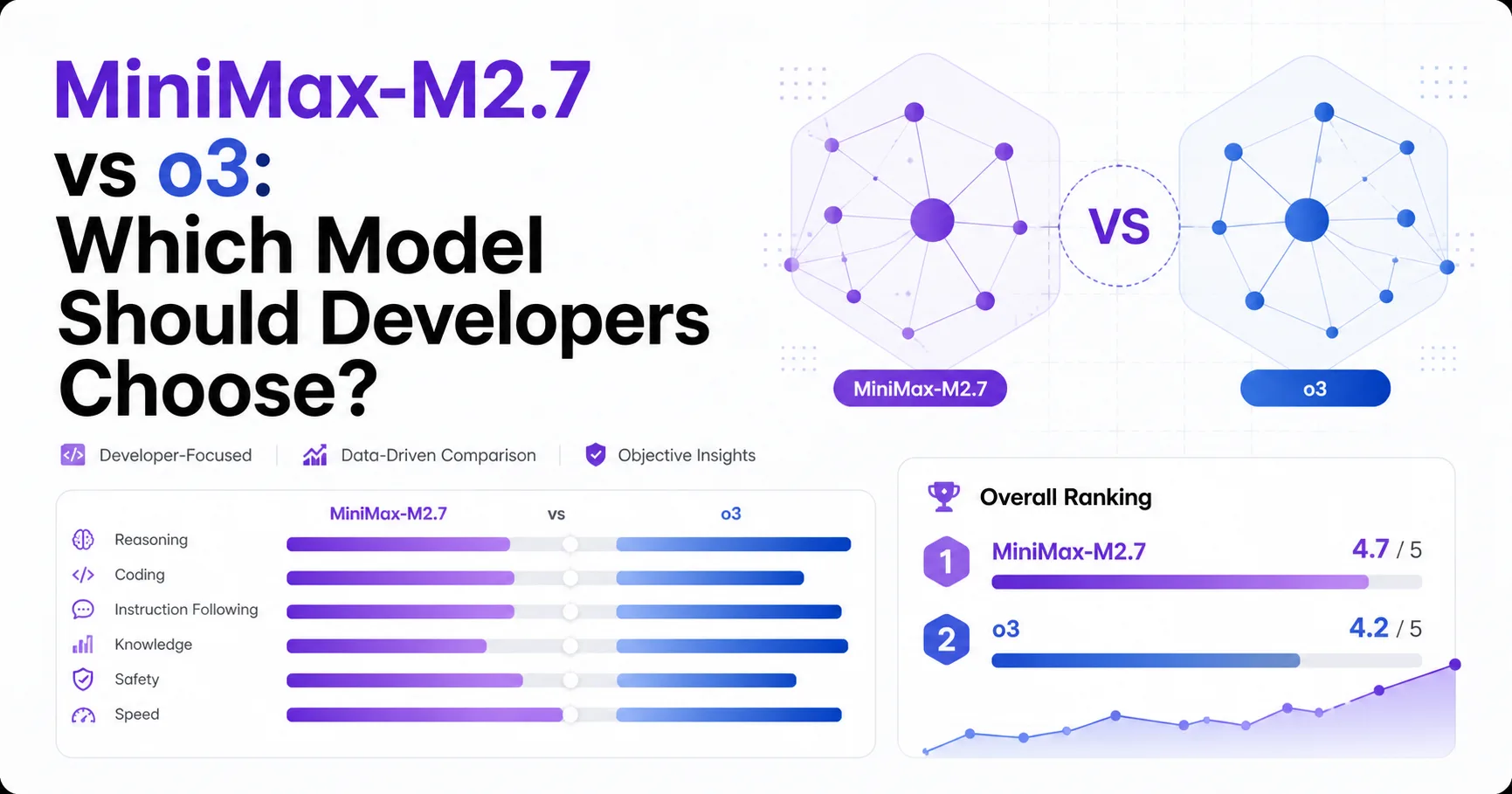
MiniMax-M2.7 is the stronger default on the available evidence, but o3 remains the safer performance choice when documented reasoning behavior matters more than price. The supplied Artificial Analysis snapshot gives MiniMax-M2.7 an Intelligence Index of 38.1 and o3 an Intelligence Index of 30.4, while the same snapshot reports o3's median output speed at 128.056 tokens per second. Data provided by https://artificialanalysis.ai/
That apparent advantage does not establish a complete product recommendation. MiniMax-M2.7 has no verifiable vendor announcement, developer documentation, pricing page, or community testing in the research brief. o3 has official model and pricing pages, but the current OpenAI catalog does not list it, and the current pricing page does not provide an o3 price. OpenAI Models and OpenAI API Pricing therefore make o3's present availability uncertain too.
The practical decision is not simply quality versus cost. It is measured benchmark evidence versus operational certainty, with neither model fully documented in the supplied materials.
MiniMax-M2.7 leads the available general intelligence comparison and costs substantially less, while o3 has the only reported output-speed measurement and the only reported math result. The Artificial Analysis snapshot reports MiniMax-M2.7 at 38.1 on its Intelligence Index, compared with 30.4 for o3. It also reports MiniMax-M2.7 at $0.525 per 1M blended tokens, compared with $3.5 for o3. Data provided by https://artificialanalysis.ai/
Those figures support a cost-sensitive MiniMax-M2.7 choice for teams that can validate access independently. They do not prove that MiniMax-M2.7 is better for coding, because the snapshot contains a MiniMax-M2.7 coding score of 52.6 but no comparable o3 coding score. They also do not prove that o3 is better for mathematical work, because the snapshot contains an o3 math score of 88.3 but no comparable MiniMax-M2.7 math score.
The official evidence changes the risk profile. The OpenAI model catalog describes the current product surface but does not list o3, its context window, output limit, API parameters, multimodal capabilities, stable alias, or replacement relationship. OpenAI Models does not resolve whether o3 can be called reliably today. MiniMax-M2.7 has even less verifiable product information in the research brief.
For a production team, the headline winner should therefore be treated as provisional. Benchmark direction favors MiniMax-M2.7, measured speed favors o3, and deployability remains unconfirmed for both within the supplied research.
o3 has the clearer performance story for latency-sensitive generation, while MiniMax-M2.7 has the stronger reported general intelligence result. Both models have a reported latency of 0.3 seconds in the Artificial Analysis snapshot, so the available evidence does not separate them on request delay. o3 is the only model with a reported median output speed, at 128.056 tokens per second. Data provided by https://artificialanalysis.ai/
For interactive developer tools, equal reported latency and a known o3 output rate make o3 easier to reason about during streaming responses. That matters for code review assistants, terminal copilots, and applications where users judge quality through response flow. MiniMax-M2.7 cannot be called slower from the supplied data. Its output-speed value is missing, so the correct conclusion is uncertainty, not a loss.
The general intelligence result points in the other direction. MiniMax-M2.7 scores 38.1 and o3 scores 30.4 on the reported Intelligence Index. A higher composite result may indicate an advantage across the evaluated task mix, but it cannot identify which developer tasks created that gap. No methodology, test distribution, or official benchmark explanation for these model-specific results appears in the research brief.
Coding evidence is incomplete. MiniMax-M2.7 has a reported Coding Index of 52.6, but o3 has no comparable value. Math evidence is also incomplete. o3 has a reported Math Index of 88.3, but MiniMax-M2.7 has no comparable value. The evidence is therefore directional, not a complete capability ranking.
Teams should run representative prompts before treating either result as a production guarantee. The research brief contains no reliable community testing, failure analysis, or verified behavior profile for either model.
MiniMax-M2.7 is the clear price leader in the supplied data, but its lower token price only creates savings if the model can be accessed and performs adequately on the target workload. The Artificial Analysis snapshot reports a blended price of $0.525 per 1M tokens for MiniMax-M2.7 and $3.5 for o3. It reports input prices of $0.3 and $2, and output prices of $1.2 and $8, respectively. Data provided by https://artificialanalysis.ai/
The output-token difference is especially important for coding agents and reasoning-heavy workflows. A model that produces longer responses, retries more often, or needs additional validation can turn a low listed rate into a higher effective application cost. The supplied data does not report token utilization, response length, retry frequency, or task success, so it cannot establish total cost per completed task.
Availability is the first condition. The research brief found no verifiable pricing page or API specification for MiniMax-M2.7. It also found no current o3 price on the official OpenAI pricing page. OpenAI API Pricing therefore does not confirm the snapshot's o3 price as a current official listing, even though the data brief supplies it for comparison.
Reliability is the second condition. If MiniMax-M2.7 lacks a stable endpoint, alias, or documented limits, engineering time spent on integration and fallback handling can outweigh token savings. The same concern applies to o3 because the current official model catalog does not list it. OpenAI Models leaves its current callability unresolved.
The cost decision should use successful task cost, not token price alone. The available evidence strongly favors MiniMax-M2.7 on listed rates, but it does not establish its production economics.
MiniMax-M2.7 leads on 3 of 3 metrics
MiniMax-M2.7 is the better first candidate for cost-sensitive evaluation, while o3 is the better candidate when a reported math result and measured streaming speed justify further validation. Choose MiniMax-M2.7 for batch generation, classification experiments, internal prototypes, and high-volume workloads where the team can verify endpoint access, observe failure behavior, and keep a fallback model available. Its reported Intelligence Index of 38.1 and blended price of $0.525 per 1M tokens make that evaluation economically attractive. Data provided by https://artificialanalysis.ai/
Choose o3 for mathematical reasoning experiments, interactive applications, or workflows where known output streaming behavior is useful. The supplied snapshot reports an o3 Math Index of 88.3 and median output speed of 128.056 tokens per second. Those results are relevant signals, not proof of superiority for every reasoning or developer task, because the corresponding MiniMax-M2.7 math result is missing and the research brief provides no common task protocol.
Do not make either model the sole production dependency based on this evidence. MiniMax-M2.7 has no verifiable official product material or reliable community reports in the research brief. o3 has official reference pages, but OpenAI Models does not list it in the current catalog, and OpenAI API Pricing does not list its current price. Both situations require an access check before implementation.
A sensible evaluation gate is simple: confirm a callable endpoint, verify authentication and model naming, measure task success on the team's own prompts, record output length and retries, and test fallback behavior. The supplied materials do not provide those operational results, so they cannot settle production readiness.
If only one model can enter a first test, MiniMax-M2.7 offers the cheaper experiment. If the test is specifically math-heavy or streaming-sensitive, o3 deserves the first comparison lane.
MiniMax-M2.7 should enter a controlled evaluation first, because its reported price and general intelligence result are attractive but its product status is unverified. The research brief contains no official documentation, stable alias, context-window specification, output limit, API parameter reference, or reliable community testing for MiniMax-M2.7.
The same adoption caution applies to o3 for a different reason. OpenAI provides current model and pricing pages, but the supplied official pages do not list o3 in the current model catalog or provide a current o3 price. OpenAI Models and OpenAI API Pricing therefore establish useful official context without confirming present availability.
The evidence gap is material for developers. Neither model has a confirmed context window in the data snapshot. Neither model has a complete set of comparable coding, math, speed, and reliability measurements. The available comparison can rank reported signals, but it cannot replace an access test and task-specific evaluation.
The next decision should depend on workload risk. Teams with flexible infrastructure can test MiniMax-M2.7 for its price advantage. Teams with strict operational requirements should verify o3's current endpoint and lifecycle before assuming that official documentation implies current callability.
MiniMax-M2.7 is better on the available general intelligence score and listed cost, but the evidence cannot establish a complete developer advantage because o3 lacks a comparable coding result and MiniMax-M2.7 lacks a comparable math result.
MiniMax-M2.7 is cheaper in the supplied data, at $0.525 per 1M blended tokens versus $3.5 for o3, although current availability and effective cost per successful task remain unverified.
o3 has the only reported output-speed measurement, at 128.056 median output tokens per second, while both models show 0.3 seconds of reported latency and MiniMax-M2.7 has no reported output-speed value.
Neither model should become a sole production dependency from this evidence alone, because MiniMax-M2.7 lacks verifiable product documentation and the current official OpenAI catalog does not list o3.
o3 has the reported math advantage in this snapshot, with a Math Index of 88.3, but MiniMax-M2.7 has no comparable math result, so the evidence cannot establish a head-to-head winner.