
Time to First Token · MiniMax-M3
1172ms
Time to First Token · o3
7185ms
Deep dive into reasoning, benchmarks, and latency insights.
The current catalog does not contain complete performance evidence for both models, so this page does not declare an overall winner. Use the available fields as comparison signals and validate the models on your own workload.
Key decision metrics at a glance.
| Model | Metric | Value | Unit | Source / snapshot |
|---|---|---|---|---|
| MiniMax-M3 | Reasoning | 6.0 | benchmark or capability score | Artificial Analysis · current catalog |
| o3 | Reasoning | 9.0 | benchmark or capability score | Artificial Analysis · current catalog |
| MiniMax-M3 | Coding | 6.0 | benchmark or capability score | Artificial Analysis · current catalog |
| o3 | Coding | 6.0 | benchmark or capability score | Artificial Analysis · current catalog |
| MiniMax-M3 | Multimodal | 4.0 | benchmark or capability score | Artificial Analysis · current catalog |
| o3 | Multimodal | 3.0 | benchmark or capability score | Artificial Analysis · current catalog |
| MiniMax-M3 | Long Context | 6.0 | benchmark or capability score | Artificial Analysis · current catalog |
| o3 | Long Context | 4.0 | benchmark or capability score | Artificial Analysis · current catalog |
| MiniMax-M3 | Blended Price / 1M tokens | $0.525 | USD per 1M tokens | Artificial Analysis · current catalog |
| o3 | Blended Price / 1M tokens | $3.5 | USD per 1M tokens | Artificial Analysis · current catalog |
| MiniMax-M3 | P95 Latency | — | milliseconds | Artificial Analysis · current catalog |
| o3 | P95 Latency | — | milliseconds | Artificial Analysis · current catalog |
| MiniMax-M3 | Tokens per second | 104.413 | tokens per second | Artificial Analysis · current catalog |
| o3 | Tokens per second | 119.185 | tokens per second | Artificial Analysis · current catalog |
Data provided by Artificial Analysis; live values use the current catalog.
This radar chart visually maps the core capabilities (reasoning, coding, math proxy, multimodal, long context) of `MiniMax-M3` vs `o3`.
This grouped bar chart provides a side-by-side comparison for each benchmark metric.
Lower time to first token is better; higher tokens per second is better.
Compare input and output pricing in USD per 1M tokens.
MiniMax-M3$0.6
o3$4
MiniMax-M3 costs $3.4 less per run
This article is a dated snapshot published on 2026-08-07. Live cards above use the current catalog; missing live fields are not inferred.
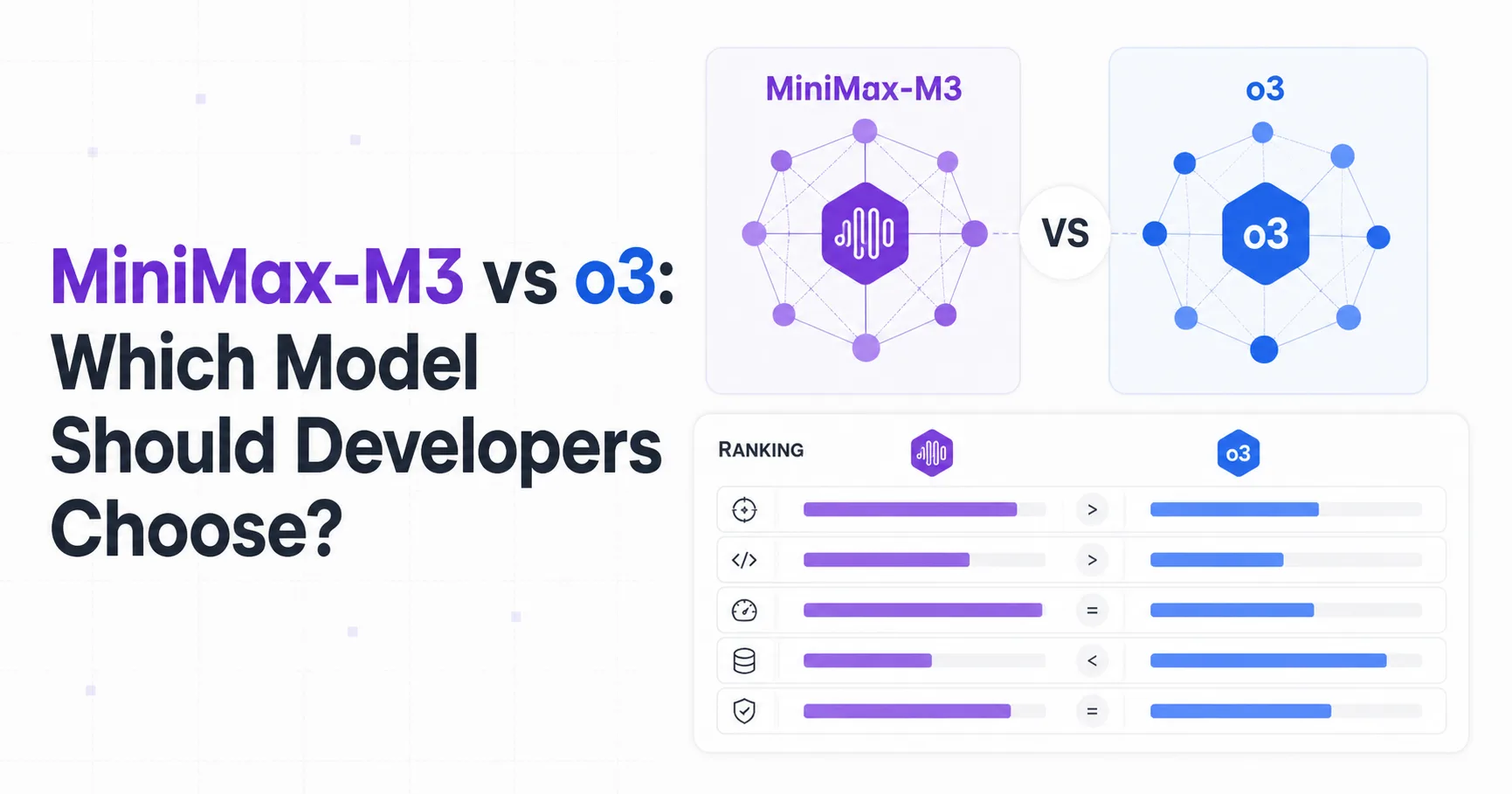
MiniMax-M3 is the stronger default for cost-sensitive developer workloads, while o3 remains the safer choice when the supplied math evidence is decisive. The supplied Artificial Analysis data gives MiniMax-M3 an intelligence index of 44.4 versus 30.4 for o3, while o3 reaches 88.3 on the math index. MiniMax-M3 also costs $0.525 per 1M blended tokens, compared with $3.5 for o3. Data provided by Artificial Analysis.\n\nThe decision is less settled than the scorecard suggests. MiniMax-M3 has a coding index of 58.6, but no comparable o3 coding value appears in the data brief. o3 has a math score, but no corresponding MiniMax-M3 math value appears. That asymmetry prevents a complete capability ranking. Current documentation also creates availability uncertainty for o3. OpenAI's current model directory does not list o3, and the research brief found no confirmed current alias or replacement path. OpenAI's model directory is therefore relevant to operational risk, not proof that o3 cannot be called.
MiniMax-M3 has the broader positive evidence in the supplied comparison, but o3 has the clearest specialist advantage. The available intelligence index favors MiniMax-M3 by 14 points, with scores of 44.4 and 30.4. That result supports MiniMax-M3 for general-purpose tasks represented by the index, although it does not establish superiority for every developer workflow.\n\no3 has the higher median output speed at 128.056 tokens per second, compared with 87.089 for MiniMax-M3. The latency result is a tie at 0.3 seconds, so faster generation does not automatically mean faster first interaction. A streaming coding assistant may benefit from o3's higher output rate, while a request dominated by model startup or network delay may see less practical difference.\n\nThe most important missing evidence concerns product behavior. The research brief found no verifiable MiniMax-M3 official release material, documentation, pricing page, community test method, or known failure pattern. For o3, the supplied official pages confirm current model-directory and pricing-page visibility questions, but they do not provide o3-specific limits, benchmark results, aliases, or failure modes. OpenAI's model documentation and OpenAI's pricing page should be treated as current reference points, not as complete historical documentation for o3.
o3 is the faster generator, but MiniMax-M3 has the stronger available general intelligence result and the only supplied coding result. o3 produces a median 128.056 output tokens per second, versus 87.089 for MiniMax-M3. That difference matters when developers wait for long completions, especially in interactive coding, document transformation, or agent steps that emit substantial text. It matters less when responses are short or when tool calls dominate the elapsed time.\n\nThe equal 0.3-second latency value changes the interpretation. Developers should not read o3's output-rate lead as a guaranteed improvement in end-to-end responsiveness. The supplied data supports a narrower conclusion: o3 can generate tokens faster after generation begins, while the measured latency is equal in this comparison.\n\nCapability evidence points in different directions. MiniMax-M3 records 44.4 on the intelligence index and 58.6 on the coding index. o3 records 30.4 on the intelligence index and 88.3 on the math index. These are not interchangeable scores, and the absent counterpart values prevent direct claims that one model is better at coding or math overall. A developer choosing for code generation should validate repository-level tasks directly because the brief provides no comparable o3 coding score. A developer choosing for mathematical reasoning should validate MiniMax-M3 because the brief provides no MiniMax-M3 math score.\n\nThe research brief also found no reliable community test methods for either model. That leaves practical behavior, refusal patterns, tool use, and failure recovery unresolved. The performance chart can rank the supplied measurements, but it cannot answer those operational questions.
MiniMax-M3 is dramatically cheaper in the supplied pricing snapshot, but its lower unit price only matters if its output is reliable enough for the workflow. MiniMax-M3 costs $0.525 per 1M blended tokens, compared with $3.5 for o3. Its input price is $0.3 per 1M tokens, compared with $2 for o3, while its output price is $1.2, compared with $8. Those differences make repeated experimentation, batch generation, and high-volume assistant traffic materially easier to budget with MiniMax-M3.\n\nThe cost conclusion can reverse when a cheaper model needs more retries, extra validation, or manual correction. The research brief does not provide verified failure rates, task success rates, or community test methods for MiniMax-M3. It also does not provide verified o3 failure rates. Therefore, no defensible total-cost claim can be made for production workflows that require a specific success threshold. The supplied prices describe token spend, not engineering time or recovery cost.\n\nOutput pricing deserves particular attention for agentic systems. A workflow that produces long answers, code patches, or repeated tool instructions exposes the $1.2 versus $8 output-price difference more strongly than a short classification request. However, o3's higher output speed may reduce waiting time in some interactive workflows. The evidence does not quantify the value of that time reduction, so developers should measure it against actual user retention or developer throughput rather than assume speed offsets price.
MiniMax-M3 leads on 3 of 3 metrics
MiniMax-M3 should be the first model tested for budget-sensitive general development tasks, while o3 should be reserved for workloads where its math evidence or output speed is worth the premium. MiniMax-M3 is the practical starting point for code assistants, internal automation, and high-volume generation because it has the lower blended price and the available intelligence and coding measurements. The recommendation remains provisional because the research brief contains no verified documentation for its API contract, context window, output limit, or stable endpoint.\n\no3 is the better candidate for mathematical reasoning experiments and latency-sensitive generation tests. Its math index is 88.3, and its median output speed is 128.056 tokens per second. Those advantages do not establish that o3 will win a complete production benchmark. They identify the cases that justify putting o3 into the test set despite its $3.5 blended price.\n\nTeams should make the final choice with a small, task-specific evaluation. Include repository changes, test repair, structured extraction, long-context prompts, mathematical proofs, tool calls, and recovery after an incorrect first attempt. Track successful task completion, retries, review time, token spend, and perceived waiting time. The supplied evidence does not define any of those outcomes, so a local evaluation is necessary.\n\nAvailability should be a release gate for o3. OpenAI's current model directory does not list o3, and its current pricing page does not list o3 pricing. The model directory and the pricing page support checking present visibility, but they do not confirm a stable alias or direct-call path for o3. Do not build a production dependency until that path is verified.
MiniMax-M3 and o3 cannot be ranked confidently on context handling, API stability, or failure recovery because the supplied research does not verify those properties. Neither model has a confirmed context-window value in the data brief. The research brief also found no reliable community post with a reproducible test method for either model.\n\nThe official evidence is asymmetric. MiniMax-M3 has no verifiable official source in the research brief. o3 has current OpenAI pages that establish what appears in the current model directory and pricing catalog, but those pages do not supply o3-specific technical limits or benchmark results. This creates two different risks: MiniMax-M3 has documentation risk, while o3 has current-availability and pricing-visibility risk.\n\nThe benchmark evidence is also incomplete. MiniMax-M3 has a coding index of 58.6, while o3 has no coding value in the supplied data. o3 has a math index of 88.3, while MiniMax-M3 has no math value. The intelligence index is directly comparable in the brief and favors MiniMax-M3, but it should not be treated as a universal substitute for task-level validation. These gaps are not minor editorial omissions. They are the main reasons the recommendation should remain test-driven.
MiniMax-M3 is the better default when token cost and the supplied general intelligence evidence matter most. It scores 44.4 on the intelligence index versus 30.4 for o3, costs $0.525 versus $3.5 per 1M blended tokens, and has the only supplied coding score at 58.6. The conclusion is provisional because the research brief does not verify its API contract, context window, stable endpoint, or failure behavior.
A developer should choose o3 when mathematical reasoning evidence or faster token generation justifies additional cost and availability checks. o3 reaches 88.3 on the math index and 128.056 median output tokens per second, while MiniMax-M3 reaches 87.089 tokens per second. The supplied evidence does not prove o3 is better for coding or general production reliability.
No, o3 is more expensive in every supplied token-price category. Its blended price is $3.5 per 1M tokens versus $0.525 for MiniMax-M3, its input price is $2 versus $0.3, and its output price is $8 versus $1.2. Total workflow cost could still differ if one model requires more retries or human correction, but those rates are not provided.
o3 may feel faster during long streamed responses because its median output speed is 128.056 tokens per second versus 87.089 for MiniMax-M3. The supplied latency value is 0.3 seconds for each model, so the evidence does not establish faster first-token response or faster end-to-end completion for every request.
The supplied evidence is insufficient to confirm that MiniMax-M3 is safe as a production dependency. The data brief provides pricing, speed, and evaluation values, but the research brief found no verifiable official documentation, context window, API parameters, stable alias, or known failure modes. Teams should verify endpoint stability and run task-level tests before committing to it.
No, a team should not assume current o3 availability or pricing from the supplied evidence. OpenAI's current model directory does not list o3, and the current pricing page does not list o3 pricing. Those pages support a current visibility check, but they do not confirm whether o3 can still be called, whether a stable alias exists, or whether a successor is required.