
Time to First Token · Nex-N2-Pro
937ms
Time to First Token · o3
7185ms
Deep dive into reasoning, benchmarks, and latency insights.
The current catalog does not contain complete performance evidence for both models, so this page does not declare an overall winner. Use the available fields as comparison signals and validate the models on your own workload.
Key decision metrics at a glance.
| Model | Metric | Value | Unit | Source / snapshot |
|---|---|---|---|---|
| Nex-N2-Pro | Reasoning | 6.0 | benchmark or capability score | Artificial Analysis · current catalog |
| o3 | Reasoning | 9.0 | benchmark or capability score | Artificial Analysis · current catalog |
| Nex-N2-Pro | Coding | 6.0 | benchmark or capability score | Artificial Analysis · current catalog |
| o3 | Coding | 6.0 | benchmark or capability score | Artificial Analysis · current catalog |
| Nex-N2-Pro | Multimodal | 3.0 | benchmark or capability score | Artificial Analysis · current catalog |
| o3 | Multimodal | 3.0 | benchmark or capability score | Artificial Analysis · current catalog |
| Nex-N2-Pro | Long Context | 5.0 | benchmark or capability score | Artificial Analysis · current catalog |
| o3 | Long Context | 4.0 | benchmark or capability score | Artificial Analysis · current catalog |
| Nex-N2-Pro | Blended Price / 1M tokens | $1 | USD per 1M tokens | Artificial Analysis · current catalog |
| o3 | Blended Price / 1M tokens | $3.5 | USD per 1M tokens | Artificial Analysis · current catalog |
| Nex-N2-Pro | P95 Latency | — | milliseconds | Artificial Analysis · current catalog |
| o3 | P95 Latency | — | milliseconds | Artificial Analysis · current catalog |
| Nex-N2-Pro | Tokens per second | 139.694 | tokens per second | Artificial Analysis · current catalog |
| o3 | Tokens per second | 119.185 | tokens per second | Artificial Analysis · current catalog |
Data provided by Artificial Analysis; live values use the current catalog.
This radar chart visually maps the core capabilities (reasoning, coding, math proxy, multimodal, long context) of `Nex-N2-Pro` vs `o3`.
This grouped bar chart provides a side-by-side comparison for each benchmark metric.
Lower time to first token is better; higher tokens per second is better.
Compare input and output pricing in USD per 1M tokens.
Nex-N2-Pro$1.125
o3$4
Nex-N2-Pro costs $2.875 less per run
This article is a dated snapshot published on 2026-08-07. Live cards above use the current catalog; missing live fields are not inferred.
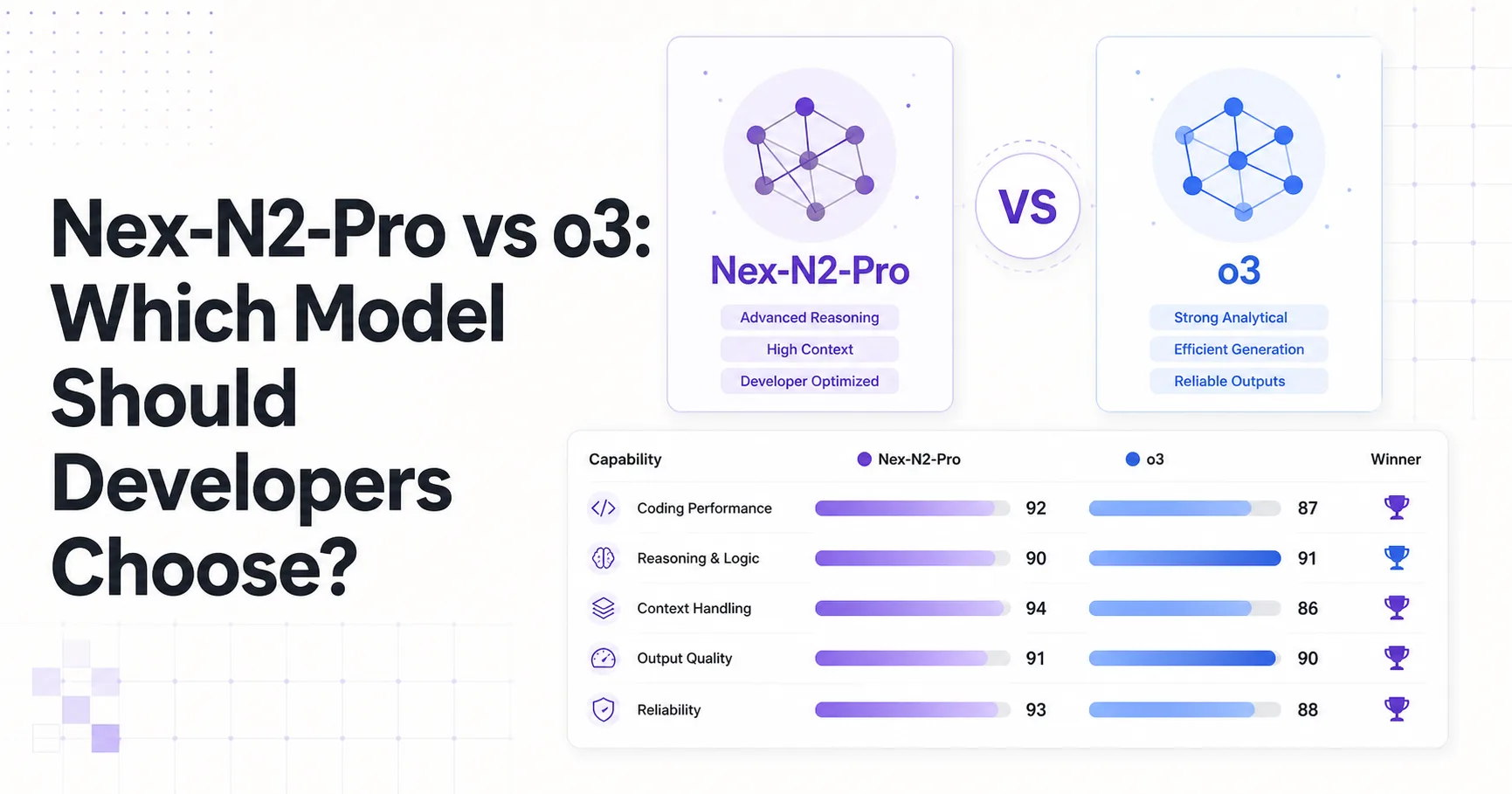
Nex-N2-Pro is the stronger default for cost-sensitive developer workloads because it combines the higher available general intelligence score with lower pricing and slightly higher output speed.
The quantitative data favors Nex-N2-Pro on the Artificial Analysis Intelligence Index, where it scores 41 compared with o3 at 30.4. Nex-N2-Pro also records 133.401 median output tokens per second, compared with 128.056 for o3. The reported latency is 0.3 seconds for each model.
The comparison is not complete enough to support a universal winner. Nex-N2-Pro has a reported coding score of 59.1, while o3 has a reported math score of 88.3. The supplied data does not provide the corresponding score for the other model in either evaluation. The research also does not verify a current official product page, callable API status, context window, or stable alias for Nex-N2-Pro. For o3, the current OpenAI model directory does not list the model, and the current OpenAI pricing page does not list its prices.
Data provided by https://artificialanalysis.ai/
Nex-N2-Pro is the better first candidate for general-purpose applications, but o3 remains relevant for math-heavy workflows where its reported evaluation is directly aligned with the task.
| Decision factor | Nex-N2-Pro | o3 | Selection meaning |
|---|---|---|---|
| Artificial Analysis Intelligence Index | 41 | 30.4 | Nex-N2-Pro has the stronger reported general score |
| Artificial Analysis Coding Index | 59.1 | Not reported | Nex-N2-Pro has a usable signal, but no matched comparison |
| Artificial Analysis Math Index | Not reported | 88.3 | o3 has the only supplied math signal |
| Median output speed | 133.401 tokens per second | 128.056 tokens per second | Nex-N2-Pro is faster in the supplied measurement |
| Latency | 0.3 seconds | 0.3 seconds | The reported result is tied |
| Blended price per 1M tokens | $1 | $3.5 | Nex-N2-Pro has the lower listed benchmark price |
The key distinction is evidence shape. Nex-N2-Pro has broader favorable signals across general intelligence, coding, speed, and price. o3 has a strong math signal, but the supplied material does not show whether that advantage transfers to coding, tool use, long-context work, or production reliability.
The official status question also changes the risk calculation. OpenAI’s model directory currently emphasizes GPT-5.6 Sol, GPT-5.6 Terra, and GPT-5.6 Luna, without listing o3. That absence does not prove that o3 cannot be called, but it does mean the supplied evidence cannot confirm current availability or a supported replacement path. Nex-N2-Pro has an even larger verification gap because the research found no reliable official or community source for its operational status.
Nex-N2-Pro is the faster and higher-scoring general option in the available measurements, while o3 is only preferable when the unpaired math result reflects the workload that matters most.
The Artificial Analysis Intelligence Index places Nex-N2-Pro at 41 and o3 at 30.4. That difference suggests Nex-N2-Pro may be the safer starting point for mixed developer tasks such as generating explanations, handling ordinary application logic, and responding across varied prompts. The result is directional, not definitive. The supplied material does not describe the index methodology in enough detail to map the score directly to a particular production success rate.
Nex-N2-Pro also has the only supplied coding score, at 59.1. That number cannot establish a coding win because o3 has no corresponding coding value in the data brief. A developer choosing for code generation should therefore treat Nex-N2-Pro as the model with evidence, not automatically as the proven coding leader. A small task-specific evaluation remains necessary.
o3 has the only reported math result, at 88.3 on the Artificial Analysis Math Index. That makes o3 worth testing for symbolic reasoning, quantitative verification, and workloads where mathematical correctness dominates response variety or cost. It does not establish superiority for broader reasoning. The research provides no verified community test method, failure analysis, or official benchmark material for o3 beyond the supplied data.
The latency result is 0.3 seconds for both models, so the visible user experience may depend more on output length and streaming behavior than on initial response timing. Nex-N2-Pro produces 133.401 median output tokens per second, compared with 128.056 for o3. That speed difference can matter in long generated responses, interactive coding sessions, and agent loops, but it cannot compensate for a missing capability that the task requires.
Neither model has a verified context window in the supplied data. Developers should not assume that either model supports a particular repository size, document length, multimodal input, or tool-calling pattern until the target endpoint is confirmed.
Nex-N2-Pro is the clear price leader in the supplied data, but o3 can still be economically rational when its math capability prevents costly downstream correction.
Nex-N2-Pro costs $1 per 1M blended tokens, compared with $3.5 for o3. Its input price is $0.5 per 1M tokens, and its output price is $2.5 per 1M tokens. o3 is listed at $2 for input and $8 for output per 1M tokens. The largest practical exposure is output-heavy use, where verbose answers, code generation, and agent traces make output pricing more important than the blended headline.
The price gap favors Nex-N2-Pro for high-volume classification, drafting, routine code assistance, and applications where developers can validate responses with deterministic checks. Lower unit cost also gives a team more room to run retries, candidate generation, or evaluation traffic. Those benefits only hold if Nex-N2-Pro is actually accessible through a stable production interface. The research does not verify a callable endpoint, stable alias, or current official listing for the model.
o3 may be cheaper at the system level when a stronger math result reduces retries, human review, incorrect calculations, or failed workflow steps. That claim is a decision hypothesis, not a measured result in the supplied material. The research contains no task-level error rates, reliability data, token usage distribution, or production failure costs. Developers should test total workflow cost rather than multiply the listed token prices by traffic alone.
A second cost risk is lifecycle uncertainty. The OpenAI pricing page does not currently list o3, so the supplied research cannot confirm whether the displayed comparison reflects a current purchase path. Nex-N2-Pro has no verified pricing page at all. Artificial Analysis supplies the comparison values, but its data does not resolve procurement, quota, contract, or endpoint availability questions.
The right cost gate is therefore simple: confirm that the model can be called under the intended account, then measure cost per accepted task. Without that validation, the cheaper listed model may be unavailable, while the expensive listed model may require migration planning.
Nex-N2-Pro leads on 3 of 3 metrics
Nex-N2-Pro should be the first model tested for broad developer use, while o3 should be retained as a targeted candidate for math-dominant workflows.
Choose Nex-N2-Pro first when the application needs a general-purpose model, price-sensitive scaling, faster streamed output, or an initial coding assistant. Its available profile is favorable across the general intelligence index, the supplied coding index, output speed, and all listed price measures. The evidence is incomplete, but it points in one consistent direction for ordinary mixed workloads.
Choose o3 first when mathematical reasoning is the central acceptance criterion and the team is willing to validate current access independently. Its reported Math Index score is 88.3, and that is the only supplied signal directly supporting a math-focused choice. Do not extend that result to coding, multimodal tasks, context handling, tool use, or operational stability without additional testing.
For a production decision, run the same representative prompts against both models after confirming callable endpoints. Include code repair, structured extraction, explanation quality, mathematical verification, refusal behavior, and long responses. Track accepted-task rate, review effort, latency, output length, and total token spend. The supplied research does not contain those measurements, so they are the missing evidence most likely to change the recommendation.
The official availability check should happen before engineering integration. OpenAI’s current model documentation does not list o3, and it does not provide a verified o3 context window, output limit, API parameter set, stable alias, or replacement statement in the supplied material. Nex-N2-Pro lacks even a comparable official source in the research. That uncertainty is a release risk for either choice.
Overall, Nex-N2-Pro is the evidence-backed default for general development workloads. o3 is the specialist candidate whose case depends on validating whether its reported math strength is real, accessible, and valuable enough to offset its listed price.
Nex-N2-Pro is the safer starting hypothesis, but endpoint and capability verification must precede production integration.
The supplied research leaves important questions unanswered for both models. Those gaps matter because a benchmark comparison describes observed measurements, while a production integration also requires a supported endpoint, predictable limits, and known failure behavior.
Nex-N2-Pro has the only supplied coding score, at 59.1, so it is the better-supported coding candidate, but the evidence does not prove it beats o3 because no matched o3 coding score is provided.
o3 is the only model with a supplied math result, scoring 88.3 on the Artificial Analysis Math Index, so it deserves priority testing for math-heavy work, but Nex-N2-Pro has no reported comparison score.
Nex-N2-Pro is cheaper in the supplied comparison, costing $1 per 1M blended tokens versus $3.5 for o3, although neither model’s current production availability is fully verified by the research.
Nex-N2-Pro has the higher reported median output speed at 133.401 tokens per second versus 128.056 for o3, while both models have the same reported latency of 0.3 seconds.
Developers cannot confirm reliable current availability for either model from the supplied research, because Nex-N2-Pro has no verified official endpoint and OpenAI’s current model directory does not list o3.
A team should test representative coding, mathematical verification, structured extraction, long responses, review effort, accepted-task rate, latency, output length, and total token spend because the supplied research lacks those production measurements.