
Time to First Token · Nemotron 3 Ultra 550B A55B (Reasoning)
1726ms
Time to First Token · o3
7185ms
Deep dive into reasoning, benchmarks, and latency insights.
The current catalog does not contain complete performance evidence for both models, so this page does not declare an overall winner. Use the available fields as comparison signals and validate the models on your own workload.
Key decision metrics at a glance.
| Model | Metric | Value | Unit | Source / snapshot |
|---|---|---|---|---|
| Nemotron 3 Ultra 550B A55B (Reasoning) | Reasoning | 6.0 | benchmark or capability score | Artificial Analysis · current catalog |
| o3 | Reasoning | 9.0 | benchmark or capability score | Artificial Analysis · current catalog |
| Nemotron 3 Ultra 550B A55B (Reasoning) | Coding | 5.0 | benchmark or capability score | Artificial Analysis · current catalog |
| o3 | Coding | 6.0 | benchmark or capability score | Artificial Analysis · current catalog |
| Nemotron 3 Ultra 550B A55B (Reasoning) | Multimodal | 3.0 | benchmark or capability score | Artificial Analysis · current catalog |
| o3 | Multimodal | 3.0 | benchmark or capability score | Artificial Analysis · current catalog |
| Nemotron 3 Ultra 550B A55B (Reasoning) | Long Context | 5.0 | benchmark or capability score | Artificial Analysis · current catalog |
| o3 | Long Context | 4.0 | benchmark or capability score | Artificial Analysis · current catalog |
| Nemotron 3 Ultra 550B A55B (Reasoning) | Blended Price / 1M tokens | $1.137 | USD per 1M tokens | Artificial Analysis · current catalog |
| o3 | Blended Price / 1M tokens | $3.5 | USD per 1M tokens | Artificial Analysis · current catalog |
| Nemotron 3 Ultra 550B A55B (Reasoning) | P95 Latency | — | milliseconds | Artificial Analysis · current catalog |
| o3 | P95 Latency | — | milliseconds | Artificial Analysis · current catalog |
| Nemotron 3 Ultra 550B A55B (Reasoning) | Tokens per second | 135.835 | tokens per second | Artificial Analysis · current catalog |
| o3 | Tokens per second | 119.185 | tokens per second | Artificial Analysis · current catalog |
Data provided by Artificial Analysis; live values use the current catalog.
This radar chart visually maps the core capabilities (reasoning, coding, math proxy, multimodal, long context) of `Nemotron 3 Ultra 550B A55B (Reasoning)` vs `o3`.
This grouped bar chart provides a side-by-side comparison for each benchmark metric.
Lower time to first token is better; higher tokens per second is better.
Compare input and output pricing in USD per 1M tokens.
Nemotron 3 Ultra 550B A55B (Reasoning)$1.288
o3$4
Nemotron 3 Ultra 550B A55B (Reasoning) costs $2.712 less per run
This article is a dated snapshot published on 2026-08-07. Live cards above use the current catalog; missing live fields are not inferred.
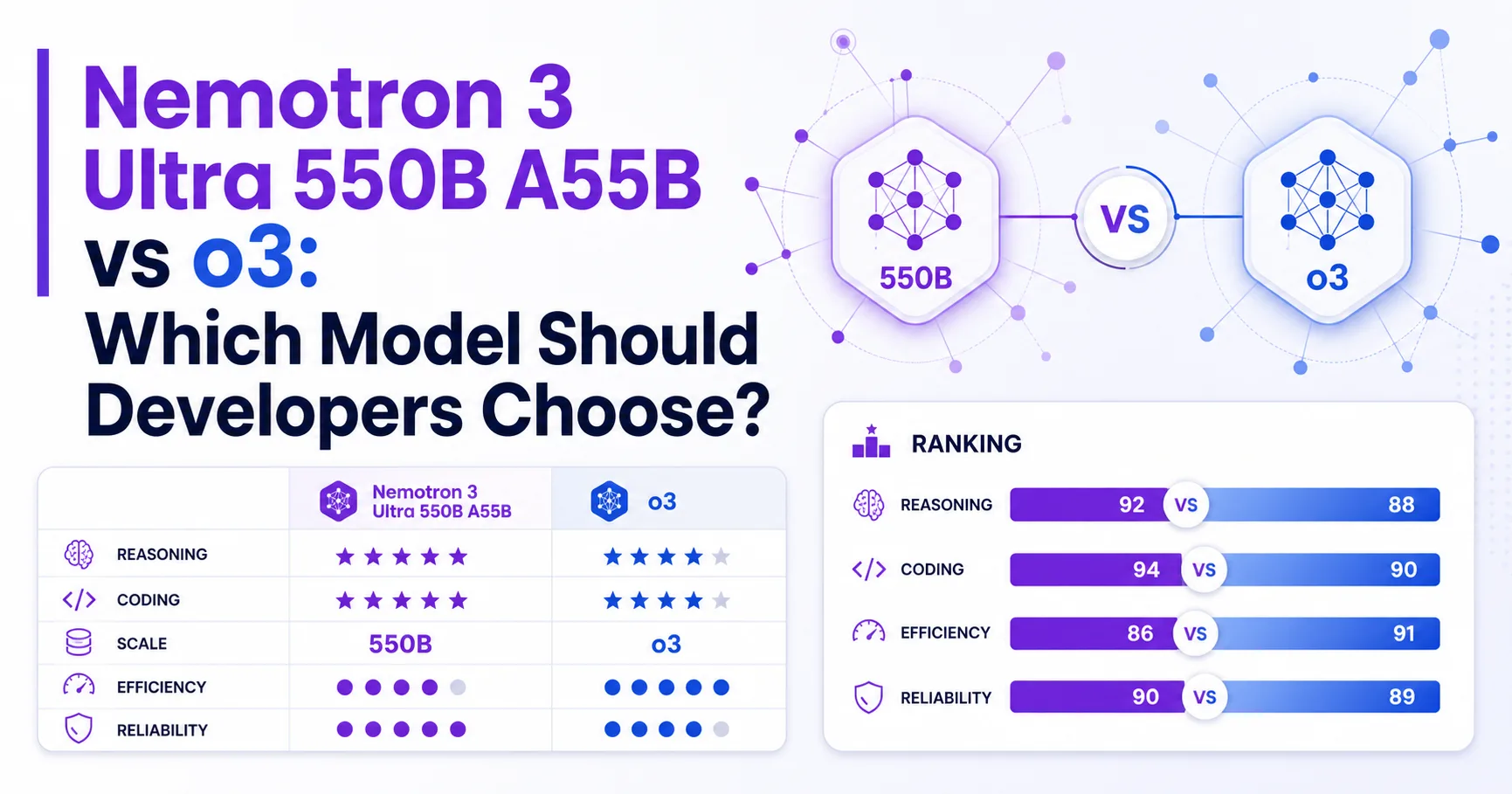
Nemotron 3 Ultra 550B A55B (Reasoning) is the stronger default for cost-sensitive developers, but o3 remains relevant for math-focused workloads.
The available data gives Nemotron a 37.8 Artificial Analysis Intelligence Index, compared with 30.4 for o3. Nemotron also has a median output speed of 145.677 tokens per second, compared with 128.056 for o3. Both models show 0.3 seconds of latency in the supplied dataset.
The commercial decision is less certain than the benchmark decision. Nemotron has a blended price of $1.175 per 1M tokens, while o3 has a blended price of $3.5. However, the research brief found no verifiable product page, stable API alias, official documentation, or community testing record for Nemotron. OpenAI's current model directory also does not list o3: https://developers.openai.com/api/docs/models.
Data provided by https://artificialanalysis.ai/
Nemotron 3 Ultra 550B A55B (Reasoning) offers the better measured general-purpose profile, while o3 has the clearest measured advantage in mathematics.
| Decision factor | Nemotron 3 Ultra 550B A55B (Reasoning) | o3 | Selection meaning |
|---|---|---|---|
| Release date | 2026-06-04 | 2025-04-16 | Nemotron is the newer entry in the supplied dataset |
| Intelligence Index | 37.8 | 30.4 | Nemotron leads the available general intelligence measurement |
| Math Index | Not available | 88.3 | o3 has the only supplied math result |
| Coding Index | 49.3 | Not available | Nemotron has the only supplied coding result |
| Median output speed | 145.677 tokens/second | 128.056 tokens/second | Nemotron is faster in the supplied measurement |
| Latency | 0.3 seconds | 0.3 seconds | The supplied latency result is tied |
| Blended price per 1M tokens | $1.175 | $3.5 | Nemotron is cheaper on the supplied blended price |
The most important comparison is not simply that one model has more scores. The evidence is asymmetric. Nemotron has a coding result but no math result. o3 has a math result but no coding result. The supplied data therefore supports a general-quality and cost conclusion, but it does not establish a complete capability ranking.
Operational confidence is also asymmetric in an inconvenient way. The research brief found no verifiable official release, documentation, pricing page, API alias, or community test record for Nemotron. For o3, the official model directory and pricing page are available, but neither currently lists o3's active availability or price: https://developers.openai.com/api/docs/models and https://developers.openai.com/api/docs/pricing.
That creates a practical split. Nemotron wins the measured value case. o3 may still win a procurement case if a team values a documented provider surface more than the supplied benchmark and price signals. The research brief does not provide enough evidence to confirm whether either model can currently be called reliably through a production API.
Nemotron 3 Ultra 550B A55B (Reasoning) has the better measured general-performance profile, but the available tests do not prove universal superiority.
Nemotron's 37.8 Intelligence Index versus o3's 30.4 suggests a meaningful advantage across the evaluation represented by that index. For developers, that can translate into fewer correction turns, more useful first drafts, or better task completion on mixed workloads. The dataset does not identify the individual tasks, weighting, or pass criteria behind the index, so the result should guide screening rather than replace application tests.
o3 has a supplied Math Index of 88.3, and Nemotron has no corresponding value. That makes o3 the safer evidence-based choice for a workload where mathematical reasoning is the primary acceptance criterion. The comparison cannot establish how Nemotron would perform on the same math evaluation because the relevant value is absent.
Nemotron also has a supplied Coding Index of 49.3, while o3 has no corresponding value. That supports Nemotron as the only model with direct coding evidence in this dataset, but it does not prove that Nemotron is better at coding. The missing o3 coding result prevents a like-for-like coding conclusion.
Speed is easier to interpret, although still dependent on serving conditions. Nemotron's median output speed is 145.677 tokens per second, compared with 128.056 for o3. This difference matters most for long generated answers, interactive coding sessions, and agent loops where users wait for visible output. It matters less when the application is dominated by retrieval, tool execution, queueing, or post-processing.
Latency is tied at 0.3 seconds in the supplied data. Developers should therefore avoid choosing Nemotron solely because it appears faster overall. Output throughput and request latency describe different user experiences. A fast stream with identical initial latency may improve completion time without improving time to first response.
The research brief found no reliable community test methods for either model's coding experience, response speed, or behavioral preferences. It also found no verified failure cases. Developers should treat prompt adherence, tool calling, structured output, and refusal behavior as open validation items rather than established differences.
Nemotron 3 Ultra 550B A55B (Reasoning) is the clear measured price leader, but its lower price does not by itself establish lower production cost.
Nemotron's blended price is $1.175 per 1M tokens, compared with $3.5 for o3. Its input price is $0.675 per 1M tokens, compared with $2 for o3. Its output price is $2.675 per 1M tokens, compared with $8 for o3. These figures make Nemotron the obvious first candidate for high-volume workloads, especially applications that generate substantial output.
The price conclusion can reverse if access is uncertain. The research brief found no current, verifiable Nemotron pricing page or stable API alias. A nominally cheaper model is not economically cheaper if a team must build custom hosting, wait for capacity, accept inconsistent availability, or maintain an unverified integration. The supplied material does not provide infrastructure, hosting, quota, or reliability costs, so those factors cannot be quantified here.
o3 has no current listed price in the provided official pricing page. The page does not list Standard, Batch, Flex, or Fast mode pricing for o3: https://developers.openai.com/api/docs/pricing. That means the $3.5 comparison comes from the supplied Artificial Analysis data, not from a currently verified OpenAI price card.
Token mix also changes the practical result. Output-heavy applications should pay close attention to the output rates because generated tokens are priced at $2.675 for Nemotron and $8 for o3 in the supplied data. Input-heavy applications still favor Nemotron on the listed rates, but the final bill depends on the application's actual prompt and completion distribution, which the brief does not provide.
The right cost test is therefore two-stage: compare the supplied token prices, then verify that the selected model has a usable production access path. Nemotron wins the first test. The evidence is insufficient to declare it the lower total-cost option.
Nemotron 3 Ultra 550B A55B (Reasoning) leads on 3 of 3 metrics
Nemotron 3 Ultra 550B A55B (Reasoning) should be the first pilot for broad, price-sensitive development workloads.
Choose Nemotron first for general assistants, coding experiments, batch generation, and applications where measured intelligence, output throughput, and token economics matter. The supplied dataset gives it a 37.8 Intelligence Index, a 49.3 Coding Index, 145.677 median output tokens per second, and a $1.175 blended price per 1M tokens. Those signals make it the stronger value candidate.
Choose o3 first for math-centered systems when the available 88.3 Math Index is directly relevant to the task. This recommendation is narrower than a general model endorsement. The data does not include an o3 coding score or a Nemotron math score, so the math decision rests on one-sided evidence.
Use a two-model evaluation if the product mixes mathematical reasoning with coding or general knowledge. Route a small, representative test set through both models and record correctness, repair turns, tool-call success, structured-output validity, and total elapsed time. The research brief provides no verified failure scenarios for either model, so application-specific testing is necessary.
Pause production commitment until access is verified. Nemotron lacks a verifiable official product page, API alias, and current pricing source in the research brief. OpenAI's current model directory does not list o3, and the brief does not confirm whether o3 remains directly callable or has a stable alias: https://developers.openai.com/api/docs/models.
The final decision should separate benchmark fit from procurement confidence. Nemotron is the measured winner on general intelligence, speed, and listed price. o3 is the evidence-based math option. Neither model has enough supplied documentation to support confident claims about context limits, output limits, multimodal support, or production availability.
Nemotron 3 Ultra 550B A55B (Reasoning) should not enter production until its access path and operational limits are independently verified.
The supplied research brief leaves several selection-critical questions unanswered. Those gaps matter because benchmark scores and token prices describe only part of a deployment decision. Teams should confirm availability, supported parameters, context behavior, output limits, and failure handling through a working integration or authoritative provider documentation.
The official OpenAI model directory is the relevant reference for current model visibility, while the official pricing page is the relevant reference for current listed prices: https://developers.openai.com/api/docs/models and https://developers.openai.com/api/docs/pricing. Neither supplied page resolves every question about o3, and the brief contains no equivalent verified official source for Nemotron.
Data provided by https://artificialanalysis.ai/
Nemotron 3 Ultra 550B A55B (Reasoning) is the better overall measured choice because it leads the supplied Intelligence Index, output speed, and blended price. The conclusion remains conditional because coding and math coverage is incomplete.
o3 is the better evidence-based choice for mathematical reasoning because the supplied data gives o3 an Artificial Analysis Math Index of 88.3. Nemotron has no corresponding math result, so a complete comparison is unavailable.
Nemotron 3 Ultra 550B A55B (Reasoning) is cheaper in the supplied pricing snapshot, with a $1.175 blended price per 1M tokens versus $3.5 for o3. Actual production cost remains unverified if access or infrastructure differs.
Nemotron 3 Ultra 550B A55B (Reasoning) is faster on the supplied median output measurement at 145.677 tokens per second versus 128.056 for o3. Both models have 0.3 seconds of listed latency.
Developers cannot confidently confirm production deployment from the supplied research alone because Nemotron lacks verified product and API documentation, while the current OpenAI model directory does not list o3. A live access test is required.
The supplied data cannot establish that Nemotron is better at coding because Nemotron has a 49.3 Coding Index while o3 has no corresponding coding value. The available evidence supports only that Nemotron has measured coding data.