
Time to First Token · o3
7185ms
Time to First Token · o3-pro
0ms
Deep dive into reasoning, benchmarks, and latency insights.
The current catalog does not contain complete performance evidence for both models, so this page does not declare an overall winner. Use the available fields as comparison signals and validate the models on your own workload.
Key decision metrics at a glance.
| Model | Metric | Value | Unit | Source / snapshot |
|---|---|---|---|---|
| o3 | Reasoning | 9.0 | benchmark or capability score | Artificial Analysis · current catalog |
| o3-pro | Reasoning | 6.0 | benchmark or capability score | Artificial Analysis · current catalog |
| o3 | Coding | 6.0 | benchmark or capability score | Artificial Analysis · current catalog |
| o3-pro | Coding | 6.0 | benchmark or capability score | Artificial Analysis · current catalog |
| o3 | Multimodal | 3.0 | benchmark or capability score | Artificial Analysis · current catalog |
| o3-pro | Multimodal | 3.0 | benchmark or capability score | Artificial Analysis · current catalog |
| o3 | Long Context | 4.0 | benchmark or capability score | Artificial Analysis · current catalog |
| o3-pro | Long Context | 4.0 | benchmark or capability score | Artificial Analysis · current catalog |
| o3 | Blended Price / 1M tokens | $3.5 | USD per 1M tokens | Artificial Analysis · current catalog |
| o3-pro | Blended Price / 1M tokens | $35 | USD per 1M tokens | Artificial Analysis · current catalog |
| o3 | P95 Latency | — | milliseconds | Artificial Analysis · current catalog |
| o3-pro | P95 Latency | — | milliseconds | Artificial Analysis · current catalog |
| o3 | Tokens per second | 119.185 | tokens per second | Artificial Analysis · current catalog |
| o3-pro | Tokens per second | 0 | tokens per second | Artificial Analysis · current catalog |
Data provided by Artificial Analysis; live values use the current catalog.
This radar chart visually maps the core capabilities (reasoning, coding, math proxy, multimodal, long context) of `o3` vs `o3-pro`.
This grouped bar chart provides a side-by-side comparison for each benchmark metric.
Lower time to first token is better; higher tokens per second is better.
Compare input and output pricing in USD per 1M tokens.
o3$4
o3-pro$40
o3 costs $36 less per run
This article is a dated snapshot published on 2026-08-07. Live cards above use the current catalog; missing live fields are not inferred.
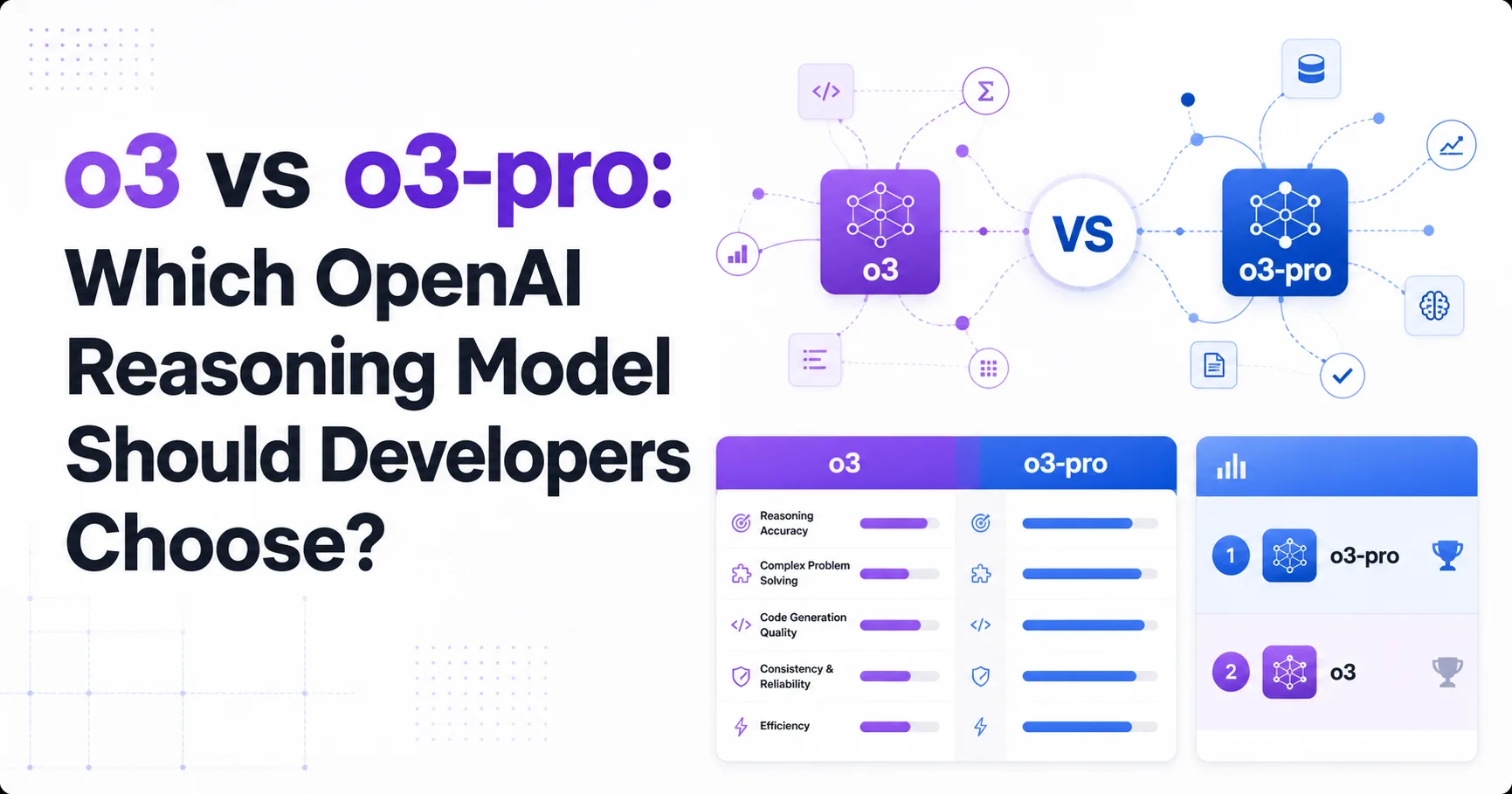
o3-pro is the stronger default for difficult reasoning, while o3 is the practical default for cost-sensitive and speed-sensitive applications. Artificial Analysis reports an Intelligence Index of 32.5 for o3-pro and 30.4 for o3, giving o3-pro the higher measured score in this comparison. Data provided by https://artificialanalysis.ai/
The decision is not simply about choosing the higher score. o3 costs $3.5 per 1M blended tokens, while o3-pro costs $35. That price gap changes the economics of high-volume applications, repeated coding assistance, automated classification, and agent workflows. o3 also has a reported median output speed of 128.056 tokens per second. The data brief does not provide a corresponding o3-pro speed value, so a complete throughput comparison is unavailable.
The official positioning points in the same direction as the measured Intelligence Index. OpenAI describes o3-pro as a model that thinks longer and provides more reliable answers for complex science, mathematics, and programming tasks in its Introducing o3-pro announcement. However, the supplied official materials do not provide a complete reproducible benchmark protocol, so the evidence supports a directional recommendation rather than a universal claim that o3-pro is better for every workload.
Developers should therefore treat o3-pro as a premium escalation model and o3 as the economical workhorse, subject to current endpoint availability and application-specific testing.
o3-pro leads on the available general intelligence measure, while o3 leads decisively on the supplied pricing and speed evidence. The Artificial Analysis Intelligence Index is 32.5 for o3-pro and 30.4 for o3, but o3-pro has no reported math index in the data brief, so the comparison does not establish a broader advantage across every capability area. Data provided by https://artificialanalysis.ai/
| Decision factor | o3 | o3-pro | What it means |
|---|---|---|---|
| Intelligence Index | 30.4 | 32.5 | o3-pro leads on the available aggregate measure |
| Math Index | 88.3 | Not provided | The supplied evidence cannot compare math performance directly |
| Blended price per 1M tokens | $3.5 | $35 | o3 is the lower-cost option |
| Input price per 1M tokens | $2 | $20 | Input-heavy workloads favor o3 economically |
| Output price per 1M tokens | $8 | $80 | Verbose generation makes o3-pro materially more expensive |
| Latency | 0.3 seconds | 0.3 seconds | The supplied latency evidence is tied |
| Median output speed | 128.056 tokens per second | Not provided | o3 has the only reported throughput figure |
The most important unresolved issue is product status. OpenAI’s current model directory lists GPT-5.6 Sol, GPT-5.6 Terra, and GPT-5.6 Luna as current frontier models, but the supplied page does not list o3. The same page does not clearly state whether o3 remains directly callable, has a stable alias, or has been formally replaced. That documentation gap matters because model quality is irrelevant if a production endpoint cannot be adopted reliably.
For a new system, confirm availability, retention policy, and operational limits before committing to either model.
o3-pro is the better candidate for tasks where an incremental reasoning-quality advantage can prevent expensive downstream errors. The available Intelligence Index favors o3-pro at 32.5 versus 30.4 for o3, and OpenAI positions o3-pro for science, mathematics, and programming tasks that benefit from longer reasoning. Introducing o3-pro describes that positioning, while the Reasoning models guide explains that reasoning models spend more time reasoning before producing an answer.
In practice, that difference is most relevant when the model must maintain a chain of constraints, inspect code carefully, explain a mathematical argument, or choose among competing implementation strategies. A higher aggregate score does not guarantee a better result for every prompt, but it supports testing o3-pro first for high-consequence reasoning paths. The official announcement does not supply a complete, reproducible test protocol, so developers should validate error rates on their own task distribution.
o3 is the better performance choice when responsiveness and predictable throughput matter more than premium reasoning. Its supplied median output speed is 128.056 tokens per second, while no o3-pro speed value appears in the data brief. Both models have a reported latency of 0.3 seconds, so the available evidence does not show a latency advantage for o3. It also does not show that o3-pro is slower, because the missing throughput value prevents that conclusion.
The practical performance decision is therefore asymmetric: o3-pro has the measured quality lead, while o3 has the measurable throughput lead. Developers should benchmark complete task outcomes, including retries, tool calls, and human review, because the supplied evidence does not quantify those factors.
o3 is the safer economic choice for high-volume generation, while o3-pro needs a meaningful quality benefit to justify its $35 blended-token price. The supplied prices are $3.5 per 1M blended tokens for o3 and $35 for o3-pro, with input prices of $2 and $20 and output prices of $8 and $80 respectively. Data provided by https://artificialanalysis.ai/
The chart below should make the price difference obvious, but it cannot show where the cheaper model becomes more expensive in the complete workflow. o3 can be the costlier option in practice if its answers cause more retries, more tool calls, more manual review, or more failed automated actions. Conversely, o3-pro can be wasteful when the task is simple, repetitive, or already protected by deterministic validation.
Output-heavy workloads deserve particular caution. The supplied output prices are $8 for o3 and $80 for o3-pro per 1M output tokens. Long explanations, large code patches, multi-step agent traces, and verbose structured responses can therefore make model selection depend more on output control than on headline model quality. Developers should constrain unnecessary output and measure accepted task completions, not just token consumption.
The official OpenAI API Pricing page lists o3-pro at approximately $20 per 1M input tokens and $80 per 1M output tokens. The supplied official materials do not provide a current o3 price, while the data brief does provide o3 pricing. That source mismatch should be resolved against the account and endpoint used in production before launch.
The cost recommendation is simple: route ordinary traffic to o3, and reserve o3-pro for requests where better reasoning can reduce failure costs.
o3 leads on 3 of 3 metrics
o3-pro should handle high-consequence reasoning, while o3 should handle routine volume and fast interactive work. This recommendation follows the measured Intelligence Index lead for o3-pro, the reported 128.056 tokens-per-second output speed for o3, and the $35 versus $3.5 blended-token prices supplied for the two models. Data provided by https://artificialanalysis.ai/
A sensible production policy has three paths:
OpenAI’s o3-pro Model Documentation identifies the API alias o3-pro and the dated version o3-pro-2025-06-10. The Reasoning models guide recommends using reasoning models through the Responses API. Those references make o3-pro’s integration path clearer than o3’s in the supplied materials.
The main caveat is that current availability remains unresolved for o3 and not fully confirmed for o3-pro. The current OpenAI model directory does not list o3, and the supplied materials do not provide a direct current-status statement for o3-pro. Developers should verify the model list, API access, version behavior, context limits, output limits, and parameter support in their own account.
Choose o3-pro as the quality-first option when a wrong answer is costly. Choose o3 when request volume, response speed, and token cost dominate. Use an evaluation set before making either choice permanent.
o3-pro has the stronger available aggregate intelligence score, but the evidence does not prove superiority on every developer workload. The Intelligence Index favors o3-pro at 32.5 versus 30.4 for o3, while the supplied brief provides no o3-pro math index and no complete official benchmark protocol. Introducing o3-pro supports the model’s complex-task positioning, but developers still need task-specific validation.
o3-pro is worth its higher price only when improved reasoning reduces failures, retries, tool calls, or human review enough to offset the $35 blended-token price. The supplied evidence supports a quality advantage, but it does not quantify production error reduction.
Developers should use o3 for routine coding assistance and escalate difficult debugging, architecture, or multi-constraint programming tasks to o3-pro. OpenAI positions o3-pro for complex programming, while the supplied data gives o3 the only reported output-speed figure.
o3 has the only reported median output speed at 128.056 tokens per second, so it is the measurable speed choice. Both models show 0.3-second latency, but the supplied evidence cannot establish o3-pro’s full throughput.
The supplied official materials do not confirm that o3 remains directly callable, has a stable alias, or has been formally replaced. OpenAI’s current model directory does not list o3, so developers must verify availability in their account before adoption.
The math performance cannot be compared directly from the supplied evidence because o3 has an Artificial Analysis Math Index of 88.3, while no corresponding o3-pro value is provided. Any broader math conclusion would exceed the available data.